WWE: 10 Wrestling Superstar Graves You Can Visit
Pro wrestling should offer a mix of joy and elation, unfortunately it has all too often been overshadowed by darkness and tragedy. While in recent years the WWE has enforced health considerations to the fullest extent, the industry hasn't always been so well looked after. In the 90's and 2000's we the fans got far too used to watching wrestling and hearing that a young talent had died. For me personally, this always stirred feelings of sadness and to an extent guilt €” how can I invest in something which is killing the performers? The stories continued to come. Drug overdoses, ring accidents and even suicide. The nature of the beast seemed to create a fatal environment. What are the reasons for wrestling and death being so linked to each other? A lot of it is down to the intense nature of the business. A wrestler often has to be up as early as 5AM to hit the gym, spend the day driving to an arena and then perform on a show in a painful bumping match. Then they are so buzzed off the adrenaline of the contest and the crowd, many wrestlers talk of a need to drink or do drugs to come back down. Getting to bed in the early hours of the AM they are often up again a few hours later. It's a pretty gruelling process which is tiring and painful. Throw into that the abuse of steroids and you have a recipe for physical and mental deterioration. Some people blame the business, citing the need for big bumps and muscular bodies as what drove talent to push their bodies to the point of enlarged hearts and painkiller addictions. I think that personal responsibility should also be taken however. Plenty of wrestlers manage to have success in the business without ever damaging their body with drugs. Unfortunately many of the men who entertained us didn't survive the business. In compiling this list of 10 wrestler graves you can visit, only two of the men lived past fifty. Here you can pay your tributes by visiting the final resting places of some of the biggest WWE talent ever to step foot in the ring. This list will detail the address of the final resting places and then discuss the life and death of the legendary performers...

10. Owen Hart, Queens Park Cemetery, Calgary, Calgary Census Division Alberta, Canada

Owen Hart was loved by both the fans and his peers. In life he was one of the most respected ring workers of his generation, right up there with brother Bret and Shawn Michaels in changing the perception of the WWF from bodybuilders to athletic smaller talents. The athletic Canadian made a name for himself in stunning tag matches with his brother and also singles competition against Bret at Wrestlemania 10 €” where Owen won clean. In my opinion he was a much better worker than Bret, but lacked the close friendship that his older sibling had with Vince McMahon. In addition to stellar matches, Owen also made a name for himself as a notorious joker. One time on an overseas trip he stuffed a fish down his singlet, and when he put Bret in a camel clutch he put the fish into his palm so as to make Bret gag for real. Unfortunately, Owen will also be remembered for being the man who broke Steve Austin's neck, arguably costing the WWF millions upon millions. The plain careless piledriver is undoubtedly the biggest botch in wrestling history. Owen sadly died in the most tragic circumstances. On May 23rd 1999 he was in Kansas, Missouri and due to descend from the kemper arena rafters to the WWF ring, much in the same way as Sting did in WCW. Tragically the harness released Owen early, sending him on a 78 foot fall to the ring. He hit the ropes and bounced into the ring, damaging his aorta and causing internal bleeding. The impact had been too much and Owen died later that night. Controversially the WWF continued the broadcast, although the cameras didn't show the incident. Owen's widow Martha settled for $18 million and there have been other legal disputes. My view is that the whole thing was a tragedy. You can visit Owen's grave in Calgary, he died aged only 34.

9. Andre The Giant, Roussimoff Family Ranch Grounds, Ellerbe, Richmond County, North Carolina USA
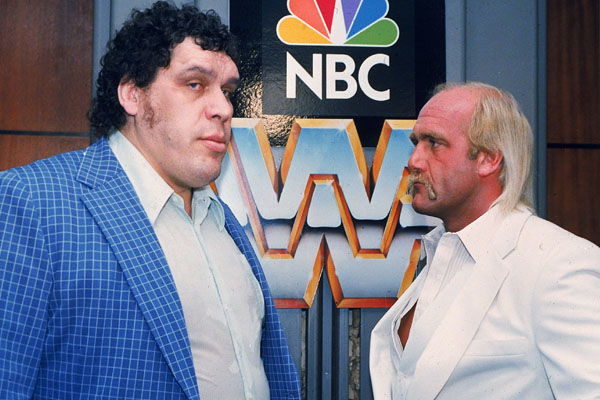
Andre the Giant is an iconic wrestler who also achieved mainstream fame. His Wrestlemania 3 match with Hulk Hogan was a pillar of the WWF success story and Andre's legitimate status as a giant impressed people the world over. He was so big in fact that when he died aged 46 of congestive heart failure it took over two weeks to find a crematorium big enough to cremate his body. Andre's death was inevitable due to the rare acromegaly condition he suffered. His gigantism affliction was physically gruelling, literally a load to bear. Even when Andre was main eventing Wrestlemania in 1987 he could barely walk, struggling to stand up due the pressure on his knees. An alcohol problem developed as a result, Andre able to put away 100 beers a night according to several sources from the period. Despite his young age, doctors had never gave the Giant a life span past 50. It was his natural time to leave this world on January 27th 1993 aged 46. He died in Paris, France after attending the funeral of his father and was flown back to the United States for cremation. His ashes are scattered across the family ranch in North Carolina.

8. Stu Hart, Eden Brook Memorial Gardens, Calgary, Calgary Census Division, Alberta, Canada, Plot: Garden of Angels, Structure 88, Niche 1059

Stu Hart's impact on the wrestling business should not be understated. The athletic product that Vince McMahon unleashed in the 1990's was greatly influenced by Stu's Stampede Wrestling, drawing upon the style of smaller faster paced wrestling matches. Vince even stole the ladder match concept from Hart. The biggest contribution Stu made was to train the next generation of superstars in his infamous dungeon. Some of the best wrestlers ever emerged from the tutelage of Stu €” Bret Hart, Owen Hart, Chris Benoit and Chris Jericho all learned their trade from Stu. Vince McMahon appreciated everything that Stu did for the industry and the pair enjoyed a respectful friendship. Even after Vince 'screwed' Bret, Stu still turned up at WWF shows to watch the action. Perhaps as a promoter he could see where Vince had been coming from in the situation. Stu lived to the grand age of 88, his old school wrestling sensibility keeping him a fit and healthy man. He died in 2003 of various health implications related to old age. You can visit his memorial in Calgary, where Stu rests with the great love of his life Helen Hart.

7. Big Boss Man, Dallas Memorial Garden, Dallas, Paulding County, Georgia, USA

Big Boss Man was one of the most memorable characters from the WWF cartoon era of the late 80's. Distinctive in his prison guard uniform he summed up what that era of wrestling was all about €” colourful gimmicks. He wasn't the greatest worker ever but he stood out and was consistently used in prominent ways. Boss Man worked with the WWF until 1993 before embarking on an unsuccessful WCW run. Returning to Vince in 1998 he was again pushed as a prominent performer, this time appearing a lot more edgier in his prison guard black. What really stood out Boss Man in this run however was the questionable creative constantly attached to him. For example at Wrestlemania he battled The Undertaker and was hanged from the Hell in a Cell in an apparent murder. Surviving this controversial angle he went on to feud with Al Snow over a dog called Pepper ... which he ended up cooking and feeding to Al. Then there was the segment when Boss Man turned up at the funeral of Big Show's father. It was again very tasteless. Aged only 41, Boss Man (real name Ray Traylor) died of a heart attack in 2004. You can visit his modest grave in Paulding County, Georgia.

6. Vince McMahon Snr, Bonnell Cemetery, Greenwich, Fairfield County, Connecticut, USA
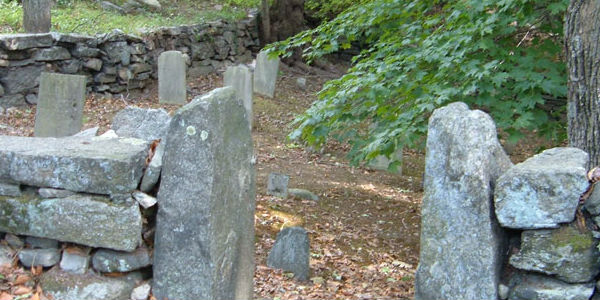
In this modest looking cemetery rests Vince McMahon Snr, the man who set Vince McMahon Jnr on the road to global domination. Vince Snr was hugely respected in the wrestling business, admired as the first man to split gate takings with his talent. He promoted shows in the heavily populated areas of New York and New Jersey, setting the solid foundations from which the global WWF franchise was built upon. McMahon was staunchly old school, believing a promoter should never be seen anywhere other than backstage. He was also firmly part of the promoter network which respected the tradition of territories and not promoting on someone else's patch. If he had any idea of what Vince Jnr had planned he never would have sold the company. He died in 1984 just a few years after selling his stock to Vince Jnr, and a few months after Hulk Hogan became WWF Champion for the first time. His age was 69 and he died of pancreatic cancer. It's worth noting that Vince Jnr will turn 69 himself this summer ... could the seemingly invincible McMahon now start questioning his own mortality and decide on his eventual retirement? We will have to wait and see.

5. Rick Rude, Green Lawn Cemetery, Roswell, Fulton County, Georgia, USA
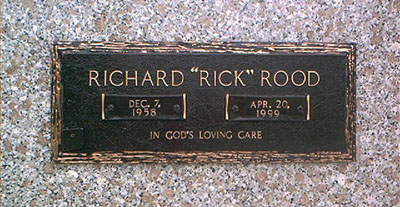
Just like Owen Hart, Rick Rude was a fantastic wrestler who probably should have been a WWF Champion. Stints in regional territories, the WWF and WCW were all well received, with Rude contesting some of the best matches of the times against the likes of Jake Roberts, Sting and Ric Flair. He even carried The Ultimate Warrior to one of the best matches of his career. Rude was also notable for his very impressive physique, which of course raised speculation of steroid abuse. When he died in April 1999 the coroner noted an overdose of mixed medications. It looks like years of the wrestling lifestyle had finally caught up with Rude, who testified in 1994 that he had abused steroids in order to decrease pain and increase his muscle mass. His last moments of fame included appearing as a founding member of D Generation X, but just two years later he was dead. Another talented wrestler gone too soon. You can visit his memorial in Georgia, USA. Like many wrestlers, Rude lived in Georgia because it was the home of WCW in Atlanta.

4. Mr Perfect, Gethsemane Cemetery, New Hope, Hennepin County, Minnesota, USA

Curt Hennig was a top quality technical wrestler who also displayed a great level of charisma as Mr Perfect. His thrilling matches with Bret Hart in the early 90's still stand out as some of the best technical wrestling matches to ever take place in the WWF. Unfortunately, outside of the ring, Hennig had his demons. He loved to party and was a heavy drinker. He also abused cocaine and steroids, showing off considerable muscle mass on his small frame. Hennig was released from the WWE for his drunken play fighting with good friend Brock Lesnar on the 'plane ride from hell' in 2002. Despite being a workhorse of a talent, he couldn't get his life under control. It was the cocaine which ultimately claimed Hennig's life, the autopsy revealing that acute cocaine intoxication had killed the 44 year old who was found in a Florida hotel room in 2003. You can see his memorial in his home state of Minnesota.

3. Yokozuna, Green Hills Memorial Park, Rancho Palos Verdes, Los Angeles County, California, USA

A two time WWF Champion and a genuinely great big man worker, Yokozuna was an unforgettable WWF character from the early 1990's. Whether it was main eventing Wrestlemania 9 AND Wrestlemania 10 or his entertaining tag team with Owen Hart, Yokozuna was always a legitimate WWF star. The problem was, his weight was increasing to the point of danger as the decade wore on. His size had made him a star but it eventually halted his career. The big Samoan was unable to pass WWF and Athletic Commission physical examinations, leaving Vince McMahon no choice but to terminate Yokozuna's contract in 1998. Despite the physical problems, Yokozuna continued to work on the indie circuit. It was while appearing on a European tour that he died of fluid in the lungs. He was aged only 34 in the year 2000 when medics found him dead in the Moat House Hotel, Liverpool, England. He now rests back in the States, his memorial at Green Hills Memorial Park in Los Angeles County, California.

2. Chris Benoit

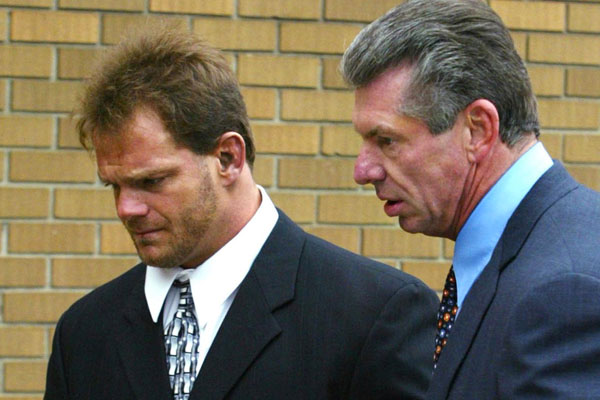
Chris Benoit will forever be remembered as the man who killed his wife and child, before killing himself. The Benoit murders sparked 24 hour news coverage as the story gripped America, and is perhaps the darkest ever day in the history of the WWE. For many fans they refused to believe that this was even possible. The Benoit character had been all about integrity and hard work, he had some of the best pro wrestling matches ever to his name. Which is arguably what killed him. Benoit worked a reckless ring style which left him with an impaired brain from head traumas. He had also undergone neck surgeries. As a small man he was also unusually stacked in muscles, which led many to speculate he was abusing steroids severely. Physically and mentally it appears that he snapped when he killed his family and himself aged 40. The June 24th 2007 Benoit murders will forever tarnish what would have been a legacy as one of the best in ring workers ever. He has no grave for obvious reasons, instead his ashes are in the possession of his family €” most likely his father Michael Benoit in Canada. You can't visit any Benoit memorial but I figured out of fan interest this entry was worth including on the list.

1. Eddie Guerrero, Green Acres Memorial Park, Scottsdale, Maricopa County, Arizona, USA

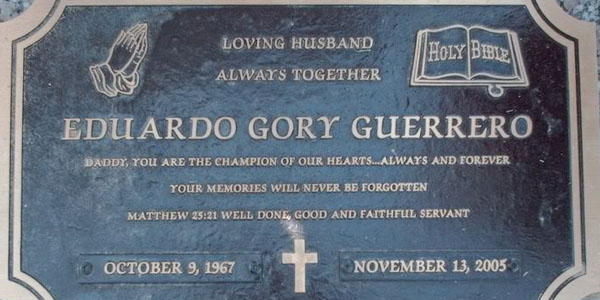
http://www.youtube.com/watch?v=NJnoHoUZedM The wrestling death that changed everything for WWE was the late great Eddie Guerrero. It was the shocking passing which sparked Vince McMahon into action with the Wellness Policy, and it has to be said, wrestling deaths seem to have decreased in recent years since. Eddie was naturally great at pro wrestling. As a talented athlete he could do just about anything in the ring, earning praise in Japan, ECW, WCW and WWE. His charismatic personality was another factor in his popularity with audiences and he won the WWE Championship in 2004 from Brock Lesnar. Sadly for Eddie he was an alcoholic. He struggled for over ten years with drinking problems, ending up in hospital and rehab on multiple occasions. Tragically he had beaten these demons and been clean for five years when his heart failed on November 13th 2005. The 38 year old was found dead in his hotel room, years of steroid, painkiller, drug and alcohol abuse coming back to haunt him. You can visit Eddie's grave in Scottsdale Arizona. What's very unusual about this grave is wife Vickie Guerrero's memorial is already carved on the grave ... despite her being very much alive and active right now on WWE television.

WWE Writer

Grahame Herbert hasn't written a bio just yet, but if they had... it would appear here.