The Terminator: 10 Biggest Plot Holes

All that time travelling can get very, very confusing.

There's something unstoppable about the Terminator series. Like creator James Cameron's bank account this is a franchise that keeps on growing and growing; a relentless cinematic behemoth that refuses to die. Like most franchises it has certainly gone downhill as it has progressed. The original The Terminator directed by James Cameron remains to this day a classic of American science fiction cinema; its gritty, ultra violent action a reminder of just how great low budget cinema can be (not to mention how much the PG-13 rating has all but ruined action movies). With its big budget, Cameron's sequel, Terminator 2: Judgment Day, set the bar for blockbusters to come, but sadly the quality of the series has been in steady decline ever since. With its complex time travel premise it was perhaps inevitable that narrative coherence would end up taking a back seat to the action, and sure enough the Terminator series isn't without a few plot holes, In fact, some of them are so large you could fit a battlefield full of robots through them. While they hardly spoil the enjoyment of watching the films (you'd be missing the point if you quibbled too much about the logic of the storyline) nevertheless it's fun to go through and pick them out. Here are ten plot holes from the Terminator franchise you might not have noticed.


10. How Does The T-1000 Mimic The Guard When It Only Touches His DNA-Free Shoes?

After relentlessly pursuing Sarah Connor in the original movie to prevent her from giving birth to her son, John, the T-800 (played by Arnold Schwarzenegger, in case you've been living in a cave the last few decades) returned in Terminator 2: Judgment Day as protector and saviour of the Connor clan. Their adversary in the movie this time around was the far more advanced T-1000, which the T-800 explains is capable of mimicking anyone it touches by copying their DNA. While this is accurate for the most part throughout the film, there's an instance where this rule is broken - when the T-1000 mimics the guard at the mental institution it only touches his shoe, which surely wouldn't carry the correct information for the T-1000 to mimic.

9. How Does The T-800 In The Terminator Not Know What Sarah Connor Looks Like?

The entire franchise kicks off with the T-800 being sent back to kill Sarah Connor to prevent her from giving birth to the leader of the resistance, and the robot overlords of the future certainly have the technical skills to build incredible robots - not to mention time machines. Why, then, when the terminator arrives in the early '80s to track her down does he have to use plain old telephone directories to try and find her, working his way through killing a number of other Sarah Connors before finally finding his target? You'd have thought that Skynet - a global AI computer system - might have full access to everyone's details so they could go straight to the correct Sarah Connor. Of course, this would have made the film considerably less tense and exciting than it actually was...

8. Why Do They Forget To Throw The New T-800's Arm Into The Molten Metal Pit At The End Of Terminator 2: Judgment Day?

One of the most spectacular action sequences of all time comes at the end of Terminator 2: Judgment Day - having stolen the CPU and arm used by Cyberdyne Systems to reverse engineer their technology, the Connors and the T-800 take them to a steel works to dispose of them. All well and good - after a great elongated battle with the seemingly unstoppable T-1000 they throw the arm and microchip on top of their pursuer in the molten metal, destroying all traces of the terminator from the present day. Except someone forgot to go back and get the other T-800's arm, still stuck in one of the machines in the steel works after Arnie battled with the T-1000. You could argue that this arm then went on to build the robot army, but since the sequels in the franchise don't suggest this you can put it down to a plot hole instead.

7. After Luring John Connor To The Skynet Base In Terminator Salvation Why Do They Only Have A Single T-800 To Kill Him?

Terminator Salvation is yet another example of why some franchises should really be left alone - from its terrible plot and boring characters to its completely derivative action sequences which steal from its predecessors without improving upon them, it's a fine example of everything wrong with Hollywood. It's also got its fair share of plot holes, not least at the end of the film when John Connor, having infiltrated Skynet, comes up against their defences - a single T-800 terminator. Given that this is the main base for the enemy it beggars belief that they would choose to defend it with just one robot - surely if they're as smart as they're supposed to be they'd throw everything but the kitchen sink at intruders.

6. And Why Is The T-800 In Terminator Salvation Impervious To Molten Steel?
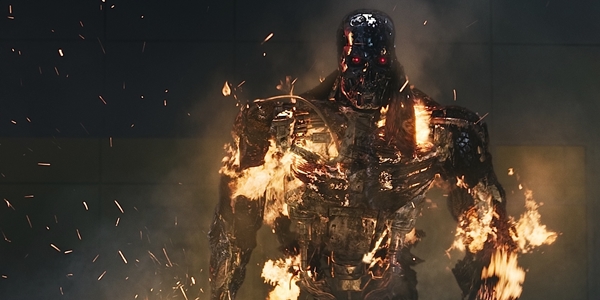
Anyone who's seen Terminator 2: Judgment Day knows that the best way to destroy your Terminator evidence is to throw it into a pool of molten steel - whether it's a T-800 or a T-1000 this works like a charm. Which beggars the question, why does the T-800 John Connor fights at the end of Terminator Salvation appear to be near-impervious to this very same substance? It seems as if the writers of this regrettable instalment into the franchise didn't really think things through - on top of being impervious to molten steel the T-800 here is also rubbish when it comes to killing people. Rather than, say, crush Connor's head it prefers to throw him around the room a bit, giving him plenty of time to fight back and defeat it.

5. Why Do The "Evil" Terminators Betray Signs Of Emotion?

One of the main themes running through the Terminator movies is the lack of emotion the machines have - it forms a central premise of the second instalment, with John Connor attempting to reprogram the T-800 to allow it to feel and express emotions. It's a great concept and one which is explored well (at least until you get to Terminator Salvation), but unfortunately there are a couple of plot holes which negate this rule. The first example comes in Terminator 2: Judgment Day - as the T-1000 falls into the molten metal and is destroyed it is clearly screaming and pulling anguished faces. In Terminator 3, the T-X shows visual signs of pleasure and excitement when she realises she's on the trail of John Connor. It seems like the filmmakers were breaking their own rule just for the sake of a "cinematic" moment.

4. How Do The T-1000 And T-X Travel Back Through Time When They're Made Of Liquid Metal Not Flesh?

One of the firmest rules established in the first Terminator movie is that only flesh can pass through the time machine. One of the main reasons this clause is established is to provide an answer to the question, why don't they just send a nuclear bomb back through time? This rule goes out of the window for pretty much the rest of the franchise - the T-1000 travels through time perfectly well despite being made of liquid metal (although for some reason it also appears naked for no real reason), while the T-X also makes it to the past without any problems despite boasting no flesh on its curvy female form. Even the "nuclear bomb" justification becomes completely pointless - in Terminator 3 the T-800 has its very own mini nukes hidden inside it.

3. How Does The Inferior T-800 Repeatedly Defeat Superior Terminator Models?

If there's one thing that franchises like to do it's up the ante on their previous instalments - bigger and (supposedly) better is the order of the day, and the Terminator franchise is no exception. Judgment Day achieved this by pitting the T-800 against the new and improved T-1000, capable of mimicking others and turning its body into weapons. That said, Skynet probably want to spend a little more time in the research and development laboratory, since the supposedly inferior T-800 seems more than capable of taking out the later model. After taking out the T-1000 in Judgment Day, the T-800 then goes on to destroy the next model up, the T-X, in Terminator 3: Rise Of The Machines. That said, even the T-800 isn't all it's cracked up to be - if you think about it when watching the first film, it's not even smart enough to outwit a waitress...

2. Why Does Skynet Only Send Back One Terminator At A Time - And To Later Periods In Time Losing The Element Of Surprise?

The plot for the first Terminator movie is perhaps the most logical of them all - that said, it's far easier to avoid tripping yourself up narrative-wise when you're establishing a universe rather than building upon one. So, when Skynet sends a Terminator back to kill Sarah Connor before she can give birth to the leader of the resistance everything kind of makes sense. Things start to fall apart in the sequel onwards when Skynet, having failed to achieve their objectives the first time around decide to send more Terminators back at a later date - when Sarah Connor is fully aware of the danger she's in. Why not send another Terminator back to the early '80s to try again while she's still obliviously waitressing? Or why not even further back to when she was a child? And why only send one at a time? Why not send back an army of Terminators to make sure the job is done properly?

1. The Entire Premise Is A Paradox

The plots for time travel movies have a habit of falling into paradoxes, especially as they grow in length and become more elaborate, but in the case of the Terminator series it could be said that the entire premise is built around a paradox. In the first movie, Kyle Reese goes back in time to save Sarah Connor where he falls in love with her and fathers their son, John. But the only reason the machines in the future exist is on account of Cyberdyne using the chip from the terminator they sent back to kill the leader of the resistance, who only exists because he himself sent his father back to protect his mother. Add to that the premise for the second movie, in which the Connors and their friendly T-800 try their best to prevent the war from happening and you have another mind-bending paradox, since without the war there's no longer a reason for older John Connor to send his father back to protect his mother and conceive him. Therefore, by essentially preventing his own existence he won't exist to prevent the war, and... if you think about it too much it's enough to make your brain malfunction. What other plot holes have you noticed in the Terminator movies? Why not post a comment below and let us know?

Contributor
Contributor

Andrew Dilks hasn't written a bio just yet, but if they had... it would appear here.