10 Times Well-Loved Scientists Were Total Jerks
Some people just can't play nice.

The noble pursuit of knowledge that is science, could there be any purer calling? Surely this higher intellectual plane is the one part of society that is free of the opinions, prejudices and personality problems of the people you meet in day to day life? Nope.
Scientists, whether in their personal lives or professional capacities are some of the worst offenders for tantrum throwing, smack talking, boundary pushing, antagonistic dickishness and there have been a fair few of them throughout history that have made a career out of getting on everybody's last nerve.
Of course, as is always the case, these are just a couple of bad apples that are spoiling it for the rest of us. But, unfortunately, these are the types of characters that end up sticking out in the history books - and not always for the right reasons.
There have been a fair few pretty nasty experiments over the years, but that's not what we're here for. We're here for the guys who were just ... you know ... jerks.
Whether it's freaking out children, endless petty bickering or straight up bullying, there are definitely a few scientists out there that could do with a good talking to from their mothers and a long, hard look in the mirror.
10. Stanley Milgram - Turning People Into Monsters

The Milgram Experiment, designed by Stanley Milgram in 1961, was made up of a series of psychological experiments designed to test obedience to authority figures. Would people inflict unbearable pain on another human being just because a man in a white coat told them to? The answer was, overwhelming, yes.
The experiment consisted of one "learner" and one "teacher", sat in adjoining rooms so that they could hear but not see one another. The learner would answer a series of questions from the teacher, and if they got them wrong, the teacher would have to administer electric shocks of increasing strength. They were told that this was to test the effect of pain on the ability to learn, which was a total lie.
If, at any point, the teacher questioned the experiment, the overseeing authority figure in a white lab coat would have four stock replies simply telling them that they had to continue. If the teacher objected more than four times, the experiment was halted.
Despite the screams of the learner in the next room (who was an actor, you'll be pleased to hear), over 65% of the original participants continued the experiment through to administering a deadly 450-volt shock. Despite many expressing concerns, most of the participants were happy to continue the experiment once they discovered that they would not be held responsible for any "permanent damage". Yikes.
The scientists came away with the conclusion that people are easily led sheep that will do anything to defer responsibility, and the participants presumably came away with a blossoming existential crisis and the need for a very stiff drink.
9. Sigmund Freud - Ruining Emma Ecksteins's Life

In 1892, everyone's favourite Oedipus, Sigmund Freud was approached by a young woman by the name of Emma Eckstein for the treatment of a stomach ailment what she described as "mild depression" due to menstruation. Freud promptly diagnosed her with hysteria and excessive masturbation (big surprise) - a habit that was considered damaging to a woman's mental health.
Not one to want to be predictable however, Freud also diagnosed a case of "nasal reflex neurosis", a condition that his friend Wilhelm Fliess was popularising at the time. The cure for this ailment, the pair decided, was the cauterisation of the nasal passage - that would surely relieve her symptoms. What followed was an experimental procedure during which Eckstein was anaesthetised with cocaine before the inside of her nose was burned and cauterised.
The surgery was an unmitigated disaster, with Eckstein suffering pain, infection and bleeding long afterwards. She was also left permanently disfigured as Fliess, who had performed the surgery, had forgotten to remove a large amount of surgical gauze from inside her nose.
It is unclear as to whether Eckstein was strictly a medical patient of Freud or, like so many others, he took a particular amorous interest in her as well. It wasn't unheard of for Freud to use his position as a psychologist to get his leg over from time to time.
8. Dr. William Beaumont - Fishing In A Man's Stomach

In 1822, a trader in the American Fur Company named Alexis St. Martin suffered terrible injuries when he was shot in the stomach. He was treated by a man called Dr. William Beaumont for his injuries, but the outlook didn't look good.
Despite the doctor's predictions, however, St. Martin survived, but was left with a hole in his stomach that would never really heal, known as a fistula. As he was unable to continue working for the American Fur Company, Dr. Beaumont took him on as an assistant and handyman. "What a kind gesture", we hear you cry, and indeed it was, but Beaumont also had an ulterior motive.
The doctor soon began performing experiments on the trader, attaching pieces of food to lengths of string and pushing them into his stomach via the fistula. This grotesque fishing trip was part of Beaumont's quest to prove that digestion was predominantly a chemical process, as opposed to a purely mechanical one.
Despite the fact that the experiments caused St. Martin considerable amounts of pain, in between them he was expected to carry out "common servant's" work for Beaumont, as the doctor had made him sign a contract of employment to keep him around. After the pair parted ways, Beaumont tried to convince him to move to Missouri with him, but St. Martin had presumably had enough of being a human lab rat, and politely refused.
After Alexis St. Martin's death in 1880, his last wish was to be left to decompose a little before burial. This gruesome request was to ensure that no more doctors got their hands on him, as many had begun to circle, and were just itching to perform an autopsy on his poor, prodded and poked body.
7. Wendell Johnson And Mary Tudor - Traumatising Children

The Monster Study is the unofficial name given to a stuttering experiment that took place in 1939 at the University of Iowa. Two researchers named Wendell Johnson and Mary Tudor, took a sample of 22 orphan children and split them into two groups.
Both groups were given speech therapy, but one was consistently showered with praise for their good progress. However, the other group were repeatedly given negative feedback and essentially bullied by a couple of grown adults about their speech.
The therapists would say things like "Don't ever speak unless you can do it right. You see how [the name of a child in the institution who stuttered severely] stutters, don't you? Well, he undoubtedly started this very same way."
By the end of the experiment, many of the children from the negative group had developed severe communication problems, including one 9-year-old girl who "practically refused to speak". Johnson and Tudor were horrified by the results of the experiment and never published them for fear of being associated with the Nazi human experiments that had recently come to light.
Tudor has since tried to make amends for the experiment, often visiting the orphanage to try and repair the damage, and an official apology from the pair was eventually released in 2001.
6. University Of California - Experimenting On Newborns

As if frightening the life out of orphans wasn't bad enough, researchers at the University of California began an experiment in the 1960s, looking into changes in blood pressure and blood flow ... on newborn babies.
The 113 test subjects ranged from one hour to three days old and were the subject of a series of experiments that were, if not dangerous, pretty mean.
The experiments ranged from dunking the babies' feet in ice water to pushing a needle through the umbilical arteries all the way to the heart.
Then, just because they thought they hadn't quite achieve optimum jerk levels yet, in a separate experiment, someone had the bright idea of strapping 50 newborns to a tilting table so that all the blood would rush to their heads.
None of the infants appear to have been harmed by the experiments, but it's a pretty rough way to spend your first couple of days on earth.
5. Antoine Lavoisier - Robbing The Poor To Give To The Rich

Antoine Lavoisier, the much loved father of modern chemistry and proponent of the metric system that is so loved by the scientific world (trying to conduct complex experiments in feet, inches, pounds and ounces? No thanks), was, unfortunately, a bit of a jerk.
This is probably to be expected as he also happened to be a wealthy aristocrat and a ruthless merchant who thought nothing of raising money from an already downtrodden pre-revolutionary French public. As an administrator for the aristocratic council in Paris, Lavoisier came up with a brilliant scheme to raise some lovely taxes - he built a dirty great wall around Paris and refused entry to traders until they paid his tax.
Yes, it's true that he did this because so many people were doing all they could to avoid taxation, which is obviously naughty and against the law. But, by and large, this was because they preferred feeding and clothing their families to paying for the king's brand new rumpus room. With the new wall in place, traders had only two options: Pay the tax or take their business elsewhere.
Unfortunately for Lavoisier, this was not a time to be antagonising the common man. As the air became thick with talk of revolution, Lavoisier's future prospects took a bit of a dive when he was accused of selling "watered down" tobacco. This was enough to earn him a one-way trip to the guillotine.
4. Aristotle - Rampant Sexism

Surely one of the most enlightened people on history couldn't possibly be a jerk? Described as "the first genuine scientist in history" and one of the founders of the idea that people should be generally nice to one another, you'd think that Aristotle would escape the trappings of jerkishness. Nope.
Unfortunately, Aristotle had a few pretty strong opinions about women. In his work "A History of Animals" he goes into great detail about women, describing them as "more jealous, more querulous, more apt to scold and to strike ... more prone to despondency and less hopeful ... more void of shame or self-respect, more false of speech, more deceptive".
That's not the end of it either, it goes on and on, detailing every way in which women were weaker than men, eventually asserting that women and girls should only be given half the amount of food as men.
Perhaps he was just a product of his time though. Hmm, maybe not. Whilst it's true that the Ancient Greeks weren't generally up on the whole feminism thing, Aristotle was definitely kicking around at the same time as the Spartans, who famously had far more enlightened (although by no means perfect) ideas about women than pretty much anyone else at the time, including their physical prowess.
If Aristotle thought that women were weak and insipid, then he'd clearly never met a Spartan, who were, by all accounts, tough as old boots.
3. Thomas Edison - Pirating Movies

Right, so everybody by now surely knows about the War of the Currents - a crazy battle for electrical supremacy between the likes of Edison, Tesla and Westinghouse (things got pretty messy).
And now a fair few people know about that time Edison electrocuted an elephant to try and prove a point? Incidentally, this is generally thought to be an urban myth arising from the fact that Edison's film company was there to simply video it. Which brings us on to the time when Edison was a total jerk.
In the early 1900s, Edison paid a photographer working with revolutionary film Le Voyage dans la Lune, to hand over the films so that he could copy it and distribute it himself. Edison offered no compensation to the film's director, Georges Méliès, who was almost bankrupted by the incident as Edison undercut him at every turn, decimating the film's income.
Not satisfied with bare faced piracy, Edison then set about gaining the monopoly on the film industry in the United States and Europe. As president of the Motion Picture Patents Company, Edison demanded that Méliès provide him with 1000 feet of film per week, forcing him to make 58 films to fill his quota and essentially working Méliès out of the industry and ultimately ending his career.
The more we find out about this guy, the less we like him.
2. Albert Einstein - Made His Wife Sign A Contract, After He Cheated On Her
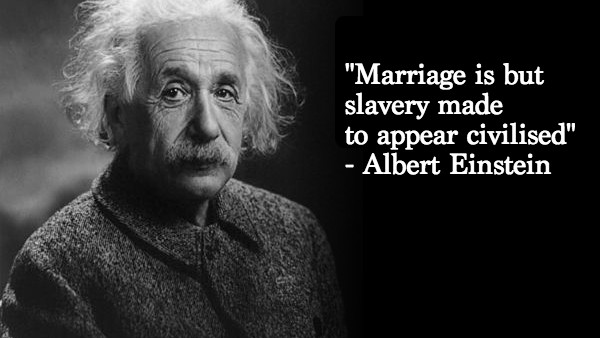
Surely not poor old Einstein? Brilliant, avuncular Einstein who smoked a pipe and unlocked the secrets of the universe?
Well, as brilliant as his mind and his work are, it turns out that old Albert was not too hot at the whole marriage thing. As the whole thing began to crumble due to naughty Einstein and his extra-marital affairs, he made a last-ditch attempt to save it.
How did he do this? Did he take some time off work to spend with his family? Did he spice things up in the bedroom? Did he offer to cook his signature bolognese for dinner once a week? Nope, what Einstein decided to do was draw up a marriage contract in which he would stipulate his demands of his long-suffering (and presumably fuming) wife. The contract read thusly:
Albert Einstein’s Wedding (Marriage) Contract:
A. You will make sure
- that my clothes and laundry are kept in good order;
- that I will receive my three meals regularly in my room;
- that my bedroom and study are kept neat, and especially that my desk is left for my use only.
B. You will renounce all personal relations with me insofar as they are not completely necessary for social reasons. Specifically, you will forego
- my sitting at home with you;
- my going out or traveling with you.
C. You will obey the following points in your relations with me:
- you will not expect any intimacy from me, nor will you reproach me in any way;
- you will stop talking to me if I request it;
- you will leave my bedroom or study immediately without protest if I request it.
D. You will undertake not to belittle me in front of our children, either through words or behavior.
Talk about an old romantic.
1. Isaac Newton - Just Generally
Isaac Newton, as in the guy with the apple, was probably one of the most unpleasant men of his day.
There are actually a fair few examples of Newton being a total dick to other people - many of which he himself outlined in a bizarre list of 57 of his sins that he used to shame himself in private with (including highlights such as "Threatening my father and mother Smith to burn them and the house over them [sic]" and "Punching my sister" - yeah, nice guy).
Chief of old Isaac's unpleasant habits, however, was his ability to bear a grudge until judgement day itself as well as a nasty habit for taking credit that wasn't his. Newton has gone down in history as the man that discovered gravity, but that's not actually what happened.
A contemporary of Newton's by the name of Robert Hooke (himself pretty high up on the "jerk scientist" scale) actually theorised the existence of gravity way before Newton got there. Unfortunately, Hooke sucked at calculus, which is what Newton used to great effect in his theory of gravity.
Newton, as the more famous scientist, then spent the rest of his career suppressing Hooke's work and it is even rumoured that Newton destroyed the only known portrait of Hooke after his death (an unsubstantiated claim, but it certainly sounds like something he'd do).
In another instance of Newton's bullying occurred when he "disagreed with astronomer John Flamsteed‘s zealous approach to research". According to the legend "Newton stole his work and published it under Edmund Halley, Flamsteed’s mortal enemy" - an inspired bit of trolling if ever there was one.