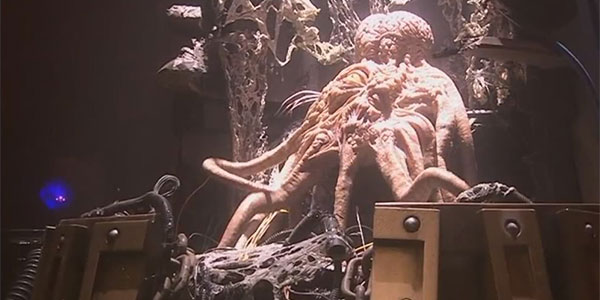
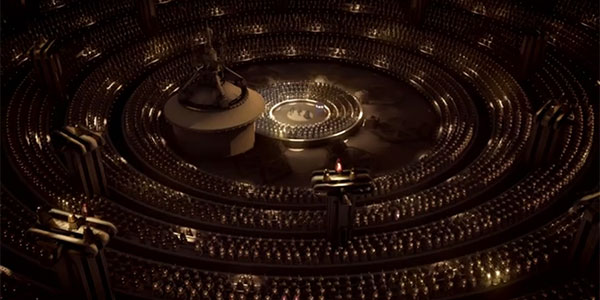
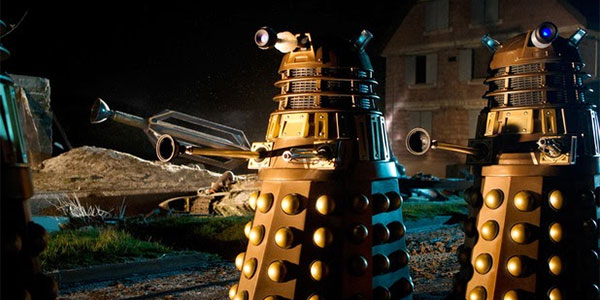
WARNING: Contains potential spoilers for Series 8 of Doctor Who (nothing beyond what was shown in the most recent BBC trailer). The recent trailer for the upcoming series of Doctor Who features the insidious tanks with the soft, squishy middles quite prominently. Why does their particular brand of evil remain an effective story telling device fifty years after they first appeared? Maybe its due to the fact that they are not simple, one-dimensional villains but physical manifestations of more profound psychological fears. The daleks were born in a time of rapid technological advancement and turbulent social change. Our current culture resonates with the same chaos. Not only do similar horrors exist genocide, racism, elitism but they are compounded by a society who exchanged privacy for a false sense of security. We are closer to the daleks than we have ever been. Does the return of the daleks signify a darker or at least more serious Doctor? One who is less liable to hide behind child-like whimsy and perhaps be less conflicted in his approach to his most hated enemies? I would suggest that dalek-centric story lines are not pandering to nostalgia but an acknowledgement of their relevance a mirror to the strife that continues to worry at the thin veneer of a civil society.
5. Deteriorate
A dalek is flesh made obsolete. The outer shell the weapon, the machine has become more important than the occupant. When picturing a dalek one does not think of the creature within but the container in which that bit of stunted spirit lives. A dalek tank is a tool that has overcome its wielder to become the dominant force. Similarly, our society struggles with the fear that our creations may one day outsmart us and lead us down paths we are not so eager to take. Bodies are fragile and prone to error mechanisms are constructed to bypass this perceived weakness. Daleks are like the drones sent into war-ravaged areas weapons without conscience, adhering to a singular purpose. Drones do not revel in the suffering they cause it is simply beside the point. Daleks represent a fear that the balance between constructive and destructive technology has already shifted. For every advance that eases human misery a weapon is devised to increase it. The further we remove ourselves from witnessing the horror of war the greater the chance that we will allow it to continue.
4. Sublimate
A dalek does not exhibit a separate identity it is debatable that it is even self-aware. Instead it is part of a collective intelligence with a rigid focus. A single dalek does not make its own decisions or have an instinct for self-preservation. Whatever individual consciousness it may retain is sublimated to the needs of the whole. Free will was extinguished in exchange for blind obedience. Our well connected world is a paradox of potential. On the one hand, our minds are broadened as we share information and expose ourselves to thoughts and attitudes we might otherwise never have considered. On the other, we allow ourselves to be picked apart tracked and quantified and used in ways that become increasingly more violating. The daleks could well be our future. The more of our identity we give up the easier we are to control. The Doctor recognizes the power of the individual, actively rebelling against passivity and conformity. The Doctor is not an agent of heaven, he is too complicated for that. He is an instigator of constructive conflict a force for inciting change and instilling responsibility. The daleks are rigidity personified they cannot evolve beyond the single-minded path they have set themselves.
3. Stagnate
Daleks, despite their violent tendencies, represent apathy and complacency. They never question their actions but always do what they are told. They are good soldiers following orders hamsters on a wheel endlessly spinning until they drop and are replaced by another. They are resources. They cannot be considerate of the beings around them as they do not consider themselves to be people. They are things, and anything that is not like them is pointless. The daleks are a manifestation of our societys fear of the other, and our inability to move beyond that fear into acceptance that different does not equate with worthless. Evolution of the mind and heart requires effort and a willingness to remain open to new possibilities. The familiar is seductive and comforting and we seek to remain within its confines even when we know it is hurting us. As long as we continue to demonize what we do not understand the daleks will remain relevant within the Doctor Who mythology and within our own culture. The Doctor is in constant motion the bringer of chaos. The daleks track a straight line that never deviates, blind to any potential and possibility they may encounter. They are trapped within their own societal construct and they represent willful ignorance and the inability to think and act creatively.
2. Humiliate
Epic stories need a cause the hero must fight for, a reason for sacrifice, a catalyst for growth. The Daleks are the most ruthlessly destructive force in the Doctor Who universe they are not sadistic but simply do not care. They are a testing ground not so much for the Doctor who has already proven himself in battle but more for the sake of the companions and the other beings they meet along the way. They are a plot device upon which integrity is measured you either give in to them or you fight, even when a successful outcome is hopeless. We live in a world where it is common to feel humiliated and defeated by the pressures surrounding us. Problems seem insurmountable poverty, greed, abuse of power. We hide our excesses, our atrocities, behind long-winded speeches and mindless spectacle. We find ourselves part of a corporate machine marching along an inexorable path to our own self-destruction. That is why archetypes like the daleks exist. To remind us that, no matter how bad it is, how hopeless it may seem, the preservation of the earth, of the universe is something worth fighting for. The Doctor may be the lone voice crying out in the wilderness but he is always inviting us to join him.
1. Exterminate
Perhaps the most interesting reason to bring back the daleks is to explore a changed dynamic. What are the ramifications of this volatile relationship now that the Doctor is no longer the man who destroyed his own people? If he is not consumed by guilt will that grant him permission to become even more ruthless in dealing with his enemies? The Doctor has, in a way, been given a get out of jail free card. This could backfire, leaving him too convinced of his own righteousness and invincibility. He is sometimes careless with the lives of others and quick to use manipulation to serve his own ends. He may be convinced he is doing the right thing but then so are the daleks. They believe just as profoundly in their mission of destruction. The topic of genocidal mania is unfortunately just as pertinent today as it was in 1963. The daleks symbolize every petty dictator who serves a warped vision of the way things should be rather than accepting the way things are. They are the U.S. Supreme Court justices who declare corporations as people while denying women the right to birth control. They are Monsanto polluting the worlds food supply in the name of greed and profit. Their stories are allegories that question our own ignorance and excesses while maintaining hope in freeing ourselves from a sociopathic society. The daleks remain because what they represent the horror of fascism, ignorance and apathy is as relevant as it ever was.
Mary Ogle is the author and illustrator of “Orangeroof Zoo” a whimsical tale of magical realism told through the pages of a coloring book for adults. Working as a professional artist in the digital medium, Mary’s commissions have included everything from fine art to fan art, book cover design, illustration and book layout. Find more of Mary’s work at www.maryogle.com. Mary currently finds inspiration in the Ojai Valley, residing in a snug little cottage with a recalcitrant cat.