9 Wrestling Matches That Turned Into Real Life Shoots
In a worked sport, workers need to work together for a work to work.
9. Perry Saturn Goes Nuts
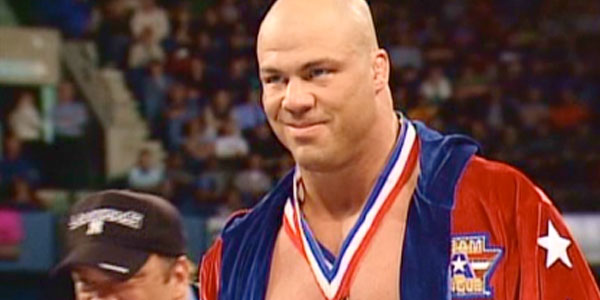
https://www.youtube.com/watch?v=D3PXIf03PNY During a taping of a C-show called WWF Jakked in 2001, full time enhancement talent Mike Bell had been booked to put musclebound ex-Radical Perry Saturn over in a short TV match. When Bell botched an armdrag and Saturn flipped over to land badly, the match took a dodgy turn. It was clearly accidental, but Saturn flipped out: As you can see from the clip, almost immediately after the botch, Saturn springs to his feet and attacks Bell for real. The punches are bad enough, but when he launches Bell out of the ring, the man nearly lands on his own head. For good measure, Saturn then viciously throws him through the steel steps at ringside. Luckily, Bell wasnt badly injured just beaten up and a little shell-shocked. The WWF (as it as then), however, did not see the fortunately side, choosing to focus on Saturns completely unprofessional and dangerous behaviour. Saturn was to undertake a significant change to his gimmick, where over-exposure to the stiff offence of WWFs resident Wrestlers Court punishment detail, the APA tag team composed of Bradshaw and Farooq, would give him (kayfabe) brain damage. The remainder of Saturns WWF career saw him throwing over resident stunner Terri Runnels for a mop, which he had fallen in love with. The Moppy angle, rumoured to be his punishment for the unsanctioned beating of Mike Bell, would be the last he had in WWF before being released, and Perry Saturns career would never recover.8. JBL Wrecks The Blue Meanie's Face
7. Goldberg Gets Schooled By Blackpool's Finest
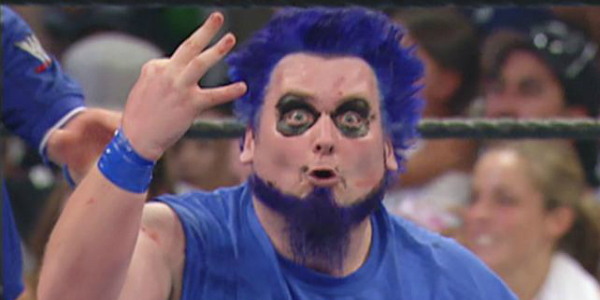
https://www.youtube.com/watch?v=Y4IdelJfk2k In February 1998, WCW monster Goldberg was riding high on a wave of pure adrenaline, squashing foes in minutes and leaving to berserk cheers from the audience. His undefeated streak was capturing the imagination more than a thousand cheap swerves and outlandish storylines. Once again (and youll hear this a lot), stories vary as to how this match actually came about, but William Regal was placed in the path of the new kid on the block on Nitro, and proceeded to have an unusually long and competitive bout by Goldbergs standards. Up until then, some of the mans entrances had taken longer than his matches. Watching it now, it seems that the green as grass rookie doesnt know how to respond to Regal taking the lead and attempting to lead him through a short but decent wrestling match, which in turn seems to lead Regal to go into business for himself. Goldberg had been fed simple two-minute squash matches for so long that that was the only story he was ready and prepared to tell that night, something Regal clearly didnt appreciate. Some say that Regal was determined to make a fool out of the inexperienced Goldberg by exposing his very real limitations as a wrestler on national television. Regal himself has claimed very steadfastly that he was told to have a competitive six-minute match and that Goldberg simply wasnt up to it. Whatever the case, Regal would be fired immediately after the match.6. Andre The Giant Refuses To Work Akira Maeda
https://www.youtube.com/watch?v=sSE91FHzQnc Akira Maeda is universally agreed to be one of the stiffest and nastiest pro wrestlers in the history of the business. With a penchant for taking out his real life frustrations on opponents in the ring, the Japanese shooter, trained by the legendary Karl Gotch, would gain a reputation for being difficult to work with. Of course, theres difficult, and then theres difficult. When faced with a drunk giant who refused to work him, Maeda would soon find out what difficult really was. One version of the story behind this May 1986 encounter is that neither man wanted to do the job for the other. Another version is that booker Antonio Inoki who Maeda was feuding with in real life, having refused to work with the boss in a guaranteed money-making angle told Andre to teach the upstart a lesson. With a whole load of heat coming with him when he rejoined New Japan Pro Wrestling, Maeda was about due for a lesson. This wasnt it, unfortunately Andre seemed legitimately too drunk to move, which for a man of his legendary capacity was some feat. He no sold several attempts by Maeda to get the action rolling, sweating profusely after only minutes. Maeda began to shoot on Andre, his kicks becoming more forceful. He took the giant down, only for Andre to simply tell him, pin me. By this time, Inoki himself had come to the ring, but was unable to persuade either man to adopt any version of the match that would actually excite the paying crowd. If this was an attempt to humble the volatile Maeda, it had backfired. Pro wrestling had been exposed as a complete mess: without the cooperation of both parties, and with Andre in that condition, a decent match was impossible.5. Bruiser Brody Terrifies Lex Luger
https://www.youtube.com/watch?v=epmXA8w0Qjo Once again, stories vary as to the reason for this infamous incident at an NWA show in Florida in January 1987. The massive, surly Bruiser Brody was notorious for refusing to job to people he didnt like. Part of his uncooperative reputation stemmed from his refusal to stay in any one promotion for too long Brody liked to travel, and hated to be kept in one place too long. The rest of it? The man was genuinely uncooperative. Placed inside a steel cage, a match between the perma-tanned Adonis Luger versus the enormous wild man looked on paper like a guaranteed crowd-pleaser: it was a story that wrote itself. That may well have been the case, but they still needed two men to tell it, and Brody simply refused to work. The match began awkwardly enough, and soon slowed to nothing at all, Brody refusing to sell Lugers punches. In fact, it was actually worse than that: betraying professional wrestlings cardinal rule, Brody had simply stopped acknowledging that Lugers fake punches were even happening. Luger had no idea what to do. The cooperation so essential to putting on a professional wrestling match simply wasnt forthcoming, and he was getting nervous. At one point, genuine hard man Brody took him down nonchalantly, almost as if trying to prove a point, and then let him back up again. Finally, Luger and referee Bill Alfonso came up with a solution, and Luger unleashed a barrage of worked punches, shoved Alfonso when he tried to intervene and so got himself disqualified (despite the fact that cage matches were supposed to be no disqualification bouts). Luger then climbed the cage and leapt over the top in his eagerness to leave the madman behind. What happened that night varies depending on who you talk to. Everyone knew that Luger was jumping ship to Jim Crockett Promotions soon, and aloof, arrogant and with the reputation of being more into himself than the business Luger wasnt well liked at the time. Some say Crockett asked Luger not to lose the match and Brody took offense, while some say he simply did it off his own initiative to embarrass both Luger and the local NWA promoter (who hed already had a difference of opinion with). Some say that the reason Luger ran from the ring is because the terrifying Brody had razor blades hidden in his finger tape and that the match would have gotten bloody if he hadnt high-tailed it. Whichever, its a story that once again exposed the business to the crowd two men unable to have a decent match because of one man's stubbornness, the web of cooperation that underpins professional wrestling having collapsed between them.4. Daniel Puder Embarrasses Kurt Angle
https://www.youtube.com/watch?v=D_12qn29WKA The Tough Enough competition was one that, like Total Divas, would blur the lines between shoot and work, real life and wrestling, over and over. The problem wasnt (and isn't) the format of each show: both have their structure, and each premise is familiar to millions from years of watching reality television; the competition and the behind the scenes drama, respectively. No, where they become confusing and weird is when they meet the odd, real/fake, fake/real world of professional wrestling: when the semi-scripted Tough Enough and the entirely fictitious Total Divas mix with the WWEs own worked programming. In 2004, the fourth Tough Enough show was actually a part of Smackdown itself, rather than having its own time slot on MTV as with the previous three seasons. The scripted events on the November 4th Smackdown taping called for real life Olympic gold medalist and professional wrestling prodigy Kurt Angle to call out the remaining competitors and challenge them to a squat thrust competition as part of a segment on the show. Angle challenged winner Chris Nawrocki to a shoot fight as his prize for winning the squat thrust challenge, easily taking the rookie down and making him tap with a neck crank (and incidentally, breaking a couple of his ribs in the process). Asking for a second volunteer, Angle was faced with the runner-up of the challenge Puder eagerly stepped up. Jockeying for position, Angle took Puder down but Puder, no slouch himself, already had Angle in a keylock, better known in 2014 as the kimura. The kimura was locked in, and Angle was seconds away from needing surgery if he didnt tap out. The worked professional wrestling show, with its competitive reality television segment that aped a shoot challenge, had turned into a genuine shoot: the fight, short as it was, was for real. Gerry Brisco on the headsets backstage recognised quickly that Angle was in trouble, and calmly told referee Jim Korderas to call the pin on Puder, who was still on his back in a guard position, the kimura locked in. Despite Puders shoulders not being fully backed onto the mat, Korderas called for the bell, and Kurt Angle was awarded the victory. Puder would go on to win the competition but fail to capitalise on it with WWE, moving on to a brief stint with Ring Of Honor and the independents, and was last seen in New Japan Pro Wrestling. In 2011, he retired from active MMA competition with a record of eight wins and zero losses.3. Tony Kozina Punishes Ryan Kidd
https://www.youtube.com/watch?v=JPMp86PRrzU At an Adrenaline Pro Wrestling event in July 2012, indie wrestling veteran Tornado Tony Kozina was booked to wrestle the then sixteen-year-old Ryan Kidd at a Magnum Pro show in Council Bluffs, Iowa. Part of the same triple-header tour as Kozina and his boys on Team Ambition, Kyle OReilly and Davey Richards, Kidd showed up for his match having posted a video to Youtube with a promo bigging up the hotshot rookie vs. ferocious veteran angle that he understood was the story of the match, as well as a few kayfabed tweets doing likewise from his wrestling Twitter account. By all accounts, Kozina (a man only really known at all due to a) having trained former Ring Of Honor world champion and current TNA wrestler Davey Richards and b) this incident) took exception to these in-character comments, and the fact that Kidds Twitter bio had cheekily read The fakest fake wrestler ever! What followed was the story of a mark for the business, attempting to stretch a minor for disrespect If the above video plays out like a dull, poorly worked ten-minute match with a pit bull sloppily savaging a teenager, well - thats exactly what it is. You can see that Kidd, a fledgling pro wrestler with no high school wrestling experience at all, has no idea how to work a man who keeps dropping down into an amateur wrestling starting position or a mixed martial arts guard position. For his part, Kozina seems to be having a bit of fun with the rookie, playing games and no-selling everything he tries to do to actually work the match, before switching to stretching him and slapping him around and finally applying a genuine triangle choke to knock Kidd out. Pro wrestlings unwritten rules mean that veterans police offences of etiquette and disrespect backstage or via stiff offense or stretching the guy in the ring. This kind of behaviour would, therefore, have been considered old-fashioned but acceptable without the legit choke ending, and had Kidd been an adult. It would also have been handy if Kozina had made his little life lesson entertaining to watch for the punters, but there you go. As it was, the industry was divided: between people who like to kid themselves that they have an old school mentality, and so backed Kozina up 100%; and people who couldnt see any disrespect in the first place, and felt a little bit sick watching a grown man beating up and knocking out a child. Richards, OReilly and Kozina would be involved in further controversy 24 hours later when they took money in advance to work the next show and then ran out of the back door with the cash without working the gig, so theres the professional part of the professional wrestler thing taken care of.2. Stanislaus Zybysko Screws The Gold Dust Trio
1. Antonio Inoki Destroys The Great Antonio