Why Zack Snyder's Wrong About Batman
Batman doesn't kill, and pretending otherwise isn't very clever.

Over the weekend, Man of Steel and Batman V Superman director Zack Snyder was asked by a fan at an event (via I09) what his thoughts were on Batman killing. Snyder, although not the first filmmaker to depict the Dark Knight murdering his foes, did preside over the one film that seemed to revel in that 'aspect' of the character, and so his response to that question shouldn't be all that surprising.
Replying, Snyder lamented that fans need to "wake the f**k up" and accept that Bruce Wayne murders, and murders all the time. Never mind the fact that Batman's famous 'one rule' has informed the character for literal decades. No, Snyder believes that anyone who holds onto the concept of a semi-benevolent Dark Knight is living in a "f**cking dream world". This came after he claimed that fans had "lost their virginity" to his movie, so maybe it turns out the man wasn't the best candidate to decide the future of DC on film after all.
"Once you’ve lost your virginity to this f**cking movie and then you come and say to me something about like ‘my superhero wouldn’t do that.’ I’m like ‘Are you serious?’ I’m like down the f**cking road on that.
It’s a cool point of view to be like ‘my heroes are still innocent. My heroes didn’t f**cking lie to America. My heroes didn’t embezzle money from their corporations. My heroes didn’t commit any atrocities.’ That’s cool. But you’re living in a f**cking dream world."
- Zack Snyder, apparently
Unsurprising though Snyder's comments may be, they do illustrate an important point: not that it is possible to be so catastrophically wrong that you feel emboldened enough to patronise years' worth of material that contradicts what you've just said - although that is worth reiterating - but rather because they show why Snyder's interpretation of the DC mythos failed as much as it did.
There's been a tendency for fans to dwell on the aesthetic tedium of Snyder's DC films, and while that's certainly worth pointing out, the root of the problem stems from the director's cynical approach to DC's comics. It just doesn't translate to the big screen, and while Snyder can happily slam fans for believing in a "fantasy world" (that's kind of the point anyway), his interpretation of Batman is just plain old incorrect.
4. How Batman's 'One Rule' Informs The Character
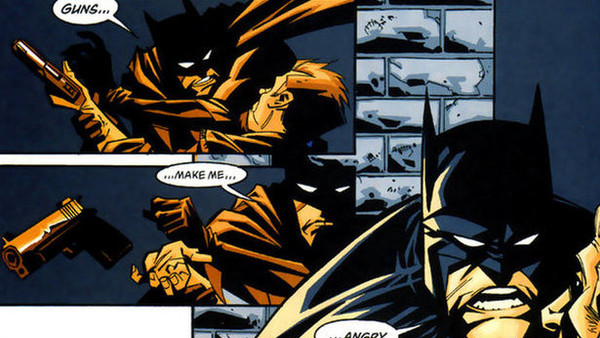
When Batman first appeared in the pages of Detective Comics #27, he killed. He also used a gun, and continued to do so for about a dozen or so more issues. It was only later when the character would adopt his famous 'no killing' rule, but it was that evolution in the character's history that made him such a unique force both on and off the page.
Any hero can kill. Most featured in Hollywood tend to use lethal force very liberally, and have done so for decades. When it came to comics, the pulp heroes of the Bronze Age, such as Dick Tracy and The Shadow, both used firearms and killed when the situation arose. Had the Dark Knight maintained his commitment to killing his foes, he'd just be another pulp hero who carried a gun; the fact he actually valued life was the thing that made him such a captivating figure.
Since his inception, Bill Finger and Bob Kane's creation has been riddled with flaws. His ideology is farcical in places, but that commitment to preserving life is what makes Batman so special. That in itself might even be silly to say, given the character's propensity to dish out cold, unforgiving street-justice on a regular basis, but it's true - Bruce Wayne takes to the streets so that no person may undergo the tragedy he befell when he was eight.
He doesn't view Gotham as a playground to tear-up in a militaristic motorcar, but instead as a city that can be saved. He funnels millions into anti-poverty programs, pretty much starts a family of his own, and abhors both killing and guns. One depiction that really understood Bruce's commitment to that last aspect was Batman: The Animated Series, which showed the moment Wayne retired from crimefighting in Batman Beyond when he entertained the thought of using a gun in self-defence.
In essence, Bruce Wayne's 'one rule' is a key pillar of the character. There have been some exceptions to that rule in the past, when all other options have been exhausted, but it's not something that can be dismissed with a brief shot of Robin's tattered costume.
3. Batman V Superman's Bruce Wayne Was Inauthentic

Although Snyder's take on Batman might seem somewhat anomalous - hence the backlash to his comments overnight - they aren't. There are many Batman fans who grew up on the character's films who genuinely believe that the Dark Knight is a pointy-eared Punisher, because they saw him kill Joker in Batman 89, explode a Penguin thug in Batman Returns, and murder Two-Face to death with a barrage of quarters in Batman Forever. Nolan's Batman managed to continue this trend too, 'not saving' Ra's al Ghul in Batman Begins, killing Harvey Dent (again) in The Dark Knight, and shooting Bane's henchman with 'The Bat' in The Dark Knight Rises.
The difference between those films and Batman V Superman, however, is that none really revelled in Batman killing. Neither of those earlier productions boast a bodycount that goes into double digits, but in Snyder's film, the Caped Crusader murders indiscriminately. Dozens are killed in a barrage of gunfire and explosions - not to mention those murdered in prison after being branded by a white-hot Batarang - and that's without even mentioning this version's affinity for firearms.
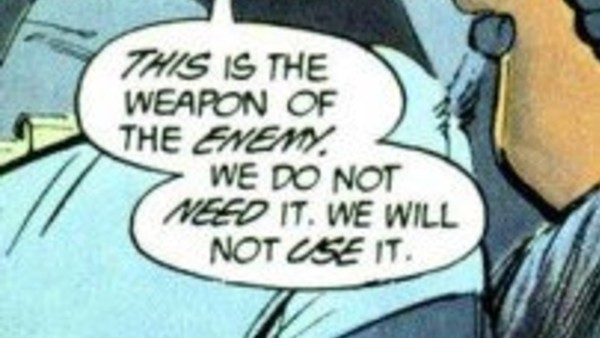
Those who see Batman V Superman as a semi-literate interpretation of Frank Miller's The Dark Knight Returns will no doubt mention that the Batman in that comic wielded guns too - and he did. He resorts to using firearms just as he comes out of retirement, but he abandons their use as the novel progresses. In a very matter of fact way, Bruce lectures his new army while breaking a shotgun in half, remarking that guns are "the weapon of the enemy. We do not need it. We do not use it." All this after he goes to town on the mutants while using rubber bullets specifically.
Miller's magnum opus is often heralded as the greatest Batman story of all time, but it only options one interpretation of the character, one broken by his war on crime who's let Gotham go to waste in his absence. The Batman of Snyder's film, however, doesn't carry that same baggage. We're led to believe that a Robin has died, but there's nothing that says he was changed by that event; for all intents and purposes, this Batman has always been a psychotic mass-murderer, and it's about as far away as you can get from the character's most definitive incarnations.
2. Taking A Cynical Approach To Comics Isn't Interesting

One of the biggest misconceptions regarding the dichotomy between Marvel and DC is that the former puts forth a 'lighter' version of the superhero genre, while the latter dwells on its darkest aspects. This isn't actually all that accurate however, and the only reason fans tend to label either company as 'light' or 'dark' stems from the fact that, for the past decade, DC on film has been completely miserable.
In truth, Marvel and DC both put out about the same in terms of lighter and darker content - at least when it comes to their respective comics. There isn't just one 'take it or leave it' tone for either company, because people who read comics are comprised of a range of tastes, ages and backgrounds, and that ultimately leaves each publisher in a healthier position. The more diverse the content, the better choice there is for the consumer, with both the Marvel and DC universes being home to characters cheery and not so much.
It is, quite literally, a fantasy world.
The fundamental error Snyder made with the DCEU was that he mistook his own cynical attitude toward that source material as being somewhat transgressive. He also mistook that same kind of cynicism and the bleak tone of his own films as though it would result in a mature depiction of DC's books, when really, it was just the opposite.
In truth, Batman V Superman is a very childish film. It takes the easy road in order to avoid broaching the ethical quandaries of Batman's ideology, and tries to mash two comics together (TDKR and the Death of Superman) in some sort of distorted 'best of' compilation that foregoes any sense of drama to maintain a hamfisted attempt at world-building. Ultimately, it is much easier to position an irredeemable character in an ostensibly irredeemable setting than it is to position a hopeful one in that same environment, especially when Batman has made such a habit of overcoming the odds throughout his career.
1. The DCEU Is Heading In A Completely Different Direction

If none of what I just said illustrates the fallacy of Snyder's comments, then surely the irony of him telling DC fans to "wake the f**k up" while the franchise he once commanded heads in pretty much the opposite direction he had in mind will.
Man of Steel, Batman V Superman and Suicide Squad were all poorly received by critics upon their release. All managed to make quite a bit of money, but were lacking in quality, with David Ayer's film working from the blueprint Snyder established in those two earlier works. Wonder Woman was the first unanimous success in Warner Bros' cinematic experiment, and it succeeded by telling an altogether more different kind of story than was seen in either of those three films. It was optimistic, hopeful, and championed Princess Diana as a peacemaker determined to save man's world from itself.
After that, Aquaman came along. Like Wonder Woman, the film divested from the bleaker tones of Snyder's earlier works and cast King Arthur Curry as a jovial adventurer, making a huge splash at the box-office and becoming DC's highest grossing movie in the process.
In the intervening months since Wonder Woman and Aquaman's success, WB have been busy restructuring the future of their franchise too. Snyder hasn't returned in a creative capacity, while the likes of Birds of Prey and Matt Reeves' Batman seek to sever ties from those earlier depictions. All serve as proof that the director's original vision just didn't translate, and yet he's patronising fans for championing a version of DC that now looks as though it'll inspire its onscreen future.
It is, quite frankly, bizarre. The DC Universe is home to dozens of different styles, tones and moods, and they all coexist under one roof. So no, fans don't need to "wake the f**ck up". If anything, Snyder would do well to reappraise his earlier works, and understand why they failed Batman in particular so badly.