10 Awesome Movie Effects That Aren't What You Think
Utterly stunning.

There's perhaps no more fascinating aspect of filmmaking craft than the insanity that is special effects production - be they old-fashioned and practical or cutting-edge and digital.
While much has been written about "invisible" special effects that the audience doesn't even notice, these 10 scenes don't even remotely try to hide the fact that some visual trickery was involved.
And while for the most part the nature of each effect might seem obvious, in each case the filmmakers and their crew employed a totally different technique from what audiences assumed.
From moments that had to be CGI - but actually weren't - to absurdly tactile effects that were in fact digitally created, and other nifty tricks that nobody could've ever seen coming, these scenes are all a testament to the incredible artistry behind Hollywood's special effects.
For every movie that boasts ugly, obvious and distracting CGI, there are films like this, which come up with ingenious ways to pull off mind-blowing sleights of hand. The result, in each case, is pure movie magic...
10. The Lunch Tray - Spider-Man

What You Thought
One of the most memorable beats in Sam Raimi's original Spider-Man sees Peter Parker (Tobey Maguire) not only catching MJ (Kirsten Dunst) when she slips over in the cafeteria, but also using his Spidey-sense to catch her entire lunch tray without dropping a single item.
Given the film's already CGI-heavy nature, it was easy to presume that Raimi simply had Tobey Maguire catch the falling lunch tray and added all the lunch objects digitally in post-production, right?
The Actual Effect
Incredibly, this was achieved entirely practically and in-camera, with Raimi filming 156 takes over 16 hours before Maguire successfully managed to catch the tray and its contents.
In fact, there's only one aspect of the shot that can even be called a special effect - sticky glue was applied to Maguire's hand to ensure that the tray stuck to his fingertips, giving him a fighting chance of actually catching all of MJ's food.
Now, just consider if Kirsten Dunst had forgotten her "Wow, great reflexes" line that follows the successful catch.
9. Rey's Instant Bread - Star Wars: The Force Awakens

What You Thought
A brief but unforgettable scene early in The Force Awakens sees Rey (Daisy Ridley) preparing a meal of polystarch, an instant bread product which is created by mixing a flour-like powder with water. Within a few seconds, the mixture rises and transforms into a doughy, dry roll of bread.
Much like Spider-Man, this film is so rife with complex visual effects that nobody really gave the bread a second thought - why wouldn't J.J. Abrams render something so seemingly simple with CGI?
The Actual Effect
In line with Abrams' commitment to achieving as much of the effects as possible practically, the bread is a 100% physical effect.
Special effects supervisor Chris Corbould stated in interviews that the completed prop took three months to design and create, as his team constantly iterated on the look of the bread, while figuring out how to make it rise while the water disappeared.
But if you thought the bread was actually edible, sadly not - according to Corbould it tastes "terrible."
Lucasfilm did provide fans with a recipe to make their own, simpler, edible version of polystarch, though.
8. Tumbler Vs. Garbage Truck - The Dark Knight

What You Thought
The Dark Knight's SWAT van chase is one of the film's most distinctive action beats, and you'll probably remember the moment where Batman's (Christian Bale) Tumbler collides with a garbage truck at full speed, easily disabling it.
Given Christopher Nolan's penchant for practical effects, there wasn't much reason to believe that he didn't just collide the two vehicles together for real.
The Actual Effect
Though the effect was indeed practical, it was actually entirely composed of miniatures.
Nolan's effects team built an identical miniature of the tunnel which the chase takes place in, and 1/3 scale motorised models of both the Tumbler and the garbage truck, which they duly crashed together.
Given how challenging it is to make miniatures match "real" footage, it's absolutely jaw-dropping how seamlessly the shot blends into the full-scale chase itself.
7. The T-1000's Battle Wounds - : Judgment Day
What You Thought
James Cameron's Terminator 2 is a stunning triumph of cutting-edge visual effects which still looks incredible almost 30 years on.
And though the film is well-noted for its smart fusion of practical and digital elements, it's safe to say that the various scenes in which the T-1000 (Robert Patrick) sustains battle damage are accepted by most everyone to be entirely digital.
The Actual Effect
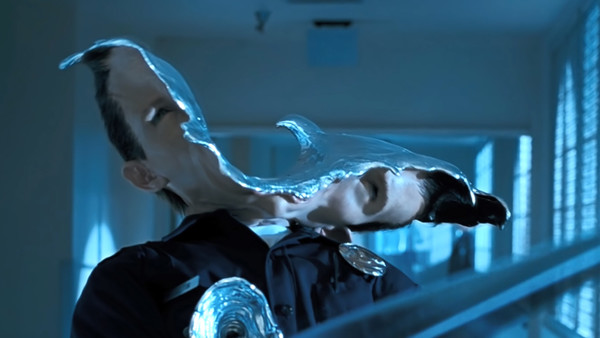
Unbelievably, a good deal of these shots were entirely practical thanks to legendary special effects wiz Stan Winston.
When the T-1000's head gets blown apart during the hospital escape, for instance, we're looking at a physical model, with animatronics used for the head's movement. CGI was only used for the final shot of the T-1000's head fully re-forming.
Elsewhere many of the T-1000's liquid metal "wounds" throughout the film are nothing more than foil squibs glued to Robert Patrick's clothes, with CGI only used to animate the original appearance and disappearance of the wounds.
Given how so many modern films struggle to blend practical and digital effects together, it remains mind-boggling just how expertly Cameron and his crew left audiences unsure of what exactly they were seeing.
6. The Floating Pen - 2001: A Space Odyssey

What You Thought
Early on in Stanley Kubrick's sci-fi masterpiece, Dr. Heywood Floyd (William Sylvester) is being transported in a space shuttle, as the audience is treated to a gorgeous zero-gravity sequence.
Memorably, a pen can be seen floating in the air before being retrieved by an air stewardess (Heather Downham).
Even with the film's eye-wateringly impressive and pioneering use of visual effects, it's fair to say that 1968 was just too early for the production to convincingly create the floating pen digitally, and most viewers likely figured it was executed with hidden wires.
The Actual Effect
The actual effect is hilariously simple and all the more genius as a result. Kubrick simply had his crew glue the pen to a large sheet of glass, which would be rotated around to give the impression of it free-floating.
Incredibly, Kubrick managed to avoid any telltale reflections, and the only vague giveaway is that Downham has to ever-so-slightly unseat the pen from the glue, rather than simply "pluck" it out of thin air were it really floating.
As complex a production as 2001 was, it's staggering that one of its most talked-about effects shots was achieved with such inspired simplicity.
5. The Magic Bathtub - Mary Poppins Returns

What You Thought
Whatever you made of Mary Poppins Returns, it's practically impossible to forget that gorgeous shot of the magical nanny (Emily Blunt) sliding backwards into a bathtub and disappearing beneath the bubbles.
It was featured in all the trailers and did a fantastic job conveying the escapist thrills the film was shooting for.
And given the film's pervasive use of CGI, everyone quite understandably believed the effect was digital, because why wouldn't it be?
The Actual Effect
Astoundingly, this was pulled off completely in-camera, with the effects team ingeniously constructing a bathtub with a secret slide in the bottom, allowing the actors to ride it to a crash mat on the floor below.
The film as a whole is so awash with lavish visual effects that most viewers didn't even give it a second thought - this had to be CGI, and yet it absolutely wasn't.
4. Tobey Maguire's Wig - Fear & Loathing In Las Vegas
What You Thought
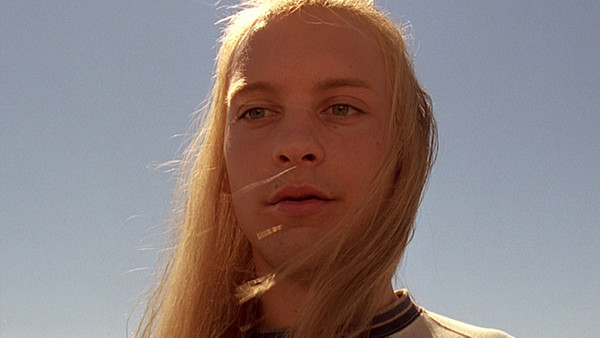
Terry Gilliam's mind-bending road movie features an unforgettable cameo from Tobey Maguire as a hitchhiker scooped up by Raoul Duke (Johnny Depp) and Dr. Gonzo (Benicio del Toro).
For the role, Maguire was required to sport a most unfortunate hairdo - long-haired yet balding, and even watching the movie today, there's no reason not to believe that he's simply wearing a wig.
The Actual Effect
The story behind Maguire's hair is extremely ridiculous. The production forgot to include a stipulation in Maguire's contract requiring him to shave his head for the role, and so the enterprising actor demanded $15,000 to do it.
Gilliam didn't much like being held hostage and so declined, instead fitting Maguire with a bald cap and adding the hair digitally in post-production.
With the movie now over 20 years old, it's insane just how difficult, even impossible, it is to find the seam between Maguire's bald cap and the CGI hair.
Hilariously, though, this effect ended up costing much more than the fee Maguire demanded to shave his head. And was there really no way to just fit a wig over the bald cap? Never change, Terry.
3. John McClane's Roof Jump - Die Hard

What You Thought
There are so many iconic action beats in John McTiernan's Die Hard, but who can forget the fantastic moment when John McClane (Bruce Willis) leaps from the roof of the Nakatomi Plaza as it explodes, tethered only to a fire hydrant as he hopes not to fall to his death?
As McClane leaps, a cacophonous explosion is set off behind him, which conventional filmmaking logic would dictate was a relatively simple, controlled explosion detonated safely behind Willis, right?
The Actual Effect
Shooting the roof explosion was quite a technical challenge, as the production had to ensure not to deal any actual explosive damage to the real skyscraper atop which the scene was filmed, California's Fox Plaza.
According to McTiernan himself, Willis performed the leap from a piece of custom-built scenery placed away from the edge of the roof, but rather than use conventional prop explosives, his crew had to get creative.
The director said, "We built these crazy machines that had a great deal of propane in them, vaporised. On 'action,' they would make a great deal of fire for about a five-second burst."
McTiernan added, "To put the fire behind him in the traditional way would have been an enormous amount of nonsense. Instead, we had these mortars drive around with a forklift, and they would put fire exactly where you wanted it."
2. Old Cap - Avengers: Endgame
What You Thought
For all of the many impressive visual effects throughout Avengers: Endgame, one of the most evocative surely has to be the aged presence of Captain America (Chris Evans) in the film's affecting coda sequence.
Given that the MCU has cornered the market on digital de-ageing effects, most fans quite rightly assumed that the effect had been applied to Evans in reverse, ageing him up with CGI.
The Actual Effect
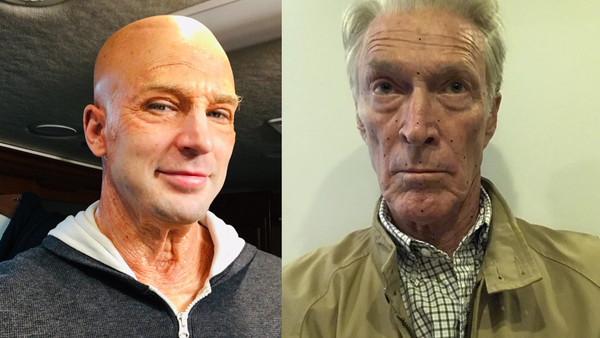
The end result is ultimately a combination of several techniques. First and foremost, Chris Evans did indeed don extensive old man makeup for the scene, and the raspy Cap voice heard in the film is indeed all him with no post-production touch-ups.
Evans' physical appearance was heavily accentuated by CGI, though, and veteran character actor Patrick Gorman was hired as a body double, to ensure the character's body physically resembled that of an older man.
Hilariously, Gorman posted a picture of himself in old Cap's clothing with CGI reference dots on his face way back in February, but of course, it flew totally under the radar.
The mere fact that this effect has people questioning its execution is all the better testament to how believable the final result truly is.
1. A Mouthful Of Bees - Candyman

What You Thought
Cult 1992 horror flick Candyman features many disturbing sequences, least not the appearance of the titular urban legend (Tony Todd) with a mouthful of bees, reflecting the fact that his human self was murdered by a lynch mob, who smeared him with honey and let bees sting him to death.
The visual of Todd's mouth full of bees is deeply unsettling, and despite the film's low budget, one assumes there's some sort of optical effect or trickery going on here.
The bees clearly weren't CGI, but animatronics, perhaps?
The Actual Effect
Shockingly, the bees are 100% real - and to be totally clear, Tony Todd indeed agreed to fill his mouth with bees.
The bees were bred specifically for the production, and being just 12 hours old at the time of shooting, their undeveloped stingers made them decidedly less dangerous to both Todd and co-star Virginia Madsen, who meanwhile had the bees plastered over her face.
In fact, the only real special effect in the entire scene was Todd being given a dental dam to put in his mouth, in order to prevent the bees from stinging his throat.
Otherwise, it was nothing more than smearing some pheromone on his face, opening his mouth wide and trying to remain calm.
For his enthusiasm, though, Todd managed to negotiate an agreement where he'd be paid an extra $1,000 for every sting he suffered. The actor ended up being stung a whopping 23 times, adding quite the well-earned bonus to his paycheck.