10 Awesome Special Effects You'll Be Shocked Didn't Use CGI
Filmmakers whose effects put others to shame without having to resort to technological wizardry to accomplish them.
 Special effects technology is becoming more advanced by the day. Soon we'll reach the point where Christian Bale's transformation into a mummified corpse for The Machinist becomes almost solely a job for computers, able to make him as fit or fat as the filmmaker desires. If the making young of Jeff Bridges for TRON: Legacy is anything to go off of however, that might be a somewhat optimistic statement, since it's clear there's still a ways to go, but I'm sure that'll change as technology advances. With this in mind, it's understandable why so many directors would embrace CGI, and why so few would stick it out using more traditional means. It's faster and it's cheaper. Plus, the more tech advances, the faster and cheaper it will become. What could go wrong, then, with such a transition? For one, it is often used as a shortcut with quality sacrificed in favor of expediency, the end result looking like something out of a mockbuster. Second of all, and most importantly, some of film's most well-known and well-respected effects were realized without the crippling crutch that is CGI. That's exactly what this article is about, filmmakers whose effects put others to shame without having to resort to technological wizardry to accomplish them.
10. Baby Joel - Eternal Sunshine of the Spotless Mind (2004)
 If you're familiar with Peter Jackson's Lord of the Rings trilogy, you're familiar with forced perspective, whether you know it or not. So much of the effects in those movies is accomplished through what amounts to optical illusions, up to and including when Gandalf and Frodo first meet. Maybe you thought Jackson shrunk Elijah Wood somehow, but it actually wasn't that simple. In fact, the process was surprisingly complicated, which you can see illustrated in the video below. http://www.youtube.com/watch?v=jDlxpnRxDJs As is almost always the case in Hollywood, there were imitators, putting Jackson's technique to use in their own films. Among the most noteworthy examples of this is the scene in Eternal Sunshine of the Spotless Mind where Jim Carrey's character is thrust back into his childhood. You would think, if you didn't know better, that it was simply some sort of CGI at work, but you'd be wrong. It, like a large portion of the film, eschews the more, shall we say, modern approaches in favor of the more crafty ones, in this case forced perspective. http://www.youtube.com/watch?v=II0er7TmkS8 For a movie so surreal, the fact that this scene, as well as many others, was done without the aid of CGI speaks wonders about it. Imagine the thought, time, and effort that went into creating what you see on your screen. Did you know that, for the scene involving two Joels, Jim Carrey merely ran back and forth, taking off or doffing his cap depending on which one he was portraying? With this in mind, it's hard not to be impressed. Would CGI have been less exhausting? Indeed it would have, especially in Carrey's case. But it's debatable whether it would have made it any better. All that matters, in the end, is that it worked, and quite wondrously at that.
9. Big Balls - Fight Club (1999)
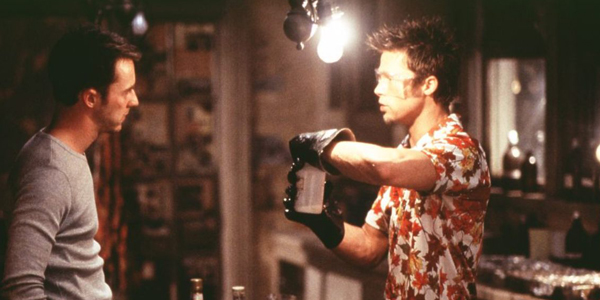 For this one, I'm relying upon your having seen the movie, which I assume the vast majority of you have, and know what it is I'm talking about. The reason I'm doing this is an inability to find so much as one picture or video of the scene in question, surprising considering its immense cult following. In addition, it's a slight cheat, as the final scene was touched up a tad with CGI. However, when I read about the lengths they went to in order to make this scene work, doing most of the grunt-work themselves without CGI, I knew I couldn't not put it on the list. The scene I'm talking about is the one that ends with the destruction of a coffee shop by a large, rolling ball. Initially, it was meant to be all CGI, but Fincher was convinced to try it for real instead by his visual effects supervisor. Except if he were able to see in to the future, there's no way he makes that decision knowing the hell he was in store for. First, the floor's weight-bearing capabilities demanded they use a much lighter ball than originally intended. The problem with that, though, was it acted like a lighter ball. When it went down the stairs, it bounced. In the water, it floated, rather than sank. Even worse, it couldn't build up the necessary speed required for the scene. The proposed solution was to have two men run with it on either side using wires to steer it along and doing their best to keep it from floating by literally holding it down. Yet that wasn't the last of their problems, not by a long shot. Next the scene asked for the ball to make a climactic crash into a coffee shop window, sailing through and smashing the counter inside. With little run up, though, and the building's low ceiling not allowing them to build a ramp any higher than two feet, the ball didn't do as they had hoped, only breaking the glass before rolling back away from the window. At this point, they'd had enough and turned it over to the effects department who went through and cleaned up all that they'd filmed, doing things ranging from removing the bouncing to adding in the destruction of the counter to other minor effects, such as extra-added splashes when the ball lands in the water. Still, for the most part, the finished product is a perfect example of the filmmakers not wanting to take the easy way out by going CGI from the get-go, and for that it has earned its place on this list.
8. Record Breaking Barrel Roll - Casino Royale (2006)
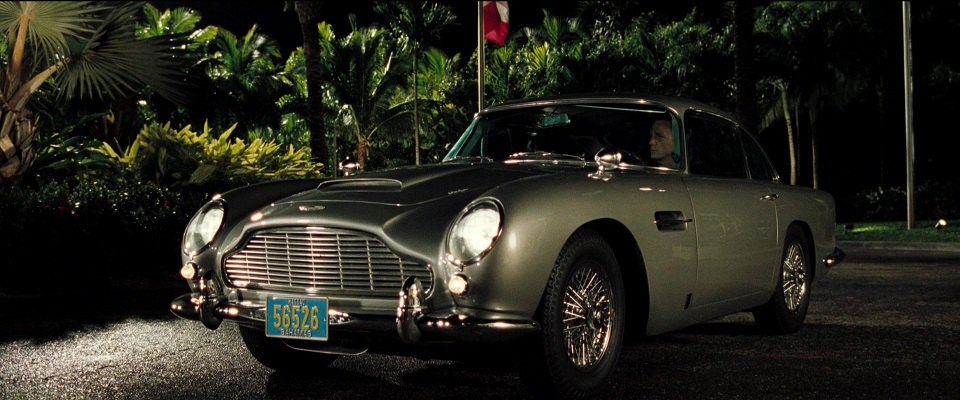
 Does breaking a world record qualify as "awesome"? Because that's precisely what the makers of the James Bond reboot, Casino Royale, did. Even more impressive is that it came as an accident. They weren't setting out to break any records. All they were after was filming the scene as it was intended, which wasn't happening using just a ramp. The solution? Strap an air-powered cannon on the inside of that car, behind the driver's seat, shoot it off, then let physics do the rest. The result? A Guinness world record for the most barrel rolls assisted by an air-cannon. http://www.youtube.com/watch?v=sgNxKOLrAyA Simple, yet elegant, like all the best special effects. Here's to hoping that Skyfall sets that record even higher.
7. The Nurses - Silent Hill (2006)
 Of all the genres, horror is the one that's best done naturalistically. Think of all its most famous faces. Michael Myers, Freddy Krueger, Jason Voorhees. Each of them has an undeniably human element to them, despite their ties to the supernatural. At some point in time, they were all human just like the rest of us, and it's their all-too-human compulsion for revenge that drives them. So, it appears that, when it comes to horror, the further rooted your movie is in reality, the more likely it is to succeed. http://www.youtube.com/watch?v=iVtDhd26420 Case in point: Silent Hill. Ask those who have seen it to name what they would label the scariest scenes in the film and the one pictured above is likely to show up on a number of lists. Few realize, though, just how easily arrived at this particular creepy effect was. Creating their seemingly inhuman walk was as simple as playing what they'd filmed in reverse. That's all it took to take a bunch of women done up in make-up and make effective monsters out of them. The filmmakers could have just as easily resorted to CGI creatures, as in I Am Legend, but they kept it simple and benefited as a result.
6. Chestburster - Alien (1979)
 Continuing with that theme, I'd be remiss if I didn't mention the infamous chest-burster scene from Ridley Scott's Alien. Similar to the nurse scene in Silent Hill, there was little fuss involved. All it took was a mechanical torso, a puppet, and tons of animal guts and blood to create what has gone on to become one of, if not the most iconic scenes in horror, and film, history. Helping create the effect was the genuine surprise of the actors involved. While they weren't completely in the dark, as is often said, they definitely weren't expecting what they ended up getting. Veronica Cartwright, for example, wasn't told she'd be sprayed with blood. Thus, what Scott succeeding in capturing was pure, unfiltered shock and horror, which is why the scene has left so indelible a mark on filmgoers the world round. It was as real as the viewers' reactions.
5. Arm Amputation - 127 Hours (2010)
 Switching genres, but not gears, let's transition to a scene so realistic that it reportedly left some viewers in need of medical assistance. That would be the arm amputation scene found in Danny Boyle's award-winning film, 127 Hours. In shooting it, Boyle set out to portray what Aaron Ralfston went through in as realistic a fashion as possible, and the result was a resounding success. Ralfston himself went so far as to say "the movie is so factually accurate it is as close to a documentary as you can get." Praise can't get any higher than that. Furthermore, he made it look easy. When filming the scene in question, he was prepared to devote their last day and a half of shooting to getting it just right, multiple fake arms at the ready. It took him one take and twenty minutes. Twenty minutes to film something so grisly and real-to-life that it had the power to make people faint. And he did it all without using so much as one bit of CGI. Just good old-fashioned special effects.
4. Every Fight - Ong-bak (2003)
 Over the years, fight scenes in movies have been increasingly dependent upon wire-work. Watch any recent action movie and it's almost a guarantee that wires will be involved somehow in any and all instances of hand-to-hand combat. That's why Ong-bak was so refreshing to watch. Its star, Tony Jaa, doesn't just do all of his own stunts; he does them without any outside assistance whatsoever. http://www.youtube.com/watch?v=nAYUv9wjV48 What you see is what you get, meaning when the voice-over says "he perfected his art," it's talking not just about the character he portrays, but Jaa himself as well. If you wanted, you could apply the movie's subtitle, "The Thai Warrior," to both. For the sake of the people who have to film this man, let's hope he's not as easily aggravated as Tom Cruise or else there might be some real dead bodies to deal with before filming is over.
3. The Transformation - An American Werewolf in London (1981).
 Makeup artists are the real magicians in Hollywood, but for years they went virtually unnoticed. It wasn't until An American Werewolf in London came around that things began to change. Following its release, the Academy Awards was quick to introduce a new category, Best Makeup, an award the movie handily won. To any who wonder why, I present the transformation sequence the movie is most famous for: the transformation scene. That scene alone is 6 days work. Just to apply the makeup daily took about 10 hours, whereas removing it took 3, so that means over half a day was spent solely on the makeup. By contrast, only 5 hours a day was spent on the actual filming. And all that time and effort can really be seen in the final product, as worthy a winner of an Oscar as there ever was. To this day, the transformation remains among the best examples of the wonders that makeup can do. It could stand alongside the nominees of recent years and not look the least bit out of place. The same can rarely be said for CGI, which starts to show its age at a rather rapid rate following its release. There's a reason why it's movies like 2001: A Space Odyssey whose effects stand the test of time. Models, make-up, etc. just hold up better because it's hard to beat the real thing or, to be more specific, a facsimile of it.
2. Stargate - 2001: A Space Odyssey (1968)
 While we're on the subject, I think it as good a time as any to look at what I consider to be the most dazzling scene in all of 2001: A Space Odyssey, the one in which Bowman finds himself racing through space at high speeds. Director Stanley Kubrick famously put off A.I.: Artificial Intelligence for as long as he did because of a long-held desire to see David played not by a child, but a real robot. With this in mind, it makes sense that his movies would favor traditional effects over computer generated ones, a preference that becomes quite clear when one watches 2001. From the models serving as spaceships, to the humans playing primates, Kubrick did an impeccable job of creating a film that could hold up over time, the look of the film impressive even by today's standards.

1. Rotating Room - Inception (2010).
 While some of you might associate the words "rotating room" with N'Sync, the rest of us see them and think Inception. Director Christopher Nolan is famous for insisting against CGI in all of his movies, but Inception, more than any other of his movies, showcases what the man can accomplish without its benefit. For the now infamous rotating room scene, Nolan just created the above contraption, similar to a gargantuan dryer, and sent the actors through a cycle. Not without them first going through two weeks of special training, of course. If either of the actors got behind on the rotation, they could have been in for a 25-foot drop. So, it goes without saying that it took some time to get used to, and the actors probably came out of it battered and bruised, all in the name of art. That is what this is: art. It takes a certain level of creativity and ingenuity in order to think up solutions like this, as opposed to sending the scene off to be created by some render farm. This is why Nolan's unforeseen popularity is such a boon for film. Big budget blockbusters needn't have that fresh off the render farm look to them that movies like The Amazing Spider-Man have to be successful. Computers don't have to be the filmmaker's lifeblood; effects can be achieved without them that rival, or even beat, those that can be had with them. Now, if more directors would just take their cues from Nolan and follow suit, maybe, just maybe, overblown CGI messes, such as Transformers, could be avoided, or at least lessened. In the words of the movie Holes: "If only, if only, the woodpecker sighs..."