10 Awful Plot Twists That Completely Ruined Great Movies
Way to mess up the ending...

Occasionally, great films are made by clever folk that suddenly go insane at some point along the way. And a twist - a narrative surprise or sudden turnaround - is a great way to ruin a movie that, up until that point, was showing enormous potential. The twist, by its very nature, is intended to flip a movie on its head, to take it in a shocking new direction that nobody saw coming.
It has to make sense as well as feel satisfying to the viewer, without dismantling everything that came before it. That's a tricky tightrope to walk; sometimes, the filmmaker just can't pull it off. And, often, the big, movie-ruining twist is saved right for the end, allowing these films a lengthy shot at greatness before they blow it all at the finish.
The inclusions below are all fairly modern - plot twists aren't a new phenomenon, but the obsession with tricking the increasingly savvy audience has grown significantly in the last decade or so, leading to just as many bad twists as good ones. Blame The Sixth Sense, as I do. Spoilers coming.
10. The Prestige

The Movie
Christopher Nolan's warring magicians tale, in which showman Robert Angier (Hugh Jackman) faces off against natural sorcerer Alfred Borden (Christian Bale) in a game of one-upmanship that spans years. Their rivalry comes to a head as Angier consults madman/scientist Nikola Tesla (David Bowie) to build a machine that will top Borden's 'Transported Man' trick.
This is a wilfully dark and courageously mind-bending thriller (this was before Nolan's Inception made intelligence at the movies cool), right up until the last frame.
The Awful Twist
Then comes the last frame. I'm not disputing that David Bowie can build a cloning machine. I'm really not. I just don't know what a cloning machine is doing in a film stood firmly behind the curtain of professional deception, one which explains illusions of the magician's world in a factual manner.
As a result, you spend a large portion of the movie searching for a logical explanation for Tesla's cloning device - is it an elaborate trick? An ingenious con on Tesla's part, or Borden's? Then the final shot comes - of tanks upon tanks filled with dead Angier clones - and you're told that a film that's spent two hours explaining the mechanics of staged magic and establishing a world based in science is actually saying "yeah, was all magic".
Oh. Thanks.
The twists should have stopped at Borden's reveal (that he is not one man, but two separate Borden brothers), a reveal that carries a tragic pathos, a depiction of a man so obsessed with his craft that he dooms himself to a lifetime of loneliness. The clones twist does nothing but negate everything that came before.
9. Source Code
The Movie
Enjoyable sci-fi nonsense in which helicopter pilot Colter Stevens (Jake Gyllenhaal) must keep returning to a locomotive-based crime scene - via state of the art Groundhog Day technology - to discover the culprit behind the train's bombing. The high concept is rivetingly executed by director Duncan Jones, who also happens to be David Bowie's son. Now let's never bring it up again.
The Awful Twist
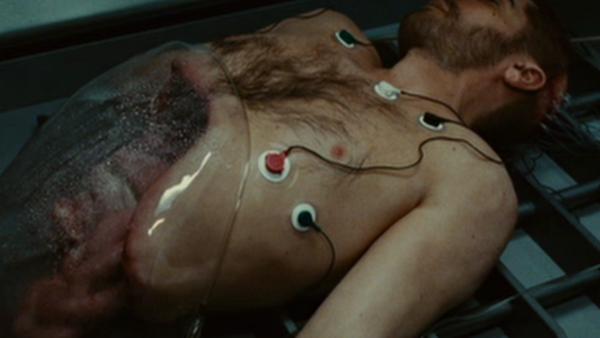
The film enters deep 'whuh?' territory as soon as it disregards its own internal logic, logic which was already pretty shaky to begin with. After talk of a military accident, Stevens is revealed to be a barely-conscious torso wired up to machines in a lab - those machines are what keep him going back to the crime scene, inside the mind of some poor, long-dead schmuck, in an alternate reality-style scenario.
So, when Colter's mission is complete and the machines (along with his life-support) are shut down, his life should go the same way. Except it doesn't. Instead, Colter gets to take over the life of another man and continue to live in an alternate reality, with his consciousness somehow transferred over via... magic? It's a nice idea, that Colter can live again as an able-bodied man with the hot girl he just picked up on the train (Michelle Monaghan).
The problem is, it just doesn't work. In short, it's a plainly nonsensical twist, with no regard for the set-up that the film itself provided. They should've just shut him down and had done with it.
8.Signs

The Movie
Everyone's favourite bigot Mel Gibson stars in a horror movie that doesn't rely on helpless women or idiots getting killed in increasingly claret-ridden ways; the effect is astonishing. Not only does Gibson give one of his better performances in this alien invasion drama, but the scares are - almost unnaturally for a modern horror film - scary.
A brief glimpse at an extraterrestrial visitor crashing a child's birthday party is pant-browningly chilling.
The Awful Twist
Shyamalan takes the ug-mo beasties out of the shadows and gives us a glimpse at some really half-assed CGI, as an unconvincing alien attacks Gibson's family inside their home. The writer/director then goes one step further and completely smashes any mythos surrounding these creatures, by killing them off in the most ridiculous way: by having Joaquin Phoenix spill water on them.
It doesn't just not make sense that an alien race allergic to H2O would consider invading a planet full of the stuff, but the sudden turnaround is handled so poorly that it diminishes all the solid tension that came before. M. Night Shyamalan made the plot twist into a water-cooler art form with The Sixth Sense (which still contains the biggest twist in cinema history, alongside Shawshank's sewage tunnel and Psycho's you-know-what), but this finale marks the exact point Shyamalan began his descent into being a massive joke.
Looking back at Signs' best moments, as well as Shyamalan's first two movies on the whole, it's mind-boggling to wonder what happened to such a talent.
7. 3:10 To Yuma
The Movie
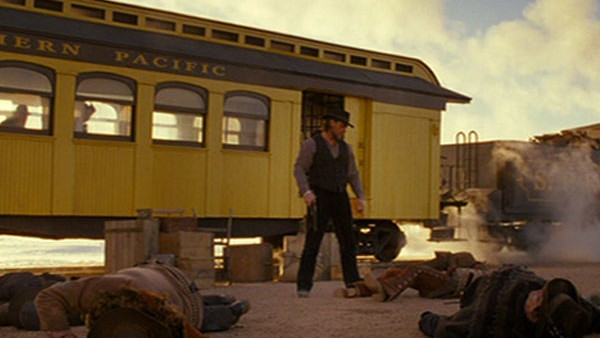
Rousing Western that sees one-legged family man Dan Evans (Christian Bale) transporting evil lothario criminal Ben Wade (Russell Crowe) to the titular 3:10 train to Yuma prison. On their trail is a campified Ben Foster as Wade's fellow gangsman Charlie Prince, who - along with a whole bunch of horrible gunslinging sods - finally surrounds Evans at Contention train station, leaving him trapped and Wade free to go back to murdering people for fun.
The Awful Twist
Evans' peg leg no longer causing him any concern during the final shootout would suffice here (director James Mangold simply gives up, deciding that making Bale walk with a limp doesn't really matter anymore, and instead lets him run like an Olympic sprinter and jump over rooftops like a superhuman). But there's worse to come.
After Prince drops Evans via a well-placed five bullets to the heart, Wade changes all his beliefs in a split-second, feeling so sorry for a man he's just met that he decides to shoot his entire crew to death. This includes his second-in-command Prince (with whom he frequently shares lover's glances throughout the film), whom he cold-bloodedly kills before boarding the prison train, for which the next stop is a likely death at the gallows.
WHAT? So Wade's spent the entire movie trying to get back to the company of his buck-toothed crew, now he's decided Death Row is really the way to go? Why was he such a pain in the ass up until this point, then, killing off Evans' fellow escorts with every opportunity he got? Ridiculous.
6. Return Of The Jedi

The Movie
The third part in a seminal sci-fi trilogy, Return of the Jedi finds Luke Skywalker (Mark Hamill), Princess Leia (Carrie Fisher) and Han Solo (Harrison Ford) facing up to the dastardly Empire in a supremely entertaining final ride.
The Awful Twist
A case of trying to spice things up but instead just making everything a lot more psychologically damaging, the revelation that Princess Leia is Luke Skywalker's sister opens up a can of worms that needed never be opened. It seems like George Lucas dropped this creepy A-bomb in there just to tie two of the main characters closer together, to give Han Solo the go-ahead on Leia and, perhaps chief among reasons, to include another familial twist of Empire Strikes Back-proportions.
Does it add to the story? No. Does it allow for character progression? No. Does it add a layer of incestuous subtext to what is essentially a kids' film? Hell yes.
After Luke previously declared "She's beautiful" in A New Hope then got off with her in The Empire Strikes Back (beginning a feature-length game of "Who can pull the royal first?" with Han), we're told halfway through Jedi that Leia has already spent nine months in an intimate relationship with Luke: inside their mother's womb.
The most scarring part is that literally no-one addresses the situation, suggesting this kind of thing is normal as well as lending the previous two films a generous helping of "eurgh, God!" It's the worst-handled part of a great sci-fi sequel that actually damages the films preceding it. And everyone always blames the Ewoks.
5. Sunshine

The Movie
Danny Boyle's gorgeously stylised sci-fi odyssey, in which a group of scientists journey across space to nuke our dying Sun back into action. Their ship, named Icarus for a bet, comes across another Icarus, the original bomb-deliverer which stopped short of its destination when its Captain - Pinbacker - went mad after staring at the stars for too long. Astonishingly, there's a twist coming that's even more ridiculous than the initial plot.
The Awful Twist
Surprise: Pinbacker's alive! Except it isn't a surprise, and it's certainly not a welcome one, not when Danny Boyle suddenly turns a sci-fi ruminating on God and the meaning of life into a cheap slasher movie. Derivative it may be, but Sunshine is thematically rich, where most modern science fiction lives and dies by its explosions and product placement.
The intelligence of its first two-thirds marks Sunshine out as one of Boyle's best, but that intelligence is swiftly shattered by unleashing a murderous Pinbacker on the crew of Icarus II. It's really just a way of quickening up the kill-count, ringing in a horribly misjudged tonal shift into horror gimmickry and juddering, MTV-style camerawork that clashes with all that came before.
It barely even constitutes a twist - that Pinbacker will make an appearance is signposted so clearly throughout the film (he makes constant appearances in archive footage, plus he's played by Mark Strong, one of the bigger names amongst the cast), it's hardly a surprise when Cillian Murphy's Capa finds him lounging in the observation room with the shade down, like it's a high-intensity sunbed.
4. War Of The Worlds

The Movie
In this enthralling, anti-Independence Day blockbuster, insane aliens execute a plot hole-ridden invasion of Earth, decimating the population at will and using their blood as a crop fertiliser.
It's something Ray Ferrier (Tom Cruise) and kids are having none of, son Robbie (Justwin Chatwin) especially, who ignores the advice of easily dying army men by running at the technologically superior enemy, armed only with an iPod and some guyliner.
The Awful Twist
There is a widely held belief that, due to its inexplicable amount of holes, War of the Worlds isn't a great film. But what modern blockbuster doesn't have plotholes? There's a lot to recommend, and I know I'm not totally alone in thinking it's a great action movie. That includes the moment when the aliens die of flue, which is fine (I maintain that the book's ending is perfect for the film).
What isn't fine, however, is that Ray and daughter Rachel (Dakota Fanning) reach Ray's step-parents' house, and everyone's alive. Seriously: they're all alive. The step-parents and Ray's ex-wife included. Everyone else in the world has been getting killed really easily; these guys not only look alive, but really, really well, as though they've been on holiday to a planet that wasn't being invaded by homicidal, extraterrestrial gardeners.
The very worst part: Ray's emo son is alive, despite running at the aliens during a firefight. It's unnecessary, and the surprisingly dark tone of the film is ruined by the pleasant and entirely unbelievable fact that all of Ray's family has survived an alien holocaust.
3. The Cabin In The Woods

The Movie
Clever meta-horror that pits a group of unsuspecting teenagers against a haunted cabin, which is actually being monitored by TV execs for a show. Eventually, two of the teens discover the underground media station and unleash all the movie monsters ever into the building, in one of the most satisfying creature-on-SWAT team massacres of all time.
The Awful Twist
The Cabin in the Woods is a film full of twists. All of them, bar one final reveal, work to benefit one of the smarter horror movies made for a long while. The movie's still full of great moments, but denied true classic status by the disappointing outcome of a deliriously entertaining third act.
When Cabin is revealed to be a horror movie within a TV show, it becomes a commentary on reality TV, on human nature, on the very existence of the horror genre. When it turns out the whole show is really for the entertainment of gargantuan gods living beneath the earth, it turns Cabin back into a regular horror, leaving that commentary behind and dropping us firmly back in the realm of nonsensical hocus-pocus.
The film just doesn't seem to know how to end after all the carnage has occurred, and so settles for throwing another twist in there (the film is one for chucking everything at the wall and seeing what sticks). It sounds absurd, too, to say this particular twist suddenly makes a film about a studio putting teenagers to death for entertainment "far-fetched", but blood-thirsty corporations really is more believable than underground gods thirsting for the blood of virgins.
The former is satire; the latter is a late plot twist for the writer who ran out of ideas and just suggested "whatever."
2. No Country For Old Men


The Movie
Oscar-winning crime thriller from the Coen brothers, in which a bewilderingly-haircutted hitman (Javier Bardem) violently pursues Vietnam vet' Llewelyn Moss (Josh Brolin) across Texas, in search of a case of stolen drugs money.
The Awful Twist
Don't get me wrong, No Country for Old Men is still a great movie. But that anticlimax can't be ignored, even after repeated watches. It may not ruin the memory of No Country altogether, but after an hour and a half of Moss and Chigurh hurtling inexorably towards one another, there still comes a sinking feeling when that inevitable showdown never comes.
To invest so much in the lead, watching him escape time and again from the clutches of Chigurh and cronies, it's disheartening when you discover he's simply been killed off-screen in a motel drive-by. All we see is a truck full of Mexican gangsters driving away, and Moss' body laid flat at his motel room door. Its the Coens, as ever, cheekily toying with their audience as well as with the cinematic norm, but it's one time where they might've been better suited to follow convention.
1. Saving Private Ryan

The Movie
Ripping WWII yarn for which the opening battle sequence changed war at the movies, Spielberg's Oscar-winner features an American-as-apple-pie army captain (Tom Hanks) and a ragtag soldiering bunch searching across Normandy for the eponymous Private Ryan (Matt Damon). A
fter Hanks' Capt. Miller finds Ryan, and they together make a failed last stand against a superior German force in an abandoned village, it looks like Ryan won't be saved after all. Hundreds of Germans versus a pre-Bourne Matt Damon and a crippled Tom Hanks is not typically good odds.
The Awful Twist
Ruining your own film right at the end really should be known as the Spielberg Special.
At the end of Private Ryan, our protagonists are dying, or facing certain death. Spielberg's point is made - war is futile. There are no winners. Then, suddenly, just as Tom Hanks starts to die like everyone else, Allied aircraft appear from nowhere and bomb the living Deutsch out of the enemy. For some reason, this prompts the hundreds of still fighting-fit German soldiers to surrender to the four or so U.S. troops remaining, and America wins.
Because, according to Spielberg, when a vastly superior force is about to decimate its enemy, it immediately gives up as soon as a couple of bombers appear.
So disappointing is this finale (along with the revelation that an older Private Ryan was reliving the entire story - D-Day landings included - in his head, despite not being present until the last third of the film), the only way to rescue the film is to eject the disc just after Hanks is taken down, and directly before the air support illogically arrives. It improves the film considerably; you can imagine all kinds of better endings on your own, or just pretend the film simply ends there.
The 'Berg has ruined many of his own pictures at the finish-line, but Private Ryan's unbelievable, split-second turnaround is possibly his worst. Without this climax, Private Ryan on the whole would have been regarded much higher than it already is, and not just remembered largely for its first 25 minutes.