10 Best Female Movie Characters Of 2015

Independent Women.

2015 has been a standout year for women at the cinema, a fact made more obvious as we approach awards season: the men's categories are pretty locked, and, supporting actor aside, pretty insipid; the women's, however, are bulging, and it's hard to draw up a list of five outstanding characters without noticing an obvious admission. Awards races might not be the best barometer of achievement, but it remains that this is one of the strongest years for female characters in a while. From battle-hardened warriors to cancer-stricken students to artificially intelligent robots, 2015 has seen a gamut of interesting, diverse, rounded female characters, played impeccably by the women in charge of controlling them.

10. Sam (Emma Stone) - Birdman

It might feel like an age ago, but Birdman (Or The Unexpected Virtue Of Ignorance), which was released in the UK way back in early-January, contains one of the very best female characters of the year (it contains quite a few, actually). Picking just one, though, it has to be Emma Stone€™s Sam, far and away the actresses€™ best role to date and the one which delivered the star her first Academy Award nomination (for Best Supporting Actress, which she lost out on to Patricia Arquette for Boyhood.) Starring as the eponymous Birdman€™s (Michael Keaton) rebellious daughter, Stone is electric as Sam, a character destined to be a tear-away and one who has had numerous issues with drugs as a consequence of her celebrity dad€™s fame and fortune. Her finest moment is the blistering monologue she delivers to Birdman, aka Riggan Thompson, in which she ridicules and lambasts him for his supposed achievements; for trying to make a fresh start as an 'artist'. There€™s a softer side to Sam, however, best displayed in her touching encounters with Ed Norton€™s Mike, an alcoholic actor with impotency issues. The closing shot of Sam looking up at Birdman in wonder, her aqueous blue eyes huge and in complete contrast with her ashen complexion, is one of the best on this list.

9. Shasta Fay Hepworth (Katherine Waterston) - Inherent Vice
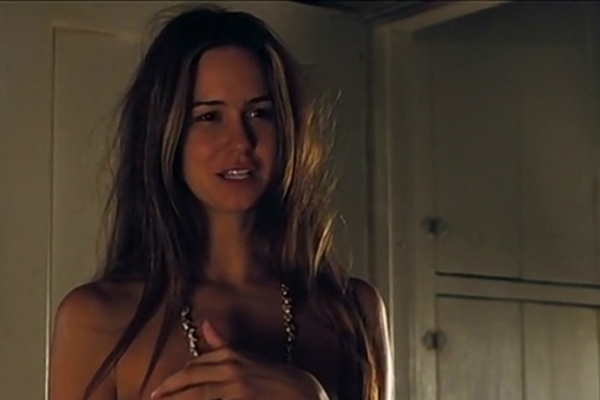
As in Thomas Pynchon€™s source novel of the same name, Shasta Fay Hepworth (Katherine Waterston) is a beguiling presence, more a beautiful apparition than a character; a slinking, sultry, kind-of femme fatale (but not really); a California surf-chick unconcerned with being a California surf-chick. She teases Doc (Joaquin Phoenix) in one of the year€™s great sexual scenes and is the reason he gets in way over his head, but there€™s nothing malicious about her, nothing manipulative. But then there kind of is, because she knows Doc loves her and will do anything for her. She€™s a walking ambiguity, a stunning, tanned enigma. Played by Waterston, Shasta Fay is an embodiment of how the love-filled 60s filtered out into the more nervous 70s: on the one hand she€™s a flower child, all blonde hair and bikini bottoms and flashbacks to when she and Doc danced in the rain to Neil Young. On the other she€™s an increasingly anxious young woman, seeking out a safe old face because she€™s in deep with some shady characters keen to leave the decade behind. She ends the film in Doc€™s front seat, driving towards an uncertain future but always glancing in the rear-view, looking back, as she goes.

8. Rose Ross (Caren Pistorius) - Slow West

It€™s been a big year for female action roles, and the most underrated comes in Slow West, John Maclean€™s masterful neo-western. You don€™t even know that Rose Ross is going to be a heroine until the final act of the film, such is her minimal, mainly-shown-in-flashback involvement in the movie up until that point. Indeed, Caren Pistorius€™ (no relation to Oscar but born in South Africa) Rose isn€™t an action role in the same way that Charlize Theron€™s (see later) is, but the fact remains that she, holed up in a wooden shack and facing bombardment by a phalanx of bounty hunters, spends the last fifteen minutes of Slow West picking off gunslingers with the skill and poise of an assassin. The love interest of Kodi Smit-McPhee€™s Jay, Rose differs in that while she doesn€™t reciprocate his feelings, she never exploits them either, staying amiable with the naïve Jay but never leading him on. This is her arc for the first three-quarters of the film, so you little expect to see her taking names by the end of it. That she does, though, and when Silar (Michael Fassbender) informs Rose that Jay loved her with all her heart (which she has just accidentally shot him in, by the way), she replies, sadly but confidently, that his was in the wrong place.

7. Rachel (Olivia Cooke) - Me And Earl And The Dying Girl

The best of the current crop of Young Adult cinema, Alfonso Gomez-Rejon€™s Me and Earl And The Dying Girl is one of 2015€™s sweetest surprises, a touch sentimental and quirky (as is YA€™s nature), but also blessed with an actual visual style, something rare in a genre usually lacking in anything even close to a cinematic aesthetic. Within it are three fine, unique young characters (as well as a hilarious supporting turn from Nick Offerman), best of whom is Olivia Cooke€™s Rachel, a high-schooler recently diagnosed with cancer. If that sounds a little mawkish, then know that Rachel is sardonic and seemingly unfazed by her diagnosis; aware of the consequences, yes, but also willing to get on with it, to not be pitied. She initially rejects the friendship from Thomas Mann€™s Greg because she knows it is forced, and she refuses to become his love interest because she is meta-aware about how that is the path she is expected to take. She never does, and it feels right. Of course, as the cancer intensifies and Olivia begins to lose her hair, she becomes sullen, a shell of her former self. Again, though, this is far from maudlin, and Olivia€™s decision to eventually bow out whilst watching the film Greg has made for her (you get the impression that she was holding on until it was complete) is both devastating and heart-warming; an acknowledgement that death doesn€™t always have to be quite so dark (the film Greg shows her is a kaleidoscope of iridescent colour, projected on a huge screen which illuminates Rachel as she slips into a permanent sleep.)

6. Melinda Ledbetter (Elizabeth Banks) - Love & Mercy

So often in biopics the woman of the story cedes centre stage to the genius man of the story. Not so in Love & Mercy, and while Bill Pohland€™s film does indeed feature a genius (The Beach Boys€™ Brian Wilson), it remains that the woman of the picture, Elizabeth Banks€™ Melinda Ledbetter, is just as influential as Wilson, perhaps more so when you consider that the character helps save the mentally ill Wilson from the clutches of Eugene Landy (Paul Giamatti), the man he suffered under as part of a controversial 24-hour therapy technique for years. A career-best performance from Banks (always an underrated actress in my opinion) sees her Melinda grow in confidence, initially wary of getting in-between Brian and Landy but ultimately compelled to do so. A lesser film would€™ve used Melinda as an inspiration to Brian, something to get out of bed and fight for (Wilson, in a bout of depression, famously spent three years in bed), and while there are of course elements of Ledbetter sparking something in him, Love & Mercy is more about Melinda€™s fight for Brian. She sees that he's in trouble and vows to help him; not because he€™s rich, not because he€™s a Beach Boy, but because she loves him; loves him in a pure way that€™s rarely seen in movies anymore.

5. Ava (Alicia Vikander) - Ex Machina

The only non-human character on this list, Alicia Vikander's Ava is an AI robot under a test to identify whether or not she can be passed off as a human - and more specifically (and importantly, given the context of Ex Machina), a woman. Throughout the film Ava is an eerie presence, by turns inquisitive and sensual, abrupt and manipulative. There are suggestions that she's actually a femme fatale, and that holds up: she lets Caleb (Domhnall Gleeson, who seems destined to have his heart broken by women on this list) believe that she likes him, luring him into her trap before abandoning him and leaving him to die in her designer's (Oscar Isaac's Nathan) Kubrickian compound. Expertly performed by Alicia Vikander, the character of Ava is just as memorable for how she acts and moves, balancing the rigidness of a robot with attempts at femininity. She is svelte, but also bereft of little female ticks (the ability to play with her hair, for instance); at one moment unmistakably a woman, at others undeniably a machine. Vikander has said that her attempts to play Ava as physically perfect led to a more robotic grace, and since what makes people human is "flaws and consistency", she had to throw in some "offbeats" to add the feminine yin to the artificial yang: "I wanted her to be a girl, but I also wanted her to have some glitches." The result of that is a brilliant character hard to pin down; one who bridges the gap between what is real and what is artificial by blurring the lines that define each.

4. Eilis (Saoirse Ronan) - Brooklyn

At the start of Brooklyn, the adaptation of Colm Tóibín€™s novel by director, John Crowley, and screenwriter, Nick Hornby, our protagonist, Eilis (Saoirse Ronan), is low on self-esteem and lacking in identity. She is unconfident and vulnerable, maybe even a little naïve. Then, after a big move to Brooklyn, New York, where education and general life prospects are a whole lot better than in Eilis€™ native Ireland, she flourishes, becomes a real woman, wiser, more attractive (notice how for so long she is framed in close-ups - her face filling the screen - but when we realise what an attractive young woman she€™s becoming, the camera tends to pull out and show us all of her), more sure of her direction. This might sound like a pretty standard coming-of-age scenario, and while it definitely has elements of that it remains that Eilis, as played by Saoirse Ronan in a staggering performance, is far from ordinary, instead presenting herself as a woman torn between two loves on opposite sides of the Atlantic but never in real need of either. The film is essentially about the complexities of the immigrant experience, but Eilis, who is in virtually every shot, transcends them, ending the film as woman influenced by her loves and journeys, but not defined by them.

3. Imperator Furiosa (Charlize Theron) - Mad Max: Fury Road

It takes a tough woman to out-badass Tom Hardy, but that's exactly what Charlize Theron's Imperator Furiosa does. Despite being called Mad Max, George Miller's film is really about her, a soldier under Immortan Joe who creates a mutiny in order to free The Five Wives (Joe's concubines). An exceptional, one-armed warrior prone to smearing herself in grease before battle, Furiosa is being hailed as a key feminist figure in recent cinema: part Ripley in Aliens and Alien 3, part Sarah Connor in Terminator 2, and wholly efficient, whether behind the wheel of a seemingly endless rig, or at the trigger of a rifle. There aren't many films in which Tom Hardy needs saving, but save him she does (giving him a beating on the way, too). Far from being a brute, though, Furiosa is instead driven by her desire to protect her fellow females, and her change of heart (she was initially Joe's top imperator and the driver of his behemoth war-rig) occurs mainly because of The Dag's (Abbey Lee) rape and subsequent pregnancy, an act which sets alarm bells ringing to further reinforce the idea of Mad Max as a feminist text, and of Imperator Furiosa as the chief character within it.

2. Carol (Cate Blanchett) - Carol

A 1950s New York socialite, Carol (Cate Blanchett) longs for the touch of a younger woman. Seeing her across the floor of a department store one Christmas, she knows she has to have her. She is married, but that's no matter: to use an old cliché, the heart wants what the heart wants. The word 'heart' there could be substituted for 'body' and it would be just as apt, because Carol, the latest film from New Queer Cinema troubadour, Todd Haynes, is just as much about two women coming to terms with their sexuality as it is their taboo, clandestine love affair. Carol is the more experienced of the two women: she knows she is a lesbian and is good at making other women realise it, too. Fraught with anxiety, though, Carol, as played by the always sublime Cate Blachett, is, despite appearances, a bit of a mess, unsure of what she wants or how she wants it, smoking cigarettes like they're going out of fashion in the process (as a side note, Cate Blanchett is one of cinema's best smokers, always using the cigarette as a manifestation of her characters' unease. Carol ends the film glancing at her on-again/off-again lover across a crowded party, her darting, magnificent eyes settling for once to see that what she needs has been in front of her the whole time.

1. Therese (Rooney Mara) - Carol

The other side of the Carol love story is Rooney Mara's Therese, the young woman enchanted by Carol in her furs. Mara won Best Actress at Cannes this year for her portrayal of Therese, and that should go someway into telling you how strong her character is. Shy and timid, striking as she is, she just isn't comfortable in her own skin, never sure of who she should be or what crowd she belongs to. This is mirrored in how she is shot and how Mara carries herself as the character, who is always obscured by door frames or blurred through windows or caught peering furtively around corners and hallways. Her hands, always drawn to her midriff like a child holding a basket, are always fiddling, tugging at something, as when she nigh on rips thumb holes in her sweater in an early meeting with Carol. Mara's impossible face is the perfect canvas for Therese to project her longing on, all wide-eyed melancholy and lip-twitching nerves. By the close of the film, she has grown, but not much: giving up the one great love of your life isn't as simple as just moving on. She dresses more refined than usual for her final (in the film, anyway) encounter with Carol, but she's not fooling anyone; Carol can have her in an instant, as made obvious by the little-longer-than-usual hand she leaves on Therese's swan-like shoulder before departing. Naturally, Therese runs to get her. None of this is to suggest that she's weak or naïve or wrapped around Carol's delicate fingers. Rather it's to suggest that she's just a young girl in the throes of a forbidden love, a woman who doesn't know that there are more down the line, that your first love is rarely who you end up with. Therese is a great character because we've all been her, and she makes the number one spot on this list as a consequence. Who was your favourite female character of 2015? Any great women we missed? Have your say down in the comments.

Contributor
Contributor

No-one I think is in my tree, I mean it must be high or low?