10 Best Films About Writer's Block
Sometimes, writers just have to work out their own demons.

The common wisdom has always been "write what you know." Yet readers often complain when some authors take it literally – when main characters are writers facing mid-life crises or other problems. In literature, no one is more guilty of this than Stephen King, whose worst works (books he's even since decried) feature alcoholic writers – which, throughout the 80s, he was. King claims he was so hooked on narcotics, legal and otherwise, he has no recollection of writing Cujo.
In film, author characters are often easier to get away with, as their actual work rarely needs to be heard nor seen, merely their presumed success or failure.
A "writer" is a common non-job for characters in a movie – much like an architect or marketing executive. They serve as an excuse for a character to own a house and live a life, but have little impact on the plot. However, they can serve as the very crux of the story - films about frustration or lack of drive or unexcised ambition and potential. Here are some of the very best.
10. Deconstructing Harry

Woody Allen's late 90's work can generously be described as spotty. In this 1997 film, the director/actor plays Harry Block, a successful author about to be honoured at a University from which he was once expelled while working on a semi-autobiographical novel. Worse, he is suffering from his namesake while trying to distract a distressed, suicidal ex with a brand new story - a kind of neurotic Sherherezad.
Along the way, segments of Block's fiction serve as flashbacks along a roadtrip with a prostitute and his son. These vignettes also blend in with his own reality, serving as semi-autobiographical examinations of his own damaged psyche. By the end of Harry's own personal dilemma, he's literally slid out of focus, overtaken by a blurry image.
A few segments are late-period Allen's best work, like Robin William's out-of-focus actor and Billy Crystal's Satan. It's one of Allen's more open-ended comedies, and surprisingly personal for such a prolific writer. Yet the question still lingers: can one who functions so well in art manage to do so in their personal life?
Ask Ronan Farrow.
9. The Shining

The Shining was Stephen King's third released novel and second film adaptation (the first being Carrie). It's also the one he has the most problems with. Whereas the book's Jack Torrance – a recovering alcoholic (get your Stephen King checklist out now) was tasked with being caretaker of a resort hotel in Colorado – slowly going mad by the hotel's any ghosts, cabin fever and personal temptations, King felt that Jack Nicholson brought immediate insanity to the role.
Nicholson plays Jack Torrance, a recovering alcoholic suffering from writer's block who holes up with his family in a Colorado Hotel off-season. Of course, when it's revealed all he's written the entire winter is less than inspirational, it's most definitely terrifying.
The differences between King and director Stanley Kubrick are well-documented, rooted mainly in King's Christianity and Kubrick's atheism. Nevertheless, it's considered one of the scariest films ever made. And if one has seen the King-scripted bore of a miniseries produced in 1997, they'd be glad he kept his distance from Kubrick's vision.
8. The Lost Weekend

Speaking of drunk writers, this 1945 Best Picture winner features Ray Milland as a writer who constantly eludes those who seek to help him, finding new and more tragic ways to fall into stupors. The film was made only a decade after the founding of AA, and little was known about alcoholism in the medical field. In fact, it would be another eleven years before alcoholism was recognized by the AMA as a mental illness.
Nevertheless, Milland's portrayal of "Don the drunk" as opposed to "Don the writer" is as nuanced and tragic as Jack Lemmon's drunk in The Days of Wine and Roses. Like 80's-era King, Don constantly talks about writing a novel about his battle with alcoholism. Unlike King, however, the bottle keeps preventing him from starting it, going so far as to pawn his typewriter to feed his habit.
7. Barton Fink

One of the quintessential writer's block films came to be out of, well, writer's block. Seems the Coen Bros. were struggling to complete the script for Miller's Crossing. Always prolific, the brothers opted against stopping work altogether and instead scripted Fink, a film about a hit New York playwright (Turturro) summoned into the Hollywood system to script a low-rent Wallace Beery wrestling picture.
Confined to a low-rent hotel room, Turturro sets about importing his high culture into a decidedly low culture feature. He befriends an insurance salesman (John Goodman) in the next room and, though Goodman appears to represent precisely the "common man" (without actually listening to one) Turturro wishes to explore, he regularly interrupts with his own conjecture and thoughts. "Because you don't listen!" Goodman exclaims toward the film's surreal climax.
The Coens loaded the film with allusions and representations of actual people, most notably William Faulkner as an alcoholic destroyed by Hollywood's sweatshop-like working conditions for writers – John Mahoney's W.P. Mayhew in the film. Faulkner himself worked on a Beery picture in the 1930s. He returned several times, whenever he was desperate for money.
6. Secret Window

As discussed, one of Stephen King's favourite tropes is that of the tortured writer. And although David Koepp's Secret Window – from King's novella Secret Window, Secret Garden – doesn't feature an alcoholic, there is something clearly...off about Mort Rainey. Mainly, his quirkiness can be attributed to Johnny Depp's eccentric, surprisingly nuanced performance (this was just before Depp's acting became more caricature).
But King's twist-driven thriller remains one of the better, if predictable, filmic realizations of the author's work. Rainey holes up in a cabin to finish a new work he can't seem to start, all the while tormented by a strange Southerner (John Turturro) who claims that he stole a short story of his. It was screenwriter Koepp's third foray into directing, and he manages to attach a sense of style that works in tandem with Depp's performance.
The less said about their later collaboration, Mortedecai, the better.
5. Wonder Boys
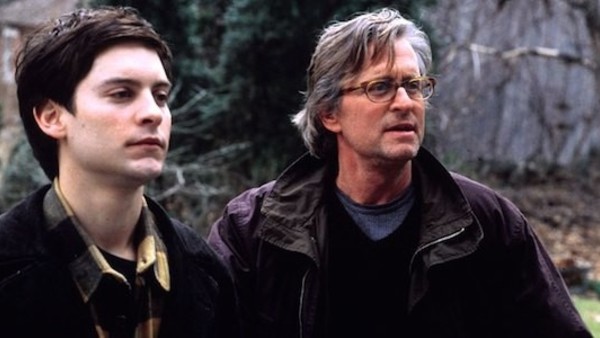
Curtis Hanson followed up L.A. Confidential – a film grand in scope and budget – with this modest Pittsburgh tale of a washed-up English professor working on his next novel.
Over the course of 48 hours, Michael Douglas' disheveled, consistently stoned Grady Tripp is forced to dodge dead dogs, a missing Marilyn Monroe jacket, a pregnant, married girlfriend, self-inflated literary phonies and an eccentric student – all the while haunted by a 2,000-plus page novel whose ending keeps getting further and further away. It could be said that Tripp suffers from the opposite of writer's block, but the result is the same. To put it in his own words, "I couldn't stop."
Hanson wisely set the film's soundtrack to 60s and 70s music reflective of Douglas' character, highlighted by an Oscar-winning song by Bob Dylan.
4. The Ghost Writer
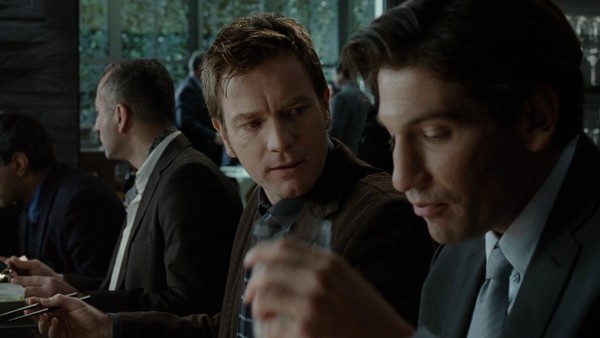
Putting Roman Polanski's personal crimes aside, there's a reason he can still draw casts like The Ghost Writer's, including Ewan MacGregor, Pierce Brosnan, Tom Wilkinson and Eli Wallach in one of his final roles. MacGregor plays a nameless ghostwriter tasked with reworking former Prime Minister Brosnan's (and Tony Blair stand-in) memoir, after the previous writer died mysteriously.
While writing Brosnan's boring, overwritten mess (with sentences that open with the genealogy of names), news breaks of accusations of torture under the PM's tenure and he's soon embroiled in political intrigue. Rather than some being stymied by some artful nuerosis, he's stuck between fixing up a hatchet job and a cover-up.
It's a crackerjack airport thriller, elevated by its performances, timeliness and some artful set-pieces including a great chase aboard a ferry. Bonus points for a bald Jim Belushi, undercut only by a terrible British accent from Kim Catrall.
3. Young Adult

Young Adult is Diablo Cody's best script to date, often overshadowed by the quip-a-second/hamburger phone Juno. In it, self-involved YA author Charlize Theron returns home to romance her high school crush away from his perfectly lovely family and suburban life. Her book series features an autobiographical high school lead whose vanity and almost sociopathic self-love are matched only by the vengeful way she discusses her less attractive peers. But she's having difficulty ending her popular series of tween books - at least until she tries to live her tween dream life.
Despite this and a severe drinking problem, she winds up befriending a handicapped, sad-sack Patton Oswalt (never better as a pathetically charming geek). Things don't go well, and by the end, Theron still retains an almost chilling lack of self-awareness. Her novel/fantasy life way well be finished, but her real one is far from beginning.
2. Stranger Than Fiction
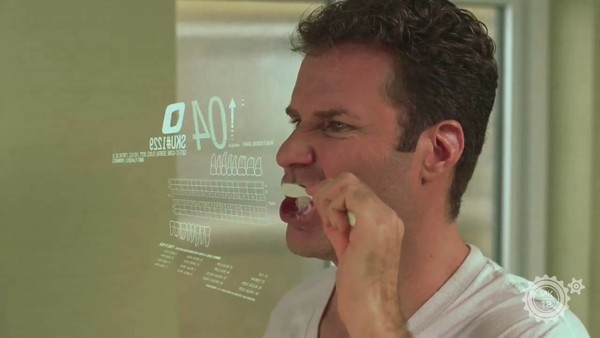
We've already mentioned that Forster's film features a terrible example of a successful writer in Thompson – who regularly kills off main characters that, without realizing it, were real people. Creative writing professor Dustin Hoffman constantly praises her work as genius, though the novel she's working on doesn't seem to deserve a great deal of merit. It could partly be an in-joke, like the ominous use of the phrase "little did he know" not being a cliche, but a grave warning.
When lowly IRS agent Will Ferrell begins to hear her narrative, he desperately finds a way to reach the author and make her aware of his corporeal existence. He does, throwing the already blocked Thompson into a moral quandary. Kill him, and her supposed masterpiece would be a success. Let him live, and the book wouldn't make thematic sense.
The film's only downfall – an otherwise fine work with a charming cast and a rare sweet performance from Ferrell – is that without Ferrell's post-modern dilemma, Thompson's novel kind of sucks.
1. Adaptation

Another film about writer's block, Charlie Kaufman (Nicolas Cage) plays the actual writer of Being John Malkovich as he prepares to write a screenplay similar to that of Fink's grand ideas – something that transcends typical Hollywood tropes like Boy Meets Girl, grand character arcs and car chases.
The studio hands him his next assignment: adapting Susan Orlean's quaint, expanded New Yorker piece The Orchid Thief. His task – turning a book seemingly about how disappointing life can be and how rarely things work out the way you hope – into a full-fledged blockbuster.
His frustration is only worsened by his twin brother Donald's (also Cage) newfound success as a screenwriter whose thriller (which appears to have the same plot as 2003's Identity) is being fast-tracked. Ultimately, Kaufman is forced to sell-out and the film ends in a series of delightfully silly cliches.