10 Best Hollywood Films Set In Japan

Japan, and Japanese culture is quite a vast tapestry in its themes, history, and ideas. Whilst researching this article to celebrate the release of The Wolverine this week (our review HERE and feature on why it's so much better than Origins HERE) it became apparent that there isn't a huge number of American films set or made in Japan, never mind Hollywood films. You could argue it's because American filmmakers aren't entirely sure of how to capture the majesty of the rural Japanese country side, or it's concrete urban jungles. A more realistic idea is that there's quite a lot of red tape involved, as Ridley Scott claimed whilst filming Black Rain (1989), his one and only film shot in Japan after he declared he would never consider filming there again.
That could be why they're such a rarity? So, the pool is fairly shallow. In spite of that, quality is in high abundance. Thematically, a lot of the same themes can be seen. Hollywood films when set in Japan love to contrast an American character to a Japanese one, as their cultural values and personalities initially clash, before warming to each other. Regardless of if they're friends, work partners, or lovers it's a pretty evident formula. We often see Japan's cultural ideas and history drawn upon, that of the Samurai, and the Yakuza, with a heavy emphasis on the U.S post-war occupation of Japan.
Join us, as we trek through several fantastic films set in the land of the rising sun.
10. House Of Bamboo (1955) 
House of Bamboo is a film noir crime story, which depicts Japan as similar to a post-depressionist America, a seedy land of crime and poverty. A supply train guarded by both Japanese, and U.S military troops is robbed, meaning an entire arsenal of weaponry is circulating underground. A detective disguises himself as a two-bit criminal known as Eddie Kenner (Robert Stack) in order to infiltrate a gang he suspects of being involved. Meanwhile Mariko (Shirley Yamaguchi) looks to Eddie for comfort as she mourns the death of her husband, who was found riddled full of the stolen bullets. The film is directed by Samuel Fuller and said to be a loose remake of The Street with No Name (1948). The film is interesting in its themes, and gritty style. However, what holds House of Bamboo back is some mediocre directing, and some shaky storytelling. The perspective, and its general consistencies aren't exactly clear throughout. That being said, House of Bamboo is mostly a riveting crime story that portrays a war-ravaged Japan incapable of recovery.
9. You Only Live Twice 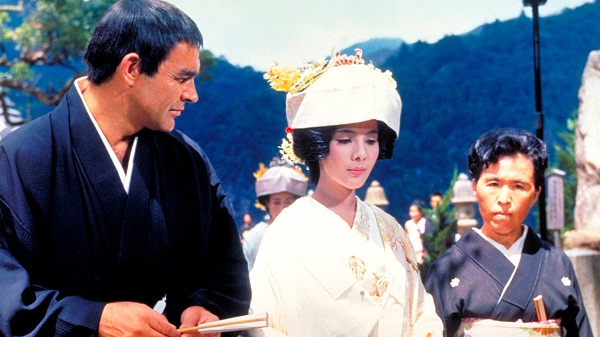
You Only Live Twice is a Bond Film, the 4th in the series more specifically. It stars Sean Connery, and somewhat questions the traditional Bond formula. The format usually depicts 007 moving from country to country on a hunt for a particular villain, goal, or general objective. For most of the duration of You Only Live Twice, Bond stays put in the land of the rising sun. Some highly praised it, some highly loathed it. Most agreed upon the fact it was highly colourful, and different. Whether that's a good thing or not, is pure opinion. Though the adventure is slightly oriental, it doesn't thematically reflect its surroundings other than its obvious scenery. The plot revolves around Blofeld attempting to coax the U.S and Soviet governments into nuclear war, contextually referring to the cold war. Bird One is a spacecraft used to capture the other countries space capsules, leading them to blame each other. The concept is interesting, if not a little ridiculous. The film is also known for the first full appearance of Ernst Blofeld which was mostly wasted, sadly. While it doesn't reach the heights of Goldfinger, and the more acclaimed entries in the series, Bond's adventure in Japan is still memorable, and fairly entertaining.
8. Kill Bill Vol. 1
 Quentin Tarantino is a director, who likes cinema. That sounds like an odd statement. In his films he often pays heavy homage to cult films, or genres. Thus it's not very surprising Kill Bill is an ode to the samurai slasher, the revenge tale, which draws from primarily Japanese cinema history. Kill Bill stands out on this list, as 1) a much more well-known and popular film, and 2) one that draws from Japanese culture instead of comparing and contrasting it to that of America. It's quite fair to say Kill Bill Vol. 1 isn't the best of Tarantino's work. The characters aren't as vivid, the plot is much more complex, cliche'd, and convoluted. The Bride (Uma Thurman) travels to Japan to continue her hunt, and kill the leader of the Yakuza, and queen of the Tokyo underground O-Ren Ishii (Lucy Liu). Apart from that, Kill Bill doesn't offer the same kind of cultural debates, or discussion as the rest of this list. As far as stylized slash-em ups go, it's a good film, but mostly belongs elsewhere.
7. The Last Samurai (2003)
 What happens when Hollywood tries to make a film about Japanese westernization partially based on historical fact? A flashy, style little substance war film starring Tom Cruise. Captain Nathan Algren (Cruise) is a washed up and remorseful American officer who feels guilt for his involvement in the native Indian wars. However, he finds himself accepting another job, as his task is to train the westernized Japanese imperial forces against a large Samurai rebellion. The Samurais defeat the foot soldiers easily, as Algren is captured by Katsumoto (Ken Watanabe) and his forces. Algren begins to adapt to the way of the Samurai, and joins them in their noble stand against the approaching imperial army. The thing is, Hollywood films set in, or about Japan will always try to tackle and depict the country's values in a certain way. While the film had excellent production values, a superb score, and a decent cast, it's message is slightly muddled. It depicts the Samurai as a noble caste of warriors who are fighting a righteous battle. The imperial forces are depicted as mostly corrupt, even though they were ultimately fighting for what they thought would advance the country. Several of the revisionist forces were also former-Samurai who defected. History is much more grey, as opposed to black and white in it's morality. While it may not be the most historical, or thought provoking film, it's an upscale epic that provides in beautifully orchestrated battle scenes, and scenery that will stun you.
6. Black Rain (1989)
 Black Rain (1989) is a film noir-esque action thriller, directed by Ridley Scott. Like many other Hollywood films set in Japan, it revolves around Yakuza dealings, and gang warfare. In this particular instance, two major gangs are warring over counterfeit money and their stake of the business. Nick Conklin (Michael Douglas) and Charlie Vincent (Andy Garcia) become involved as they are tasked with sending a Japanese assassin back to Japan. He escapes, as they become involved with the case, and are assigned an accompanying officer in the form of Masahiro Matsumoto (Ken Takakura). The aesthetics of Black Rain bare an incredible resemblance to Ridley Scott's seminal science fiction hit Blade Runner. This is mostly due to the fact Blade Runner's rendition of a futuristic Los Angeles was mostly inspired by Japan, Tokyo in particular. Both films also draw heavily on tropes found in the film/neo-noir genres. The film's fairly brutal, quite characteristic of the 80's. It's main protagonist as played by Michael Douglas is traditionally more of an anti-hero, with his dirty dealings, and aggressive manner. In true culture clashstyle, it takes Masahiro with his strict and regimental values to make a respectable cop out of Nick in the end. Black Rain is a brutal and unconventional story, with some very original concepts.
5. The Teahouse Of The August Moon (1956)
 The Teahouse of the August Moon is a much more gentle look at Japanese culture, with some riveting satirical comedy and light historical elements. Captain Fisby (Glenn Ford) is a bumbling officer of the U.S military who's failed to be of any use. As a last ditch effort Col. Purdy sends him to the small little known-village Tobiki along with translating toerag Sakini (Marlon Brando). The idea is Captain Fisby is supposed to colonize and modernize the village by building a school, and teaching the villagers the 'American way'. The inhabitants of Tobiki have other ideas... It's satire is mainly aimed at the U.S military's seemingly misguided ideas of post-war recovery. Marlon Brando steals the show as lazy translator Sakini (who rarely translates) as he generally misleads his friend Captain Fisby into a series of awkward situations. The satire is mostly for the sake of comedy, but does seem to legitimately critique military procedure. Teahouse of the August Moon is a zany satirical comedy, that ages incredibly well, and is worth watching for those with a sharp wit.
4. Memoirs Of A Geisha (2005)
 Geishas are an often misunderstood concept, one that stems from the wacky and typically outlandish culture of Japan. To be a Geisha, is to be an entertainer of men. How you ask? Well, Geishas are highly trained in a number of tasks, that can include dancing, and or performing for a customer, serving them tea, or simply entertaining them through conversation. A misconception is that a Geisha is essentially a prostitute, which is not the case. It's a job of female empowerment, and elegance, one that's an alien concept to the western world. Chiyo Sakomoto (Zhang Ziyi) is a child sold into a life of solitude. After treated kindly by a chairman (Ken Watanabe) Chiyo decides to become a Geisha in order to please him when she's older. She's tragically split from her sister, and taken in by experienced Geisha teacher Mameha (Michelle Yeoh). She learns the way of the Geisha, and struggles to endure many hardships on her spiritual journey.
Memoirs of a Geisha (2005) is a highly celebrated film. With 6 Academy Award nominations, and 3 notable wins for Best Art Direction, and Best Costume Design, and Best Cinematography. It's one of the most visually authentic films for a period drama, in scenery, set and costume. The story it's self is nontraditional, based on the highly selling novel of the same name. While a dazzling and heartbreaking piece of world cinema, admittedly it's not everyone's cup of tea.
3. The Yakuza (1974)
 The Yakuza (1974) is a cult neo-noir film directed by the acclaimed Sydney Pollack, and written by the Schrader brothers, with assistance from Robert Towne. It depicts the Yakuza as a once noble people, compared to that of the Samurai, who were gradually corrupted by their overwhelming ambitions. Japan is depicted as a dark place, mostly cloaked in darkness, and ravaged by it's warring powers, particularly the of the Yakuza. Harry Kilmer (Robert Mitchum) is dragged into gang warfare between his old friend, who turns out to be an arms dealer, and the local head of the Yakuza. Drawing on Ken Tanaka (Ken Takakura) Harry delves into the seedy underground in order to save both himself, and Ken. The film touches heavily on the rituals, and nature of the Yakuza, as well as some Japanese cultural concepts such as 'Giri' an important or life debt one man owes to another. While the Japan we see in Yakuza is corrupted like many of the other films on this list, there is some reprieve. Through Ken and Harry, we see some mutual respect between them by the end of the narrative, regardless of the strife that once occurred between them. Some academics see this as warming relations between the west and the east since World War 2 and the accompanying trauma. The Yakuza is an unlikely, but incredibly effective blend of the samurai gang film, and the film noir thriller. Robert Mitchum's remorseful and retired private detective matches perfectly to Ken Takakura's shamed ex-Yakuza hitman, to give us a high stylized amalgamation of classic western and eastern cinema culture.
2. Lost In Translation (2003)
 To be a westerner lost in Tokyo, without a real purpose is a scary thought. The world around you is alienating, and through the dizzying lights, and bizarre cultural differences you feel lost. In Sofia Coppola's bittersweet drama Lost in Translation (2003) she delves deeply into the concept of western and eastern cultures being so different, so far from each other both in distance and meaning. Bob Harris (Bill Murray) is an aging actor paid to promote Suntory Whiskey, as he struggles to cope with the bizarre and isolating world around him. He, and recent college graduate Charlotte (Scarlett Johansson) begin to form a connection after they both find themselves distant and in dire need of some familiar company. At it's base Lost in Translation is a romance story, but it's the use of Tokyo as this looming non-narrative character that differentiates it as a fantastic piece of cinema. Visually the film is very natural, and contrasts all of the sublime sights and sounds of busy inner-city Tokyo, to the nature and tranquility of some of it's more secluded spots. Visually it's a very complex and vivid piece of cinema, but it also harbors some intriguing debates about it's more subtle motifs. Bob drifts through his work, pretending to vaguely understand what his directors tell him from the clearly inept translation, and muffled engrish. He goes to take a shower, only to find the showerhead far too high for his height. He struggles to work the treadmill, and has no idea what his courtesy hooker is saying when she attempts to seduce him. Beyond this base level of cultural clashes, Japan stands as this new-agey contemporary world that's somewhat a critique of modernity, marriage and monogamy, and seemingly false promises of money and fame. In it's meaning, aesthetics, visuals, and script Lost in Translation is a fantastic film. However, one immortal classic barely surpasses it as the best Hollywood film set in Japan.
1. Sayonara (1957)
 Post World War 2 Japan was certainly a turbulent time. Social and racial boundaries were in heavy enforcement, regardless of peacetime. Ace Gruver (Marlon Brando) is in many ways a metaphor for America as a whole. He's initially intolerant, and refers to his friend Joe Kelly's wife as a 'slanty-eyed runt'. But as he travels to Kobe and becomes enveloped in Japanese culture, he finds himself a different man. The racial intolerance in Sayonara is at first subtle, before it begins to ooze from the film as the military staff, and citizens of Japan as they both rebel against the idea of interracial marriage. The film won 4 academy awards, and is renowned for being one of many films first depicting interracial marriage, which spurred some significant changes in society. Sayonara is an incredibly deep film. At many points it feels crass, or kind of shallow until it slowly unfolds into quite a tragic tale. While Sayonara may or may not be the 'best' Hollywood film made in Japan, it explores the culture and it's historical differences with Western and American culture to a tee. Ace represents America, being a stern and proud Air Force major, while Hana-Ogi (Miiko Taka) is an epitome of traditional Japanese culture as an elegant kabuki star. At first they think of each other as enemies, Ace holding onto his propaganda and racial slurs, and Hana with her hate of the American people due to the war which took many of her family members. But slowly this dissolves, as all grudges come to an end. Sayonara is a slow and winding romance thriller, with some real cultural exploration and inspiring performances, and could well be considered the best Hollywood film set in Japan. Sayonara.