10 Best Musical Interludes In Movies That Aren't Musicals
 Music and movies are inseparable. Even during the era of silent movies there would often be musical accompaniment from a piano player or an orchestra in more extravagant theaters. Tone, pacing, and atmosphere are all impacted by the music used in a film. Musicals exploit the intertwined relationship of film and music by having characters literally sing their emotions to the audience, in the world of the movie musical it is entirely natural for you to break out into song and it would be impolite for complete strangers not to join you for your densely choreographed dance number. Movies that aren't musicals obviously have different rules; characters don't break into song all willy-nilly, there has to be a reason for such tom-foolery (both in the narrative sense and in order to deal with the film's thematic concerns). This list deals only with diegetic music, meaning that it exists in the world of the characters (rather than a song on a soundtrack that the characters can't hear), and that it is music actually being played or sung by characters in the film. This means that songs that simply play over the scene don't count (sorry Mean Streets) and songs that characters hear on the radio, even if they react to it, don't count either (sorry Reservoir Dogs). Some seemingly obvious choices have been omitted (I don't need to hear Sam play it again), but every film on this list uses musical asides in a meaningful and iconic way.
10. Funeral Song In Akira Kurosawa's Dreams
 Dreams is a kaleidoscopic and surreal film, territories the exacting Kurosawa rarely ventured into. A series of vignettes all prefaced with a title card reading "Another dream..." it can be gleaned that the dreams of the film encompass the life of a man from his youth to his old age. The dreams change in scope as the boy grows up into a man: the boy dreams of the ghosts of dead peach trees satisfying his wish to see them alive once more, the man dreams of the dead men in his platoon and an oncoming nuclear holocaust that could threaten his family. Every sequence but the final one deals with the supernatural, ghosts and demons, incomplete souls and marital foxes (if you've seen the movie, that kind of makes sense). Dreams should be seen for the sequence in which Martin Scorsese plays Vincent van Gogh (and the protagonist ventures through the worlds of his paintings), but should be remembered for the last sequence. The fear of death permeates the film, it is something to be avoided at all costs, but the final dream shows the protagonist seemingly coming to terms with death. While Kurosawa uses a wise old man to decry newfangled technology, it depicts a world at peace. https://www.youtube.com/watch?v=ptEowkL4gXU The marching procession which closes out the film seems more like a wedding celebration than a funeral. The upbeat song is accompanied by brass and bells, children throwing flower petals, and different chants for the men and women (the song even calls to mind the Isley Brothers Shout, a little bit softer now, and a little bit softer now). Whereas death looms ominously over the film in the earlier segments, a shadowy specter in an increasingly dark world, death is finally shown as a natural part of life. The film is nicely tied together in this wonderful musical sequence.
9. Party Song In Pedro Almodovar's Tie Me Up! Tie Me Down!
 A charming love story about a man who tries to make a porn star/actress love him by tying her up in her apartment until she gives in to him due to a severe case of Stockholm Syndrome, Tie Me Up! Tie Me Down! is quintessentially Almodovarian. Obsession, desire, and big bold colors light up a film that gets you to root for a mentally deranged kidnapper (but who wouldn't fall in love with Antonio Banderas?). The film starts out as being a movie about a movie, the porn star is making her way into legitimate filmmaking with a famous director trying his hand at a B-movie (Almodovar self-reflexively commenting on the extreme nature of his melodramas, of course). Performance becomes a central idea in the film: Banderas's kidnapper wants her to act like they are a couple already so that they can live the rest of their lives together. But to what extent is the tied up actress acting to please her captor? Is he in love (i.e. obsessed) with her or his image of a pornographic goddess? The musical sequence is from a party scene immediately after the actress has been kidnapped, her sister seductively sings at the wrap party for the B-movie shoot. The full scene isn't available on Youtube, but a portion of it can be seen in the trailer starting at the 38 second mark. The audience is given the perspective of the director of the film, who harbors his own obsession with the actress, as he watches the actress's sister hike up her dress as she dances along to the song she is singing. She is performing for no one in particular, but her presentation is the point: she is on display for your viewing pleasure. She looks directly into the camera, at the interested spectator looking for something to latch on to.
8. Hoichi The Earless Playing The Biwa In Masaki Kobayashi's Kwaidan
 Kwaidan is a Japanese omnibus movie, broken up into vignettes like Dreams, with four distinct ghost stories. The best of the four is called Hoichi The Earless, a segment that is focused on the titular biwa player. A biwa is a Japanese string instrument, which sounds kind of like a harsher and more discordant version of a mandolin. Hoichi is a blind man working at a Buddhist temple who recounts the history of the area through song, and it is implied that his lack of sight leads him to have an enhanced sense of sound, allowing him to be an excellent biwa player and singer. The segment is loaded with great musical moments, but the scene that made it on to this list is at the very beginning of Hoichi The Earless. Hoichi recounts the tale of a samurai battle fought in the ocean while it is visually captured with highly expressionistic and colorful sets. Once again the full scene isn't on Youtube, but the song that is played along with some stills can be seen here. The violent blows and the breaking waves are highlighted with the harsh breakdowns of the melody, the history depicted in the Japanese paintings shown in the film are being brought to life by the song. As the story progresses, the losers of the sea battle become ghosts that require Hoichi's songs to re-enter the world. They are dependent on the sound, the songs literally become a spiritual bridge between worlds. Kwaidan suggests that not only can there be a life after death, we can access it through art.
7. Cinema! Cinema! Rémy Belvaux, André Bonzel, Benoît Poelvoorde's Man Bites Dog
 Man Bites Dog is a French mockumentary about a camera crew that follows around a serial killer. The crew finds the killer to be so charming and likable that they eventually help him in his chosen profession. A dark comedy that questions not only the idea of objectivity in documentary but the inherent participation of a documentary crew in what they are filming, Man Bites Dog has a unique spin on the violent anti-hero. The movie's narrative seems almost too ridiculous (the killer even gets the crew to dump bodies with him), but the insistence on following documentary film techniques make the movie seem real enough. The musical scene that makes it on to this list follows the crew and the killer getting drunk at a bar. The killer is kicked out for being too rowdy and in a moment of inebriated wisdom shouts out "I AM CINEMA!" He then begins to sing as the crew follows him out of the bar on to the street in one continuous shot, and he gets the similarly drunk crew to sing along with him. He is cinema: violent and crude, with a certain mixture of pretension and stupidity, yet somehow he is charming and compelling. The crew follows him because he is where the action is, and although his despicable nature becomes more and more apparent throughout the film the cinema of Man Bites Dog commands your attention.
6. Slow Boat To China In Paul Thomas Anderson's The Master
This may be a spoiler for people who have not yet seen Paul Thomas Anderson's latest venture into the soul of man (you should check it out, it's really good) so you can skip ahead to number five if you need to. Phillip Seymour Hoffman's Master Lancaster Dodd is an enigma, how can a man who purports knowledge of everything that is important be anything other than secretive? The Master has another great musical sequence in which Hoffman's character sings A-Roving while Joaquin Phoenix's character pictures all the dancing women in the room naked. But how can you beat the bellowing and seductive voice of Hoffman when he tailors his performance for an audience of one? So when Lancaster Dodd recalls (imagines?) that he had met Freddy Quell (Phoenix) in a past life as members of a French resistance that sent messages across enemy lines, is it really so weird that he proceeds to serenade him with a particular big band song? The answer is still yes. Keeping in line with his tradition of absurd endings (frogs falling from the sky, milkshakes being consumed) Anderson pumps up the homoerotic tension in this scene. The sheer weight of Hoffman's brilliant performance makes the scene a compelling conundrum rather than a laughable disaster, and the sincerity in which Phoenix responds to the song is just as good. With the huge glass window behind Hoffman's character (which is neither stained like a traditional church nor transparent, an apt metaphor for The Cause) enveloping him, Hoffman sings away without musical accompaniment. The Master will have you scratching your head, but this scene is certainly a highlight.
5. Entracte In Leos Carax's Holy Motors
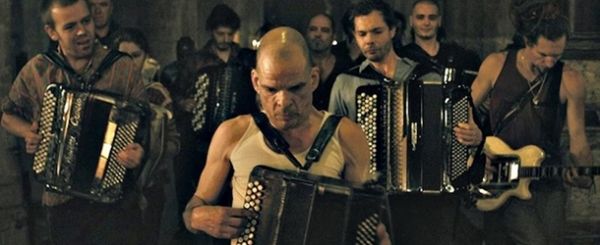 Of all of the scenes on this list, this one is the closest to breaking the rules mentioned in the opening. Leos Carax's film about the insanity of making movies varies in genres several times throughout the course of the narrative. It could be said that during the Entracte (the intermission) the film becomes a musical before reverting back to its structure. However, the truth is the scene is too good to not include. Denis Lavant (the bald guy in the wife beater in the center of the photo above) plays an actor who, for some reason, has to play various roles throughout the course of a day. Several references are made to filmmaking during the course of the movie, Carax uses different segments to make points about the state of cinema (he is particularly harsh when it comes to using gratuitous amounts of CGI). But in the stellar Entracte, in which Lavant walks into a church alone with an accordion, begins playing "Let My Baby Ride" and is eventually joined by a dozen other people to play the rest of the song, displays the ultimate power of music in movies. https://www.youtube.com/watch?v=lDcnIVdzyS4 It's fun, it's engrossing, and it is concise, but Carax uses one long steadicam shot to capture the impromptu marching band in all their glory. The irony is that although the shot is elaborate and detailed, the lighting is mostly naturalistic and it isn't as overtly stylistic as much of the rest of the movie. The church of cinema is a place where anything is possible, if a group of accordion enthusiasts happens along someone playing a catchy tune why wouldn't they join in? The Entracte in Holy Motors is unbridled movie magic.
4. Children's Song In Samuel Fuller's Naked Kiss
 Samuel Fuller's film noir about a former prostitute named trying to make good by becoming a nurse is, like all of Fuller's work, deeper than it seems at first glance. An indictment of an unforgiving culture (particularly when it comes to female sexuality), The Naked Kiss shifts in the beginning of the third act to an altogether different kind of moral deviancy. The victim of Kelly's former career is Kelly, but the tightly-knit community of small town America cannot withstand her harmless nature (although it can withstand something more sinister in its most "honest" citizens). But before the shocking third act reveal, there is an excellent scene in which the children of the hospital that the former prostitute (played by the wonderful Constance Towers) works at sing a song together. The children look directly into the camera, and their lack of singing talent only adds to the preciousness of the number. When Constance Towers takes over the singing duties from the children, her surprisingly beautiful voice adds a new dimension to her character. No longer simply the hard-working social climber, Kelly showcases her talent and her genuine motherly affection for the children shines through. After the dramatic reveal the song takes on a new and harrowing meaning. If you haven't seen The Naked Kiss yet it is on Youtube in its entirety, a film that basks in the melodrama of film noir.
3. Friends Forever In Woo-Sang Park's Miami Connection
 Gloriously cheesy 80s B-movie Miami Connection has a lot going for it: ninjas, biker gangs, big 80s hair, a synth-rock band named Dragon Sound, and the extra material from the cut off sleeves in the movie were enough to clothe the entire city of Miami for a year. Miami Connection opens with ninjas attacking people who appear to be trafficking cocaine. Why are they doing this? Will this be brought up later in the movie? Of course not. The protagonists of the movie are the members of Dragon Sound, and a few of their songs get played at a club that is apparently a lucrative enough set to kill for. Their song Friends plays after the opening credits, and boy is it a classic. The chorus of the song of an intentionally forgotten generation goes as follows: "Friends for eternity loyalty and honesty we stay together through thick or thin, friends forever we'll be together, we're on top because we play to win." It should be pointed out that this early in the movie there is no way to tell that the movie is going to be about Dragon Sound. Other than their jammin' tunes, we don't know anything about the band, other than that one of the bad guys is the brother of the girl on stage. But, and I know that I may be pushing it here, this scene is perfectly emblematic of the rest of the movie. Everything in Miami Connection is either a bloody fight between TaeKwonDo masters (Dragon Sound are also going to be a touring martial arts team, if you didn't know) or an overblown and occasionally embarrassing celebration. Miami Connection is a movie that must be seen to be believed, and then seen again to be believed even harder. But, as the title cards say before the credits, the only way to achieve world peace is by the end of violence. And Dragon Sound. Mostly Dragon Sound.
2. Lauren Bacall's Violent Song In Howard Hawks's The Big Sleep
 From one American classic to another, The Big Sleep is Bogie and Bacall at their most scintillating. Their famous repartee during a scene in which the two Hollywood stars and legends discuss horseback riding (hint: they're talking about doin' the nasty) and their will-they, won't-they chemistry are the driving force behind a film that is dark as noirs come. The movie's plot is complex and convoluted, as most Raymond Chandler stories are, but each part of the hard-boiled narrative is there. Humphrey Bogart plays Phillip Marlowe, a private detective working for the father of Lauren Bacall's character Vivian. The controversial nature of the narrative (which includes sly references to pornography and several murders) almost detracts from how bleak the film actually is. The respectable old guard, represented by Vivian's father the general, is dying out and the new guard of hedonistic and violent crooks is taking over. Bogart's detective isn't driven by morality (nor is he really driven by the more socially acceptable motivation of cold hard cash), figuring out the mystery is more important to him. But the ultimate result of all of the confusion isn't righteous indignation but a general apathy. Sure, we want to see Bogie and Bacall get together, but the fact that she was implicitly involved with a murder doesn't really matter in the brutal post-war world. When Bacall stands next to the piano and sings "He socked her in the choppers, such a sweet, sweet guy was he." Crying tears of blood after being the victim of domestic violence is something Megadeath would sing about. The cheerful facade of the party environment is undercut by the brutal lyrics, there is a darkness seeping underneath the surface of The Big Sleep.
1. The Final Casualty Of War In Stanley Kubrick's Paths Of Glory
 Stanley Kubrick's 1957 film about the First World War is an indictment of the uncompromising bureaucracy of military command as well as merciless statement about human nature. The plot centers around Kirk Douglas's character, who nobly plays a French military officer and lawyer with his natural American accent. After he refuses to lead his men through the trenches and across enemy lines (which would be a suicide mission) a few of his men are summarily subjected to a firing squad. The movie revolves around his legal attempt to disrupt the system and save the lives of the soldiers that were randomly selected to be killed, and the dancing chess match that is the power struggle for officers in the French army is disconcerting to say the least. What Kubrick finds troublesome about the war is not the actual death: obviously killing soldiers isn't viewed positively on the field of battle, but it is the loss of the value of human life in the officer class of the army that is truly the scourge of the war. The musical scene that deserves the top spot on this list is at the very end of the movie, but it isn't necessarily a spoiler for people who haven't seen the rest of the film. The French soldiers gather in a saloon before being sent off once again to the front lines. The men whistle and catcall as the bar owner trots out a German woman (Kubrick's real-life wife) who clearly does not want to be there. Tears roll down her face as she begins to singand the men who were once so eager to see her as a sexual object recognize the sad beauty of the song. The singer isn't given a back story but it is safe to assume that she, like the soldiers, has become a prisoner of the war in a symbolic sense. Their own loss of innocence is channeled through her, and they begin to hum along with her and several soldiers begin to cry. Kubrick would forgo these big emotional scenes in his later work, but the power of the shared voices in the bar at the end of Paths of Glory echoes loudly for anyone who has seen the film.