10 Best Scenes In 2013 Movies

Here's our picks for those movie scenes that stuck with us the most over the course of 2013...
Whenever we sit down to watch a movie, it's the individual scenes that we later recall in our heads when we begin to process what we've witnessed - isolated moments that allow us to remember how we felt about watching the movie in its entirety, or just those which stuck with us purely because they were so insanely badass, overtly emotional, purely terrifying or inflicted with a strange, unexplainable power. Think of your favourite movie, and you know what your favourite "scenes" are - in all likelihood, they're probably what cemented the deal for you in the first place. Movies pass by in a flurry of scenes, of course, and not all scenes are as memorable as others: those often regarded as "set pieces" in blockbusters, for example, are the ones that the filmmakers intended to stick with you long after the credits have rolled, and not those that feature two characters walking down a hallway dealing exposition like it's going out of style. But "set pieces" aren't just specific to blockbusters: all movies have set pieces, fundamentally - some movies, like those of Martin Scorsese, seem to be made up entirely of interconnecting set pieces. All in all, 2013 was a great year when it came to individual movie scenes - perhaps more than it was for movies in general, if you can get your head around such an observation. Join us, then, as we here at WhatCulture take you through our favourite scenes from movies released over the course of the past year, many of which come directly from some of 2013's best movies (whereas others were great scenes from movies that weren't quite up to the same level as whole products). Missed your favourite? Don't be afraid to let us know in the comments section below...

10. Train Yard Fight - The Grandmaster

You might not yet have got around to watching The Grandmaster, Wong Kar-Wai's biopic of China's most famous 20th century martial artist, the Ip Man - and though the film itself is wobbly in places, there's something to be said for what is undoubtably its best scene: the train yard fight. The Grandmaster itself is a stunningly beautiful movie, one that works on a visual level far better than it does on a narrative one, but this sequence exemplifies Kar-Wai's powers as a director in all the ways a proper martial arts sequence should - it's genuinely kind of breathtaking. What's interesting is that this scene doesn't even involve the Ip man - the duel takes place between his kindred spirit, Gong Er, and bad guy Ma San, on a snow-covered train platform. So, yes, it's very artsy, but it's also violent and brutal, too. For anybody who dislikes the "choreographness" that can plague martial arts fight sequences, you might not be convinced by the way that this one is almost parody-like in its execution: but there's no denying that it has a strange, beautiful power - one that only Wong Kar-Wai could have brought to the table.

9. Modern Love - Frances Ha

Frances Ha shouldn't have been anywhere near as good a movie as it ultimately was: Greta Gerwig as a confused, occasionally irritating and possible demented twentysomething searching for a way to fill a hole in her life doesn't sound like the stuff of cinematic revelation, but Noah Baumbach's rather strange but surprisingly addictive little flick was one of the best films of the entire year. And it also happened to contain one of the most purely joyful scenes in all of 2013, which has Greta Gerwig running through the streets, back by David Bowie's "Modern Love." This is, of course, a playful nod to Leos Carax's French movie Bad Love, which makes sense when you consider that Frances Ha seems to have been inspired by movies of the French New Wave. Like in that movie, the song becomes a kind of anthem for its main character, who is - for all intents and purposes - both adorable and delusional, clueless and oddly enlightened. But it's not really necessary to delve too deep into what makes this such a great movie moment: as we learned in climax of Woody Allen's Manhattan, it's just fun to watch people running to music.

8. Cemetery Chase - The Place Beyond The Pines

Writer/director Derek Cianfrance's follow-up to the arguably superior Blue Valentine seemed to divide audiences and critics alike when it first shot into theatres earlier this year: a bombastically-realised crime saga that wasn't advertised as such in the trailer (people were presumably expecting something akin to Drive), it's safe to say the story never really comes together in all the ways it should have. And yet, for all its flaws, The Place Behind the Pines still feels like an important and worthwhile film - the sheer passion of its director seeps into every single frame. But The Place Beyond the Pines is not an action movie, nor does it pretend to be. Still, there's one brilliant, innovative and highly kinetic sequence that occurs towards the beginning of the flick, as Ryan Gosling's bank robber makes an attempted escape on a motorcycle as Bradley Cooper's cop pursues, who's confined to his police car as Gosling races through a cemetery. We witness the whole chase from inside Cooper's vehicle, and the sequence is wonderfully shot in a single, unbroken take. For sheer thrill factor alone, this was one of the most exciting scenes of 2013.

7. "Please Mr. Kennedy" - Inside Llewyn Davis
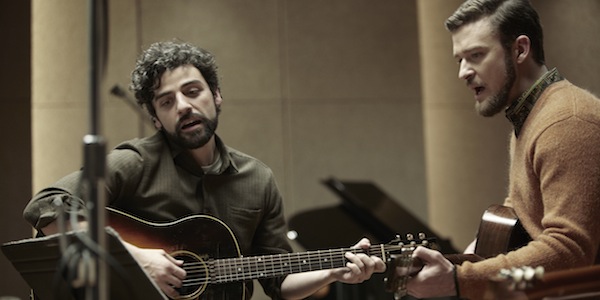
To be entirely frank, there were so many great, individual scenes that could have made this list courtesy of the Coen Brother's latest masterpiece, Inside Llewyn Davis, but for sheer fun factor alone - and the fact that it works as a great showpiece for the entire movie - we'll settle for the "Please Mr. Kennedy" sequence, which has wannabe folk singer Llewyn Davis (Oscar Issac) teaming up with Justin Timberlake's character, Jim, to sing a novelty song branded with the title "Please Mr. Kennedy." Watching them put it together is cinematic bliss. Davis, of course, should be above songs of this kind, but given that he's strapped for cash, he agrees to help his friend out during the recording session. The whole sequence is given an added boost of comedy thanks to the presence of a cowboy character (Adam Driver), whose back-up vocals are... well, you have to see it to believe it. The whole scene exists, of course, to parody hollow and dumb protest songs, but the most surprising aspect is that the song itself isn't all that bad - in fact, you might even find yourself tapping your toes to the music.

6. "Wanna Fight?" - Only God Forgives

There's a feeling that director Nicolas Winding Refn missed an opportunity to make a truly awesome crime thriller with his follow-up to Drive, and the reaction he received at Cannes (the film was booed) seems to point to the fact that the critics wished it had been a lot more like that movie. Whereas Only God Forgives can't be called a success in itself, then, there are a few wonderful, hallucinatory sequences that make the film worth your time - the most memorable of which, perhaps, takes place towards the end: a fight sequence, but not as you'd expect it. That's to say, when Julian's (Ryan Gosling) brother is murdered for killing a prostitute, he sets out for revenge, but the strange, demented Lt. Chang - tasked with wrapping up the whole mess - has other ideas. At the climax at the movie, Julian and Chang agree to battle, and it's seemingly the moment that the entire flick has been building up to. And yet Winding Refn shatters our expectations - with Clive Martinez's dark, gothic electronic score playing over the top, Julian doesn't even land a single punch. Instead, Chang beats him to a pulp without even taking a hit, and it's both hilarious and disturbing to watch it unfold. Which is presumably what Refn wanted.

5. Shock - Captain Phillips

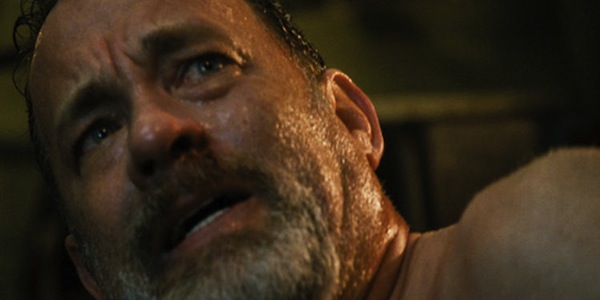
For almost the entirety of Paul Greengrass' efficient, thrilling Captain Phillips, Tom Hanks - who plays the movie's eponymous character - imbues his performance with a sense of the "workmanlike." That's not to discredit what Tom Hanks does here at all - he offers up Phillips, whose cargo ship was really overtaken by Somali pirates in 2009, without any actor-ly flourishes - he understands that it's important not to make a "hero" out of him in the generic Hollywood sense. So for the sum of the picture, through the ambush and subsequent abduction of Phillips at the hands of his invaders, it's easy to think: "Man, this Captain Phillips is really keeping his cool." It's true to say, then, that Hank's performance - though competent - isn't particularly noteworthy. And then it comes: Phillips is rescued by Seal Team 6, and Hanks goes to town. As Phillips is taken to the infirmary, completely in shock, the actor offers up one of the most intricate and unexpected portraits of a shock victim in cinematic history - and considering the normality that Hanks grants Phillips throughout, the sudden explosion of emotion makes for an incredibly powerful, heartbreaking scene. It lasts all but a few minutes, but it's without a doubt the best scene in the whole movie, and showcases Tom Hanks as an actor still at the very top of his game.

4. Return To Earth - Gravity

Though many would probably opt for the sensational - and eventually nerve-shattering - opening scene of Alfonso Cuaron's Gravity as the standout sequence from his visual masterpiece, Gravity, we'll argue that the last scene in the movie - which depicts a beaten, emotionally-scarred Sandra Bullock returning to Earth's atmosphere after a repair mission on the Hubble telescope goes horribly wrong - as the best scene. As Bullock's re-entry pod crash lands in the water, she's subjected to one last trial: escape before she drowns (and for a minute, you suspect she won't). And then she's free, and we're finally able to breath a sigh of relief. As Dr. Ryan Stone clambers to shore, Gravity's awesome musical score - courtesy of Steven Price - swells in the background. It's the moment that she attempts to stand up, though, that cements this as one of 2013's best scenes: it's almost Darwinian in conceit... a lifeform clambering out of the ocean, learning to walk. Reunited with the precious gravity of the movie's title, Stone stares out across a beautiful, tropical landscape as we cut to the credits. After what we've just witnessed, it's insanely satisfying to watch this survivor back on Earth, with - thank God - her feet planted firmly on the ground.

3. The Hanging - 12 Years A Slave

Is 12 Years A Slave destined for Oscar glory at next year's ceremony? Going by this scene alone, the answer is a reassuring "yes." The movie, which stars the deftly underrated Chiwetel Ejiofor as free man turned slave Soloman Northup (based on his real-life memoirs), is a brilliant melting pot of sensational direction, cinematography, performance and writing, all of which come together precisely in what is the undoubtably the film's best scene (and therefore one of the best of the year): Northup, as a punishment, is subjected to a botched near-hanging. It's only down to luck that he's eventually rescued before it's too late, but the way that director Steve McQueen frames this scene - with the camera panning back as Soloman is literally forced into a dance of death - provides us with the most definitive image of this truly incredible movie. Ejiofor, who is a force to behold in 12 Years A Slave, is mesmerising here, and the movie itself hinges on his performance - it might not have worked without such elegantly casting, after all. What's more remarkable is the way that life just continues on around Soloman as he dangles. As a moment, it's harrowing - but this is history, and it resonates long after the movie is over.

2. Quaaludes - The Wolf Of Wall Street
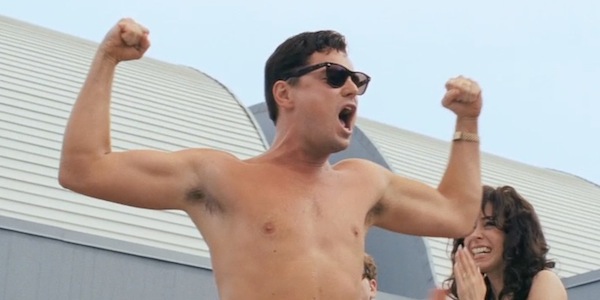
Martin Scorsese's The Wolf Of Wall Street owes a lot to the free-wheeling and fluid structure of works like Goodfellas and Casino, but this movie - the director's fifth collaboration with his 21st century Robert DeNiro, Leonardo DiCaprio, no less - is arguably the funniest movie that the 71-year-old director has ever made. Whether or not you can take it as being entirely "funny" probably depends on what you allow yourself to laugh it, though it's hard to deny that the movie's soon-to-become hugely famous "lemmons" quaaludes scene isn't an exercise in bonafide hilarity. The movie itself chronicles the adventures of one Jordan Belfort, whose journey from wholesome banker to Wall Street monster makes up the sum of the narrative. And though Belfort's debauchery is explored in a number of awesome sequences, the best scene in the movie has Belfort and his friend Donnie (as played by Jonah Hill) taking a strain of quaaludes nicknamed "lemmons." Not just one dosage, mind: several. Way too many, in fact. To say anymore is to spoil the scene, but the resulting physical comedy pretty much remains unrivalled in the entire Scorsese canon - this is a showcase for everyone involved... cinema at its most insanely glorious!

1. The Hotel Fight - Before Midnight

In Before Midnight, the sequel to the brilliant and still throughly underseen indie gems Before Sunrise and Before Sunset, writer/director Richard Linklater (who penned the script with co-stars Ethan Hawke and Julie Delpy) takes two of cinema's best and most realistic characters to the one place we all hoped they'd never go. Whereas the last two movies had lovers Jesse and Celine confined with a romantic bubble, wandering around, flirting and being cute, the passing of time - and the fact that they're now married - meant that this had to be a different movie entirely. So whilst the first half of Midnight feels similar to its predecessors in its free-wheeling ambitions to muse on love and life, Linklater drops a sudden bomb in the last 20 minutes, and has the couple engage in what is perhaps one of the most vivid and emotional arguments in cinema history. This isn't just two people shouting insults at each other: it's spiteful, filled with all the resentment and snipes you'd expect from years of contact - a couple we also happen to have seen from inception to destruction. But it makes sense that Jesse and Celine would get to this point - they're human beings. The best scene of the year, in what is also the year's best movie. Truly unforgettable. Like this article? Let us know in the comments section below.

Contributor
Contributor

Articles published under the WhatCulture name denote collective efforts of a number of our writers, both past and present.