10 Classic Films Whose Themes Still Ring True Today
 History repeats itself. We've all heard this before. The wars, the social and cultural turmoil, the heightened international tension and a growing sense of American jingoism; any and all of these things can be found in the annals of world history. Doesn't it stand to reason, then, that if the situations are the same, artistic interpretation of said situations would be the same? Of course there are some films whose themes work with today's global situation, but it's usually coincidental that these themes still hold relevance. But what about those filmmakers who saw the world's vicious cycle and built themes they knew would still be relevant decades on? Filmmakers like Charles Chaplin and Orson Welles are one of a kind. We may never see another Stanley Kubrick again! But before we begin it would be prudent to establish just what qualifies as a "classic." To go deep in to the topic would require an entire essay all its own so I'll just say I only examined films released prior to the '90s. You can tear me a new one in the comments about classics of the '90s and '00s if you so choose.
10. The Great Dictator (1940)
 If I wanted to I could buffer this list exclusively with Chaplin films. From the first time he stepped behind the camera to his final films Chaplin had an understanding of the world that an infinitesimally small number of people had at the time. His film, The Great Dictator, is an outward parody of Adolf Hitler and Benito Mussolini, but there's so much more to it. I'd say he keeps his commentary subtle, but he doesn't. At All. At the film's conclusion Chaplin, playing the Jewish barber, pretending to be Tomanian dictator Adenoid Hynkel (which is Chaplin's criticism of himself!) proffers a speech that sums up the entire two-hour spectacle. He discusses the misery men put each other through, but how that's not the nature of man; goodness is. He praises the closeness that science has provided mankind and appeals to the world to use science to knock down national barriers and improve the quality of life for every man, woman and child. It's an optimistic speech, a speech that was inspired by the ugliness World War II and its perpetrators inflicted on the world. It's a speech that sees beyond that temporary barriers of hate established by the dictators and envisions a world of togetherness, of unity. Whilst orating, Chaplin as the Jewish barber as Hynkel as Chaplin carries in his eyes and deep sadness. This sadness is what makes the film so relevant to today's world, because Chaplin knew that his speech would fall on deaf ears, thereby offering irony to an earlier line when Chaplin says he is being heard by "millions of people." Who was really listening? Although I'm not stuffing this list with Chaplin, we will see one other of his films later on...
9. The Ballad of Narayama (1958)
 This is probably the darkest film on the list with the most uncomfortable subject matter. From director Keisuke Kinoshita, The Ballad of Narayama tells the story of a small Japanese village that honors an ancient tradition: upon reaching a certain age the village elderly must ascend Mt. Narayama and sit atop its peak until death takes them. The reasoning behind such barbarity is that the old and infirm are no longer considered valuable members of society Thus, they alleviate woes, financially and socially, from their offspring, by removing themselves from life. The entire film was shot in vivid color on theatrical backdrops (a send up to Kinoshita's days in the theatre) and thereby makes the subject matter all the harder to ingest. That it's so bright, colorful and lively looking lends a dark and critical irony to the overall story. The film could be remade today (it already was in the '80s) with just as much poignancy. Indeed, we are so quick to remove our grandparents and their peers from society by hiding them away in nursing homes that essentially serve as waiting lines of death, the occupants slowly and unassumingly waiting for their numbers to be called. An argument could be made that Kinoshita was focusing solely on the time he made the film (1958, a period when many young people were looking to develop a greater sense of independence from their parents) but that argument is quashed by the film's final scene: a train in (then) modern day Japan leaves a station that sits by Mt. Narayama. That the scene is the only one in black and white suggests Kinoshita believed things were worse off for the elderly than they were two centuries prior.
8. The Graduate (1967)
 Sure it's an overrated slab of mediocrity, but The Graduate is still the first and most resounding film to capture the "what next?" disillusionment of the counter culture. No other film to date portrayed youth with such accuracy - uncomfortable sexual awareness; pressure from parents to do more; a burning desire to take time off and de-stress after 18 plus years of schooling. The film practically shouted, "Yes! This is how today's youth feel, but this is how it's always been! This is nothing new!" And that's one of the most honest things we can say about society. It was nothing new then and it's nothing new now. Despite the fact our parents suffered the same awkward experience, they rush to perpetuate history's fallacies and there's not a doubt in my mind that our generation will be found guilty of such as well. We can claim to be much different from our parents all we want but remember: their Occupation Wall Street was Woodstock; their Gay Rights Movement was the Civil Rights Movement; their hipsters were also called hipsters. And our parents actually achieved social change - we still have not. The filmmakers behind The Graduate knew today's youth would experience much the same they did and so perhaps it's crucial to look to these films as guides for how to make it/survive/do something. Of course, The Graduate ends on an ambiguously dark note so maybe I'm just blowing smoke.
7. ¡Alambrista! (1977)
 This is quite possibly the most universal film on this list, perhaps ever made. It's a film that literally every person can relate to, past, present and future. It's set in the American Southwest and features Roberto, a Mexican man who decides to try his luck as a migrant worker in the states after his wife gives birth to their firstborn. At its core it's a film about a man who's seeking an opportunity to better his and his family's lives. It's about a Mexican illegal immigrant but it's such an American film. All of our ancestors migrated to this country at one point or another seeking what? Opportunities and better lives. Even us now, whether we're second generation American or our families arrived on the Mayflower, we are seeking opportunities to better ourselves. Roberto represents not just the American individual, but America itself. During his travels he stumbles and nearly forgets his mission, comes near to neglecting his wife and child back home for a more permanent home in Stockton, California. It's only until a dramatic element is introduced that he actively returns home, remembering what it is he's laboring for. We are much the same, as individuals and as a whole society; we stumble and forget our path and only a serious knock on the head can right us again. For as long as their are people looking for opportunities, whether immigrants or born citizens, this film will maintain relevance. There is not a single doubt that writer and director Robert M. Young knew this while making the film.
6. Things To Come (1936)
 If, in The Great Dictator, Charlie Chaplin preached the good that science and technology can bestow upon the world, Things to Come attempts to show that good. Adapted by H.G. Wells from his own novel, The Shape of Things to Come, the film begins in Everytown, 1936 and ends in the same place 100 years later. It chronicles the onset of a great war that lasts nearly the entire centennial and features a worldwide plague (The Wandering Sickness) and a meteoric rise in technological advancement. The war eventually boils down to a feud between the air people, representing science, and the hill people, representing primitive life circa 1936. Of course, science wins as Wells was trying to make a point. The book and original script are much meatier than the final film and truthfully, the finished product is a middling tribulation featuring one diatribe after another, delivered by the oratorically gifted Raymond Massey. Though Wells misjudged how science would be abused, the film is actually quite ironic as it shows (most likely unintentionally) the destructive power science and technology have. Thus, even as the film's themes regarding science and technology have missed the mark, it's what Wells predicted the future would be like that merits the film's placement on this list. Humanity is totally dependent on technology now, and it's turning us into empathy-lacking, insociable and entitled droids who pine after any ego-driven maniac crazy enough to step up as a leader and tell us what to do! OK, the last half of that sentence is overly dramatic, I know, but the part up to when I call us entitled is on the money.
5. Psycho (1960)
 We are a society obsessed with celebrity, but even more specifically, we are obsessed with the lives of others. (Coincidentally, the 2008 film The Lives of Others would fit perfectly on this list if it fit the criterion, that is, being a classic from before 1990.) Reality TV is amazingly popular and unashamedly so. Duck Dynasty, Keeping Up With the Kardashians and its many spin-offs, The Real Housewives of Voyeurism Lane, etc. Whatever it is, if it involves getting to creep in to the lives of some other schmuck, we're on board. Thus, Psycho. What is it about? Well, the first 40 minutes are a criminal on the run story. Then it becomes horror, but what remains pertinent throughout, is the theme of voyeurism. Norman Bates is a dirty disgusting peeping tom. The scene where he spies on Marion while she disrobes for a shower is so iconic and to the viewer who only half-heartedly watches it, they see a pervert spying on a woman. The rest of us know what Norman was up to; that is, masturbating, but Hitchcock is more subtle than that and the Production Code wasn't so dead yet. But he was masturbating sure enough and do you think he'd have been doing it if Marion had invited him into her room and presently performed a strip tease? Absolutely not! He was getting his jimmies through the act of spying. The mystery and risk was what got him off, not the half naked woman on the other side of the wall. It's such a blatant criticism of society's obsession with spying on other people, but replace Norman with the average consumer and replace physical masturbating with mental masturbating. We get our minds off by feeding it voyeuristic kitsch because, let's face it, our lives are drab in comparison. Well, their lives are drab and uninteresting too, but they're being filmed so somewhere along the way it becomes interesting? I think I actually confused myself there. Wait, no, I didn't confuse myself; I just don't get the need to live vicariously through some half-witted duck call maker when I can go out and live my own life. Anyway, Psycho is relevant today. I think I argued that in that rant somewhere. If not, well, moving on...
4. Hearts and Minds (1974)
 First off, this film is not easy to watch. It's verité cinema at its apex an shows the unadulterated ugliness humankind is capable of. It's a documentary about the Vietnam War and it is not sparse on the graphic imagery. The thing is, take Hearts and Minds, make it 35 years later and it fits so perfectly with the Iraq War: we entered both wars under false pretenses, grievous crimes were committed "in the name of freedom" and when it was all said and done we managed to accomplish nothing. Director Peter Davis crafted such a scathing film with Hearts and Minds that any and all who saw couldn't help but be convinced (and rightly so) that there was no honor in going to Vietnam. Even the hardcore backers of the war were made sick by seeing what actually had been done. There's a sequence in the film that shows some sort of banquet dinner in Vietnam where the guests poke fun at America and engaged in other forms of gaiety. These shots are intercut with a jungle village that had recently been laid to and destroyed by American forces. Watching the lost and wandering souls shamble about in confusion and fright makes the juxtaposition that much more horrific.
3. Monsieur Verdoux (1947)
 Remember when I said we'd be returning to Chaplin? That time has come. Seven years after The Great Dictator Charlie Chaplin came out with Monsieur Verdoux, a darkly comic tale about a man who seduces financially endowed widows and then poisons them to inherit their fortunes. Despite the classic Chaplin brand of comedy that is apparent throughout, Monsieur Verdoux is a tonally dark, somber and just all around cynical film. So, what happened in those seven years that caused Chaplin to change his style so dramatically? Well, for starters he was chased out of America by a pitchfork and torch wielding mob. And of course there's that other thing; kind of a small affair, really. You may have heard of it: World War II. Seeing the war and all it comprised proved to Chaplin that his hopeful viewpoint expressed in The Great Dictator was a pipe dream at best. But much like The Great Dictator, Monsieur Verdoux ends with Chaplin delivering another astounding oratory, but again, one much more cynical. He opens the monologue by saying that for 35 years he used his intelligence for good, but after that, "nobody wanted them." He then goes on to say that mass killing is encouraged by the people, that our governments have learned how to commit mass killings "scientifically." In the film's very last scene before Verdoux (Chaplin) is marched (he walks so casually) to his fate, he utters the most heartbreakingly true line in all of cinema: "One murder makes a villain; millions, a hero." So how is it that Monsieur Verdoux is relevant today? Better yet, how are both of Chaplin's conflicting viewpoints relevant simultaneously? Well, they're both true. Our modern world has found so many positive and productive uses for science, uses that aid and better our daily lives. But for every altruist there's an opportunist, a sly fox whose language is so diplomatic he's to be considered charismatic and likable (much like Hitler, and strangely enough, Verdoux). Think of the number of innocent lives lost due to drone strikes. It's a sad fact, science and technology are tools; it's the hands they're in that make them good or evil.
2. Dr. Strangelove or: How I Learned to Stop Worrying and Love the Bomb (1967)
 Let's face it, we love war. We pine after war because it brings something interesting to talk about into our mundane and assembly line-like lives. And let's face it, we've never once gone to war for altruistic purposes. Here's a recap: in the American Revolution we were not fighting for our freedom, we were in open rebellion over taxes. Mind you, taxes in America, now or then, have never been as large as taxes in countries like Norway, so we really have no level to complain on there. In the Civil War, we weren't fighting to free the slaves, we were fighting to bring the South back under our heel. (Emancipation didn't become our 'goal' until 1863 and that was only a diplomatic move anyway.) In WWI we were profiteering. In WWII we were profiteering. In Vietnam we were doing something, no one really knows, but it wasn't beneficent. And in all of the wars we've fought in the Middle East since, it's been about oil. (Of course, we can look at the dismal reaction the American government got from the public regarding its consideration to enter into war with Syria and say, "See? We're getting tired of it!" No, we've just had enough war for the past 10 years and need a break from it. If this Syria affair had waited five years to happen you better believe we'd be sending red, white and blue painted tanks of democracy to sort through that sandbox.) The title of Dr. Strangelove is enough to merit its placement on this list because it exemplifies perfectly how we react to war. We're reluctant at first, because no one really knows what the war's actually about. Then some influential posturer invents a reason that ignites the fires of 'patriotism' in the people and off we go! The film is also a commentary on our sadistic love of mass killing. I mean there's a character in the film named Jack Ripper and Slim Pickens rides the bomb down to Earth like a cowboy on a bronco. Mass murder is an obsession (for more, see entry #3, Monsieur Verdoux).
1. Citizen Kane (1941)
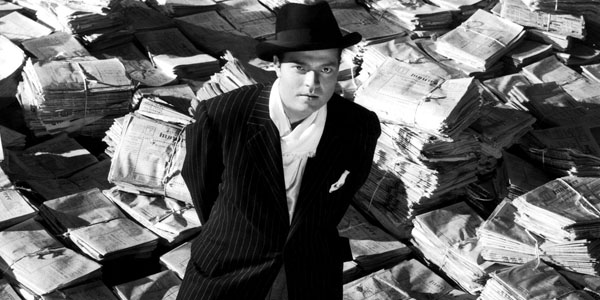 Are you in any way surprised? Of course Citizen Kane would make the list; the reason every write-up on it calls it "ahead of its time" is because of its universal relevancy. It's not a critique of William Randolph Hearst, but rather of every absurdly rich opportunist to ever walk this earth. Charles Foster Kane is Rupert Murdoch, is Ted Turner, is the Koch brothers, etc. The list is endless, and will remain so for generations to come. Orson Welles was well aware of this while making Citizen Kane because before Hearst their were J.P. Morgan and Thomas Edison. That's all I really have to say on the matter because there isn't a single new thing anyone can write on Citizen Kane. It's only on the list because it's topical and relevant. I'm not here to break new ground because there is none. Know of any other classics with contemporarily relevant themes? Post up in the comments and remember: the only reason history repeats itself is because it is forgotten.