10 Classic Movie Monsters With Unexpected Origins
The Babadook has been around longer than you think.
Perhaps even more pivotal to a film's success than a smart script and strong director, at least in the horror genre, is the actual design of the antagonist itself. This is especially true when it's supposed to be a grotesque, otherworldly or otherwise supernatural creature.
On Hollywood blockbusters, entire design departments are devoted to conceptualising creatures until they finally conjure up one that the director is happy with, and unsurprisingly, these designs are often influenced by both reality and prior pop-culture.
These 10 horror movie icons, whether humanoid or completely "other," all have their origins in most unexpected sources, from famous pieces of art to food, genitalia and even actual people.
If you thought these designs were strictly "original," think again, but in each case that inspiration was elevated to legendary levels through its brilliant use in the respective final film.
If nothing else, the genesis of these iconic movie creatures are all proof that even the most seemingly benign person or object can become pure nightmare fuel in the right light...
10. Gremlins' George The Mogwai Was Modelled On Edward G. Robinson
The gremlins were the pre-eminent cutesy critters of 80s cinema, for though there were many imitators released in the wake of Joe Dante's classic creature features, the overpowering charm of the Gremlins films cannot be denied.
In a rare case of a sequel easily bettering its predecessor, 1990's Gremlins 2: The New Batch saw Dante ratcheting up the campy satire to intoxicating levels as he threw every madcap idea he had at the screen to see what stuck.
And honestly, most of it does, best of all the dozens if not hundreds of unique gremlin designs: there's a spider-gremlin, a bat-gremlin, an electronic-gremlin, a sexy-gremlin and even a super-smart-gremlin, among so many more.
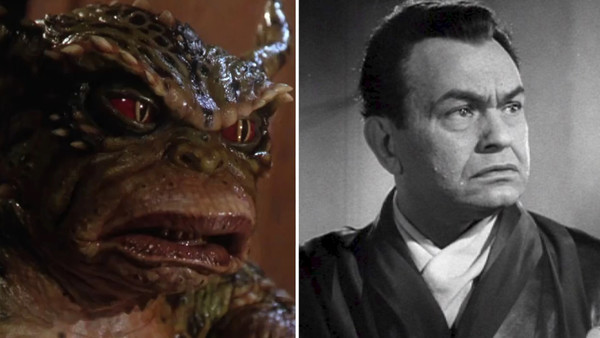
Then there's George, who in his big-lipped, cigar-chomping gremlin form, was in fact modelled after legendary gangster actor Edward G. Robinson, as confirmed by Gremlins star Zach Galligan.
It's easily missed if you're not much of a 1950s film noir buff, but absolutely uncanny once you realise - those lips are unmistakable.
9. Godzilla Was Based On The Rhedosaurus From The Beast From 20,000 Fathoms
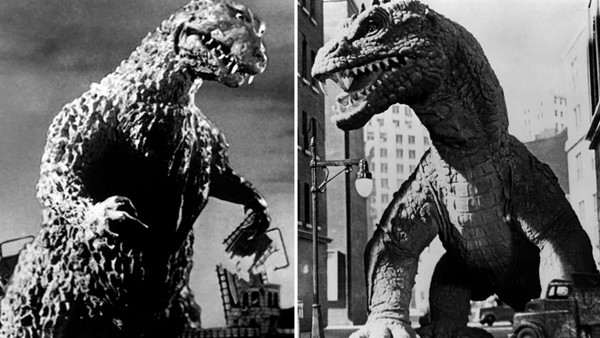
You'd be forgiven for assuming that Godzilla was an entirely original creation for Toho's classic 1954 monster movie Gojira.
However, its design was actually based heavily on the gigantic, carnivorous dinosaur known as the Rhedosaurus from an American monster movie released the year prior, The Beast from 20,000 Fathoms.
If you're gonna steal, you may as well steal from the best, and with the Rhedosaurus having been designed by legendary stop-motion artist Ray Harryhausen, who better to pilfer from?
Better still, Rhedosaurus was originally supposed to have atomic breath, yet this was cut due to budgetary restrictions and ultimately used instead in Gojira, where it's been one of the monster's defining characteristics ever since.
Godzilla has of course undergone several makeovers over the last 65 years - some good, many bad - but the creature's original DNA resides in an American monster movie, which given that Gojira is a thinly-veiled criticism of the American nuclear program, is pretty ironic.
8. Pan's Labyrinth's Pale Man Is A Fusion Of A Goya Painting, Manta Rays & Del Toro's Loose Skin
Guillermo del Toro is one of the most creative filmmakers working today, in large part due to his ingeniously thoughtful and often intensely unsettling creature designs.
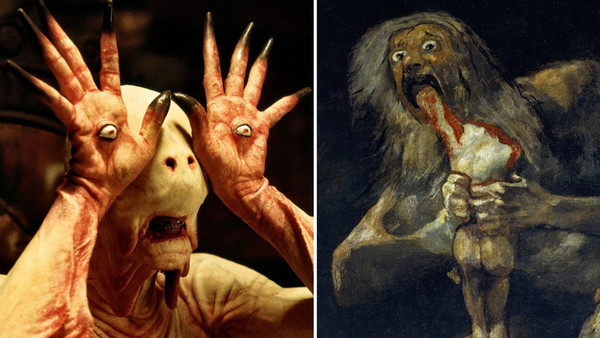
By far the most memorable monster in his masterful Pan's Labyrinth is the Pale Man, the child-eating entity which young Ofelia (Ivana Baquero) faces off against. But the sublimely creepy monster had two very specific influences.
For starters, its wiry look and penchant for eating children were both inspired by Francisco Goya's iconic painting "Saturn Devouring His Son," while its grotesque nostrils and far-apart eyes were modelled on the underside of a manta ray.
Del Toro said, "As a kid...manta rays freaked me out - because if you flop a manta ray on its belly, you can see a little mouth and two nostril-like openings but the eyes on another side, and I find them really creepy."
As for the creature's sagging skin? That was an even more personal touch from the filmmaker, who had himself become the recipient of some loose skin after losing a significant amount of weight during pre-production.
7. Jabba The Hutt Was Based On Film Noir Legend Sydney Greenstreet
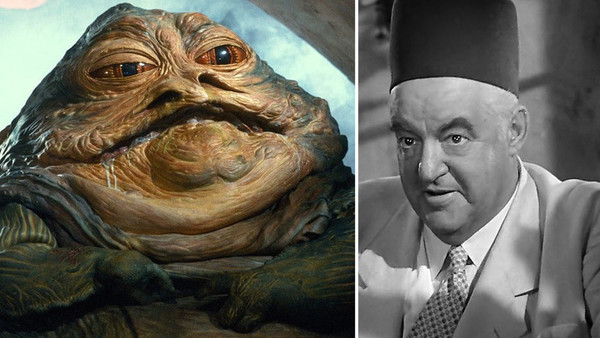
You probably won't be much surprised to learn that Star Wars' gelatinous intergalactic gangster Jabba the Hutt was partly modelled on both annelid worms and snakes, but you probably aren't aware that there was also a decidedly more human inspiration for his final look.
Legendary British actor Sydney Greenstreet is best known for his supporting roles in classic 1940s Humphrey Bogart movies such as The Maltese Falcon and Casablanca, but also served as the primer for Jabba's overall screen presence.
This is to such an extent that Jabba was initially supposed to wear a fez, homaging Greenstreet's fez-wearing antagonist Signor Ferrari in Casablanca.
Special effects supervisor Phil Tippett recalled George Lucas telling him to make Jabba look "alien and grotesque...just like Sydney Greenstreet," and seeing the two side-by-side, it's easy to appreciate how Jabba is basically a gooey caricature of Greenstreet's facial features.
That's quite the back-handed tribute if there ever was one, George.
6. The Predator Was Influenced By Rastafarian Warriors

There are few creatures in sci-fi lore as iconic as the Predator, and director John McTiernan smartly hired late visual effects wizard Stan Winston to conceptualise and execute the titular monster's design.
Winston received some most random inspiration, however, when meeting with producer Joel Silver, who had a painting of a Rastafarian warrior in his office.
Winston said, "I saw that and I thought it was a great starting concept for the Predator. I started drawing and designing this alien character with quills that in silhouette would look like dreadlocks."
Furthermore, we have none other than James Cameron to thank for the Predator's distinctive mandibles, which was casually suggested by the Terminator filmmaker while sat on a plane next to Winston during pre-production.
Hilariously, Winston humbly appreciated how much assistance he had creating the Predator, "Between the Rastafarian painting in Joel Silver's office and the mandible idea from Jim Cameron, I came up with 'Stan Winston's Predator'. And I take complete credit for it, even though I had nothing to do with it, obviously!"
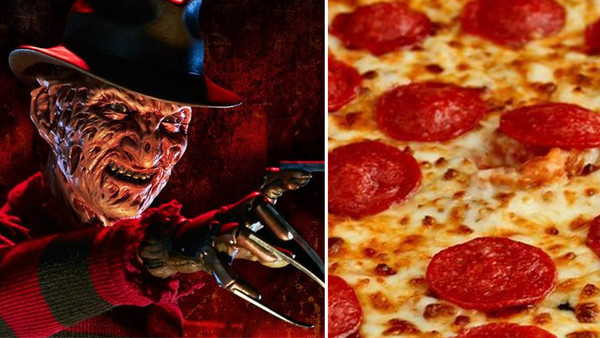
5. Freddy Krueger Was Inspired By...A Pepperoni Pizza
The actual genesis of the concept which would become A Nightmare on Elm Street was a 1970s newspaper article Wes Craven read about a Cambodian survivor of the Killing Fields suffering a nightmare so vivid it caused their heart to stop.
But the ultimate design of franchise antagonist Freddy Krueger (Robert Englund) went through numerous agonised iterations, and only when special effects artist David B. Miller was chowing down on a pepperoni pizza one night did he finally realise what had to be done.
Miller didn't even finish noshing the pizza: he took it home immediately and used its doughy, torn texture as a reference for Freddy's melted face.
Clearly it was worth the pizza getting cold - but who doesn't love cold pizza? - because Freddy's grotesque countenance is one of the series' most recognisable elements.
4. The Xenomorph Is Basically A Walking, Murderous Penis

Even more iconic than the Predator is Alien's xenomorph, a creature whose design and physiology have fascinated and terrified audiences for 40 years.
The monster was of course created by inimitable Swiss painter H. R. Giger, who won an Oscar for his work on Alien's special effects.
The xenomorph's final design was influenced by Giger's 1976 painting Necronom IV, which depicted a decidedly phallic-looking creature, fully in line with Giger's penchant for sexually provocative imagery.
And though the xenomorph's bulbous head was made slightly less penis-like for the sake of subtlety, Giger nevertheless sneaked as much suggestive content into his designs for the movie as possible - most notably, the xenomorph being born by penetrating through characters' chests after they were effectively raped by a facehugger.
That's not to forget that the various alien chambers are accessed through entrances that look a hell of a lot like vaginas, and Giger's original design for the xenomorph egg was also supposed to look like a vagina, until he was assured it wouldn't ever get past the MPAA.
Between its violent, penetrative birth, phallic design and the often-ambiguous nature of its attacks - especially the possible-rape of Lambert (Veronica Cartwright) in the first film - it's safe to say the Alien franchise has earned its consistent spate of R ratings.
3. The Host's Monster Was Based On...Steve Buscemi
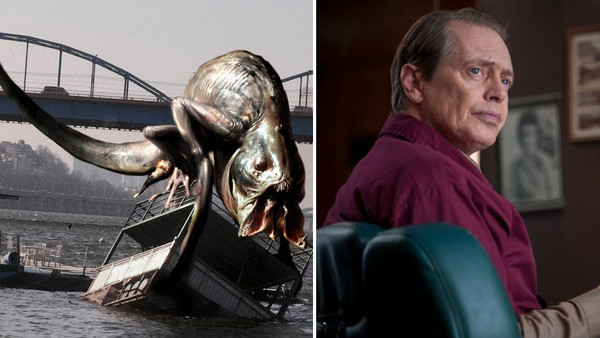
Bong Joon-ho's cult classic 2006 monster movie revolves around a gigantic amphibious mutant monster terrorising South Korea, and though the director's immediate influence for making the movie was a news article about a deformed fish located in a nearby river, he turned to a major Hollywood talent for a more intimate inspiration.
When completing the creature's design, Joon-ho deferred to none other than Steve freaking Buscemi.
In his own words, "I tried to achieve some humanness through its behavior patterns. It was important to give the impression that the monster is somewhat clumsy - like when it misses its footing or rolls down the slope when it first attacks people. So I wanted it to be clumsy and violent and even hysterical - a character without charisma. Not like Hannibal Lecter, who’s full of charisma in The Silence of the Lambs, but like Steve Buscemi in Fargo. Actually, my creature designer and myself often thought of Steve Buscemi while working on the design."
Furthermore, the director gave the creature modelers and animators pictures of Steve Buscemi as a visual reference, and while the resemblance between the two is hardly uncanny, it's a fine demonstration of the abstract processes which go into designing movie monsters.
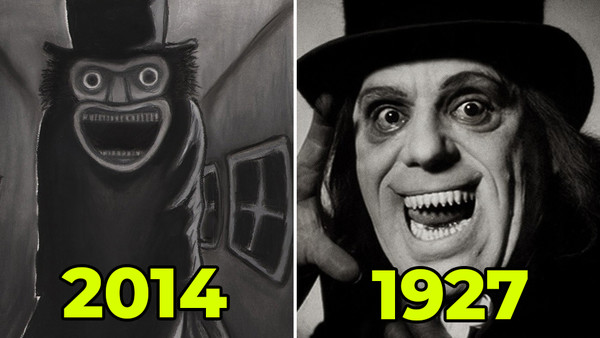
2. The Babadook Was Inspired By A 1927 Lon Chaney Movie
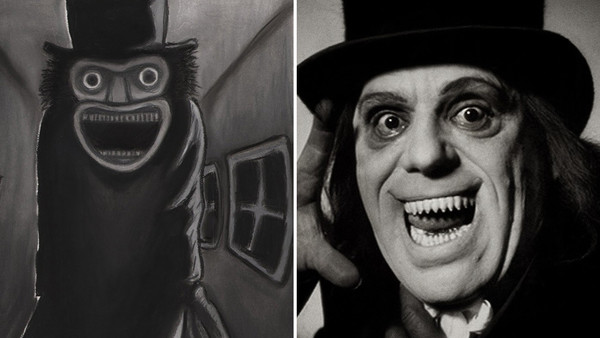
Though 2014's Aussie arthouse horror film The Babadook may not be on the blockbuster level of some of these other films, the titular pale, top hat-wearing monster is nevertheless one of the most memorably creepy horror movie antagonists of the last decade.
But writer-director Jennifer Kent had some inspiration from a movie released almost 90 years prior - the Lon Chaney-starring 1927 horror film London After Midnight.
In the film, Chaney plays a pale, sharp-toothed, top hat-wearing entity billed simply as The Man in the Beaver Hat, and the visual similarity between it and the Babadook is unmistakable.
Kent has freely admitted the "borrowing", though, and considering that the last-known print of Chaney's movie was sadly lost in the 1965 MGM vault fire, it's almost as though she's helping keep the character's likeness alive by inserting it into her contemporary movie - quite brilliantly, too.
1. The Dark Crystal's Skeksis Were Based On A Lewis Carroll Illustration
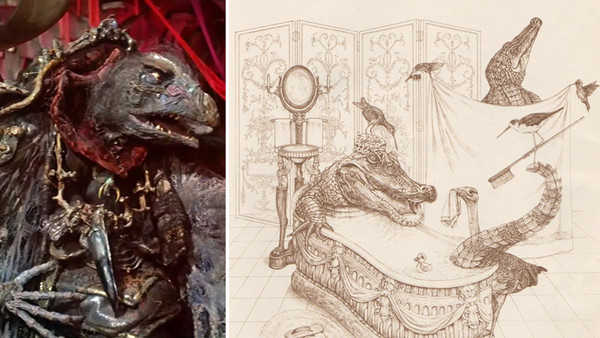
Jim Henson's The Dark Crystal has enjoyed a well-earned resurgence in popularity with the recent release of the brilliant Netflix series, but back when Henson was designing the villainous Skeksis, he modelled them after the seven deadly sins.
And because he settled on featuring 10 Skeksis in the movie, he had a few of the sins double up.
But Henson was also inspired by Leonard Lubin's illustration of Lewis Carroll's poem The Pig-Tale, which depicted two crocodiles behaving like humans in a bathroom.
Henson immediately fell in love with the idea of reptilian creatures acting as human conquerors, even initially naming the Skeksis "Reptus."
The final design of the Skeksis retains much of that reptilian quality, especially in the face, even if Henson clearly ran with that and made the creatures so much more than a mere imitation.