10 Essential Time Travel Movies
 The idea of travelling through time has inspired writers and creative artists for centuries. While you might credit H. G. Wells with popularising the concept in his 1895 novel The Time Machine, the earliest time travel story dates back to around 700BC, in the ancient Sanskrit text the Mahabahrata. Since the 1940s there has been a string of films that have used time travel as a plot device, from the frivolous and fanciful to the murky and mysterious. I previously addressed the popularity of time travel films in a 2012 article for Torn magazine, which you can read here. I argued that they are novel and intriguing ways to examine our society without necessarily having to confront our problems head-on. But today Im going to take a different approach, offering my pick for the 10 best time travel films. Apologies in advance if I dont include your favourite pick there is quite a range of films from which to choose.

6. The Time Machine (dir. George Pal, 1960)
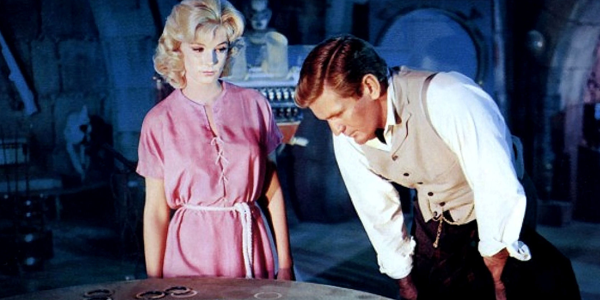 No Top 10 of time travel films would be complete without the original and best adaptation of H. G. Wells seminal novel. Helmed by George Pal, who previously directed The War of the Worlds, it follows a man called George (unnamed in the novel) who creates a time machine and travels forward in time through the two world wars. Having barely escaped a nuclear holocaust, he ends up thousands of years in the future in the futuristic utopia of the Eloi only to find that their civilisation has a dark and sinister underbelly Like The War of the Worlds, The Time Machine is a product of its time. Changes are made to incorporate the threat of nuclear war, and Wells social analysis is reversed; the bourgeois Eloi are now the victims of the proletarian Morlocks, rather than the other way around. But the main beats of the story are still preserved, and the film still holds up as a cautionary tale about humanity, warning about an embittered underclass rising up against a civilisation built on mindless escapism. The film won an Oscar for its special effects, including its early use of time-lapse photography as the machine speeds forward through time. The degeneration of the Morlocks in this fashion is every bit as creepy as Walter Donovans death in Indiana Jones and the Last Crusade. Time Travel Trivia: The 2002 remake of this film was directed by Simon Wells the great-grandson of H. G. Wells. Early on in his career he served as a story consultant on Back to the Future Parts II & III.
 Kurt Vonneguts Slaughterhouse-Five is one of the most important and influential works in post-war science fiction. Inspired by Vonneguts experience of the Dresden bombings of World War II, the story follows fatalistic soldier Billy Pilgrim, who has become unstuck in time; the events of his life play out in a seemingly random order, as he journeys to the alien planet of Tralfamadore and relives his own death many times. The aliens he meets are capable of seeing every event in time simultaneously, and have therefore adopted a very philosophical approach to death and suffering: when confronted with the very worst humanity has to offer, their response is always so it goes. George Roy Hill might not strike one as the best director for the job, being best known for the warmly nostalgic Butch Cassidy and The Sting. But this is by far his most adventurous film, which successfully handled the non-linear timeframe and gets a lot of the novels substance across. Some of the changes made are hard to understand including the fact that so it goes is never uttered, despite being in the book more than 100 times. But its still an appealing slice of blackly comic sci-fi, which came with the personal approval of Vonnegut himself.

 Time After Time is at the appealingly silly end of the sub-genre. Based on Kurt Alexanders novel, it was directed by Nicholas Meyer, who later helmed Star Trek II: The Wrath of Khan (or Star Trek Into Darkness, as its now known). It conceives of a world in which H. G. Wells (played by Malcolm McDowell) actually has a working time machine, using it to pursue Jack the Ripper (David Warner) in a race through time. The pair end up in San Francisco in the late-1970s, where all manner of chaos ensues along with an unintentional foreshadowing of Star Trek IV: The Voyage Home. While its not the most adeptly-directed film, Time After Time is a lot of fun so long as you dont take it too seriously. Its internal logic is sound and it does raise of couple of interesting ideas about the changing nature of crime and societys position towards violence. David Warner gets a number of really juicy lines as the Ripper, proclaiming at one point: Ninety years ago, I was a freak. Now Im an amateur. McDowall, fresh from playing the title role in the infamous Caligula, gives as good as he gets and is very convincing.

 Terry Gilliams first of two entries is the lighter of his time travel films, which provided him with his first big American hit outside Monty Python. The film follows a young boy called Kevin, whose boring suburban life changes when six time travelling dwarfs burst through his wardrobe, with a map that leads to treasure hidden throughout time. This merry and motley band travel through history, stealing treasure while evading the wicked plans of Evil himself (David Warner, in his second appearance on this list). While it isnt as weighty as Brazil or as head-scrambling as Twelve Monkeys, Time Bandits remains one of Gilliams most enjoyable films. Like his previous film Jabberwocky, the fingerprints of Python are all over it, with Michael Palin co-writing and supplying a cameo, and John Cleese turning up as Robin Hood. The time travel element is more of a plot device than a springboard for ideas, but it does set the stage for Gilliams famously elaborate production values and a bunch of really good jokes.

 Of all Roger Cormans pupils, James Cameron is the one who has least adhered to the masters teaching about narrative discipline. But whatever the excesses of his more recent works, The Terminator remains a lean and intelligent science fiction film. In case you needed reminding, it follows the journey of Sarah Connor (Linda Hamilton) as she attempts to evade a Terminator, a killing machine set back in time from 2029 when the human race has been largely exterminated by sentient machines. The Terminator is notable for any number of reasons. It made Arnold Schwarzenegger a star, lifting him from the high camp of the Conan films into something more powerful and threatening. It kick-started Camerons career, leading not just to the acclaimed sequel but Aliens and The Abyss. But beyond the star power or it terrifying effects, the film is an interesting work in the post-apocalyptic canon, taking the imagery and concerns of The Time Machine or Mad Max 2 and bringing them into the later Cold War age.

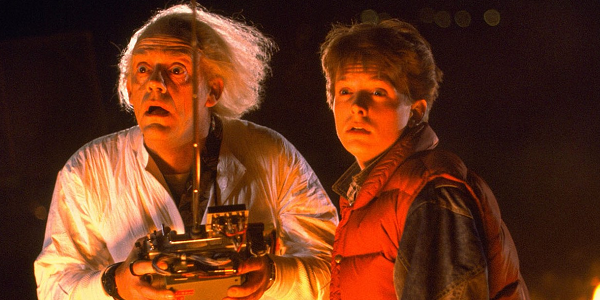
 No list of time travel films would be complete without Marty McFly unless the compiler of said list had a penchant for being lynched. Outlining the plot is almost totally pointless; the film has become such a mainstay of pop culture that many people will know all the references without having actually seen it. But for the uninitiated, it involves high school student Marty McFly (Michael J. Fox) being sent back to 1955, where his future mothers accidentally falls in love with him. He must ensure his parents meet and fall in love, before getting home with the help of Doc Brown (Christopher Lloyd). Back to the Future is one of the quintessential films of the 1980s: its soundtrack, its humour, its sharp writing, its nostalgic evocation of the past and its warm, likeable characters. Like Time Bandits it uses time travel as a device rather than a springboard to darker ideas, but every plot point holds together brilliantly and all the jokes pay off. Whether as a warm nostalgia trip or a surprisingly smart summer blockbuster, Back to the Future has truly stood the test of time.

 Lets face it youd throw a fit if I included the first Terminator without also mentioning the sequel. Having destroyed the original Terminator, Sarah Connor is separated from her young son John (Edward Furlong) and is committed to a mental institution. Skynet sends a new, highly-advanced Terminator (Robert Patrick) back to 1995 to kill John only to be confronted by Arnie, who has been reprogrammed by the human resistance and set back to protect John and Sarah. Terminator 2: Judgment Day is widely regarded as one of the best sequels of all time, and with good reason. If you can ignore the paradox of its premise (expertly pointed out by Roger Ebert here), it improves on the original in every fashion, with better effects, more complex character development and a feast of juicy one-liners. Its also a very good example of how cranking up the action doesnt always hamper the storytelling: there is plenty of eye candy, but all of it is narratively integral.

1. Twelve Monkeys (dir. Terry Gilliam, 1995)
 To paraphrase Mark Kermode (a huge fan of Gilliam), if Time Bandits is an admirable soufflé of a film, Twelve Monkeys is a big dark cake of doom. This strange, esoteric masterpiece is set in a bleak future, after the human race has been decimated by a deadly virus. Convicted criminal James Cole (Bruce Willis) is set back in time to the 1990s to ascertain the cause of the plague and if possible obtain a sample so that a cure may be found. He is instructed to focus on the Army of the Twelve Monkeys, a terrorist organisation that may not be all that they seem With its roots in Chris Markers apocalyptic short La Jetée, Twelve Monkeys is bleak to the bone, offering up pessimism and dark humour while raising all manner of questions about technology, consumerism, television and morality. Its a science fiction film driven by ideas, developing them through the brilliant performances of Madeleine Stowe, an Oscar-nominated Brad Pitt and a career-best turn from Bruce Willis. Whether you read it as an allegory for the AIDS epidemic or a dark comedy about the dangers of communication, Twelve Monkeys is enormously rewarding and its traumatic ending rivals anything in Memento. Time Travel Trivia: One scene in the film involves a hamster in a hamster wheel being seen on screen. But when the time came to shoot that scene, the hamster in question wouldnt perform and it took a whole day to shoot 10 seconds. This incident and others like it are explored in the acclaimed documentary, The Hamster Factor and Other Tales of the Twelve Monkeys.

7. Source Code (dir. Duncan Jones, 2011)
I realise that Im breaking my own rule with this entry, but since so many time travel films do the same, I think I can get away with it. Duncan Jones more mainstream follow-up to Moon features Jack Gyllenhaal as Captain Colter Stevens, who wakes up on a train to Chicago which explodes, killing everyone on board. He then awakes in a capsule called the Source Code, and is informed by his superiors (Vera Farmiga and Jeffrey Wright) that he must relieve the last eight minutes of the train journey until he finds the bomb and discovers who is behind the attack. Much like Terminator 2, Source Code is testament to the fact that more action in a film does not always equate to less intelligence. Ben Ripleys twisty script is brought to life by Jones assured direction, with many comic moments to punctuate what could be an annoyingly repetitive premise. Writing the film off as Groundhog Day on a train does both Jones and Ripley a great disservice, since this is one of the best films of 2011 and a further sign that Jones is the real deal.
---
The Top 10 again, in order: 10. Time After Time (1979) 9. Slaughterhouse-Five (1972) 8. Time Bandits (1981) 7. Source Code (2011) 6. The Time Machine (1960) 5. Donnie Darko (2000) 4. The Terminator (1984) 3. Back to the Future (1985) 2. Terminator 2: Judgement Day (1991) 1. Twelve Monkeys (1995)