10 Essential War Movies
 Cinema is a child of the twentieth century; it was born, developed, and expanded and became the art form of the common man, something that anyone could watch and enjoy. As such, it has long been concerned with what has most affected us: social reforms, poverty, anguish, heartbreak, and joy. The pervading legacy of the twentieth century is war, two of the largest wars in the history of the world happened in the first half of the century and the threat of a third loomed over much the second half. As such, the war film has long been one of the representative film genres as right away they were exciting, terrifying, traumatic, but yet completely relatable to most of the people who saw them. Much of the audience had lived through the spectre of war; even if they had never served on the front, they were aware of its effects and war films were used as something that could be cathartic, or as propaganda, or something that attacked the very idea of war. Out of this genre came some of the most important movies ever made. The criteria for this list was that the main characters must be soldiers and the events of the film must take place during a war. This disqualifies such great films as Schindler's List, Pan's Labyrinth, Casablanca, and several others which deal with war but are not necessarily war films. The chosen films were then ranked according to several different factors: the quality of the film both narratively and aesthetically, the artistic qualities of each film, the impact of the film on subsequent entries in the genre, the importance of each in film history, and most importantly, does the film in question say something important about the nature of war or does it present it in such a way as to make the viewer consider it in a way they hadn't before? The following films all tell their stories differently, some are small and intimate and some are grand and theatrical, but they all have one thing in common, they have taken one of cinema's most important genres and told it in new, and daring fashion.
10. Das Boot
 Claustrophobic and intense, Das Boot follows a German U-Boat during World War Two and offers one of the bleakest views of war ever shown on film. Das Boot is told through the eyes of war correspondant Lieutenant Werner as the crew of U-96 crosses the pacific ocean, engaging allied freight at every opportunity. To make the film as realistic as possible, director Wolfgang Peterson shot within the actual confines of a model U-boat, ensuring the actors had to actually move around in the same cramped conditions as the real soldiers would have. Few filmmakers would have been able to make a near four hour long film (the Director's cut clocks in at 209 minutes) set in a confined space without it being dreadfully dull but Peterson manages to make it not only realistic and powerful, but exciting as well. One of the most fascinating aspects of Das Boot is that it doesn't take sides. Although it is a german sub, the captain is not a Nazi and openly ridicules many of the German leaders. The soldiers are not idealized either, instead Das Boot simply focuses on the arduous and cramped task of serving on a submarine during World War Two. By making as realistic a film as possible, Peterson also managed to create one of the most effective and memorable as well.
9. Platoon
 Inspired by Oliver Stone's own experience in Vietnam, Platoon earned substantial acclaim upon its release including a win for Best Picture at the Academy Awards. Platoon follows Chris Taylor, a college dropout who volunteers for combat because he sees it as his patriotic duty, unfortunately he soon realizes that he's not fighting just the Viet Cong but the environment, hunger, thirst, and in some cases his fellow soldiers. The standard good guys and bad guys are nowhere to be found in this movie; the Viet Cong are rarely seen except when shrouded in darkness and the Americans are either vicious monsters like Sergeant Barnes or people who back home would be the dregs of society. The one soldier who seems to be a role model for Taylor is Sergeant Elias, unfortunately, he is left for dead halfway through the movie by Sergeant Barnes. By drawing on his own war experiences, Stone managed to create a film that hit harder to home than almost any other. He filmed action scenes that don't excite but frighten, characters that are simultaneously sympathetic and disgusting, and in the process might have created a film that better than any other recreates the feeling of actually serving a tour in combat.
8. Full Metal Jacket
 Overshadowed by Platoon being released the same year, Full Metal Jacket is the superior film even if Platoon did walk away with Best Picture that year. Where films like Platoon and Saving Private Ryan focused on being as realistic as possible in order to show the horror of war, Full Metal Jacket is intentionally off-kilter and is told in a fragmented manner with half the film devoted to the training of a group of soldiers with the second half covering the actual war. The best performance, and the lasting image most people remember from the film, is gunnery Sergeant Hartman who abuses incoming recruits with a torrent of abuses both verbal and physical. His method works all too well, his recruits are turned into killing machines, even the chubby weakling Gomer Pyle. Pyle eventually kills both himself and Hartman at the end of training in an act that illustrates both the self-destructive consequences of war and the unnaturalness of turning ordinary people into hardened killers. Being a Stanley Kubrick film, Full Metal Jacket is nearly flawless technically and many of the scenes in the last half of the film contain images of astonishing power. Fragmented and powerful, Full Metal Jacket doesn't pretend to answer questions about the nature of war but instead shows us the horror and confusion with some of the most memorable scenes of Kubrick's illustrious career.
7. Paths Of Glory
 Kubrick makes another appearance with one of his finest films. While not as subtle as earlier anti-war films like Grand Illusion, Paths of Glory is a film every bit as powerful and in my eyes it has aged slightly better than other war films of the time. One of the few Hollywood films set during World War One, Paths of Glory deals with a French Army Colonel named Dax (played by Kirk Douglas) who is ordered to lead an impossible attack on a German outpost. The attack fails and it is discovered that an entire company never left the trenches because of overwhelming enemy fire. To save face, the French general in charge of the attack decides to court martial three randomly selected soldiers for cowardice in the face of the enemy. Dax, who was a lawyer before the war, serves as defense attorney for the soldiers but he never has a chance as the heads of the committee are not about to blame the general instead of three lowly soldiers no one cares about. The three men are shot by a firing squad and a forlorn Dax returns to his unit moments before receiving orders to report to the front once again. Paths of Glory contains very little battlefield violence, only a few minutes at the beginning of the film even take place at the front, what concerns Kubrick is not the actual battlefield but rather the political exchanges that lead to hundreds of men being sacrificed in exchange for a chance promotion or a reassignment for one higher ranking office. Paths of Glory shows us the callous indifference war breeds in men and that sometimes the horror doesn't even come from the front but rather from the mind of a few corrupt individuals.
6. The Bridge On The River Kwai
David Lean's The Bridge on the River Kwai shows almost no combat on screen but instead focuses on how war shakes preconceived perceptions of right and wrong and the madness it bestows on its participants. A captured group of British soldiers, led by Alec Guinness's Colonel Nicholson, are tasked by their Japanese captors to build a bridge over the Kwai river in order to assist the Japanese war effort. Despite protestations from his officers, Nicholson puts an end to the intentional sloppiness and orders his men to build a working bridge, despite how much it will help the Japanese. As Nicholson loses sight of his purpose, believing that completing the bridge will help his men's morale, an allied force plans to blow up the bridge before its completion. It all comes to a head in one of the most memorable final scenes ever filmed. The Bridge on the River Kwai benefits from brilliant performances from its main actors: Alec Guinness turns in one of his best portrayals, Sessue Hayakawa ably plays the conflicted Japanese leader, and both William Holden and Jack Hawkins are memorable in their roles. The Bridge on the River Kwai featured the talents of director David Lean at the height of his power. Before this film, Lean had made tightly constructed, character driven works and afterwards, he made massive epics that aimed to instill a sense of awe in the audience. The Bridge on the River Kwai catches Lean right in the middle of those two phases in his career and the result is a bona fide epic with the strong heart of a smaller film.5. Saving Private Ryan
 Saving Private Ryan manages to contain both the best and worst of Steven Spielberg. While it is a work of astonishing technical accomplishment, Saving Private Ryan doesn't quite reach its potential because of Spielberg's insistence on making several key scenes overly sentimental where understatement probably would have been more effective. Nevertheless, as a whole, Saving Private Ryan remains one of the towering works in the war film genre. Saving Private Ryan follows a group of soldiers who are tasked with recovering a Private James Ryan, who is missing in action. Ryan is the last of four brothers who have fought in the war and it is decided that recovering him would be good for morale on the homefront. A group of soldiers headed by Captain Miller is assembled to find him and much of the movie deals with their search and with the group wondering why eight lives are being risked for the sake of one. Even the harshest critics of Spielberg have nothing to complain about for the first 27 minutes of the film as Spielberg puts together one of the most riveting scenes in movie history. As allied forces storm the beach at Normandy, the camera focuses on the chaos of the battlefield and does not attempt to make any sense of the action. The result is a tour-de force of filmmaking that the rest of the movie never reaches although the final battle is nearly as visceral but smaller in scope. Spielberg does not skimp on attention to detail and this film might contain the most realistic reproduction of battle scenes of any movie on this list. The actors are chosen against type, the characters they play are not action heroes, they are regular people with normal lives as most of the soldiers would have been in real life. Saving Private Ryan's realism is one of the reasons it seems to be a favorite of military veterans, who connect with it in a way that other, more stylized war films, often fail to do. Saving Private Ryan is as philosophical a film as Spielberg has ever made and it is told in a series of astonishing images that few filmmakers would even dare to attempt. However I can't shake the feeling that with just a few small changes here and there to make the film a bit more subtle and it could have challenged for number one on the list. Regardless, Saving Private Ryan is one of the best war movies ever made and no modern war film has captured the imagination of the general public, or impacted succeeding war films, more thoroughly than it has.
4. Lawrence Of Arabia
3. The Thin Red Line
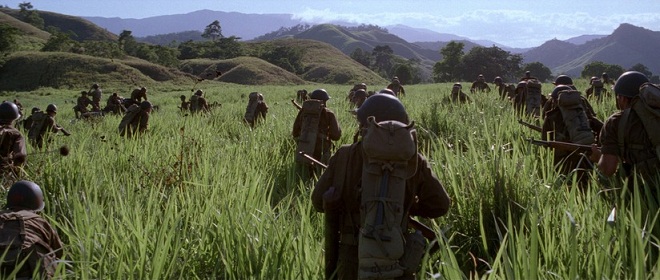 For many years, Terrence Malick was almost a myth. He had burst onto the scene in the early 70's with the one-two punch of Badlands and Days of Heaven and had helped to revitalize American cinema. Then, for 20 years he disappeared from moviemaking and rumors about what he was doing were rampant. Then in the late 90's, he returned with one of the most philosophical, and certainly the must gorgeous, war movies of all time. It could be said that The Thin Red Line is not actually about war but only uses it as its setting, rather the film is an exploration of philosophical ideas told through a series of remarkable images. Malick concerns himself primarily with juxtaposing images of brutal warfare with the pristine natural environment of Guadalcanal while hushed voiceovers betray the innermost thoughts of those involved. While soldiers in the heat of battle would likely never think like this in the midst of battle, The Thin Red Line is not concerned so much with realism as it about exploring ideas. Malick explores the idea of a "war in the heart of nature", soldiers fighting in the jungle are trapped in the process of life, death, and renewal and it is themes such as this that interest Malick, not in portraying a realistic depiction of the Battle of Guadalcanal. The Thin Red Line is not an easy film to watch for many people; it is slow, long, and not very action-packed,the story is told in a fragmented series of images rather than through action scenes and exposition, and characters come and go without the audience getting the chance to know them as they would in a more traditional film. If the viewer can get past these "flaws"and see the absolutely gorgeous film , both aesthetically and thematically, that the Thin Red Line is, few movie watching experiences will ever be more rewarding. The Thin Red Line is a movie that you likely will either love or hate but it is undoubtedly one of the most important war movies ever made. Martin Scorsese called it one of his favorite films of the 90's and praised the way it opened the door for new forms of visual storytelling. Overshadowed by Saving Private Ryan being released the same year, the question over which is the better film almost comes down to preference; Saving Private Ryan is much more gritty and realistic and is essentially the perfect traditional war film, The Thin Red Line on the other hand is more of a guided meditation through various themes and ideas. Saving Private Ryan will undoubtedly appeal to more people, but in my opinion, The Thin Red Line is the deeper, and more fulfilling of the two.
2. Grand Illusion
 Grand Illusion suffers from what I call Citizen Kane syndrome, essentially meaning that it is such an influential movie and has impacted so many subsequent films that it's not anywhere near as fresh as it once was. Many of the most prominent tropes of war movies originated in Grand Illusion and for a long time it was considered one of the greatest movies of all time. Nowadays only film scholars and the most hardcore film fans have even heard of it but there's no denying its influence and importance. Released in 1937 and influenced by Jean Renoir's own experience in World War One, Grand Illusion is one of the most powerful anti-war films ever made. Two French officers are captured by German forces and throughout the movie and most of the movie focuses on their attempts to escape. Grand Illusion dealt with class issues, the rise of Fascism, and prejudice, but above all, Grand Illusion is a profound study of war and the petty difference between cultures that cause it. There is no combat on-screen in Grand Illusion, except for one gunshot at the end, and the focus is on the relationship between the prisoners, and between the prisoner and the guards. Because of its message, Grand Illusion was condemned by Joseph Goebbels and after the Nazi's seized Paris in 1940, many thought that the original print of the film was lost. Fortunately, additional prints were discovered in the 1950's and the film has since gone on to become one of the giants of world cinema. Echoes of the film can be seen in Casablanca, The Great Escape, and many others but even ignoring its influence, Grand Illusion is an impressive accomplishment. The film is fair to both sides although not necessarily favorable to either and condemns the very nature of war as something monstrously absurd. Orson Welles, who regarded Jean Renoir as one of the greatest directors ever, was once asked what two movies he would save for posterity and the first movie he could think of was Grand Illusion.
1. Apocalypse Now
 In 1976, Francis Ford Coppola disappeared into the jungles of the Philippines to perform an agonizing shoot that lasted over a year and one which saw actor Martin Sheen suffer a heart attack on set. Coppola returned with one of the most complex, extraordinary, and memorable movies of not just the war genre, but in cinematic history. U.S Army Special Operations Officer Willard is dispatched on a mission to kill the renegade Colonel Kurtz. On the way, he witnesses events that would shake even the best of men. From an an attack on a Viet Cong village, to being attacked by bow and arrow while traveling down a river, Willard is tested over and over again and when he finally reaches Kurtz hideaway, things become even more treacherous. Apocalypse Now succeeds on multiple levels, Marlon Brando delivers one of his best performances despite having limited screen time, Martin Sheen likewise is at his best. Coppola strings together brilliant scene after brilliant scene: a helicopter attack set to Wagner's Ride of the Valkyries, the haunting finale, the mesmerizing opening scene set to music by The Doors, and the scenes with Brando's Colonel Kurtz all rank among the most striking scenes in modern cinema. Apocalypse Now is one of the most beautifully shot movies ever made, and the glorious visuals make a brilliant contrast with the madness going on around the characters. Above all, the pervading tone of quiet horror makes Apocalypse Now one of the most memorable films ever made. Apocalypse Now is among the darkest of all war films. It sees war as irrevocably horrible, something which destroys men both physically and mentally. No film before or since has examined war with such bold honesty and few films have matched its technique, its passion, and its depth.