10 Fascinating Films About Schizophrenia
 Schizophrenia is a devastating mental illness which affects roughly 1 in a hundred people. It usually strikes first in the sufferer's teenage years (but can afflict anyone at any age) and leads to a life of visual and auditory hallucinations, delusions, and in many sufferers loss of enjoyment in things they used to find interesting and fun, no motivation and a paucity of emotional feelings. Schizophrenia is an illness which simultaneously horrifies and fascinates people. It has also intrigued film directors for several decades. Usually the director tries to recreate the mental experiences of the sufferer - to take us inside of all the horrors of the disease. A good film on schizophrenia is usually judged on the basis of its verisimilitude - how accurately the disease is portrayed. I have purposefully left out A Beautiful Mind, Through a Glass Darkly and I Never Promised You a Rose Garden as I have reviewed them in a previous article about Films with mental illness as a theme. This time, I wanted to focus in on schizophrenia completely as a theme by itself as it is a fascinating subject and there are lots of brave films that tackle it.
10. The Snake Pit (1948)
 Virginia Cunningham is an inmate in the State Mental Asylum and appears to be schizophrenic - not even remembering her husband Robert. Dr Kik is her benevolent psychiatrist and we are treated to, in flashback form, the beginning of Virginia and Robert's relationship, how they met and fell in love. Their marriage and how she drifted away into an alternate reality on her wedding day. The rest of the film focuses on Dr Kik's attempts to rehabilitate her through therapy. The hospital system is a hierarchy where patients get moved up or down according to their progress. Like all films set in a mental hospital, there is a bitch nurse - Nurse Davis who goads Virginia until she is straight jacketed out of Level 1 and sent to the bottom level. However, Dr Kik's tender loving care rescues Virginia from a life of psychotic oblivion and she is cured and reunited with her husband. Olivia de Havilland was nominated for Best Actress for her work in The Snake Pit. She eagerly researched her role for months - visiting several asylums, watching ECT and other treatments and sitting in on therapy sessions when she was allowed to. Her marvellous and believable performance as a schizophrenic woman showed that all the research paid off. The film was exceedingly bold for its time, it took a subject that was a taboo and made it into a damning indictment of how awful psychiatric hospitals are and the abuse of patients by staff. The film led to reform of many asylums. The heroine Virginia recovers from being schizophrenic in Olympic standard time whenever most people with the disease flounder with it for years but kudos to Hollywood for tackling such a brave subject.
9. Lilith (1964)
 Vincent, a young ex-soldier who doesn't have much direction in his life decides to train as an occupational therapist in a private mental hospital. There he falls under the spell of a patient called Lilith who is beautiful and seductive and lives in a fantasy world. Lilith and Vincent fall in love, however, Stephen, another patient is in love with Lilith but a jealous and possessive Vincent practically engineers Stephen's suicide. Following the death, Lilith loses all contact with reality and Vincent presents himself to the hospital not as a worker, but as a patient. Warren Beatty is quite stiff in this film (but I have never rated him as much of an actor). However Jean Seberg is fantastic as Lilith, a deeply troubled yet beguiling girl who spins a web around all the people close to her. However it is a very romanticised and genteel portrait of schizophrenia. Real life sufferers might be quite insulted by the portrayal of schizophrenia as Lilith doesn't seem to be afflicted with hallucinations and voices (well if she does, she hides it very well) which are the trademark of schizophrenia. But she does show one truism of schizophrenia - you can exist in two parallel worlds at the same time - one of reality and one of madness.
8. Benny and Joon (1993)
 Benny is an auto shop owner who doesn't have much of a life as he has to look after his sister - Joon who is seriously mentally ill. Joon requires constant surveillance but tries the patience too much of every housekeeper in town. In comes Sam into their life as Joon's carer through a number of circumstances. Sam is undereducated and mostly illiterate but he is a comic genius who can perform like Buster Keaton and Charlie Chaplin and he also has encyclopaedic knowledge of old movies. Sam makes Joon laugh and he truly cares for her. He also lives outside of the confines of normal society the same way as Joon. Joon appreciates Sam as he is but will there ever be a relationship between the two? The odds are against them but can love conquer all? The name of Joon's mental illness is never named but it is pretty clear that she suffers from schizophrenia. This can be seen through her auditory hallucinations, need for routine and need to take medication. The film explores the need for schizophrenics to stay on their medication and various other facets of schizophrenia but it doesn't dwell on them long enough to depress the viewer or make the film dark. It is a bittersweet romance that ends happily. Sufferers of schizophrenia may feel that the film trivialises their illness but at the end of the day it is a film about love, not mental illness.
7. The Fisher King (1991)
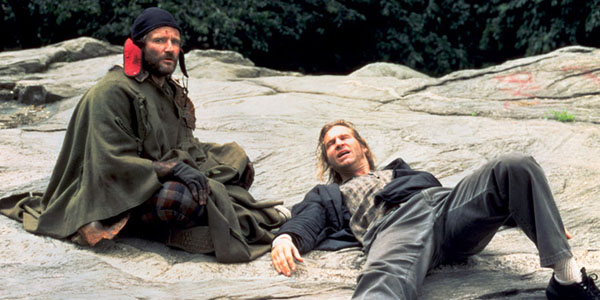 Cynical, arrogant radio host - Jack Lucas - feels suicidally depressed after some on air remarks he made contributed to a mass shooting in a bar. Three years later he is drunk and tries to kill himself. Before he can commit the act, a bunch of thugs think he is a homeless man and nearly set fire to him. He is rescued by Parry - a deluded homeless man who is on the quest for the Holy Grail. With nothing better to do Jack joins him. Especially when he finds out Parry's madness was caused by witnessing the killing of his wife in the mass shooting he feels responsible for. Parry is tormented by an hallucinatory Red Knight who plagues him when he shows any confidence, plus he had been in a catatonic state for a few years after his wife died. Jack wants to help Parry find love and sets him up with Lydia, a shy accountant. They fall in love but Parry suffers from hallucinations and when trying to get away from them, he is sent upon by the same bunch of thugs who tried to beat up Jack. Parry goes catatonic again. Jack gets a trophy which serves as The Holy Grail for Parry and he comes out of his catatonic state. All ends well. Director Terry Gilliam does a fantastic job of evoking Parry's hallucinations. They are awesome and terrifying. Parry's quest to find the Holy Grail is not an unthinkable scenario for a schizophrenic to enact, especially if they are having grandiose delusions. Catatonia is another nasty symptom of schizophrenia and it tends to lead to a very negative outcome. Robin Williams does a good job with his portrayal of Parry - his cooky comic side meshes well with his serious dramatic side - to produce a man who is eccentric on one level and deeply disturbed on another level. Jeff Bridges does some fantastic acting as Jack Lucas, who through helping Parry, finds some redemption and resolution of his own mental demons.
6. Shutter Island (2010)
In 1954, two US Marshalls - Teddy Daniels and Chuck Aule travel to Shutter Island where there is a hospital for the criminally insane. They are looking for a patient called Rachel Solando who has been locked up for killing her three children. The authorities and doctors are uncooperative. Daniels gets disturbing flashbacks to the liberation of Dachau and also of his wife who was killed in a fire by arsonist Andrew Laeddis. His wife, in a dream tells him Laeddis is still on the island and this is a major incentive for him to stay there - to hunt him down. With no cooperation forthcoming, Daniels and Aule break into Ward C where a patient tells them that patients get lobotomised in the light house. Daniels and Aule get separated on the rocks on their way to the light house. Daniels comes across a woman in a cave who claims to be the real Rachel Solando. She tells Daniels she was a former psychiatrist who left the hospital after the doctors were experimenting on patients with psychotropic drugs and mind control techniques. Meanwhile Aule has disappeared, and Daniels confronts Dr Cawley, the lead psychiatrist, who tells him there never was an Aule and Daniels himself is Andrew Laeddis who killed his wife after she killed their children. All of what he has just experienced is to let his psyche unravel its conspiracy theory obsession. Everything was played out for him. The memory of killing his wife comes back to him and he faints. When he wakes up he can tell the doctors about the killing and they take this as progress. Apparently he was as forward as this nine months prior but regressed. The doctors tell him this is his last chance. Unfortunately he has a psychotic relapse and the doctors take him away, presumably to be lobotomised. It is established that Martin Scorsese is a cinematic genius. Shutter Island is another great piece of work - it is, for me anyway, a psychological horror film where schizophrenia is the bogey man. The film shows very accurately how asylums would have been run back then. To let Laeddis play out his psychotic fantasies is a bit extreme, but there is little doubt that there was little effective medication for the mentally ill back then and in places such as a hospital for the criminally insane, I'm sure they handed out lobotomies like sweeties. An interesting film which shows the impossibility of getting over guilt and the psychological effect that has on the schizophrenic.
5. Pi (1998)
 Max Cohen is a gifted mathematician who seeks to understand the universe through numbers. He is paranoid to a schizophrenic degree and has problems socialising with people. The one person who talks to him is his old maths tutor Sol Robeson. Max makes stock predictions on Euclid his computer. It crashes after it spits out a 216 number as well as a pick on one tenth of its single value. However, checking the Stock Market the next morning he sees Euclid's predictions were right. Unsettled he tells Sol all about the experience and the number that he threw away. Sol asks him about the 216 number and tells him to take a break - Sol himself had come across that number on a previous occasion and I think he had a bad experience with it. Max meets an Hasidic Jew called Lenny Meyer who is doing mathematical research into the Torah. Max is very interested in his work as it holds some parallels to his own Research including the Fibonacci sequence. Max is also approached by a Wall Street firm to work for them. He eventually accepts the offer and takes possession of a classified computer chip called 'Ming Mecca'. Using the chip, Max runs the Torah's mathematical data through Euclid. The same 216 number appears, Max has an epiphany and passes out. When he comes to, he is clairvoyant and can visualise stock market patterns. Sol tells him again to take a break but he is accosted on the street and menaced by the Wall Street firm who want him to explain the number. Lenny and his friends save him but they too want an explanation of the number. They believe the number will trigger a Messianic age as the number is God's name. Max won't tell anyone the number and runs away. Trying to understand it, he reaches a crescendo and standing in his trashed apartment performs a DIY trepanation on himself. He is at peace at last. The film is incredible for what it managed to achieve on its $60,000 budget. It puts big Hollywood productions to shame. Aronofsky is infinitely inventive in how he shoots and directs the film, giving it a highly quirky edge that stamps it out as a very unique film. Geniuses who are close to madness is quite a hackneyed movie theme but Sean Gulette does a good job of portraying an insanely gifted man on the edge. He cannot stop his mathematical mental quests that drive him to a tormented state. At the end he is finally free of his tyranny.
4. The Soloist (2009)
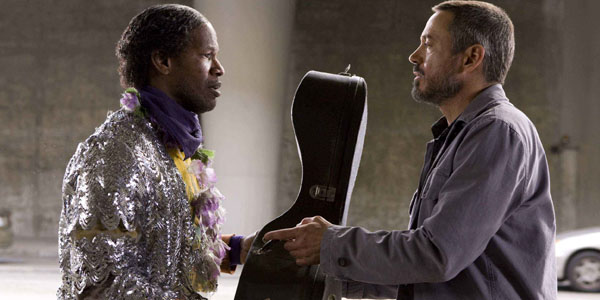 Steve Lopez is a journalist who has a bad motorbike crash and ends up in hospital. One day he hears beautiful violin music playing. Investigating, he finds out that the player of the violin is Nathaniel Ayers - a homeless schizophrenic who attended Juilliard for a while. Curious as to how such a prestigious student could have ended up this way, Lopez believes this is a good story and track's down Nathaniel's family. His sister says that he was a child prodigy where music was concerned and then he had to drop out because he developed mental illness and ended up on the street as a result. Lopez publishes the story and a kind reader gives a cello to Ayers which he can play as brilliantly as the violin. However Ayer's wandering puts him and his instruments in danger. Lopez tries to get him to leave the instruments in a homeless shelter to keep them safe. He also tries to get Ayer's to see a doctor, but Ayers is not interested. Music lesson with a friend go well but Ayers is increasingly dependent on Lopez who is trying to chuck him in an apartment. The article is so famous, Ayers is given his own recital but he goes nuts on the night and it doesn't pass. This convinces the doctor to help Ayers but when Ayer's finds out about this, he throws Lopez out of his appartment and threatens to kill him. But once the two characters realise how much they have changed each other for the better, they are reconciled. Robert Downey Junior and Jamie Foxx are excellent as Steve Lopez and Nathaniel Ayers respectively. The film packs a mean punch when it comes to the portrayal of schizophrenia - there are not always sunshine, lollipops and rainbows at the cessation of the disease - most people with the illness like Ayers suffer chronically for the rest of their lives after diagnosis. The film also asks an interesting question - should the mentally ill be forcibly medicated? This is a very pertinent question however, each person reacts differently to each treatment and sometimes, the cure is more distressing than the symptoms of schizophrenia.
3. Angel Baby (1995)
 Angel Baby is an excellent Australian film that follows the lives of Harry and Kate - both schizophrenics - who meet at a group therapy session and fall passionately in love. Both of them are fine whenever they are on their medication. Harry can even keep down a good job. But his brother, who has nursed Harry when he was ill, has misgivings about the relationship. Kate gets pregnant and goes off her meds for fear of harming the baby. Harry goes off his meds in sympathy and a show of solidarity. Of course it all goes to hell in a hand basket and Kate ends up pleading for her meds as she is in such mental agony. She is hospitalised. When she does have the baby she dies in labour. Harry asks his brother to look after his baby. The ending is left open as to whether he commits suicide. Schizophrenia - the disease - has rarely been portrayed in a realistic, non-sensationalised manner in cinema. Prior to A Beautiful Mind, it was hardly represented at all in a way that people could truly understand the illness. Angel Baby is a terrific depiction of schizophrenia and points out the difficulties women with schizophrenia face when they are pregnant. Should they stay on their meds or not? And attendant worry about the effects of drugs on the foetus. It also is very pro-medication. It shows how when schizophrenics stop their medication - things fall apart and life becomes a train-wreck. A very realistic portrayal of the disease by both lead actors.
2. Revolution # 9 (2001)
 Michael Risley is a pretty normal guy. He has a girlfriend he loves, a good job, an appartment. Everything is ticking over nicely until he thinks that his co-workers are messing around with his desk. This paranoia and delusions escalate until his work performance deteriorates and he is fired. He is obsessed with a television advert which he feels is plotting his downfall. Friends and relatives become alienated and money runs out. Michael ends up in hospital - crappy, grimy, third rate hospitals that do nothing for him and only drive him madder. Unable to stand the mental torment anymore, Michael goes to a rooftop and some teenagers shout at him to jump... This film is one of the more realistic depictions of schizophrenia. It shows how the disease affects apparently normal people in a very naturalistic, cinema verite way that is almost like a documentary. The film has very believable characters with whom the viewer can identify and what it achieves on its budget is amazing. It is ultimately a very sad story and it shows that schizophrenia is like a malignant tumour of the mind - some people can take medication that acts like chemotherapy on the mind and their pain is eased. Others don't take medication and the tumour kills them (via suicide).
1. Clean, Shaven (1994)
 Clean, Shaven directed by Lodge Kerrigan, is an onjective attempt to get into the mind of a schizophrenic and see the results the illness has on other people around him. Peter Winter has been released from a mental hospital and is intent on finding his daughter. A young girl accidentally hits his car with a soccer ball and he gets an orange bag and exits the car. Off screen we hear the young girl screaming as if she is being beaten and Peter returns to the car with his orange bag. Has he killed her? We see Peter's schizophrenic behaviour when he returns to his home. He hates mirrors and believes a transmitter is buried under his skin which he tries to cut out. He seeks refuge in isolation but his mother shows a lot of concern for him. She treats him like an idiot and doesn't want him to find his daughter. Peter's travels resume and he gets caught up in the investigation of a murder of a young girl. The detective has no evidence but this doesn't deter him from following Peter to his daughter. Peter kidnaps his daughter and they are about to reconcile when the detective bursts in on them. Peter fumbles around with his gun and the detective assumes he has killed his daughter and shoots Peter dead. Returning the gun to Peter's car, he finds the orange bag is filled with nothing but newspapers. Kerrigan's film is the best film you could watch if you want to get an insight into the horrors of being a schizophrenic. Every shot is meaningful and full of tension. Things may appear irrelevant to the viewer, but they are highly portentous in the world of the schizophrenic. You get to experience anxiety, hallucinations, extreme paranoia and delusions as well as the terrible feeling of isolation and the fact that nobody could possibly understand what Peter is going through unless they have had an acute psychotic episode. Director and lead actor - Peter Greene - must have done some serious research for their roles. Greene in particular doesn't just act, he saturates himself in the role. The film is probably repellant to most people who couldn't face living in the mind of a schizophrenic for an hour and a half. This is understandable as the condition is an ugly one and extremely frightening for most people to comprehend. But Clean, Shaven will take you the full nine yards when it comes to the illness