10 Film Directors Who Totally Tricked The Studio
Nolan told a white lie to direct Batman.

Hollywood is a high-pressure, ultra-stressful business at even the best of times, and it's sadly all-too-common for talented filmmakers to find themselves facing off against a studio machine that doesn't much care for good art.
There are countless tales of potentially great movies being put through the studio mangle and turned into cinematic dreck, but every now and then, a canny director will use their cunning to slyly bend a studio to their will.
These 10 filmmakers, all now venerated legends of the industry in one way or another, exercised some brilliantly devious judgment in knowing how to surreptitiously wrap the studio around their finger.
While this manipulation was certainly risky and could've easily had dire consequences, in each case it was ultimately for the best, both for the sake of the movie long-term and also for the careers of the directors themselves.
After all, sometimes a studio just can't see past the piles of cash they're busy counting, and can't just let good artists make good art. Thankfully, these directors had the stones to give the studio the daring runaround...
10. Ridley Scott & Harrison Ford Deliberately Ruined The Studio-Mandated Narration (Probably) - Blade Runner

The infamously maligned theatrical cut of Ridley Scott's sci-fi classic Blade Runner was widely pilloried for Harrison Ford's hilariously flat voice-over narration, as was only included in the film at the studio's insistence after test audiences found the original cut "confusing."
Poor Ford was dragged into a recording booth in post-production and, if legend is to be believed, he conspired with Scott to deliberately give an affect-free, hilariously dull performance in the hope that Warner Bros. wouldn't use it.
But of course, they initially used it anyway, even despite one of the film's producers calling Ford's voiceover "terrible" following a test screening.
And while their apparent scheme may have backfired at the time of Blade Runner's original release, Scott and Ford managed to have the last laugh a decade later, when the 1992 Director's Cut deleted the voiceover entirely, and the film went on to enjoy a major critical re-evaluation.
In fairness, Ford has denied claims he intentionally tanked the narration, yet this is a piece of apocryphal movie history so pervasive - while the narration is so awful - that it's practically impossible not to believe.
9. John McTiernan Added The "Deforestation" Scene Because The Studio Asked For More Shootouts - Predator

During production of Predator, director John McTiernan received word from Fox that they wanted the suspense thriller to include more scenes of guns being fired.
But McTiernan, having little interest in making a generic shoot 'em up action flick, decided to comply with Fox's demand in the most hilariously passive-aggressive way possible.
To "satisfy" the studio while not turning his movie into overcooked action schlock, McTiernan came up with the iconic sequence where the soldiers fire blindly into the forest in a vain attempt to kill the Predator, but end up hitting nothing.
On the film's DVD commentary, the director added, "What I was really doing was to quietly ridicule the desire to see pictures of guns firing...The whole point was the impotence of all the guns. Which was the exact opposite of what I believe I was being hired to sell."
Even though it was conceived out of malicious compliance on McTiernan's part, the scene is nevertheless one of the most memorable and badass moments in the entire movie.
8. David Fincher Agreed To Change A Line Of Dialogue...To A More Offensive One - Fight Club

David Fincher has a history of bristling up against the studio, especially earlier in his career, and especially when he's worked with Fox.
While shooting Fight Club, Fincher received pushback from the studio for a scene where Marla Singer (Helen Bonham) tells Tyler Durden (Brad Pitt) post-coitus, "I want to have your abortion."
Fox execs were horrified by the one-liner and insisted that Fincher change it to something else.
Though Fincher didn't have final cut privilege, he was nevertheless able to wrangle a deal with the executives where he would change the line once, but only once.
And so, the studio was surely left red-faced when Fincher decided to replace the abortion line with the arguably even more vile quip, "I haven't been f**ked like that since grade school."
Quite how Fincher was able to convince Fox executives to agree to his deal is anyone's guess, honestly.
7. Orson Welles Shot The Opening Scene As A Single Take To Calm The Studio Down - Touch Of Evil

If you somehow needed extra proof of Orson Welles' filmmaking genius, look no further than the production of his 1958 film noir classic Touch of Evil.
The film memorably opens with a single-take sequence in which the audience follows a car with a bomb on-board as it crosses the Mexican border into the U.S. and subsequently explodes, but Welles didn't conceive this brauva three-minute one-shot just for the fun of it.
Welles had earned an unfortunate rep among studios by the late-50s for being unreliable and exceeding production budgets, and so Universal only bankrolled Touch of Evil after making Welles agree to file a shooting report at the end of each work day.
But Welles had a plan. In order to get the studio off his back, he would not only film the bulk of the opening scene in a single take on a single day, but he spread the 5-minute sequence over 10 script pages to give the impression that he'd actually shot more material than he had.
And so, once Universal got word that Welles had shot 10 pages - that's roughly 10% of the movie - in just one day, they relaxed and let Welles off the leash. Genius.
6. Matt Stone & Trey Parker Derailed A PG-13 Marketing Campaign - South Park: Bigger, Longer & Uncut

Matt Stone and Trey Parker fought extensively with Paramount during production of South Park: Bigger, Longer & Uncut, as the studio initially tried to convince the duo to release the film with a PG-13 rating.
Stone and Parker stuck to their R-rated guns, even if Paramount's marketing team continued to create cutesy commercials for the film which blatantly misrepresented its tone as more family-friendly.
When the filmmakers received a VHS screener of one of the trailers, they promptly snapped it in half and sent it back to Paramount.
But the pair took advantage of a prime opportunity when, some time later, Paramount commissioned the creation of a promotional South Park music video intended to air on MTV, with all the R-rated material predictably edited out and the implication once again being that the film was rated PG-13.
For some reason, Paramount sent the original master VHS of the music video to Stone and Parker for review, and Stone responded by putting the tape in the trunk of his car and driving home. This prompted the studio, who needed the tape back to send it to MTV, to threaten the duo with legal action.
Nothing came of it in the end, though, and Stone and Parker managed to avoid an apparently revolting, deceptive commercial for their movie making it on the air.
Presumably Paramount calmed down somewhat once the film grossed almost four-times its budget at the box office, made a killing on home video, and even received a Best Original Song Oscar nomination for "Blame Canada."
5. Stanley Kubrick Made The Forced Narration Intentionally Misleading - The Killing

Stanley Kubrick's 1956 film noir classic The Killing is a non-linear heist film, and one which United Artists felt was initially too confusing.
As such, they insisted that Kubrick include a voiceover narration track, ultimately provided by Art Gilmore, to keep the audience informed on when scenes were taking place in the chronology of the story.
But Kubrick, ever the sly dog, decided to have the narrated times be intentionally inconsistent and misleading, therefore only adding yet another layer of dubious reliability and confusion as opposed to actually clarifying the story.
There are enough contradictions on the part of the "omniscient" narrator that he really only makes things more labyrinthine, even if to a studio executive likely not paying much attention to the movie at all, Kubrick lived up to his basic end of the request.
4. John Lasseter Let A Disney Boss Embarrass Himself In Front Of Walt Disney's Nephew - Toy Story

It truly is nothing short of a major miracle that Toy Story turned out as magnificent as it did, in turn making Pixar an overnight household name and reinventing the animated film as we now know it.
During the film's lengthy and painful development, however, Disney Studios boss Jeffrey Katzenberg aggressively insisted to director John Lasseter that the film have a more adult edge, with Woody (Tom Hanks) being more of a conventional villain character.
Lasseter had no choice but to relent, leading to the one of the darkest - yet ultimately most important - days in Pixar's history, better known as the infamous "Black Friday incident."
At Katzenberg's behest, a fully voice-acted animatic was screened in November 1993 for various Disney executives and also Roy E. Disney, the nephew of Walt Disney and son of Disney co-founder Roy O. Disney.
The scene was a far darker and more mean-spirited iteration of the sequence where Woody knocks Buzz (Tim Allen) out of Andy's window, with Woody bombarding the other toys with insults and basically coming off as an irredeemable tyrant.
Roy E. Disney was reportedly infuriated with the scene, to the extent that Peter Schneider, president of Walt Disney Feature Animation at the time, suggested the entire project be scrapped.
The prevailing sentiment was that Katzenberg's dictatorial oversight had taken the project away from Lasseter and the rest of Pixar, after which an embarrassed Lasseter was given just two weeks to re-work the script, this time with full support from a hands-off Katzenberg.
Though this was hardly a Machiavellian scheme on Lasseter's part to humiliate Katzenberg in front of the Disney brass, by having him fail so spectacularly in a room with them, the director was eventually allowed to make the more sweet-natured movie he always wanted to, and his career as a Pixar mainstay for two more decades was firmly cemented.
3. Mel Brooks Pretended To Listen To Studio Notes...Despite Having Final Cut - Blazing Saddles

Mel Brooks didn't merely trick the studio during production of his legendary 1974 western comedy Blazing Saddles: he straight-up trolled them. Brooks was called into a meeting with Warner Bros. executives, who suggested a laundry list of changes to the movie.
These changes included cutting all uses of the "n-word," removing the scenes where a horse and an old lady get punched, and deleting the iconic farting scene (which was the first on-screen fart in movie history, by the way).
Brooks took extensive notes of the execs' requests, which was especially hilarious given that his contract granted him final cut privilege, and so he didn't have to listen to a single studio note.
When the meeting was finished, he took his notes and simply threw them all in the bin. In a recent retrospective interview, Brooks hilariously said, "If I had made their changes the film would have been just 14 minutes long!"
2. Christopher Nolan Lied To Warner Bros. About Superman (1978) - Batman Begins

Christopher Nolan was certainly a bit of a creative gamble to direct Batman Begins back in 2004, given his lack of experience in the blockbuster realm.
But an especially tricky point of contention was Nolan's desire to not have the Dark Knight revealed in his cape and cowl until roughly half-way through the movie, putting his suited-up debut well past the one-hour mark.
Nolan recently confirmed that he managed to quell Warner Bros.' concerns by telling a "white lie", by claiming that in Richard Donner's 1978 Superman, Christopher Reeve didn't suit up until 53 minutes into the film.
Reeve actually dons his classic superhero duds a short while earlier than that, but by fudging the facts and citing one of Warner Bros.' most beloved and successful movies back at them, he was able to get the bean-counters off his case.
The rest, of course, is history, and everybody involved must feel pretty damn grand about that deception all things considered.
1. F.W. Murnau Added A Happy Epilogue...With An Apology To The Audience - The Last Laugh

Legendary Nosferatu director F.W Murnau seemingly invented the art of flipping the bird at an intrusive and annoying movie studio while working on his 1924 silent film The Last Laugh.
The film was originally intended to end with the death of the hotel doorman protagonist (Emil Jannings), but executives at studio UFA insisted that Murnau come up with a happier ending ahead of the film's premiere to boost box office business.
With the help of screenwriter Carl Mayer, a thoroughly pissed-off Murnau conceived a cynical, parodically happy ending where the doorman randomly inherits a massive fortune.
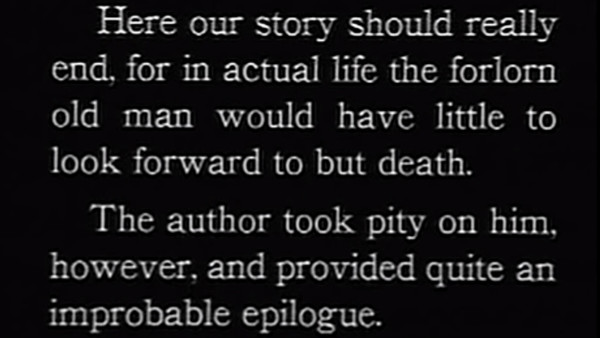
And in case that wasn't unsubtle enough, Murnau even included a title card before the epilogue which read, "Here our story should really end, for in actual life the forlorn old man would have little to look forward to but death. The author took pity on him, however, and provided quite an improbable epilogue."
The irony of the film's title, then, speaks for itself, because while The Last Laugh was a massive critical and commercial hit for the studio, Murnau was also able to blatantly register his protest at the tacked-on denouement and near enough acquit himself from criticism in the process.