10 Films That Suddenly Went Completely Nuts
What just happened?
 Ever see a film that suddenly went so mental that it literally made your jaw drop? Chances are it was probably one of these. There have been some fantastically strange movies to emerge from all corners of the world, with the likes of David Lynch, David Cronenberg, Takashi Miike, Luis Bunuel, and Lars Von Trier all creating productions that defied the laws of filmmaking in one way or another: pictures that were crazy from beginning to end. But then there have been films that have had the audacity to masquerade as something relatively conventional. Films that have begun innocently enough with a seemingly ordinary setting, before suddenly flipping into utterly unimaginable chaos and freakishness. Indeed, each movie on this list packs a sucker punch that rocked audiences on initial viewings; with film critics, fans and scholars continuing to assess just what the hell happened to this day. Be warned, the following article will inevitably be JAM PACKED WITH SPOILERS. Get out of here now if you don't want to know the mad surprises that these films have in store. On the other hand, if this is all cool with you and/or you're up for reliving some great movie digressions - then simply click "Next" to kick off the craziness...
10. Burn After Reading
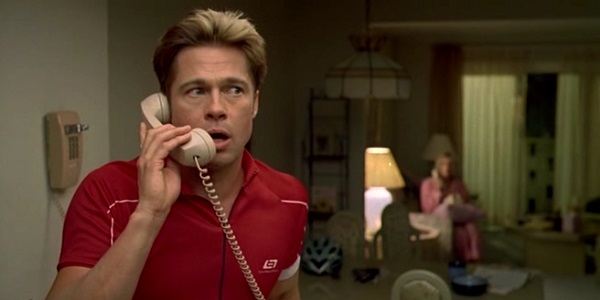 A screwball comedy with the energy of a pinball machine powered by redbull, Burn After Reading begins with a rich tapestry of quirky characters, before flying off the handle into an all-action runaround picture. Directed by the ever-idiosyncratic Coen brothers, Burn After Reading dances between genres before bombastically crashing into gonzo territory that involves gunfights and greed. Burn After Reading mischievously manipulates several recognised star images, casting Brad Pitt as an imbecile, George Clooney as a panic-stricken adulterer, and Frances McDormand as Pitt's partner in crime. The film becomes more twisted as it goes on: exposing the insane snowball effect that can occur out of misunderstandings and jumping to conclusions. Each of the stars (which also include Tilda Swinton and Richard Jenkins) race around all corners of the screen; each for their own reasons and every one of them making mistakes. The film's nuttiness comes to a head with an ornery John Malkovich lamenting the "league of morons" that he's been forced to associate with his entire life. Malkovich has been in his fair share of mad films, with Being John Malkovich the obvious contender. Indeed, that film has a crazy spine running all the way through it and belongs on an entirely separate list; whilst Burn After Reading merits its place here (as a film that takes a crazy turn) given the way it mumbles, rumbles, and eventually pops open to let a surprising deliriousness spill out across the screen.
9. After Hours
 Martin Scorsese embraces madness. Flick through his early filmography and you'll be hard pushed to find a film that doesn't incorporate elements adapted from German Expressionism: a movement that spawned legendary horror films Nosferatu and The Cabinet of Dr Caligari. A movement that zoned in on dark themes of delusion and madness, Expressionism heightened a surrealistic atmosphere to create pictures that had potential for anything to happen. Scorsese's adoration for this period is never more evident than in After Hours, a film that begins innocently enough before tumbling into absurdity and refusing to come back to normality until the final reel. Griffin Dunne stars as Paul Hackett, an ordinary New Yorker who meets an intriguing girl in a cafe after work one evening, and agrees to meet her in Soho later that night. From the cab ride onwards, the film flips wildly, and Paul descends into a world within a world: a place where he finds himself at director Scorsese's maniacal mercy. Stuffed with bizarre characters and scenarios, Paul's creeping paranoia is palpable as the film turns wildly black, before coming full circle back to Paul's office as the sun comes up. The craziness of it all makes you feel like you've just had a weird dream as opposed to watching a movie.
8. Magnolia
 Paul Thomas Anderson's epic Magnolia is one of those incredible polarising films that managed to simultaneously earn both critical adoration and backlash upon release. Some admired its ambition; others claimed it overreached. Some loved its plethora of colourful characters; others found it overstuffed. But the key issue that divided critics was an astonishing event that comes from absolutely nowhere towards the end of the film. Some claimed to be enchanted by it; others felt cheated. Everyone agreed it was bewildering. Featuring a juicy selection of star-studded stories in Los Angeles, Magnolia actually goes nuts twice. Before the much-discussed scene where objects tumble from the clear night sky, the film takes a separate bizarre detour by abruptly breaking into song. Each of Paul Thomas Anderson's characters find themselves in desperate positions, and suddenly the film drifts past every one of them singing Aimee Mann's "Wise Up". It' s not a scene you'll forget in a hurry, but it's merely a digressive warm-up for the film's enormously wacky conclusion.
7. Falling Down
 William Foster is having a really, really, really bad day. A newly-divorced, newly-unemployed middle-aged man kept apart from his single daughter by a restraining order, he begins to overboil when he gets stuck in a traffic jam on his way home. His patience with life finally runs out after being refused change for a phonecall in a convenience store. Falling Down depicts how instead of going home and getting stuck into a bottle of Jack in front of his TV, Foster goes on a wild rampage across Los Angeles. Michael Douglas' character begins to explode pretty early on in Joel Schumacher's film, but the extent to which Foster crashes across the city with such violence snowballs so quickly that the film goes instantly from a portraying a disgruntled man in a mid-life crisis to a psychopathic gangster in the middle of a turf war. Foster rapidly goes from giving whom he deems 'unworthy citizens' their comeuppance, to terrorising completely innocent families eating out for the day. It's a bitter pill to swallow when all you want is some bacon and eggs and you reach the fast-food joint just seconds after they've rolled the boards to the lunch menus. Ordinarily in the movies there'd be a civil compromise, but by the time William Foster strolls into a restaurant just past 11.30am, Falling Down is in full maddening flow, and Foster wields a gun instead, demanding an item from the breakfast menu. The film becomes systematically more chaotic as Foster presses on through the city, eventually coming toe-to-toe with last-day-on-the-job cop Robert Duvall. Watching Falling Down perhaps gives us a little more of an understanding into why Batman & Robin - also directed by Schumacher - was so astonishingly over-the-top. The director loves crazy chaos, and Falling Down has it in abundance.
6. Barton Fink
 A typically offbeat Coen Brothers production, Barton Fink stars John Turturro in the eponymous lead role as an acclaimed playwright who moves into Hollywood screenwriting. Fink enters the world of film appearing overwhelmed, uneasy and nebbish - unable to write any meaningful work in his drab hotel room due to constant interruption. His neighbour John Goodman makes too much noise, and there is a buzzing mosquito that just won't go away. But as Fink becomes increasingly desperate for ideas and inspiration, the film bounces from a portrayal of a writer in-over-his-head, to a man trapped in a world of absurdity and surrealism. Only the Coen Brothers could successfully flip a film in such a way - with Barton Fink beginning as a portrayal of frustration and ending with John Goodman parading around a burning hotel with a shotgun. Nuts.
5. The Devil's Advocate
 For two-thirds of its running time, Devil's Advocate is a courtroom drama, sprinkled with evil supernatural elements which gain momentum in the film's final furlong. Before long the courtroom vanishes and the celestial stuff takes over the entire film: plunging the viewer headfirst into sets of rich satanic imagery. Starring Keanu Reaves as a hotshot lawyer who moves to the big apple after being headhunted by a lavish law firm, The Devil's Advocate charts Reaves' workaholic attitude against his wife's slowly deteriorating sanity. Of course, there is more to this turn of events than meets the eye. And after some time, it is hinted that the work of Satan is in play. And who better than to play the Devil than Al Pacino on top form? Indeed, the narrative structure of Devil's Advocate is best reflected in Pacino's performance. The actor deliberately paces himself, showing admirable restraint in his performance before engaging in an exuberant outburst of bravado during the film's climax. Director Taylor Hackford intermittently jerks the viewer with brief spots of evil imagery, before the narrative and Pacino suddenly erupt like the volcanoes of hell.
4. Drive
3. Hot Fuzz
 The final third of Edgar Wright's Hot Fuzz is so deliriously over-the-top that you have to watch it twice to even believe your own eyes. Beginning as a tongue-in-cheek look at the action and buddy cop genre, the film tells the story of a too-good-to-be-true cop from London (Simon Pegg) who is forced to move into a quiet, rural town down south and partner up with a roly-poly amateur policeman played by Nick Frost. Whilst Hot Fuzz largely keeps its feet on the ground for its opening half, we can sense that it's always building to something; with intermittent whipping fast-cuts sandwiched between benign South-Western slurs. And as PC Nicolas Angel begins to discover the truth about the tiny town of Sandford, the film playfully flicks through a swiss army knife of genres before going all-out bonkers in the finale. Wright is chuckling all the way through: you can feel it in his camerawork. By the end he's roaring with laughter and doesn't stop until every last action-film cliche is adopted and exploded in wild comedic fashion. Wonderful, nutty stuff.
2. Kill List
 The final scene of Kill List is enough to haunt your nightmares forever. Sickening and chilling all at once, the climax of Ben Wheatley's first wide-reaching film packs a fierce and sudden blow. Whilst the opening sequences of the film are emotionally dark, there is never any hint of what's to come in the maniacal final stretch. Neil Maskell and Michael Smiley star as two hardened soldiers from the British military, who take up a contract killing job upon their return to the UK after being stationed in Kiev. There is a deliberate effort on Wheatley's part to manipulate the viewer and he leaves a lot of threads hanging, and the sense of intrigue he creates leaves us locked onto the screen from beginning to end. The film doesn't simply explode into mayhem like several others on this list. It creeps up on us, with the result being an unforeseeable venture into one the darkest corners of British cinema. The film has a surreptitious shift from violent drama into distressing macabre which is both bold and frightening; and whilst there is always something sinister snarling beneath the surface, the direction that Kill List actually ventures into is one of the more undeniably shocking twists seen in UK film for years.
1. From Dusk Till Dawn
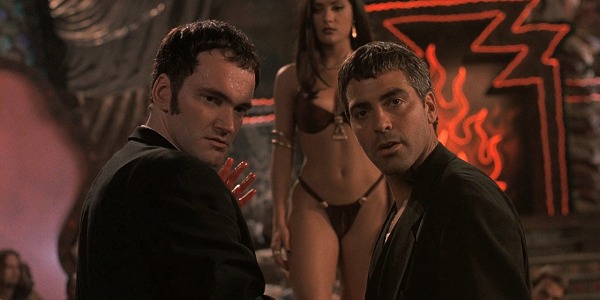 From Dusk Till Dawn is a bit like Tommy Lee Jones' depiction of Batman villain Two-Face: part classy crook, part monster. Written by Roberto Rodriguez and Quentin Tarantino, the film adopts TLJ's villainous form as being insanely split right down the middle: with one half a slick, gun-toting crime movie, and the other a roaring, bloody horror film. A lot of people were pretty p**sed off when the film hit cinemas, bemoaning the unnecessary lurch from gangster to vampire flick. This is perhaps unsurprising given how the first half of From Dusk Till Dawn does seem to have enough about it to hold up for feature length. But if you embrace the unapologetic jolt into the horror genre, you can have a hell of a good time with this film. George Clooney swapped his shift at the ER for this big-screen debut, and he makes for a convincing crook who, along with Tarantino, capture a family of three (with Harvey Keitel as the mild-mannered father) to smuggle their way across the Mexican border. It's foul-mouthed and it's violent, but From Dusk Till Dawn continues to remain a resolute crime thriller until they reach their destination in Mexico: a rowdy, dangerous dive bar. As part of the evening entertainment, a voluptuous dancer played by Salma Hayek exotically grooves her way across stage, before inexplicably morphing into a revolting vampire. The bar staff and dancers also contort into malevolent undead monsters, and just like that, From Dusk Till Dawn becomes a terrifying horror film. Much of the character development is ripped to shreds as the leads become different people in the face of supernatural horror. It's easy to see why many viewers felt the genre-shift like a slap in the face. But whichever way you look at it, From Dusk Till Dawn is deliriously original. For once, we are as surprised to see vampires as the characters on-screen are.