10 First Draft Movie Ideas Better Than What We Got
Quit living in the past, Cap.
Making a movie sure isn't easy, and for the vast majority of hit Hollywood blockbusters, they go through countless iterations in the scripting stage before finally arriving at a screenplay fit for shooting.
And the annals of cinema are undeniably littered with terrible first draft ideas that were thankfully nixed before filming began - Star Wars' Luke Skywalker (Mark Hamill) was originally named "Luke Starkiller", Jurassic Park 4 was written to include gun-totting mutant dinosaurs, and Creed II even featured a ghostly appearance from Apollo Creed (Carl Weathers). Oof.
That's just a few examples, and they're proof of how valuable the drafting process truly can be, of streamlining characters and concepts while removing any elements likely to upset the tone or prove problematic.
But sadly, sometimes filmmakers and executives take things too far, throwing out great concepts, characters, endings and even entire scripts in the pursuit of something broader and, generally speaking, less satisfying.
Though not all of these movies are bad - in fact, a few of them are great - each nevertheless tossed out a solid gold, five-star idea for reasons that tended to be cynical or in the very least misguided.
Thankfully in many cases the scripts have since leaked online, serving as a fascinating and infuriating monument to potential unrealised...
10. Newt & Hicks Survive - Alien 3

The Original Idea
In 1987, legendary cyberpunk author William Gibson was approached to write a script for Alien 3, and with Sigourney Weaver's return as franchise heroine Ripley very much in doubt, Gibson was charged with continuing the series in her absence.
His Alien 3 begins with Ripley entering a coma after her cryotube is damaged, shifting the focus to Hicks (Michael Biehn) and Bishop (Lance Henriksen), while Newt (Carrie Henn) is safely shipped back to Earth to live with her grandparents.
The action-packed script sees Hicks leading a desperate battle to fend off a Xenomorph infestation on the space station Anchorpoint, concluding with a sequel-bait ending where humanity bands together to locate and destroy the Xeno homeworld.
Despite the script being well-received by fans, the film's producers found it dull. In a small act of solace, however, the script was adapted into an Audible audiobook released just last month, and it's pretty damn great.
What We Got
Alien 3 went through several more drafts before finally settling on a script primarily assembled by franchise producers David Giler and Walter Hill.
The film's production was an infamous mess, as Fox wrestled with first-time filmmaker David Fincher over various aspects of the shoot. And when the film finally hit cinemas, fans were naturally outraged that it opened with the deaths of both Newt and Hicks.
Though Weaver did ultimately return for the threequel, killing her off in the finale opened up a gigantic can of worms once the producers realised the franchise desperately needed the character.
This of course resulted in Ripley's fan fic-esque revival-by-cloning in the fourth film, Alien Resurrection.
9. More Obi-Wan & Darth Maul, Less Jar Jar & Qui-Gon - Star Wars: Episode I – The Phantom Menace

The Original Idea
George Lucas' first draft of Star Wars: Episode I differed quite significantly from the final film.
Most of all, Qui-Gon Jinn (Liam Neeson) doesn't show up until Coruscant, with Obi-Wan Kenobi (Ewan McGregor) taking on much of Qui-Gon's eventual duties, as the script places a greater emphasis on his relationship with Anakin Skywalker (Jake Lloyd).
Darth Maul (Ray Park), by far the most disappointingly under-served character across the prequels, meanwhile has more of a presence and says more than a whole three lines.
Jar Jar (Ahmed Best) is also more tolerable in this draft: he's in the film less, and doesn't speak with the irritating - if not downright problematic - gobbledegook present in the end product.
What We Got
You can't really knock the idea of Liam Neeson being in a Star Wars movie, but given that Episodes II and III were focused on the relationship between Obi-Wan and Anakin (Hayden Christensen), Qui-Gon often feels like he gets in the way of that in the final film.
McGregor's in the movie plenty, of course, but the centrality of his role is de-emphasised somewhat, with many of his original actions being divided between himself and Qui-Gon.
Darth Maul is a complete wash despite his awesome visual appearance and a few neat action beats - thanks, John Williams! - while Jar Jar turned out an annoying merch-baiting abomination at best, or a spectacularly offensive racial caricature at worst.
8. Jim Saves Aurora's Life By Waking Her Up - Passengers

The Original Idea
Jon Spaihts' original script for sci-fi romance Passengers ended up on the prestigious Black List of best unproduced screenplays back in 2007, and with damn fine reason.
This version of the script does a much better job of depicting the spaceship Avalon's systematic malfunctions, leading to a third act where all 5,000 of the sleeping colonists' pods are ejected into space.
This completely shifts the moral quandary surrounding Jim (Chris Pratt) waking Aurora (Jennifer Lawrence) up from cryo-sleep to combat his own loneliness, because if he hadn't done so, Aurora would've been fired into space with the other colonists.
It's a tidy way of combating the potentially troubling nature of the central romance, basically.
What We Got
The final film absolutely glosses over the ethical issues involved with Jim's decision in the failed vein of crafting a sweepingly romantic, agonisingly broad Titanic-in-Space vehicle.
Despite Jim's obvious lonely desperation, the film never reconciles the obvious Stockholm syndrome present in their relationship, and by having Aurora voluntarily live out her days with Jim at the end of the film, it only further confirms how utterly off-brand its tone truly is. This ain't sweet, it's creepy.
7. Hancock Is The Villain - Hancock

The Original Idea
Hancock started out as a spec script called Tonight, He Comes, written by Vincent Ngo in 1996 - and boy, it is wild.
The evidently R-rated material takes a far darker and more sinister approach to the "superhero" genre, fashioning John Hancock (Will Smith) as a tortured superhuman who ends up killing police officers and, uh, considers raping a woman.
Yeah, they were probably right to leave that last part out, actually.
Nevertheless, Hancock wears a cape reminiscent of Superman - more like Brightburn, really - and occasionally tries to be good, despite him clearly being the true villain of this story.
He ultimately crosses paths with the Longfellow family and attempts to steal the wife, Mary, away from her sad sack husband Horus. This leads to Hancock nearly forcing himself on Mary and slaughtering the aforementioned fleet of cops, ahead of a final battle with Horus.
After almost killing Horus and believing he's killed Mary, Hancock attempts in vain to kill himself, after which he finally vows to be a good guy.
It's undeniably rough around the edges, but it sure is a lot more interesting than what we ended up with.
What We Got
The released movie is a far broader stab at the spine of the original idea - yes, Hancock is a washed-up superhero who can't seem to do the right thing, but the character's edges are softened, making his redemption decidedly easier for the audience to get on-board with.
The tone bristles up against the edges of the PG-13 rating, but it's still PG-13, with the graphic violence and sexual content of the original script significantly downplayed.
Though Hancock does also become involved with a couple in the film, it takes an entirely different direction - Mary (Charlize Theron) is eventually revealed to be a superhero herself, while Horus is replaced with Ray (Jason Bateman), a PR specialist attempting to rehabilitate his image.
It's easy to understand why Peter Berg made the movie that he did, but it's a damn shame the world missed out on an unrestrained, R-rated rendition of this promising concept. Instead, the end result was generic, passably watchable blockbuster sludge.
6. Mutt Doesn't Exist & Marion Gets More To Do - Indiana Jones & The Kingdom Of The Crystal Skull

The Original Idea
Back in May 2002, Frank Darabont (The Shawshank Redemption) was hired to write the prospective fourth Indiana Jones film, and eventually turned in the script for Indiana Jones and the City of Gods.
Though many of the set-pieces from Kingdom of the Crystal Skull had their genesis in this script - yes, the infamous fridge debacle is in there - Indy's widely-loathed son Mutt (Shia LaBeouf) is mercifully nowhere to be seen.
Moreover, the script draws a much stronger focus on Indy's (Harrison Ford) accelerating age rather than mostly ignoring it.
But best of all, a larger role is afforded for Marion Ravenwood (Karen Allen), who gets to sink her teeth into some meaty action rather than being reduced to birthing the franchise's heir apparent.
But George Lucas ultimately rejected the script and decided to write a treatment himself, which was adapted into a shooting script by David Koepp.
What We Got
Kingdom of the Crystal Skull may have scored decent critical notices, but the fanbase largely scorned it for feeling like a pallid, soulless attempt to shock a corpse back to life.
LaBeouf's Mutt was met with near-universal disdain from fans for feeling like a cynical inclusion intended solely to preserve the series' future - one which backfired spectacularly - and despite the crowd-pleasing appearance of Marion, she doesn't really do much interesting.
Darabont's script may not be perfect, but it reads as so much more creative and true to the franchise than the boilerplate sequel we ended up with.
5. Basically Everything - Prometheus

The Original Idea
Passengers sadly wasn't the first and only time that Jon Spaihts had one of his scripts molested by a studio that thought it knew better, as Spaihts' original script for Prometheus - a more direct Alien prequel called Alien: Engineers - differs significantly from the final film, and almost always for the better.
Where to begin? First and foremost, the moon the scientists touch down on is indeed LV-426 from Alien, and the film as a whole places a more direct emphasis on leading into the events of Ridley Scott's 1979 classic.
Elsewhere, David (Michael Fassbender) is more overtly villainous and directly impregnates female lead Watts with an alien embryo by placing a Facehugger on her mug.
This leads to a final showdown between Watts and the Xenomorph - removed from her womb in much the same way the Trilobite was in Prometheus - which she kills by chainsawing its head off.
The story ends with Watts reunited with David and forming an uneasy alliance, just as pyramids can be seen lighting up in in the distance, suggesting more Engineers are about to pay them a visit.
Other different details include the reduced presence of the black goo, which is instead described as a swarm of scarab-like insects, and Peter Weyland (Guy Pearce) never appears on the ship, nor is Vickers (Charlize Theron) his daughter.
The entire subplot about him wishing to extend his life is absent, as his motivations are purely financial, to acquire the Engineers' planet-terraforming tech.
What We Got
Lost's Damon Lindelof was eventually brought on-board to help "flesh out" Spaihts' script with Scott, leading to an intriguing if frustratingly non-committal final movie filled with head-scratching creative calls.
Lindelof and Scott ultimately made Prometheus less of a direct Alien prequel than the original script, shifting the action to an adjacent moon for reasons that still aren't really clear.
David's villainous arc is decidedly more ambiguous and convoluted, as getting to the proto-Xenomorph requires him poisoning Holloway (Logan Marshall-Green) with the black goo, Holloway having sex with Shaw (Noomi Rapace), Shaw "aborting" the creature, the creature impregnating the angry Engineer and the Engineer finally hatching the Xeno. Having David simply impregnate Watts is so much tidier and less fussy.
Aside from that final glimpse, Prometheus of course features no Xenomorphs whatsoever, and the cliffhanger is notably different, ending with Shaw and David heading off to seek out the Engineers' homeworld.
Is Prometheus a bad movie? Absolutely not, but it frustrates precisely because the seeds of a brilliant movie are so clearly sewn, especially once you take a look at Spaihts' script.
The next time this guy writes an original sci-fi movie, can we just leave him alone, yeah?
4. Robin Hood & The Sheriff Of Nottingham Are The Same Person - Robin Hood (2010)

The Original Idea
One of the many early drafts for Ridley Scott's 2010 Robin Hood made the curious yet undeniably insane decision to have the Sheriff of Nottingham chasing his own tail, by dropping a Fight Club-esque reveal that Robin and the Sheriff would actually be the same person.
Screenwriter William Martell ran down the various aborted scripts in a lengthy blog post, with this version featuring the Sheriff essentially pursuing himself for most of the movie. But of course, it was eventually rubbished, with Martell speculating that someone found the premise too silly.
What We Got
Pretty much every interesting iteration of the premise was thrown out, and Oscar-winning screenwriter Brian Helgeland (L.A. Confidential) was brought in to craft a more simplistic and straight-forward Robin Hood story.
Needless to say, the film's utter lack of soul and creativity led to critical pannings and commercial disappointment.
That's not to say the Robin Hood: Fight Club treatment would've been a box office smash, but it at least would've been something more inspired and interesting than what we ended up with.
3. Actually Adapting The Novel - World War Z

The Original Idea
The first draft of World War Z by Babylon 5 creator J. Michael Straczynski actually attempted to adapt Max Brooks' beloved epistolary zombie novel, by having government employee protagonist Gerry (Brad Pitt) - a character fabricated for the movie - travel the world and collect stories from survivors of the zombie apocalypse.
It was a neat device to allow the film to invoke many of the accounts from Brooks' novel, while not just devolving into a blatant anthology film of disparate zombie narratives.
What We Got
Straczynski's script was thrown out once director Marc Forster came aboard, who in the writer's own words, wanted to make a "big, huge action movie that wasn’t terribly smart and had big, huge set pieces in it."
And that's exactly what World War Z ultimately turned to be - a CGI-fuelled, over-budgeted PG-13 slog with little of character or narrative interest.
But more frustratingly, it was World War Z in name only, taking virtually zero influence from the beloved source material and simply using the title for cynical branding purposes.
2. Cap Ends Up With Sharon Carter - Avengers: Endgame

The Original Idea
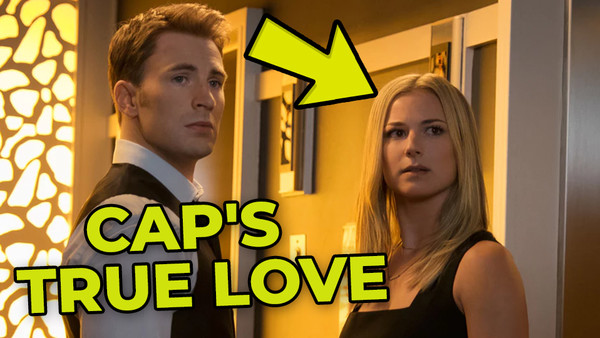
In interviews following Avengers: Endgame's release, screenwriters Stephen McFeely and Christopher Markus detailed many of the possible storylines they envisioned while writing the film, including a draft where Captain America (Chris Evans) was living with Agent 13 aka Sharon Carter (Emily VanCamp) following the events of Infinity War.
As a through-line for Cap's future, this ending actually feels a lot more natural and organic, if only because it allows him to move on with his life rather than be both literally and figuratively re-living the past.
We're going to assume that McFeely and Markus ditched the Steve/Sharon love-in for two reasons: everyone was too weirded out by that kiss in Civil War, and the sentimental fan service of a Steve/Peggy (Hayley Atwell) reunion was too tough to resist.
What We Got
Steve of course travels back to the past to live out something resembling his original life with Peggy, which while cute and sweet, just feels a bit regressive for an out-of-time character like Cap.
Having Steve stick to his current time, move on from Peggy and stay with Sharon would've felt neater thematically speaking, as long as you can deal with Sharon being Peggy's great-niece.
1. It Ends With A Surreal Johnny Depp Cameo - Birdman

The Original Idea
Alejandro G. Iñárritu's Best Picture and Best Director-winning drama almost concluded in even more bats*** crazy fashion than it actually did.
In the first draft, after Riggan Thomson (Michael Keaton) shoots himself on stage, a seamless single-take would reveal that Thomson received rave reviews for his performance, as we pass backstage to a dressing room.
Inside, Johnny Depp is kitting himself up in the Riggan Thomson wig, while a Pirates of the Caribbean poster is visible in the background, and Depp says to himself in his Jack Sparrow voice, "What the f*** are we doing here, mate?"
Birdman co-writer Alex Dinelaris said of the planned ending, "It was going to be the satire of the endless loop of that", and frankly, it sounds absolutely hilarious.
What We Got
The final ending is no slouch either, if much more frustrating. Thomson wakes up in the hospital and decides to take a stroll out of his window, after which his terrified daughter Sam (Emma Stone) looks out the window, peers down, then up and smiles.
Did Riggan truly become Birdman and take flight, or this simply a visual allegory and Thomson is splattered all over the pavement below?
It's agonised audiences ever since the film released, and rightly so, but the Depp cameo just feels like a punchier final note on which to end things, offering up one final rib on Hollywood's gluttonous excess.