10 Genius Ways Movies Made You Rewatch Them
These films found brilliantly clever ways to ensure you rewatched them.

There are so many movies out there begging to be watched that, of the perhaps thousands of films you might watch in your lifetime, how many of them are you actually going to revisit more than once? There just isn't enough time in a day.
We all have our faves that we can watch again and again of course, but there are also some ingenious ways that filmmakers have encouraged audiences to rewatch their work. Being merely "good," these films all had some nifty tricks up their sleeve to heighten audience engagement and perhaps even make a repeat viewing feel totally necessary.
From offering up mind-melting plot twists to sneaking secrets in the background of the frame, unexpectedly predicting the future, and everything else in between, the following movies all found incredible ways to ensure that a large portion of the audience came back for seconds. Hell, perhaps even thirds, fourths, and fifths too.
Getting viewers en masse to sit through a movie once is enough of an ask in and of itself, but these films all cracked the code on guaranteeing that people would want to experience it all over again...
10. To Watch With Knowledge Of The Twist - Fight Club/The Usual Suspects/The Sixth Sense

This goes for basically any movie with a shockingly entertaining twist, because if a film manages to bamboozle audiences with an all-timer rug-pull, it's pretty much required viewing to quickly watch the picture again with the full context of its story.
Take Fight Club. Watching it with the prior knowledge of who Tyler Durden (Brad Pitt) is, completely changes the experience in a totally fascinating way. Similarly, knowing what's coming in The Usual Suspects or The Sixth Sense forces you to engage with the movie in entirely different terms.
Though some lesser "twist movies" don't offer up much reason for a second viewing - especially if the twist feels tacked-on or strains the bounds of the narrative's credibility - the better ones become practically transformative the next time you watch them.
On a repeat viewing, it often becomes clear how the big twist was basically hiding in plain sight, and the filmmakers might even be slyly winking at you about it the entire time.
9. To Follow The Secret Alien Invasion Subplot - Searching

2018 thriller Searching uniquely takes place entirely on computer screens and smartphones, and while there's sure value in rewatching the film to see all the clues pointing to the identity of the person behind the disappearance of protagonist David's (John Cho) daughter, a closer look reveals an entire subplot secretly taking place.
Shortly after the film's release, fans began to report that, amid the sheer bombardment of visual information displayed on-screen at any time, there were numerous sustained references to an alien invasion taking place in the background of the story.
Keep your eyes fixated on the various news websites, YouTube thumbnails, and social media comments shown throughout Searching and you'll see countless blink-and-you'll-miss-it mentions of alien sightings, the discovery of an "electromagnetic anomaly" on Earth, and NASA having an emergency meeting with the White House.
Filmmakers Aneesh Chaganty and Sev Ohanian initially included a few of these references as a bit of a joke, but they ultimately expanded the running gag into a genuine, fleshed-out story running parallel with the main kidnapping plot, prompting many fans to rewatch the movie and comb through every single shot looking for more clues.
8. To Look For The Demon - Paranormal Activity

If The Blair Witch Project pioneered the idea of inviting viewers to catch glimpses of its titular entity throughout a shaky assemblage of handheld camera footage - despite there actually being no visible monsters at all - Paranormal Activity took that idea and stuck it on a tripod.
So much of the original Paranormal Activity is comprised of locked-off shots of strange, possibly paranormal phenomena unfolding in and around the bedroom of protagonists Katie (Katie Featherston) and Micah (Micah Sloat).
As the happenings become increasingly unexplainable, the audience is practically begged to scan around the frame, searching for even the faintest glimpses of the invisible demon interacting with the environment. And this might be the main reason to rewatch the movies, honestly, as the franchise mastered the art of letting audiences do most of the scaring themselves with their own imaginations.
Did you see a shape moving in the dark of the upstairs hallway? Did the bedsheet just move by itself? Paranormal Activity is a brilliant exercise in both economic filmmaking and scoring repeat business.
7. By Being Wildly Open To Interpretation - Donnie Darko/Mulholland Drive
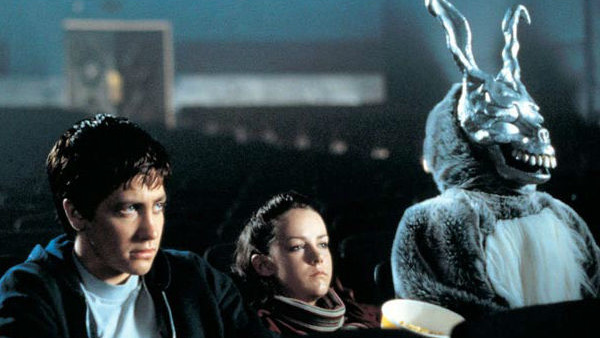
A sure-fire way to ensure people rewatch your movie? Make it confusing as hell, or more generously to the filmmakers, leave it "open to interpretation," such that when audiences leave the film scratching their heads, they feel obligated to revisit it for a second look.
Perhaps the two most blatant semi-mainstream examples of this in cinema history are Donnie Darko and Mulholland Drive - both popular, brilliantly crafted pictures whose surreal, dreamlike narrative trajectories practically guarantee that nobody's going to have made full sense of them after a single watch.
However, because the filmmaking and the performances are absolutely hypnotic, viewers are less likely to blame each feature's confusing nature on the film itself, but rather crave a second, third, maybe even fourth viewing to try and soak in every last detail and fully appreciate what's going on.
In David Lynch's case, he's largely refused to offer much elaboration on Mulholland Drive's tricksy narrative, ensuring it continues to live on as an endlessly rewatchable curio without a clear, concrete meaning - though there are some highly plausible fan theories.
6. To Watch It In Chronological Order - Memento

Christopher Nolan's Memento is one of the most ingeniously premised thrillers of all time, revolving around Leonard Shelby (Guy Pearce), a man suffering from anterograde amnesia as he attempts to solve the mystery of his wife's death.
Nolan visualises Leonard's amnesia through a deviously non-linear narrative, with one sequence of scenes taking place chronologically, while the other plays out in reverse-order, and the two finally meet in the movie's climax.
Even for attentive viewers, it's a heady stew of a feature that damn-near requires at least one additional viewing to glean everything that Nolan's doing. But Memento also goes one step further than this, as the film's DVD release features a special version of the picture in which the story plays out in entirely chronological order.
While there's a strong argument to be made that watching the film chronologically is actually not great - due to the story clearly not being designed to be ingested this way - it is nevertheless a fascinating way to encourage people to revisit it in a highly unconventional new format.
5. To Find Every Easter Egg - Spider-Man: Across The Spider-Verse

Easter eggs are extremely common in any modern franchise movie, because there are few things fans love more than keeping their eyes peeled for dozens, perhaps even hundreds of nods - visual and otherwise - to the wider IP. For some, fan service is one of the big reasons to buy a film when it hits home video.
On that front, there's simply no greater example of this in modern times than Spider-Man: Across the Spider-Verse - an animated masterpiece of a superhero movie that, for all of its visual splendour worth seeing on the biggest screen possible, also feels tailor-made for the freeze-frame treatment at home,
Almost every single shot of Across the Spider-Verse has a neat stylistic detail or reference to wider Spider-Man lore for fans to fixate on. And while most of them will breathlessly rush past you on an initial viewing, on repeat watches you can pause at will and seek out every single detail packed within a given frame.
4. By Being Insanely Prophetic - Contagion

Steven Soderbergh's pandemic thriller Contagion was well-received by critics and performed solidly at the box office in 2011, though at the time it was generally accepted to be a mid-tier effort from the director and ended up fading from the public consciousness in short order.
However, Contagion's popularity surged in 2020 in light of the COVID-19 pandemic, with the film going viral as many pointed out the shocking similarities between its depiction of a viral outbreak and the one which actually happened. But this was no mere accident, as Contagion was tirelessly researched by screenwriter Scott Z. Burns, who consulted with both the World Health Organisation (WHO) and medical experts while penning the script.
More than that, though, Burns also perfectly predicted the frustrating human response to the scenario, both in terms of mass hysteria and how ill-intentioned grifters would capitalise on the panic for their own material gain, with Jude Law's conspiracy theorist character Alan Krumwiede peddling a fake cure.
Following the film's resurgence in popularity, Burns expressed surprise at so many considering the picture prophetic:
"It is also surreal to me that people from all over the world write to me asking how I knew it would involve a bat or how I knew the term 'social distancing.' I didn't have a crystal ball - I had access to great expertise. So, if people find the movie to be accurate, it should give them confidence in the public health experts who are out there right now trying to guide us."
While it's incredibly difficult for films to "predict" future events with any real certainty, Burns clearly did the meticulous leg-work when writing his script, resulting in a feature that, as is ultimately unfortunate, has aged exceptionally well.
3. To Catch Every Sight Gag - Airplane!

Airplane! is one of the funniest films of all time, and while nobody would call its brand of humour subtle, that's entirely the point. In the grand tradition of genre parodies, Airplane! populates almost every single shot with at least something funny - and often, many funny things.
In fact, the frame is often so densely filled with sight gags in both the foreground and background that it's impossible to catch them all on a single viewing. And so, Airplane! and features like it encourage viewers to return for additional helpings not just because they're hilarious, but also because there's so much more hilarity to seek out in the periphery.
Fun fact: a totally scientific study in 2012 claimed Airplane! to be the funniest film ever made, registering an average of three laughs per minute. Though given the sheer density of gags strewn throughout, that's very clearly low-balling it.
2. To Figure Out Who The Killer Is In Each Scene - The Scream Franchise

There's one very simple reason why all-but-one of the Scream films have had at least two killers: it immediately boosts each movie's rewatch value.
Once you've sat through a Scream picture once and found out who the killers are, it's a ton of fun to rewatch each film and try to figure out who carried out which killing.
Though the Ghostface attire obviously cloaks its wearer from head to toe, there are sometimes physical "tells" which make it clear who is doing the slashing in a given scene. And while some of the slayings could only be carried out by one character because the other is accounted for at the time, many death scenes keep it ambiguous, allowing fans to endlessly speculate on who killed who throughout the franchise.
Knowing the identities of the killers and then revisiting the movie to make sense of who was donning the Ghostface attire at any moment, is a total blast.
1. To Revisit It At A Different Age - Boyhood/Toy Story

Coming-of-age movies focused on the relationship between a child and their parent(s) invite the audience to revisit them in an altogether more poignant way, because how you engage with them as a younger person compared to how you relate as an older adult will be very different.
Take Richard Linklater's Boyhood, which chronicles protagonist Mason's (Ellar Coltrane) transition from childhood into adulthood from the ages of six to 18, as was captured by Linklater over the course of 12 years in real time.
Watched in younger days, you'll surely find kinship with Mason, but come back to it today, a decade later, and you may well connect more with the experiences of Mason's parents (Ethan Hawke and Patricia Arquette).
Granted, Boyhood is literally only 10 years old, so for many it might be a little while longer before it truly connects with them on a different level from that first viewing, but the same can be said for other popular movies with coming-of-age elements, such as Toy Story.
Watching the original Toy Story as a kid yourself and identifying with Andy is an entirely different experience to watching it 20 or 30 years later and perhaps being a parent yourself, where you'll likely see it through the eyes of Andy's mother instead.
Roger Ebert once famously called cinema the "Empathy Machine", and honestly, is there any better expression of it than this?