10 Great Books That Made Utterly Terrible Movies
 These days, it's hard to find a movie based on a completely original idea. More than likely, you're going to find movies that have been adapted from pre-existing stories, with books as the most popular medium. That's not necessarily a bad thing: books being made into movies has been a staple of the cinema scene since forever. Many movie classics were based on books, and in some cases, the movie ends up being better than the book, or at least better well-known: I'm looking at you The Godfather and The Shawshank Redemption. Still, sometimes it's better to just let the books remain as books. The movie adaptation formula doesn't always work, and more often than not, we get adaptations that pale in comparison to the original written works. And I'm not just talking about leaving a movie thinking: "That was good, but the book was better." I'm talking about movies where, having seen them, you have to re-read the book as quickly as possible just to assure yourself that the original story was actually good. So movie studios, listen up: just because you have the opportunity to turn a book into a movie doesn't mean you always should. Sometimes, that unforgettable story that people loved and admired can't be replicated on the silver screen. Sometimes, a two-hour running time isn't enough to squeeze everything into a coherent narrative. Sometimes, altering the book's story to make it more appealing to a movie audience doesn't actually make it more appealing. Don't believe me? Take a look at the 10 movie adaptations gathered here - all terrible compared to the books that they were based upon...
10. Bonfire of the Vanities
 I had not heard of this book before writing this list, but after a little research, I stumbled upon it. Written in 1987, "Bonfire of the Vanities" follows a black activist, a bond trader, a Jewish lawyer, and British journalist as they navigate through the greed and politics of 1980s New York. Author Tom Wolfe wanted the book to capture what life in 1980s New York really was like, from the societal differences to racial tensions. Like the rest of the books on the list, it was a critical success. The movie, however, was the complete opposite. Released in 1990, the film was a failure across the board. Directed by Brian De Palma, who three years before gave us "The Untouchables," the film was critiqued largely for its pacing issues and for focusing too much on Tom Hanks' character rather than the story itself. Even De Palma later admitted that it had been a mistake to place so much emphasis on Hanks' character. Another problem was that the movie had a more comedic tone compared to the book's dark narrative. But hey, the movie was popular in Eastern Europe for a while. That has to be worth something. Right?
9. The Scarlet Letter (1995)
 If you're like me, Nathaniel Hawthorne's classic was probably required reading in high school. For others, their only exposure to it has been its influence on the teen comedy film Easy A. For the few of you who still don't know what I'm talking about, here's a brief synopsis. In Puritan Boston, Hester Prynn is forced to wear a scarlet "A" on her clothing to signify her shame as an adulterer. Raising her daughter Pearl by herself, Hester must do whatever it takes to keep her daughter in her custody. We also watch as the mystery of Pearl's father is revealed over the course of the novel. While there have been several adaptations of the novel, the 1995 movie featuring Demin Moore and Gary Oldman was panned critically upon its release. The film's major criticism was its deviation from the book's ending, as well as other liberties with the story. To further back people's hatred of the film, it was nominated for seven Golden Rasberry Awards, including "Worst Remake or Sequel," as two nominations for Demi Moore and co-star Robert Duvall. I'm going to have to agree with Emma Stone's character from Easy A on this one: if you absolutely feel the need to watch a movie version of the story, stick with the old black and white film. This one is not, and never will be, worth your time.
8. Gulliver's Travels
This entry is a perfect demonstration of what happens when you loosely translate a book so much that only one plot element is intact for the movie. In this case, "Gulliver's Travels." Written by Jonathan Swift in the 1700s, this satirical classic follows Gulliver as he finds himself in predicaments on four different supernatural locales: an island of tiny people, an island of giants, a floating island of intellectuals, and an island where horses are the intelligent beings. The movie has one thing in common with the book: a guy named Gulliver finds himself stranded on an island of tiny people... and that's it. Yes, this comedy led by Jack Black was only loosely adapted from the novel and is instead about a depressed mail room employee who helps the tiny people save their community. Oh, and did I mention that Jack Black is dressed up as a baby for part of the movie when he is kidnapped? Yeah, that actually happened. This movie might have appealed to children, but the juvenile humor that it relied on ended up being its downfall. Here's the thing: if you're going to make a movie based a book using the book's original title, at least make it resemble the source.7. The Golden Compass
 Taking place in an alternate universe where people's souls exist as sentient creatures called daemons, "The Golden Compass" follows a young girl named Lyra and her daemon Pantalaimon as they search for her missing friend and her uncle Lord Asriel, who was experimenting with a mysterious substance called "Dust." She must also face off against Ms. Coulter, who leads a mysterious group known as the Gobblers who have been kidnapping children from around the world. The book was the first in a trilogy that expanded its adventures to our world as well. The movie featured an excellent cast that included Nicole Kidman, Sam Elliot and Daniel Craig. However, although the special effects of the movie were top notch, the movie itself failed to live up to the book's popularity. The simple fact is that the book had too much going on to be effectively shown in a movie. As a result, the movie's story was crammed way too tight for its barely two hour running time. Combine that with some changes made to the movie's story, and you get a film that lacked the emotional appeal that made the book such a great read. The sad part about all this: the movie ended on a cliffhanger because it was expected that its sequel "The Subtle Knife" would be made into a movie. Six years later, and there still doesn't seem to be any hope of it getting made.
6. Bicentennial Man
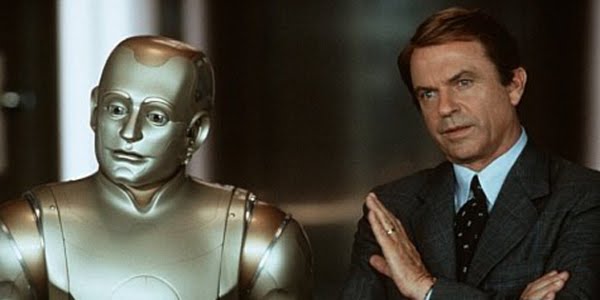 Bicentennial Man was based off Isaac Asimov's novel "The Positronic Man." Released in 1992, the story follows a robot named Andrew who is a servant to the Martin family. As he learns about human behavior and emotions, he starts to act like the humans he serves and yearns to be more than just a mechanical man. Over time, he replaces the mechanical parts of his body with organic parts, turning him slowly into a human. The movie followed the same premise as the book (along with some added plot points), but unfortunately the Robin Williams-led feature was not able to convey the same tone as the book did. Yes, there were some comedic moments with Williams in the robot suit, but when it comes to a science fiction tale like this, humor isn't necessarily the best medium to convey the tone. Cluttered with sentimental cliches and bad dialogue, the movie was less of a look on humanity and more of just a romantic fantasy movie.
5. The Cat in the Hat
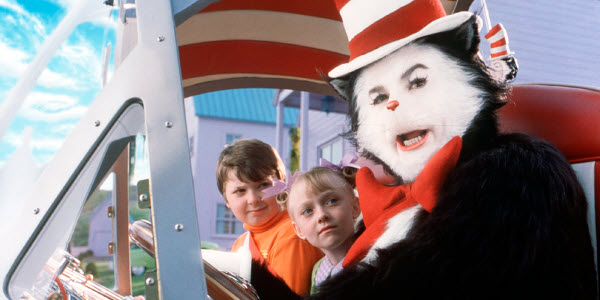 Ah, "The Cat in the Hat." We all grew up with this Dr. Seuss book as children. For those of you whose parents raised you under a rock, the book is about two children who are home alone on a rainy day with nothing to do. Suddenly, an anthropomorphic cat with a tall hat and a box filled with random crap comes arrives at their doorstep and entertains the children, which ultimately results in complete chaos. You'd think that it would be impossible to make a feature-length film based off a short story like this, but when you combine Mike Myers in cat-makeup with wacky subplots and special effects, anything is possible. The problem is that this movie took out all the heart the original story had. Ignoring the sexual innuendos and threats of violence that are peppered throughout this PG-rated film, the movie itself just doesn't work. Not only do you have a crazed cat who is destroying the house, but you've also got the side-villain played by Alec Baldwin who is dating the children's mother and wants to ship the boy off to military school. Right, but wouldn't he still have to interact with the daughter? With a bad story and humor that about as tasteless as can be, it's no wonder a sequel was never made. This movie was so bad that Audrey Geisel, Theodore Geisel's wife, forbid anymore live-action adaptations of her husbands work. It was for the best, because although we'll only be seeing CGI Dr. Seuss movies in the future, anything is better than this crap-fest.
4. The Da Vinci Code
 When Dan Brown released "The Da Vinci Code" in 2003, it took the world by storm. A worldwide bestseller, the book followed Professor Robert Langdon as he followed clues left by a deceased museum curator, which eventually leads him to on a mission to track the location of the Holy Grail. The book received a lot of attention from its depiction of the Catholic Church and its historical deviations of European history. Honestly, while the book wasn't an extraordinary piece of literature in retrospect, I found it quite exciting the first time I read it. Unfortunately, I didn't feel the same excitement while watching the movie. Starring Tom Hanks and Ian McKellen, the movie was overly complicated and lacked the thrill that the book provided. The movie was also cenosred in multiple countires due to the content, as well protested in some areas in the U.S. Hanks, McKellen, and the other actors played their roles fine, but the movie itself never amounted to much even with all the money it raked in. The worst part about all this is that director Ron Howard is still making adaptations of these Robert Langdon novels. "Angels and Demons" was released in 2009 and was only slightly better than its predecessor, and the film version of "Inferno" is scheduled to be released in 2015. My thought: if the first two movies were generally panned, it's probably not a good idea to go through with the third one.
3. The Time Machine (2002)
 H.G. Wells is considered by many to be the father of science fiction, and for good reason. With books like "War of the Worlds" and "The Invisible Man," he introduced ideas to literature that would form the basis of what science fiction is today. However, his most famous novel (and my favorite), is "The Time Machine," a term which Wells himself came up with. The story follows a nameless inventor who creates a machine that allows him to travel through time. While using it, he ends up in the year 802,701 A.D., where the Earth has deteriorated into a more natural setting and is inhabited by two primary species: the peaceful, childlike Eloi, and the nocturnal, monstrous Morlocks. The novel itself is rather short, so like many literary adaptations, things needed to be added to make the story more coherent. Unfortunately, the story itself and many of the characters suffered as a result. I was especially bothered by the writers changing the Eloi from childish humanoids to just primitive humans. I get that the protagonist needs a love interest, but by changing the basic essence of what a character originally was, you're missing the point of the story. Add in a holographic A.I. who gives sarcastic remarks and inconsistencies regarding the nature of time travel itself, this movie took a story that was an excellent social critique and dumbed it down to a blockbuster adventure film. If you want to see a good "Time Machine" movie, stick with the classic Rod Taylor film. You won't get any satisfaction watching this adaptation.
2. All The King's Men (2006)
 I consider this book to not only be a great piece of American literature, but one of the defining political novels of the 20th century. Through the eyes of narrator Jack Burden, we watch the journey of charismatic Willie Stark through his political career. Stark, the fictional parallel of Huey Long, starts out as an idealistic lawyer who wants to leave his mark on the political landscape. Idealism only goes so far for him, though, as he eventually succumbs to corruption to finance his political machinations and uses intimidation to make sure his opponents never stand in his way. With a star-studded cast that included Sean Penn, Kate Winslet, and Anthony Hopkins, the 2006 adaptation was said to be a more direct adaptation of the book. Unfortunately, it was a critical and commercial failure at the box office. The film's narrative felt bogged down and was overly complicated - not to mention boring. They also removed the subplot of Willie dealing with his son Tom, which I thought was a mistake. Basically, the movie lacked the energy and political insight that made the book the classic it is today. It goes to show that just because the movie has the look it doesn't mean it has the right "feel."
1. Eragon
"Eragon" was one of the few fantasy stories that appealed to me while growing up. The first story of the Inheritance Cycle, we follow a boy named Eragon whose ordinary life is shattered when he discovers a dragon egg. The dragon hatches several months later and Eragon names it Saphira. However, with most of the dragons having been killed centuries before under the command of Galbatorix, King of the Empire, Eragon and Saphira are forced leave their village when Galbatorix's agents come searching for him. His uncle having been killed, Eragon swears revenge, and with the help of a storyteller named Brom, he goes forth with Saphira to discover his destiny. The book itself was influenced from Star Wars and "The Lord of the Rings," but there was still a degree of originality that made Eragon an exciting read. Sadly, the movie lacked none of that originality. Released in 2006, the Eragon movie was a poor attempt at starting another book-based movie franchise. Financially, it was a success, but the movie itself sucked. Even with Jeremy Irons and John Malkovich as part of the cast, the movie lacked all the excitement that made the book a joy to read. Those influences that I mentioned earlier were reflected more prominently in the movie, making it look like a rip-off of previously seen adventure movies. One thing that especially irritated me was how they changed Arya from an elf to a human. Not only was this unnecessary, but Arya's elven heritage is crucial to the plot of the books. If the movie series had been allowed to continue, there would have been major inconstancies between the books and movies. This movie taught me a valuable lesson: just because a book reads like a movie doesn't mean it should be adapted as one. Like this article? Let us know in the comments section below.