In early January of this year, former Canadian Defense Minister Paul Hellyer claimed to the world's media that "aliens already walk among us". He went on to state that they are currently refusing to share their technology with us until we change our warring and polluting ways. Hellyer claims that there are around 80 different species currently active on earth, ranging from Tall Whites who are working with the U.S. Air Force in Nevada to other who look just like us - we could pass them on the street and we'd have no inclination that they were from another planet.
While readers might want to take Hellyer's statement with a pinch of salt (or not - some people believe the idea is entirely plausible), when it comes to the movies, aliens most definitely have been walking among us for several decades. They're back with us again this week, this time in the tempting guise of Scarlett Johansson in Jonathan Glazer's latest film Under the Skin. Johansson plays a predatory alien sent to earth to prey on unsuspecting hitchhikers - an intergalactic seductress treading new territory between the boundaries of existential musings and feminine sexuality. Here's a clip from the movie which is released in UK cinemas from tomorrow; https://www.youtube.com/watch?v=LZLgq5FqWzA Former Defense Minister Hellyer's claims that most of the aliens walking among us today are relatively benign might well be the truth, but when it comes to aliens disguised as humans in films it isn't necessarily quite so clear-cut. The following are some of the great movies where aliens - with good intentions or bad - don their human form and blend into society.
10. The Man Who Fell To Earth
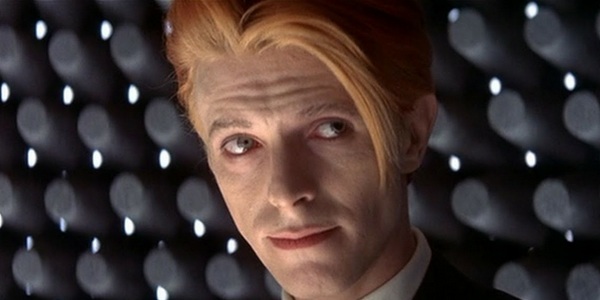
With his timeless androgynous appearance, David Bowie is perfectly cast as Thomas Jerome Newton, the extraterrestrial who crash lands on Earth while desperately looking for water for his drought-ridden home planet. With his advanced understanding of technology it doesn't take long before he amasses a huge fortune as the head of the World Enterprises Corporation, and sets about constructing a new ship to take water back to his planet. In the hands of one of the great visionary directors of the 1970s, Nicholas Roeg, The Man Who Fell to Earth is something of a surrealist puzzle box of a movie. Roeg plays with time and memory, cutting away to scenes of Newton's family slowly dying on his home planet along with hints that he exists in multiple time frames here on Earth (given that time as we know it is a human construct this makes sense - for an alien race, time may well be little more than an illusion). As visually arresting as it is thematically ambiguous, The Man Who Fell to Earth is the kind of ambitious science fiction movie rarely seen today, as much a profound commentary on modern values and culture as it is an experiment in narrative structure. The fact that Bowie was heavily into cocaine at the time only adds to the fragility of his character Newton, who gradually falls to pieces as his mission becomes increasingly unattainable.
9. Slither
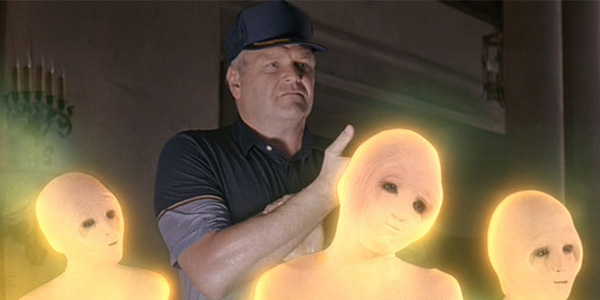
If The Man Who Fell to Earth is something of an art house meditation on our cultural values in the context of alien visitation, then Slither sits comfortably at the other end of the genre spectrum; a trashy, gory and hugely entertaining B-movie romp heavily influenced by the body horror excesses of David Cronenberg. In typical B-movie fashion Slither finds us in small town middle America, territory familiar to anyone who's seen Gremlins or the Critters series. When local car dealer Grant Grant (Michael Rooker) stumbles across a mysterious meteorite it isn't long before he finds himself infected by a deadly parasite intent on taking over the planet, and despite his best efforts to hide the infection from the townsfolk, before long he's infecting his neighbours with his intergalactic offspring. Slither is wonderfully schlocky horror which builds to a visually inventive grand finale in which the human appearance has well and truly slipped to reveal the tentacle-strewn true face of the invader, an incarnation which owes a clear debt to Brian Yuzna's Society, not to mention a certain sci-fi horror classic by John Carpenter (which we'll have a close encounter with shortly...)
8. Cocoon
From sucking the life force out of the entire human race to rejuvenating the elderly with a swimming pool charged with a powerful "life force", Cocoon shows that sometimes the aliens really do come in peace. Cocoon plays on the idea of the ancient city of Atlantis as the outpost of an alien race known as the Antareans, a peaceful race of aliens who return to Earth after 10,000 years to retrieve their ancestors. Assuming human form, they inadvertently give away their extraterrestrial origin when ship captain Jack Bonner (Steve Guttenberg) sees one of them transform from a beautiful woman to her alien self. He agrees to help them retrieve the titular cocoons and return to their home planet, but the "life force" swimming pool is slowly being drained of its rejuvenating properties by a group of increasingly lively retirees. Cocoon is an affable comedy at heart, with a message about youth and immortality that bears a resemblance to the Spielberg-directed episode of The Twilight Zone: The Movie, Kick the Can, in which reminiscences about the joys of youth become a reality thanks to the magical interjection of the mysterious Mr. Bloom. A feel-good movie through and through, anyone watching who grew up in the 80s will undoubtedly find themselves asking as the credits roll, "What on earth happened to Steve Guttenberg?"
7. Invasion Of The Body Snatchers
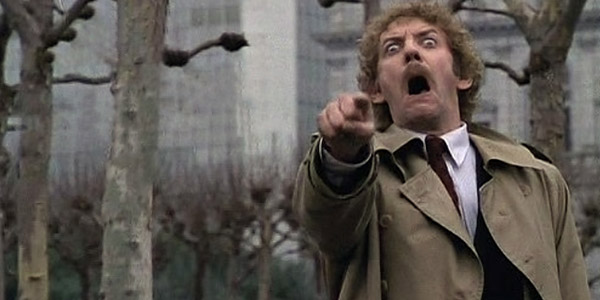
When Philip Kaufman remade the 1950s sci-fi classic Invasion of the Body Snatchers in 1978, the Cold War might not have been over but the "reds under the beds" hysteria had certainly died down. Subsequently, Kaufman toned down the Communist hysteria allegorical aspect of the original film (itself an adaptation of the novel The Body Snatchers by Jack Finney) focusing instead on the interpersonal paranoia, as human beings are increasingly replaced by unemotional parasitic aliens. Donald Sutherland stars as health inspector Matthew Bennell, who soon finds himself drawn into a web of extraterrestrial intrigue in which autonomous pod people seek to take over the human race and transform them into a mindless, obedient collective. While there is an undercurrent of political commentary and the dangers of conformity (laughed off by some critics at the time as "liberal nonsense"), Invasion of the Body Snatchers is best enjoyed as a thriller, where disquieting tension rises to the full blown horror of a world in which no one is who they appear to be. A great film in its own right, Invasion of the Body Snatchers is proof that not all remakes are unnecessary - indeed, in the right hands they can both pay homage to and exceed their originals, a fact today that most of us will agree Hollywood would do well to remember.
6. Men In Black
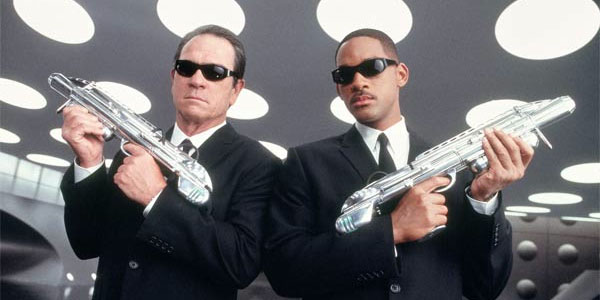
Sometimes, creatures from outer space come in all shapes and sizes - and nevertheless somehow manage to squeeze themselves into a human body. With that much interstellar traffic it takes a specially trained team of secretive government agents to keep them all in check - introducing the Men in Black. Men in Black are a staple of conspiracy lore and the movie of the same name certainly plays every reference in the book and throws in a healthy dose of big budget action and sidekick comedy to boot. Agents K and J (played with ultra cool style by Tommy Lee Jones and Will Smith) working for the eponymous government agency soon find themselves hot on the heels of The Bug, a highly dangerous alien threatening to destroy Earth. Cue shape shifting aliens, exotic futuristic weaponry and action galore. Men in Black remains today a classic example of how to do a summer blockbuster properly. Rick Baker's character design is inventively over the top, the script by Ed Solomon bristles with wit and warmth and the performances are delivered with aplomb, most notably the two leads, with Jones's surly, stoic old-timer bouncing off Smith's loud-mouthed young upstart in one great scene after another. Few Hollywood bl0ckbusters deliver as much fun as Men in Black.
5. The Thing
Whereas the remake of Invasion of the Body Snatchers took the paranoia of the Cold War and reconfigured it in the densely populated city of San Francisco in the 1970s, John Carpenter's remake of the 50s classic The Thing From Another World sticks closely to the claustrophobic setting of the original - a small band of research scientists isolated in the Antarctica. Kurt Russell stars as Jack MacReady, the helicopter pilot who discovers a strange smouldering corpse at a nearby Norwegian research station and takes it back to his colleagues to analyze, after a mysterious dog arrives at the compound, pursued by grenade-wielding Norwegian scientists. The evidence soon leads to the discovery a vast alien craft buried deep within the Antarctic ice, and before long an alien presence has begun working its way through the camp, assimilating people one by one. Infamously a box office failure having followed on from the cutesy success of E.T. The Extra-Terrestrial, The Thing has justly gone on to become a bona fide cult classic. It's not hard to see why: Rob Bottin's incredible visual effects - all puppets, latex and animatronics - prove that hands-on special effects can often out-trump CGI (just watch the vastly inferior, CG-laden 2011 prequel/remake to see for yourself). The plot may well suspend logic - and disbelief - from time to time, but with a film so gleefully intent on scaring the pants of the audience it's a small criticism to be made. Several decades since its release, The Thing's legacy to science fiction horror remains secure.
4. Earth Girls Are Easy
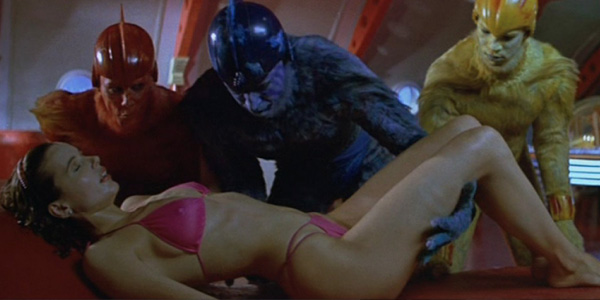
From all-male cold winter bleakness of the Antarctica to the sunny, scantily-clad Valley Girls of Los Angeles in the musical comedy Earth Girls Are Easy, about as silly and throwaway piece of Hollywood entertainment as you're likely to find. Geena Davis stars as manicurist Valerie Gail, who suddenly finds a trio of horny male aliens enter her life after they land in her swimming pool while she sunbaths. Intrigued by these strange hairless females, the aliens are given a quick shave by Valerie so as not to arouse suspicion, whereupon she takes them to parties, L.A.-style - a world where everyone bursts into song at the drop of a hat. Earth Girls Are Easy is nothing if not tacky, gaudy and more than a little stupid, but it certainly retains some charm amidst the unsophisticated nonsense. As to whether or not earth girls actually are easy - I'll leave it to the aliens to reserve judgement on that one.
3. The Brother From Another Planet
If you're an alien who has escaped enslavement and landed in Upper New York Harbour and you look like an African-American, you could find much worse places to hide than Harlem, which is where The Brother winds up in John Sayles's ultra low budget 1984 movie, The Brother From Another Planet. Mistaken for a mute homeless man, The Brother (Joe Morton) finds himself taken in by kindly locals who are intrigued then amazed by his ability to fix all things technical. They attempt to help him integrate into society, even finding him a job at a video arcade. But as he gradually becomes accustomed to his surroundings, he finds himself hunted down by two mysterious men in black - aliens who are out to re-capture escaped slaves and return them to their home planet. The Brother From Another Planet has plenty of humorous moments which subtly play on the intergalactic fish out of water premise, and as you may expect from John Sayles there's an allegorical subtext to be found about the nature of immigrants and how they struggle to integrate into "alien" societies. It all works beautifully thanks to Morton's silent yet expressive performance, and the fact that it was shot on a shoe string budget of $350,000 shows that a lack of money is no obstacle to delivering a solid movie.
2. They Live
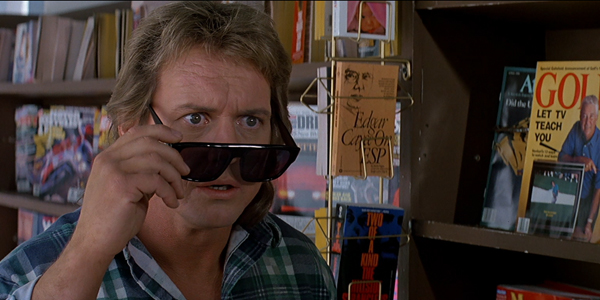
It might seem to some that featuring two movies by John Carpenter is over-indulging the director a little, but few films have increased their status as a cult classic in recent years as his 1988 movie They Live, widely considered to be far more prescient today than it was on its release. They Live follows a drifter by the name of Nada (played by former wrestler Roddy Piper) as he looks for work on a construction site and befriends Frank Armitage (Keith David). After discovering a box of sunglasses in a seemingly abandoned church, he puts a pair on and they reveal a black and white world where the billboards contain ominous messages instructing people to "Obey" and "Consume", while people in positions of power and authority are actually humanoid aliens with skull-like faces. He soon hooks up with a group of underground activists and freedom fighters, who inform him that Earth is under the control of an alien race who intend to deplete it of all its resources while using advanced technology to keep humanity in a subliminal state of ignorance. With its themes of mindless consumerism, environmental degradation and the cold, psychopathic hidden side to the ruling elites, it's clear why They Live has transformed itself into something of a cultural meme in today's society, increasingly skeptical of the power-that-be as many people have become. It also features one of the most entertainingly silly and protracted fight scenes ever committed to film as well as one of the best ad-libbed lines in science fiction, "I have come here to chew bubblegum and kick ass. And I'm all out of bubblegum". What more could you ask for?
1. Superman
I suppose it was inevitable - how can anyone compile a list of cinematic aliens walking among us without including the true icon of the concept? Who is more legendary in popular culture than Superman? (I think we can safely say that's a rhetorical question). Clark Kent is the quintessential alien among us; clumsy and awkward with a barely-concealed crush on his colleague Lois Lane - no one would think for a second that he was also Superman, flying through the skies saving the world from destruction. Of course, you're better off watching the original Superman movie to get a feel for this dynamic, since Zack Snyder's Man of Steel dispensed almost entirely with the idea of Superman-as-Kent integrating into normal society while saving people from burning buildings, preferring instead to refashion him as a brute force content with destroy entire cities in the name of saving the planet (if you can't reinvent the wheel you can always smash it to pieces). Far better - in the context of this list, at least - to enjoy Superman in his Christopher Reeve incarnation, with a greater emphasis on the Clarke Kent alter ego as he lives and works in a huge metropolis, contrasting Snyder's drifting loner seeking escape. As colourful and camp as Richard Donner's 1978 original may well be, it certainly has a lot more fun with his interaction with the other characters, not least a genuinely engaging love story between Superman/Clark and Lois Lane and some great banter with Lex Luther and his goons. The time reversing finale, while it does beggar the question, "Why doesn't Superman just turn back time every time something bad happens?", has at its core an emotional resonance which seems far more satisfying than snapping someone's neck in a fit of rage (with the added caveat that this is my opinion, as much as it may unleash a can of worms). If there's a better way to end a list like this or if you can think of any glaring omissions, I'm all ears. Why not post a comment below?