10 Great Sci-Fi Movies For The Modern Age
It's not all about going to space...

It used to be when people thought of science fiction they thought of spaceships, aliens, Star Trek; if it's nerdy, stick it in the sci-fi bin and leave it to someone with the niche tastes required. But as we move further into a world reliant on tech, science is more and more a part of our daily lives, and the gap between fiction and reality closes.
It follows that this should be reflected in a medium that’s preoccupied with our lives on this planet, film. Sci-fi is becoming less confined to a genre and more of an aspect of our existence. Whether a film is a comedy or a horror or a romance, technology is becoming so ingrained in the way we relate to one another that it’s elemental to a modern reading of the human experience.
That’s not to say sci-fi in the modern era doesn’t still have it’s fair share of aliens and spaceships, but the good ones present this with realistic responses, explanations and repercussions.
10. A Quiet Place

Has silence ever been so exhilarating? The success of A Quiet Place lies in its commitment - you really aren’t going to hear a lot of dialogue in this taught 90 minute thriller.
Here sci-fi is more of a utilitarian element. The film needs an antagonist that will kill you at the drop of a pin from seemingly any distance, but can’t see a thing... Aliens? Sure, that’ll work.
This may be an extreme example, but like most good sci-fis today the actual science fiction part is mostly a means to an end to tell a larger story about humanity. The story here is one of family, survival and teamwork but the reason you need to see A Quiet Place is for its technical execution.
From the sound design to the pacing and the performances, A Quiet Place will have you locked in from the outset, not saying a word.
9. Ex Machina

Ex Machina tackles the question of A.I but like never before. Where as we may get hand-waved explanations of the tech in say, I Robot, Ex Machina has done it’s homework and is all the more terrifying for it. We follow computer programmer Caleb Smith (Domhnall Gleeson) as he wins a company competition to spend a week at the isolated home of his CEO Nathan Bateman (Oscar Isaac), shadowy tech billionaire of a prominent search engine now dabbling in androids and A.I, remind you of anyone?
Caleb is tasked with testing Nathan’s latest creation Ava (Alicia Vikander), a lifelike android on the cusp of consciousness. Part of the film’s brilliance is how it deals with the tough questions, how did Nathan get close to the problem of consciousness in machines? Well, by illegally harvesting search engine data from every phone on the planet, allowing him to not only know what people thought about, but how they thought, cataloging the patterns between their searches.
Ex Machina’s brilliance lies in its tantalising plausibility, just out of reach yet rooted enough in what we know to make you feel your synapses fire along with Ava’s progression, expanding our consciousness as we explore the possibility of creating a consciousness - plus Oscar Issac turns in one of the dance performances of the last twenty years.
8. Arrival

Arrival asks, what would actually happen if Aliens landed on earth and just wanted to talk? It’s a strong addition to the new wave of sci-fis that deal with other-worldly situations with painstaking rationality. It follows the Earth’s struggle to communicate with and assess the threat posed by an Alien touchdown. Amy Adams plays a linguist, Louise Banks, tasked with deciphering the cryptic language signed out by the “Heptapods” as they meet us face to face.
As Louise begins to unpick the language she and her team cross reference what they find with nations across the planet also dealing with the Alien visitors, they soon learn that communication across the globe and beyond can result in a miraculous evolution. Part of that evolution is the idea that time is not necessarily linear, but Arrival grounds the Alien chit chat and time skipping craziness in a poignant story of human loss and longing.
The humanist story at the core brings an emotional weight that contextualises the Alien aspects within human experience, elevating the film to new frontiers of emotionality.
7. Under The Skin

Under The Skin gets us inside the head of an Alien visitor like never before. We are aligned with Scarlett Johansson’s unnamed character as she, or it, makes their way through Scotland; preying on unsuspecting men along the way. Under The Skin was innovative for its use of hidden cameras that captured real people reacting to Johansson’s performance; as well as the film’s uncompromising arthouse aesthetic.
Much of the film is bereft of dialogue, but chances are, if you showed up on an Alien planet you probably wouldn’t be fluent in the lingo would you? As Johansson’s character analyses her surroundings, the pitch perfect score from Mica Levi hints that she is often overwhelmed by the cacophony of human existence, not knowing what to focus on amid all the noise.
Under The Skin remains one of the most realistic and experiential portrayals of what it would be like exploring a planet completely alien to your own.
6. Melancholia

Much of Melancholia takes place on a couple’s wedding night, we see the familiar tropes of the disgruntled in-laws, the happy, if slightly exacerbated newly weds and the catering staff who are watching the clock waiting for it all to be over - be careful what you wish for. As the wedding progresses we get the sense that something is off with the bride Justine (Kirsten Dunst), she appears distracted, disengaged, on another planet at times. It appears she knows something we don’t.
That something is that Melancholia, a rogue planet, is going to collide with earth. Others are convinced it will brush right by and see it as just a conversation piece, and that’s how it functions for much of the film. The subject of Melancholia orbits the story quietly in the background as we zero in on Justine’s relationship with her new husband, but it seems she’s already weighed down by the pull of Melancholia.
The film uses something out of this world (a literal other planet) to intensify an experience that is uniquely human. Director Lars von Trier said the film was spawned from a depressive episode he suffered, and it seems to permeate the film’s dream- like atmosphere of doom punctuated by existential crises. We can see this in Justine’s behaviour throughout, she retreats into herself only to act impulsive and rash at other times, she seems hopeless, manic and resigned to her fate all at once.
Melancholia shows a trend for character-driven sci-fi. The fantastical elements are hidden within a story of interpersonal relationships. The impending armageddon sharpens the nuances of human existence to a level that couldn’t be reached in your average drama.
5. Annihilation

Annihilation caused some initial buzz for its all-female leading cast when it was announced, but there’s plenty of substance to back up its style. A Biologist named Lena (Natalie Portman) and her team are tasked with entering “The Shimmer”, a dividing line that crosses into a section of the American coast affect by a downed meteor, now referred to as “Area X.” A group of intrepid explores in unfamiliar, often dangerous surroundings may seem fairly old hat to an avid sci-fi fan but Annihilation shines through its exploration of theme.
Woven into the film’s hallucinogenic atmosphere is a theory that seems doomed to prove itself time and time again, mankind will always lean towards self destruction. Annihilation, if you will.
Some proof of this lies in the act of Lena and co. entering “Area X”, from which only one person has ever returned, and they were never the same. There’s also “The Shimmer” itself, which looks a lot like an all encompassing oil bubble covering this unspecified area of the American coast, a confirmed parallel to the disastrous BP oil spill in the gulf of Mexico - an instance of some real life self destruction from us lovely humans.
Within “The Shimmer” DNA appears to refract, realign and coalesce into terrifying and hauntingly beautiful amalgamations (see the bear with human screams and the human/flower hybrid scenes respectively.) When Lena’s DNA is taken by an Alien in humanoid form the Alien begins to mimc her movements; creepy? Absolutely, but not necessarily hostile. The humanoid begins to take on Lena’s exact appearance and as if this were the final straw, Lena responds by obliterating the image of herself with a grenade. Thus, the theme of self destruction is brought full circle and we have to question whether the most hostile lifeforms in the universe are human.
Annihilation tackles the problem of mutation and destruction in a way that could only come from the reality we find ourselves in today, unfortunately that’s our tendency to bring about our own doom.
4. Coherence

Coherence follows eight friends at a reunion dinner party when the close passing of a meteor splits open the fabric of the universe and unspools parallel realities. This sounds pretty high concept and it is, but the low budget aesthetic of Coherence works to its advantage. It feels gritty and real, managing to smuggle in the overblown idea amongst the familiar back-biting of old friends that maybe aren’t so friendly anymore.
As they investigate further, the dinner party turns into a malevolent game of musical chairs with the group hopping between realities, hoping to find out what’s going on and end in the right, or at least the best reality before the music stops. Questions start to arise as the group ask if everybody is who they say they are and relations threaten to implode along with reality.
Coherence’s ability to tap into the visceral and disturbing side of becoming unstuck in the universe gives it a nastier edge than a lot of its contemporaries. It takes the balancing act of realism, horror and high concept in stride, earning a category all of its own.
3. Her

Her deals with the duality of Tech as both a force of isolation and new levels of connectivity. We follow Theodore Twombly (Joaquin Phoenix) as he falls in love with an artificially intelligent virtual assistant voiced be Scarlett Johansson, think Siri, but now it’s the life of the party.
The film asks what makes a relationship real, does it need a physical element or are words and emotions enough? In an age where people fall in love online and have a relationship for years without ever meeting (looking at you Catfish), this seems like a prescient preoccupation for the new wave of sci-fi.
Not many films can boast being so captivating when one of the main characters is a disembodied voice, that’s a testament to the ideas on display in Her, an exploration of how tech may augment our romantic lives for the better and for the worse. Would romance with an A.I bring new heights of compatibility or new depths of inadequacy, on levels our human brains are yet to even comprehend? It seems all the tech in the world might never solve that love algorithm.
2. Inception

If you don’t know about Inception by now then perhaps you’ve been asleep for 10 years. But that's good news, because Christopher Nolan’s start-studded psychological heist takes place in dreams as well, so you’ll fit right in.
Nobody needs the essay of attempted plot synopsis for this one but it’s safe to say Inception proved more than most that sci-fi doesn’t have to be about pointed ears and tractor beams. Slick, stylish, intelligent and with more layers than the earth’s crust, Inception ask whether the most dangerous frontier is our very own psyche.
Nolan’s masterful set pieces coupled with an all star cast and an iconic score from Hans Zimmer make Inception a modern classic. Whilst many genres would like to claim Inception for their own, this dream-hopping tour de force sits firmly in the sci-fi camp and showed studio executives that the modern audience were hungry for the challenging and original stories sci-fi could provide.
1. The Lobster
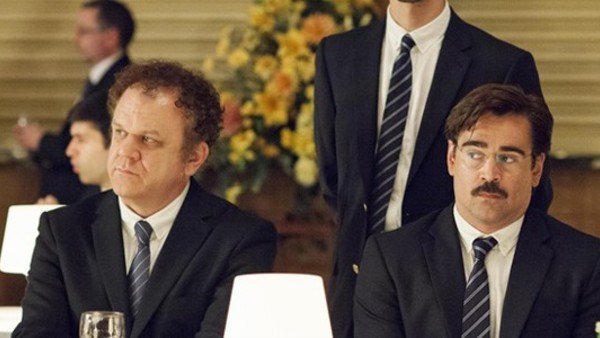
Single people are given 45 days to find a partner of they will be turned into animals. Sounds kind of charming right? No, not really. The lobster resists complete whimsy and acknowledges that being turned into an animal against your will probably wouldn’t be all that great.
It’s a story of dating in a dystopian future with a prevailing atmosphere of stilted, pitch black comedy, a little horror and a lot of awkwardness, like any Tinder date then really. If you want to find a match it helps to have a characteristic in common, literally any characteristic. Our hero (?) David, played by Colin Farrell, gets put through the ringer trying to learn the ropes of this dating world; like when a love interest kicks his brother to death.
He finds compatibility in a fellow short-sighted girl only to have it taken away when she’s blinded. We’re left to wonder in the closing scene as David stands at the mirror with a steak knife.
The Lobster is a hyperreal portrayal of the exhaustive search for love, ironically driving humans to act rather out of character when threatened with loosing their identity.