10 Greatest Directorial Debut Sci-Fi Movies
Experience isn't everything when it comes to creating a science fiction classic.

Science fiction can be a difficult genre for even the most experienced of directors to bring to the big screen. By its very nature, sci-fi deals with concepts and scenarios that are highly imaginative, and therefore can often be tricky to visualise in a convincing manner. It seems ludicrous that any first time filmmaker would want to jump in at the deep end with a sci-fi flick, and even more so that the end result would be brilliant. Even Stanley Kubrick made 10 films before he attempted to tell the entire history of humanity with the sci-fi epic 2001: A Space Odyssey.
Thankfully, there are a handful of directors who took the plunge into filmmaking with science fiction, and came out the other end with a stone cold classic. Whether they be showcases of dazzling special effects, or thoughtful examinations of some of the deepest philosophical questions life has to offer, these films somehow managed to not only be good, but revered for years to come.
So on that note, let's take a look back at some of the greatest freshman efforts that science fiction cinema has to offer.
10. Ex Machina

Alex Garland was no stranger to the big screen when he made his directorial debut with Ex Machina in 2014. Having a few writing credits under his belt already, including 28 Days Later, Sunshine, and Dredd, Garland proved he wasn't just a one-trick pony with his own feature.
The film follows programmer Caleb (Domhnall Gleeson), who's invited to the solitary residence of his company's CEO (Oscar Isaac) to administer the Turing test on his latest creation, an intelligent, humanoid robot (Alicia Vikander). But what starts as a moody, introspective sci-fi thriller about what it means to be human, slowly begins to unravel along with its characters into something far more unique.
The brilliance of Ex Machina is in its simplicity, with its three main characters being given space to breathe (or in Oscar Isaac's case, dance) against the stark, modernist architecture. The film unravels like a play, albeit with a haunting soundtrack from Portishead's Geoff Barrow, which superbly blends artificial and natural sounds to complement its main themes.
9. District 9

Kafkaesque is a phrase that gets thrown about a lot, often inappropriately, but when it comes to Neill Blomkamp's 2009 debut District 9 there couldn't be a more apt description. Drawing direct inspiration from Apartheid South Africa, this sci-fi mockumentary takes a very different approach to your typical alien invasion flick.
After an alien mothership appears over Johannesburg in the 1980s, the South African government confines the insectoid aliens into an internment camp, the titular District 9. Through the use of 'interview' footage, we're introduced to the painfully average bureaucrat Wikus (Sharlto Copley), who's tasked with enforcing a mass eviction of the aliens residing in District 9. But like the protagonist of Kafka's infamous The Metamorphosis, Wikus finds himself slowly transforming into the very species he's been oppressing.
Before making his directorial debut, Blomkamp had cut his teeth in the industry as a special effects artist and 3D animator, which allowed him to blend a handheld, cinéma vérité shooting technique with photo-realistic CG. The result is a truly unique sci-fi film that despite its high-concept, is an ultimately grounded portrayal and allegory of racism and segregation.
8. Moon

Being the son of the legendary and cosmic musician David Bowie, it was fitting that Duncan Jones' first foray into the world of filmmaking took him to the stars. Set in the not too distant future after an oil crisis has led to companies mining helium-3 from the lunar surface, Moon (2009) centres around Sam Bell (Sam Rockwell) an astronaut who's nearing the end of his solitary three-year stint on the dark side of the moon.
With a modest budget and small cast, Moon harkens back to the very classic sci-fi of old. With Jones' background in philosophy, the film explores the concepts of loneliness, the self, and the exploitation of people by massive corporations. All this is further enhanced by Sam Rockwell's intense performance, who essentially carries the entire film by himself.
It's rather difficult to describe what else makes Moon so great without going into spoiler territory, so if you're yet to see this great little sci-fi feature, do yourself a favour and watch it right now.
7. Attack The Block

Before John Boyega was saving a galaxy far, far away, and before Jodie Whittaker became the latest Time Lord to call the TARDIS home, they were the stars of this brilliant sci-fi comedy from comedian Joe Cornish.
Attack the Block centres on a gang of teenagers who have to defend their South London council estate from an invasion of luminescent gorilla-like aliens. Having some tonal similarities to the works of Edgar Wright with its mixture of comedy, violence, and unapologetic Britishness (as well as an appearance by Nick Frost), Cornish manages to take a high-concept idea and give it a lot of heart and humanity.
It was also incredibly refreshing to see a sci-fi film with such a diverse cast, one that aptly represents life on a British council estate. Boyega shines as the main character Moses, a kid who feels disillusioned with his place in society but manages to find a purpose when it comes to protecting his home. It's no surprise that when J.J Abrams saw Attack The Block, he knew he found his star for The Force Awakens.
6. Primer

If there is such a thing as a DIY movie then there is no better example than the cerebral time-travel film Primer (2004). Made on a ridiculously small budget of just $7000, Shane Carruth not only directed this mind-bending movie, but also wrote, produced, edited, and scored it.
As Carruth was a former engineer with a degree in mathematics, the film itself holds back no punches when it comes to its complexity, full to the brim of technical jargon and philosophical implications. The film centres around two engineers who accidentally invent a form of time-travel, an idea that Carruth himself said stems from the fact that most scientific discoveries are usually accidents themselves. This is further exemplified by the small-scale and mundane aesthetics of the film, which are in stark contrast to the typical neon lights and high-tech visuals of most science fiction.
The narrative and time-travel within the film are both so complex people have even gone out of their way to create diagrams to explain how everything works in the years since it's release. It might not be an overly accessible film, but it is certainly one of the most thought provoking and impressive directorial debuts of any genre.
5. Monsters

Most monster movies tend to focus on people running and screaming chaotically amidst the destruction of alien behemoths, but with 2010's Monsters, director Gareth Edwards sought to tell a different kind of tale.
Rather than taking place in the immediate aftermath of a monster invasion, Monsters instead takes place several years after some giant tentacled creatures appear in Mexico, which is then cordoned off as an 'infected zone'. The film follows a photojournalist (Scoot McNairy) who's tasked with escorting his boss' daughter (Whitney Able) back to the US through said infected zone.
Mixing elements of Francis Ford Coppola's upriver journey in Apocalypse Now against a backdrop of Spielbergian wonder, Monsters focuses on its human characters and their relationships whilst surrounded by the fantastical titular creatures.
Edwards not only wrote and directed Monsters, but also served as the cinematographer and visual effects artist, using consumer-level software to create some truly incredible creature designs. Thanks to Edwards' talent at balancing large-scale effects with small-scale drama, he was quickly scouted to direct 2014's Godzilla reboot.
4. Silent Running

Douglas Trumbull started out in the film industry as a visual effects artist, following in the footsteps of his father Donald Trumbull who created effects for the groundbreaking The Wizard of Oz back in 1939. It was quite surprising then, when Douglas tried his hand at directing with 1972's Silent Running, and ended up creating a sci-fi classic for the ages.
Led by a brilliant performance from a young Bruce Dern, Silent Running centres around an Earth where all plant life is becoming extinct, leading humanity to preserve what remains in greenhouse-like domes orbiting Saturn. Dern plays botanist Freeman Lowell, who's tasked with maintaining one of these domes. But after his superiors order the domes destroyed, Lowell rebels and instead opts to save the plants and animals on his ship.
What follows is a beautifully simple story of conservation, protection and isolation, with some unsurprisingly excellent special effects that still hold up to this day. In fact the main reason why Trumbull chose Saturn as the place of orbit for the bio-domes is because he'd already started mocking up special effects of the planet for 2001: A Space Odyssey, before Kubrick decided to go with Jupiter for the stargate sequence.
3. Donnie Darko
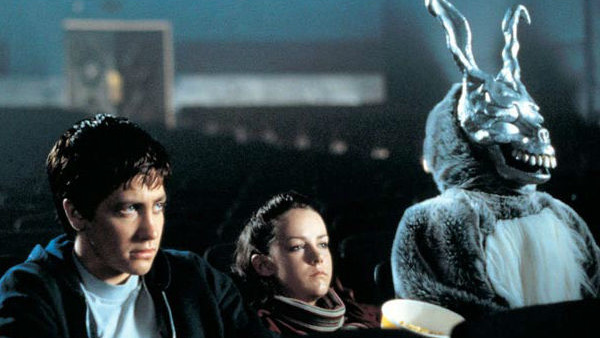
19 years after it's initial release, Donnie Darko is still heralded as one of the great cult-classics, and rightly so. With it's moody atmosphere, off-kilter characters and surreal narrative, Richard Kelly's blend of coming of age drama with cerebral sci-fi was an excellent first outing for the director.
After surviving a freak aeroplane accident, protagonist Donnie (Jake Gyllenhaal) begins to have bizarre visions of a man in a creepy rabbit suit named Frank who's heralding an oncoming apocalypse. On paper it shouldn't work as a film, but thanks to Kelly's direction and a superb performance from a young Jake Gyllenhaal it somehow manages to pull it off.
The film was very nearly a box-office bomb, as due to the 9/11 attacks just a month prior it was scarcely advertised, especially due to the plane crash being an integral part of the story. Luckily its release on home video helped it develop a huge cult following, and in turn allowed Kelly to creator a Director's Cut for the film, a feat that's very rare for films with an unsuccessful box office performance.
2. Serenity

Although he'd already had some directing experience in TV with his own shows Buffy the Vampire Slayer and Firefly, it was with 2005's Serenity that Joss Whedon dipped his toe in the world of feature directing.
Taking place a few months after the last episode of critically-acclaimed yet unjustly cancelled space western Firefly, Serenity is a great sci-fi romp that not only ties up loose ends for fans of the show, but also manages to be a great starting point for those that haven't seen its predecessor.
Following a ragtag crew of smugglers who were on the losing side of a civil war, Whedon does what he does best, showcasing a cast of lovable characters with smart, snappy dialogue and exciting set pieces. Nathan Fillion shines once again as the quick-witted Captain Mal, playing opposite a truly menacing Chiwetel Ejiofor as the ruthless villain known only as the Operative.
Whedon wouldn't direct another feature film until 2012 with The Avengers, and it's clear watching both films that the man has a knack for balancing a large cast of characters, with each one given time to breathe.
1. THX 1138

Only six years before George Lucas became synonymous with the science fiction genre with the release of Star Wars, the young filmmaker created a very different kind of sci-fi movie with THX 1138 (1971).
Based on an earlier student film he'd made titled Electronic Labyrinth: THX 1138 4EB, THX 1138 was co-written with Walter Murch, and painted a unique and dystopian vision of life in the 25th century.
Bearing similarities to literary sci-fi classics such as 1984 and Brave New World, THX 1338 stars Robert Duvall as the eponymous protagonist, a member of an underground society where intercourse and reproduction are outlawed, and people are forced to take psychoactive drugs in order to enforce compliance. When Duvall's character decides to stop taking the mind-controlling drugs, he ends up falling in love and becoming a threat to the very stability of society.
The film's brutalist visuals and haunting sound design create a perfect marriage to complement the the bleak and oppressive world that the narrative takes place in. You can even spot elements that would inspire Lucas' work on Star Wars, especially when it comes to the cold, clinical interior design of the Empire's Star Destroyers.