10 Greatest Murder-Mystery Films That Fooled Us All
What separates the greats from the rest of the pack is their ability to keep us guessing until the very end.

Since the days of Hitchcock, writers and directors have been trying to perfect the Murder-Mystery.
Why? Because there is something psychologically scintillating about being on the edge of our seat; we, as the audience, love it and hate it. It's like playing with fire - you know that once you touch it you'll get burned, but you just can't help yourself.
Hitchcock knew that that the audience loved to be fooled, to be toyed and played with. We want to be shocked and awed, and, if we could, have our pants blown literally right off in the process.
That said, some films do this better than others. But what separates the greats from the rest of the pack is their ability to keep us guessing until the very end.
Whether it's a head in a box, or discovering the killer has a split personality, these films have climbed to the top of the murder-mystery genre - and for good reason. Sit back and make sure your pants are on tight, these are the greatest murder-mystery films that fooled us all.
10. Rear Window

Rear Window follows a photographer, L.B. Jeffries, who broke his leg and is now confined to a wheelchair in his apartment. With time on his hands, he begins noticing bizarre activities of his neighbor, who, at this point, has a wife who is missing, and, as good ole' Jeffries notices, has been out late for the last several nights.
It isn't just Jimmy Stewart and Grace Kelly's acting that keeps us bolstered to the chair (much like Jeffries by the way), it's the suspense built from the moment the audience is introduced to the characters in Greenwich Village.
First, Jeffries hears a woman cry, "Don't!". Next, he catches his neighbor cleaning a large knife and a chainsaw. As Jeffries' suspicions rise, so do ours. The whole time we watch Jeffries snap photographs of the events going on across the street, we keep in the back of our heads that Jeffries is paralyzed for the time being and if the killer even glances across the street he'll be as good as dead.
We pray and hope that he doesn't look our way, but deep down you know he will. And he does. It's Hitchcock all the way, from the camera shots detailing the lives of each of the tenants to the finale, where the killer is on Jeffries' door step and there's no one to help him.
9. The Usual Suspects

Keyser Soze. One of the greatest revelations in the history of film. With class acting, writing, and directing, The Usual Suspects was a crime-thriller/murder-mystery that had our heads spinning until Verbal Kint walked out of the police station - and then our jaws hit the floor.
This movie had us walking on a tightrope of what we knew and what we didn't, that line sometimes blurring: "The greatest trick the devil ever pulled was convincing the world he didn't exist."
It is lines like that, as we followed Verbal Kint's story through his interrogation, that gave us a haunting feeling that something wasn't right, that there was something we were missing. How did all these mobsters get put in a line-up together? Who had enough power to set these men up? Who the hell is Keyser Soze? In the end, we are left with a revelation that preys upon the minds of its viewers and leaves us in awe of how delicate and precise it was put together.
8. The Vanishing

What was originally a Dutch-French film adapted from the novella titled, Golden Egg, The Vanishing follows a lover's obsession over what happened to his girlfriend three years ago while vacationing in France: Rex and Saskia stop at a petrol station to fuel up and Saskia is never seen again.
What had us hooked as viewers wasn't who the killer was - you discovered that early on - but what actually happened to this man's lover. This question culminates in a scene between the killer and Rex, when the killer tells him that the only way to learn the truth of what happened is to experience it himself.
We won't give away the ending, but the way in which this filmed fooled us all wasn't finding out who the killer was, it was discovering the ultimate fate of Rex and the mystery behind the golden egg Saskia was seeing in her dreams early on in the film. The Dutch film was adapted to Hollywood but critics didn't care for it as much as the original, because - spoiler alert! - there was a happier ending.
7. Se7en

It's hard to say if there is a movie more disturbing and haunting than Se7en. Over the span of seven days, a killer, John Doe, targets people who exhibit one of the seven deadly sins from the Bible. Each murder is gruesome, traumatizing, and psychologically destructive to the characters and the audience.
But there's more: Se7en goes down as the one of only films to fool the viewer twice. First, the writers never reveal who plays the killer in the film, as they leave him out of the credits, and when we see him, we can't help but even be more scared by the actor that plays him - the man has a way of playing a dedicated psychopath that gives us shudders.
Second is the climatic scene between Mills and Doe, and having the audience wonder what's in the box (WHAT'S IN THE BOX? WHAT'S IN THE BOX?!). We were fooled. John Doe had turned himself into the police and agreed to lead the detectives to the last two bodies. We couldn't be that gullible, could we? We knew he had something up his sleeve, right? We may have, but no one expected THAT.
6. Strangers On A Train
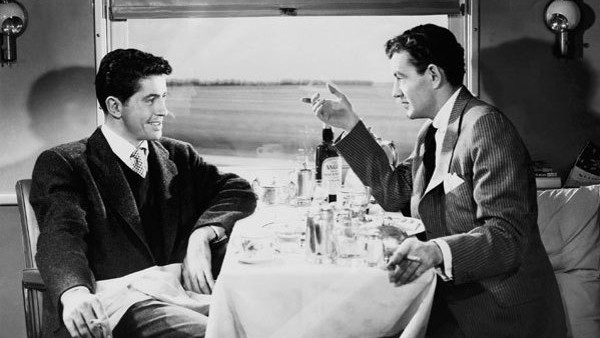
What would you do if a total stranger approached you on a train and discussed "exchanging" murders? He knows you hate the marriage you are in and he knows you long for another woman; he also tells you he desires to see his father killed. It would be the perfect crime, he would say, if you took his murder and he took yours. There would be no identifiable motive tying you two to the crimes.
You're amused and thinking nothing more of that ridiculous conversation as he walks away until you find your wife dead that night, strangled. Now, what?
That's what Patricia Highsmith's novel, Strangers on a Train, tells the story of. Adapted to film by Hitchcock, we watch as the suspense builds and the characters spiral out of control. What fooled us was not only the story's set-up and conclusions, but also in the realization that there is evil lurking beneath ordinary men - and when you agree to something remember that some people take it seriously.
We, as the audience, are forced to watch as Guy Haines wrestles with the idea of holding up his end of the bargain, and when he doesn't it causes the suspense to nearly overwhelm us. In a finale climatic scene at the carousel, we discover that even while dying some men lie.
5. Memento

Suffering from anterograde amnesia, Leonard Shelby is on a vengeful path to discover the second man responsible for his wife's rape and murder; Shelby knows there were two attackers that night - one of which he has already killed - but no one believes him.
Like pieces of a puzzle, the movie is shot in two different sequences. One is in black and white, and shows the order of events chronologically, while the other is shot in color, and shows the order of events in reverse. Christopher Nolan deliberately confuses us; he desires us to view the events as Leonard sees them - in disjointed, discontinuous images. And it works.
We can't tell up from down, left from right, and as Shelby gets closer and closer to discovering his killer, so do the color and black and white images. We, as well as Shelby, are haunted by the name "John G." - who is he and why does Shelby insist on tattooing the name on his body? The movie ends, the way it begins - with a man taking a bullet to the head and Shelby walking away from the scene.
4. The Girl With The Dragon Tattoo

A mysterious disappearance forty years ago, a list of names and numbers no one can decipher, political intrigue, and a series of murders spanning nearly twenty years - what's not to love about this movie?
Originally a novel by Stieg Larsson, The Girl with the Dragon Tattoo is filled with twists and turns, and just when you think you have a hold of what's going on, the story takes you for a spin.
It's gritty, raw, and completely lacks sentimentality. But that's what draws us in - we know this isn't a happy tale and we don't care. Who was the serial killer all those years ago? Where did Harriet mysteriously disappear to? And will there ever be justice for any of these characters? This movie had us right where it wanted us, constantly wondering, never being sure, and hoping that somewhere there is happiness, for us and for them.
3. Shutter Island

Two U.S. Marshals arrive at Shutter Island to investigate the disappearance of a patient at Ashecliff hospital for the criminally insane. What starts out as a calm, logical, and composed narrative turns into a compelling psychological thriller that follows the protagonist, Teddy, into the depths of his own mind.
Teddy, at first, starts having migraine headaches, then begins having disturbing dreams of his dead wife who causes Teddy to question the motives of the staff, patients, and even his own partner. The reveal occurring at the top of the lighthouse all but makes us question our own reality and who we really are.
The final scene is leaves the audience speechless as Teddy says, "Which would be worse? To live as a monster or die as a good man?"
2. Vertigo

Voted the greatest movie of all time, Vertigo follows John "Scottie" Ferguson, a retired detective who has a severe fear of heights and has growing obsession with Madeline, a woman Scottie was hired to follow because the husband believes she has been possessed. Could anyone contain themselves as Scottie trekked up the stairs only to stop and watch as Madeline fell to her death?
We felt for him - his acrophobia had already caused the death of a fellow police officer. But Hitchcock fools us again by introducing Judy, a woman who looks strikingly similar to Madeline - too similar.
As the plot unravels, Scottie, and us, find out that Madeline is nothing more than a murder plot to hide the true victim and her killer. By the end of the movie, we are sympathizing for both Scottie and Judy, one is in love the a man, the other in love with the dream of a woman inside his head. And, as Scottie finally gets the courage to reach the top of the bell tower, to overcome his fears - and accept reality - Hitchcock has one more surprise for us...
1. Psycho

Psycho. The ultimate Hitchcock film. What has become a trope in numerous television shows and movies started off as a bone-chilling murder mystery at the Bates Motel. Janet Leigh plays Marion, an embezzler, who ends up at the secluded Bates Motel and encounters Norman, the utterly creepy motel manager.
This is, excuse the pun, the mother of all murder mysteries. The audience watches as an unknown womanly figure stabs Leigh in her shower - a scene that has now become iconic - to which Norman arrives and removes the body. Our suspicions rise as we are shown the disturbing relationship between Norman and his mother, through flashes of lightning and distorted insults to her son.
But Hitchcock being, well, Hitchcock, forces us to scramble as it is revealed that Norman's mother died years ago, along with her lover. The ending - now used too many times in movies to count - is iconic for shocking the world into silence as we hear the words: "It's sad when a mother has to speak the words that condemn her own son."
Know of any other murder-mysteries that fooled everyone? Let us know down in the comments.