10 Gripping Films About Mental Illness
 Mental illness is one of the great taboos in society. Nobody wants to admit to it - not even depression - let alone bipolar or schizophrenia. Decent mainstream portrayals of mental illness are extremely rare and tend to glamourise the condition of the sufferer. Therefore we have A Beautiful Mind - connects schizophrenia to genius. Girl Interrupted - mental illness to creativity (the main character wants to be a writer). However, there have been some excellent portrayals of mental illness which do not shy away in their shocking and factual nature. It is a subject we will always be interested in. 1 in 4 of us in our lifetimes will suffer from a mental illness and we all have to suffer unpleasant mental states in our life - such as sadness, grief, anxiety. It is important that we talk about such issues. So I am doing my own little bit of awareness raising in 10 Films About Mental Illness:
10. A Streetcar Named Desire (1951)
 As a pure piece of drama, A Streetcar Named Desire, is enjoyable to watch. It left me a blubbering mess which is probably due to Vivienne Leigh's powerful performance as Blanche Dubois. Blanche is a fading beauty, an alcoholic Southern belle who is a man eater and lives in a world of fantasies and illusions. She is keeping up a facade of demureness but inside she is cracking. She runs into trouble with Stanley (Marlon Brando) - her sister Stella's macho, brooding husband who hates Blanche's pretence and superior air towards him. Stella, in turn, is frightened by Stanley's domination of her but she is powerfully sexually attracted to him. The two have a tit for tat rivalry and Stanley finds out about Stella's sordid past (including seducing a 17 year old boy). Their feud culminates in the rape of Stella by Stanley - an event that pushes her into a breakdown. She is sent away, totally nuts to a psychiatric hospital. Then it's a case of Stella! Stella! Can't you hear me yella? You're putting me through hella! Blanche was such a flaky character, she was bound to go dolally sooner or later, Stanley was just an excuse. But it is a terribly sad tale. Blanche - used to twirling men round her finger, gets a big heap of male testosterone and is crushed. If I talk about it anymore I might start crying again, so I will stop.
9. Betty Blue (1986)
 Betty has problems. Donning my psychiatrist's hat, I would deem her as having Borderline Personality Disorder. This can be seen in her outbursts of extreme rage - stabbing a restaurant patron in the hand when they complain about the food and smashing her hand through a glass window because she is annoyed at Zorg. She displays self-destructive behaviour - hacking off all of her hair and running away with a little boy which she knows will get her into trouble. Betty also indulges in suicidal/parasuicidal behaviour by gouging out her own eye. She experiences psychosis (voices in her head) which is usually transient in Borderline Personality Disorder sufferers but leads to Betty being in an irreversible state of catatonia, which is more of a plot device than something that would happen in real life. Altogether, Beatrice Dalle's turn as Betty is a compelling and believable descent into madness. Unbelievably sexy, wild and uninhibited at first, she quickly descends into a mercurial, messed up, tormented wreck of a woman. Should have kept on that medication Betty.
8. A Beautiful Mind (2001)
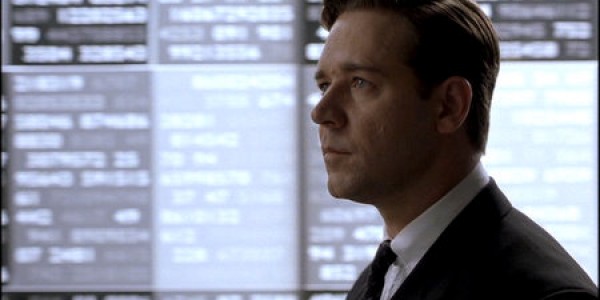 Super genius John Nash (Russell Crowe) can propagate mathematics theories and bust open codes. He even finds time for a wife. However, he becomes convinced he is being chased by Soviet agents and is institutionalised. Cue much psychiatric merriment with relapses, not taking drugs, dramatic realisations of the truth etc. A rather glamourised version of schizophrenia, I suspect that John Nash and his family went through a hell of a lot more stress, anguish and annoyance than portrayed in the film. The end message that Nash learned how to cope with schizophrenia without drugs sets a dangerous precedent for anyone watching to stop their medication in the hope that they can cope without it too. From what I know, John Nash did not do much significant work after his schizophrenic break. And he sired a son who is similarly tormented by schizophrenia. Laudable in that it took a taboo subject - schizophrenia - to the public and increased awareness that it is not a psycho killer illness - it affects the world's cleverest people, A Beautiful Mind is highly watchable but for people with schizophrenia, it will bear little resemblance to their daily struggles.
7. Girl, Interrupted (1999)
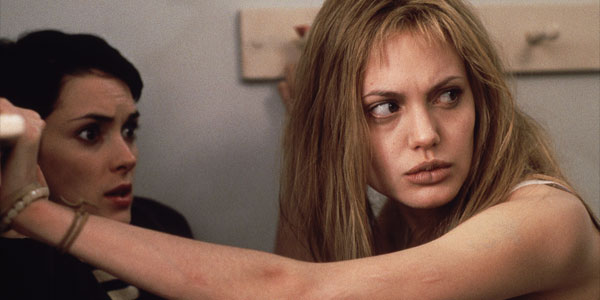 Based on the book by Susannah Kaysen, Girl Interrupted features the psychological journey of Susannah who is diagnosed with Borderline Personality Disorder after she took an overdose of aspirin, And showed signs of reckless promiscuity and self harm. I have a problem with the hospital - it seems more like a girl's summer camp. Maybe this is because it is a private hospital, but in any case, I severely doubt that any hospital, private or not would let these girls get up to the shenanigans they do at night time. There would have to be psychiatric nurses around in case an emergency occurred. It's not a 9-5 job. Winona is boring in the lead role. Okay she is competent, but she is acted off the screen by Angelina Jolie as the charismatic sociopath Lisa and Brittany Murphy as poor sexually abused, OCD, bulimic, self mutilating Daisy Randone. These two characters are far more interesting in their psychopathology than Susannah who just acts like a silly little whiny bitch for the most part of the film. In fact it is the strong supporting cast and the women around Susannah who make the film what it is. We are led to believe that saintly nurse Whoopi Goldberg tolerates a barrage of nasty racist abuse by Susannah. That would never happen in real life. The nurse would get you transferred to PICU (Psychiatric Intensive Care) which I am reliably informed, by people who have been in both, is worse than being in jail.
6. I Never Promised You a Rose Garden (1977)
 Kathleen Quinlan plays Deborah, a young schizophrenic girl whose mind inhabits a bizarre alternate reality. She is institutionalised for 3 years as she struggles to find some semblance of sanity. I liked this film a lot. It is probably a cash in on One Flew Over the Cuckoo's Nest with the protagonist being female instead of male. Kathleen Quinlan does a really good job in portraying a mentally disturbed young woman. There is plenty of opportunity for her to chew the scenery (to really munch it) but she reins herself in admirably. The film also features a deviant nurse - there is always one in every ward, even in real life, trust me. It is a claustrophobic film to watch as it is primarily set within the confines of an institution. The film is replete with all the psychiatric stereotypes you could imagine. Bibi Andersson does a terrific turn as the warm, humane doctor who sticks by Deborah and coaxes her into something resembling sanity. Highly interesting to watch, but not as good or as detailed as the real life story book upon which it was based which is a masterpiece of mental health literature.
5. Family Life (1971)
 Directed by Ken Loach, this is a highly naturalistic, almost documentary style study about a young woman called Janice who lives with her conservative, killjoy parents who lead a dreary working class existence and see any attempt on the behalf of Janice to have fun as bad behaviour. When Janice gets pregnant, they force her into an abortion and when her psyche cracks, they blame her for deliberately trying to upset them. Things escalate with Janice meandering into psychosis. Typically, the doctors and psychiatrists are of little help, and are in fact at times, downright insulting and patronising. With no adequate support or treatment, the last we see of Janice is her being wheeled in to a symposium full of medical students as a 'specimen' Janice is a good example of how environmental pressures can create mental illness. If she was not squashed by her stultifying parents or mishandled by psychiatry, she might have stood a chance. Her 'rebellion' that is so shaming is nothing more than teenage girl frolics. Okay she had the misfortune to become pregnant and I guess that back in the 1970s it would have been a big deal. But her parents treat her with a cruel disdain. Filmed in a social realism style, the arguments that break out are highly naturalistic and you can imagine them happening in any family. I wouldn't be surprised if a lot of the dialog was ad-libbed. A fascinating study of madness caused by environmental factors.
4. One Flew Over the Cuckoo's Nest (1975)
I enjoyed One Flew Over the Cuckoo's Nest. It is probably the film that people base their knowledge on mental illness the most. It won all 5 major Oscars and hardly anyone has a bad word to say about it. Jack Nicholson is perfect as Randle McMurphy, the petty criminal who opts for an 'easy' life in a mental hospital rather than serve out his time doing hard labour. He gets into battle with Nurse Ratched, the head of the ward who uses humiliation and boredom to control the inmates. Randle tries to shake the inmates out of their complacency. He rebels and rebels and rebels until he is lobotomised and his friend Chief Bromden smothers him with a pillow as he cannot bear to see the fight knocked out of his dear friend. The film is principally interesting due to its portrayal of the psychiatric hospital system and how the patient can never gain a victory over them. Every, and I mean every, psychiatric hospital has a nurse or psychiatrist like Nurse Ratched - power mad, vicious, uncaring of the patients. Rebellion against the system never works. They will chemically cosh you, move you to a locked ward, detain you indefinitely. The system is rigged so you never win. So it is important not to be a Randle McMurphy type - take the hard labour over the loony bin and don't question the system - Obey it and behave. Through doing this you paradoxically achieve greater freedom.
3. Through a Glass Darkly (1961)
 Through a Glass Darkly is a sombre Swedish film directed by one of my personal cinematic heroes Ingmar Bergman. In this film, he produces an excellent portrayal of a psychotic break in a schizophrenic woman - Karin played by Harriet Andersson. The action takes place over a 24 hour period on a Swedish Island. There is Karin, her husband Martin, her brother Minus and her father David. Karin has just been released from hospital and her husband informs her father that her disease is almost incurable. Over the 24 hours, Karin begins to crack. In the middle of the night, she is led by a foghorn into a room in which she can hear voices behind the peeling wallpaper. She goes for comfort to her father. When he leaves the room, Karin reads his diary in which he has detailed how he finds himself having a cold and curious fascination with her illness. This greatly upsets her as her worse fears are confirmed - she won't be cured. The next day, Karin tells Minus about her episodes and how she feels God is going to reveal himself to her behind the wallpaper. An ambulance is called for. Karin wants to go back to the hospital because she cannot bear to live in two realities. She runs to the attic and Martin and David follow her. She hallucinates that God appears to her in the form of a spider with a cruel face which tries to penetrate her. She screams and cries in horror and has to be sedated. The helicopter comes to take her away to the hospital. A lot more goes on in the film than I have described, but for the purposes of this article we are chiefly concerned with the portrayal of mental ill health. Karin's psychotic break is very convincing and true to life. Many schizophrenics have delusions about God and they are very idiosyncratic. The fact that Karin's case is incurable would be in fitting with the time - 1961. There was a paucity of psychiatric drugs and suitable treatments. The ultimate drug for incurable schizophrenia - Clozapine - was decades away from being in use and helping the lives of people like Karin. Nowadays, there would be more hope for her.
2. Thin (2006)
 Thin is a cinema verite documentary made for HBO about the lives of several women tormented by eating disorders in a residential unit. It deals with the lives of these women in the clinic as they go through therapy, mealtimes and the official regimes, but it also portrays the women's turbulent relationships with each other and what they get up to when no eyes are upon them. The main participants are: Shelly, a 25 year old psychiatric nurse who has had 10 hospitalisations and comes to Renfrew weighing 85 lbs. She is addicted to psychiatric drugs and suffers from severe mood swings. Polly has been at the unit for 9 weeks. She tried to kill herself after eating two slices of pizza, describing it as the "straw that broke the camel's back". She celebrates her 30th birthday at the unit and seems to be making progress with her anorexia but she is a persistent rule breaker. She is thrown out. Polly died by suicide in 2008. Brittany is a 15 year old girl who lost nearly 100 lbs in under a year. She has hair loss, liver damage and a low pulse rate. She is treatment resistant and expresses the desire to lose more weight. Her insurance runs out and she has to leave the centre. She restricted after discharge and lost weight rapidly but her insurance wouldn't pay for treatment. Alisa is a 30 year old divorced mother of two who describes massive binge and purge sessions which coupled with the abuse of diuretics, laxatives and ipecac leave her frequently hospitalised with severe dehydration. Interspersed with this are days when she will restrict to 200 calories. She does well in recovery but has a severe relapse and attempts suicide. A second stay at the centre is more profitable and she now leads a normal life. This is a film that unless you have had an eating disorder, you are not really going to understand. You are more likely to look at these young women and think "Why the heck are they destroying themselves in such a determined manner?" - it may seem like gratuitous self destruction. It is only when you have had an eating disorder that you understand the terrible grip that the illness has upon them. Whenever your weight goes below a certain level, you are no longer capable of thinking rationally for yourself - your mind goes crazy and all you can think about is losing the next pound. It is an obsession. Weight gain becomes the most terrifying thing in the world. The girls in this film reflect this terror. It is a miserable disease and on one level you are desperate to get rid of it but on the other hand you are a slave to it and its constant demands to go further and further into the world of weight loss. The behaviour of the girls in the film reflect this agonising dichotomy - for example consenting to in patient treatment but breaking the rules by purging. Recovery is a terrifying experience and Lauren Greenfield has capably captured the double edged sword in her documentary. 5%-20% of people with anorexia will die from it.
1. Revolution No 9 (2001)
 If you want to get a glimpse of how a normal person can descend into the depths of paranoid schizophrenia then this film will show you all you need to know. It is utterly terrifying in that it shows us how any man or woman can be affected by the disease at any time in their lives. It is a masterclass on what low budget, independent film making can achieve to make a powerful affecting movie. The film depicts Michael Risley's trauma of going from being a normal guy with a long time girlfriend, a good job and generally he has his life together. He begins to get paranoid - his co workers are messing around with his desk and this line of thinking carries on until he begins seeing subliminal messages on the television and comes to believe that a TV advert is plotting his downfall. The ending is so sad, I cried my eyes out. Extremely realistic in recreating the things that the mentally ill are subjected to - horrible, crappy hospitalisations with uncaring staff and demeaning treatment, total fear, bewilderment and alienation from loved ones - Revolution No 9 is terrifying. There's no sexy Beatrice Dalle or Blanche DuBois who can always depend on the kindness of strangers. This is raw, realistic and an accurate assessment of what madness does to a person. Not seen or recognised by many people, Revolution No 9 is probably the best portrayal of schizophrenia that I have seen due to its verisimilitude. Harrowing but a tour de force.