10 Horror Movie Endings That Leave You Speechless
These conclusions defy even your ability to manifest a pithy Letterboxd one-liner.
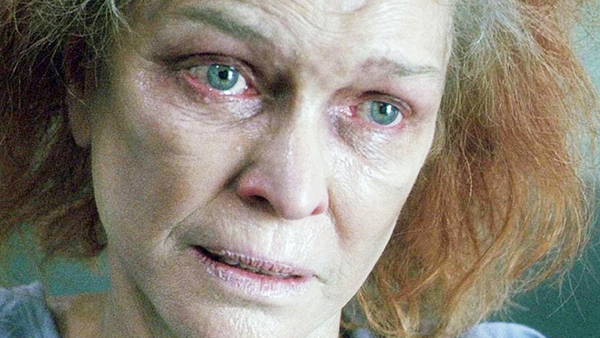
The final act; the conclusion; the climax; the point in a movie when everything we have been watching either comes together harmoniously, shatters into a thousand pieces, leaves us feeling good and whole, or tears apart everything we think we know. It will come as no surprise that a good many horror movies traffic in the latter, as for many of the genre's directors this is the whole point of the endeavour - to shock and spoil.
After all, who hasn't sat in stunned silence as the credits for Requiem for a Dream roll on by? Who hasn't spent the next half hour scratching their head after Don't Look Now? And who hasn't tried to scrub Hereditary from their brain with an hour's doom-scrolling?
There is a whole canon of horror movies that use their final scenes to smite the viewer any which way they can. Some are tangibly harrowing, some leave us perplexed, others contain unspeakable twists, and others yet still simply defy the spoken word, or our ability to utter it.
These 10 horror film endings are guaranteed to make you lose your appetite for both popcorn and conversation.
10. It's What's Inside (2024)
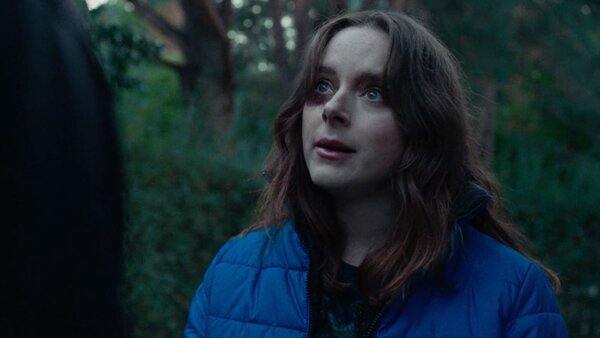
Last year, It's What's Inside presented us with one of the more original horror sci-fi outings in years, taking the basic premise of Bodies Bodies Bodies and folding it over a few times.
In the film, old college friends use experimental body swap technology brought along by group outcast Forbes (David Thompson), to play a game in which they have to guess who is in their body. But once the bodies are swapped, nobody can seem to behave themselves, and it's anyone's guess who is responsible when the game turns deadly and several of the group die in each others bodies.
Director Greg Jardin uses colour filters to try and keep us upright throughout the film, navigating the head-scratching switches with glimpses into who is really behind the eyes and faces. But in this big old mish-mash of happenings, we fail to notice there is one character who is never focused on in their other forms - Forbes. And that's because Forbes, from the very beginning, has actually been body-swapped with his younger sister Beatrice (Madison Davenport), who the group drove insane years before and has come to exact her revenge.
The conclusion shows us the disastrous effects of the final swap, with innocent characters blamed for the deaths, some characters stuck in the wrong bodies, Forbes locked in Beatrice's body, and Beatrice on the run with the body-swapping machine.
9. Hereditary (2018)

The current reigning champion for the scariest horror film of the 21st century, Ari Aster's Hereditary jams us, face-first, into the lives of the grieving Graham family - miniature artist Annie (Toni Collette), her psychiatrist husband Steve (Gabriel Byrne) and their children, Peter (Alex Wolff) and Charlie (Milly Shapiro) - shortly after the death of Annie’s mother. But grandma had more than a few skeletons in her closet, and they gradually come out to play as a series of mysterious events, sinister occurrences and possessions take over the Grahams' lives.
Glacial paced to begin with, Hereditary spends much of its first half building tension and laying the groundwork for things to come, up to the accidental decapitation of Charlie, who as it turns out was set to be the host for the demon king Paimon that her gran worshipped. From here, things only get darker, with Annie succumbing to possession and destroying her family from the inside out.
As if everything that happens isn't bad enough - beheadings, immolation, you name it - the conclusion is its own breath-taking exercise in misery. Annie beheads herself and Peter, new host of Paimon, is led by Annie's corpse into the family's treehouse, where the headless corpse of Peter's grandmother awaits, worshipping a mannequin with Charlie's severed head on it. Hereditary, indeed.
8. Don't Look Now (1973)

Despite being revered as a '70s horror classic by most who were alive to see it in the cinema, Don't Look Now is a less clear-cut affair for modern viewers used to pacey storytelling and clever reveals.
Based on Daphne Du Maurier's short story, Nicolas Roeg's film puts Donald Sutherland and Julie Christie in the heart of Venice, as bereaved couple John and Laura Baxter. To forget the accidental drowning of their daughter, John busies himself in his work restoring an old church, while Laura is left wander the city, encountering all manner of oddballs and weirdos. This includes Heather and Wendy (Hilary Mason and Clelia Matania, respectively), sisters with the gift of second sight, who bring a warning from the Baxters' deceased daughter to leave Venice.
But the Baxters stay put and things begin to unspool, with John hallucinating and having visions that may or may not suggest he is connected to the other side, including the omen of his daughter running around the canals, wearing the red raincoat she died in.
Whatever we could expect from the ending, then, is not what we get. John finally manages to follow his daughter at the film's close, catching up to her in a deserted palazzo. But, when she turns to face him, it's not his daughter but a hideous dwarf lady (Adelina Poerio) - not seen or referred to in any way throughout the rest of the narrative - who promptly pulls out a knife and cuts his throat.
7. Saint Maud (2019)

Rose Glass is one of the newest directors on the horror scene, but her first feature - Saint Maud - is proof of just how much can be achieved in the genre with as little as possible.
Made on a budget of $2.5 million, and featuring a small cast with just two main characters, Saint Maud makes horror of the everyday, setting us down in Scarborough, where Welsh palliative care nurse Maud (Morfydd Clark) has a new client in former US dancer and choreographer Amanda (Jennifer Ehle).
A devout Catholic, Maud fails to draw a line between her own personal beliefs and her job, scorning Amanda’s hedonistic, atheistic lifestyle and positioning herself as a holy messenger of God, who has been tasked with saving Amanda's soul. Needless to say, this doesn't go so well, and Maud's delusions lead her down a dark path, hallucinating visions and miracles, punishing her own flesh and stabbing Amanda to death with a pair of scissors.
And that's not even the end - Maud self-immolates on Scarborough beach, seeming a vision of divinity in a whirl of holy fire. Unfortunately, Glass takes this opportunity to smash cut back to reality and our last image is of Maud screaming in pain and terror as she burns alive.
6. The Painted Bird (2019)
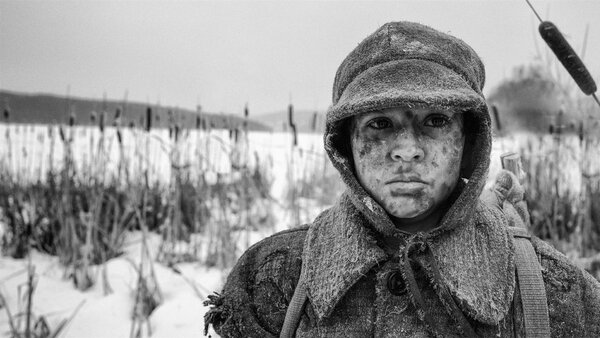
A war horror to end all war, The Painted Bird takes a similar line to Come and See, depicting a young boy caught, itinerant and alone, in the midst of WWII, visited by a multitude of man-made hells. Adapted from Jerzy Kosiński's infamous book, director Václav Marhoul keeps in all the worst parts, presenting war and its horrors unflinchingly, challenging audiences to face the worst parts of a reality many countries around the world are forced to live with today.
We follow Joska (Petr Kotlar) through scenes of depravity and misery, as he leaves behind his dead aunt and has to wander out across Eastern Europe alone. He witnesses rape, murder and animal abuse, is subjected to several forms of paedophilia, physical abuse and racism, and is forced to engage in violence for his own survival and others' pleasure.
Thus, when the end of the film rolls round and Joska is returned to his family, he is barely recognisable, and has lost his previous self, refusing to respond to his name and protesting furiously against his father who tries to explain why they sent him to his aunt's. This bleakness is only compounded by a final image on the bus home, where Joska uncovers his father's Auschwitz concentration camp tattoo.
There is no way not to take the point, to feel the horrors, but we also never want to watch it again - and therein lies the film's ultimate lesson.
5. Inside (2007)

Noughties French horror is a breed unto itself, pulling together a continental sense of propriety (or, you know, lack thereof) with the kind of low-budget guts and gore we saw during the UK video nasties period. And Julien Maury and Alexandre Bustillo’s Inside (original, À l'intérieur) is about as full-on as it gets.
The premise is simple: pregnant and widowed Sarah Scarangella (Alysson Paradis) is trapped alone in her own home on Christmas Eve by a character known only as La Femme (Beatrice Dalle), a mysterious and unhinged woman who seeks to take Sarah’s unborn child – by any means necessary. Things get real bloody real quick, and when the police, Sarah’s doctor and her mother drop by to check on her, we are treated to an ongoing barrage of gruesome injury, with scissors through skulls, people shot in the face, Sarah’s pregnant belly punctured and even La Femme’s face partially burnt off.
The point of all this is that the car accident that killed Sarah’s husband also killed La Femme’s unborn baby, and she lost her mind as a result, seeing only one path to being whole again. And, you know what? She gets it.
The final scenes of the film have La Femme perform an ad hoc Caesarean section on a beaten and bloody Sarah, saving the baby and killing its mother. And these words don’t even go halfway to describing what this feels like to watch.
4. Titane (2021)
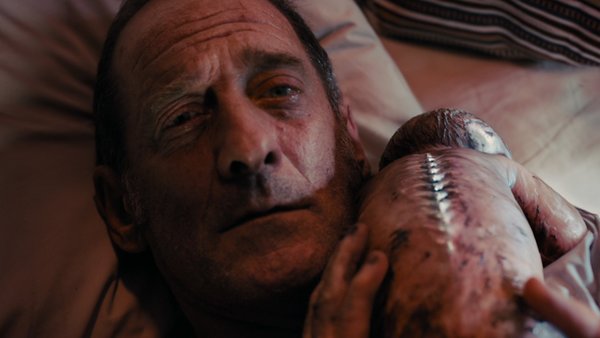
In Titane, Julia Ducournau takes the autophilia of David Cronenberg's Crash and goes the extra mile, serving up a body horror that is even tougher to stomach than most of the master's greatest hits.
Alexia (Agathe Rousselle) is a murderous car model with a metal plate in her head and an erotic obsession for the humble automobile. After getting down and dirty with a pimped-up Cadillac, she falls pregnant and goes on the run from authorities, posing as fire captain Vincent’s (Vincent London) long-lost son to evade capture.
Far from happy families, however, Alexia's inherent strangeness does not go unnoticed at the fire station where they live, and she becomes another painful complexity in Vincent's steroid-fuelled life. Nevertheless, the pair remain together - even after he realises she's not his son - and Alexia ends up delivering her baby at home.
As if the film hadn’t gone far enough to disgust, revolt or otherwise alienate us (with bitten-off nipples, chopsticks in ears, vaginas dripping motor oil), we are treated to the full experience of Alexia's labour. Her body breaks down, her skin tears away to reveal new metal sections, and the original titanium plate in her skull splits open, killing her as she successfully delivers her child. And what a child it is: the newborn's body is riveted with titanium, flesh and metal and blood and bone made one, with Vincent its unwitting father.
You can close your mouth now.
3. Requiem for a Dream (2000)
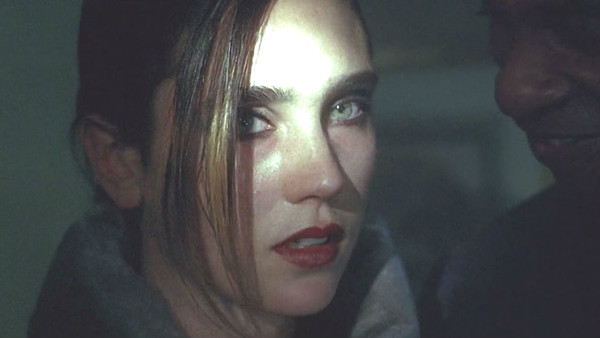
Darren Aronofsky's Requiem for a Dream is not what most people reach for when they're settling in for a good scare, but this psychological horror features more disturbing imagery and full-system shocks than many big Hollywood horrors released today.
All these years, and several ground-breaking, showstopping films later, and Requiem for a Dream still remains Aronofsky's best work. It's also his bleakest. Based on Hubert Selby Jr's novel, this story of thieving, relapsing drug addicts and their dire influence on the world around them doesn't let up, maintaining a near-painful tension throughout. Sara (Ellen Burstyn) is an NYC widow dreaming of gameshow stardom; her son Harry (Jared Leto) and his friend Tyrone (Marlon Wayans) are heroin addicts hoping to get out of the ghetto and kick their habit; and Harry’s girlfriend Marion (Jennifer Connolly) plans to open a clothes shop selling her own designs. Each chases their own portion of the consumer-capitalist dream, and each fails diabolically.
Several scenes throughout the film are difficult to watch, as Sara succumbs to delusions and prescription pills, Harry and Tyrone's addiction overtakes their entrepreneurial abilities, and Marion turns to extreme sex work. But the ending is the clincher: Sara is catatonic after undergoing shock therapy, Tyrone is abused in prison, Marion is pimped out for group sex, and Harry has his gangrenous arm amputated. All the while Clint Mansell's Lux Aeterna squeals away in the background, a melancholic death knell whose warning heard so early in the film, but which we all ignored.
2. Would You Rather (2012)

David Guy Levy’s Would You Rather is an exercise in abject cruelty, inspired by other game-based torture movies like Saw, but packing its own unique set of quirks and surprises.
Eight people are trapped in millionaire philanthropist Shepard Lambrick's (Jeffrey Combs) mansion and compelled to play a brutal game of "would you rather" for money. Amongst them is our protagonist, Iris (Brittany Snow), who is playing for the cash to fund her brother Raleigh's (Logan Miller) cancer treatment and find the bone marrow donor needed to save his life.
Shepard pushes each player to their limits, offering up increasingly large prizes for increasingly questionable decisions, before plunging into the game proper, where they are asked whether they would rather visit one or other cruelty upon themselves or their fellow players. Of the many miseries experienced, Iris has to eat meat (she's a vegetarian), whip a man, be submerged underwater for two minutes, and finally kill one of her fellow players in cold blood.
And, when she has abandoned her morals, suffered immeasurably and secured more than enough money for Raleigh's care, she returns home to find her brother has committed suicide, no longer wishing to be a burden on her. See what can be saved with a socialist health system!
1. The Killing of a Sacred Deer (2017)

Right on the cusp of director Yorgos Lanthimos' big breakthrough - when he was stepping from absurdity to super-stardom, from arthouse indie flicks to Oscar-winners, from films shot in a single house and garden to globe-trotting sci-fi spectacles - came absurdist psychological horror The Killing of a Sacred Deer.
The film stars Colin Farrell as beleaguered Doctor Steven Murphy, a cardiovascular surgeon whose inability to save a man on his operating table comes back to bite him in the behind - in the form of the man's son, 16-year-old Martin Lang (Barry Keoghan). After wheedling his way into the doctor's life, Martin tells Steven that if he doesn't kill one of his own family - to balance out the loss of Martin's father - the entire Murphy clan will die from paralysis, an inability to eat and bleeding eyes.
Steven doesn't take the young upstart seriously at first, until his own son Bob (Sunny Suljic) begins displaying these symptoms. Like any great work of absurdism, The Killing of a Sacred Deer is short on explanations, but big on consequences. Thus, Steven begins a decision process to determine which family members are "best", while they vie for their own survival. This culminates in a harrowing climax that sees Steven stand between his wife, daughter and son, cover his face, spin around and fire a rifle at random, shooting Bob dead in the process...