10 Iconic Spider-Man Comics Moments We're Still Waiting To See On Screen

Or in other words - please just make Kraven's Last Hunt soon!

Over the course of five films, Sony€™s Spider-Man franchise has featured a number of moments plucked directly from the comic books. Just to name a few: Uncle Ben€™s death; Peter Parker discarding his Spider-Man costume in a garbage can; and most recently (*spoilers*), the death of Peter€™s girlfriend, Gwen Stacy. In nearly every instance, adapting these iconic comic book scenes has led to some of the most memorable and inspired sequences in both the Sam Raimi and Marc Webb movie-verses. The success and popularity of these movie moments should come as no surprise. For more than 50 years, Spider-Man comic books have been the standard bearer for the industry. Even when Spidey comics are at their worst (€œClone Saga,€ or €œOne More Day€), the franchise has still found a way to produce influential and iconic scenes that stick with readers for years after they were first published. With that in mind, there are still plenty of top-notch comic book moments ready to be mined for future Spider-Man movies. And with at least two The Amazing Spider-Man sequels in the works, plus two spinoff movies involving the Sinister Six and Venom, any and all of the following 10 comic book scenes should be considered for cinematic inclusion. Just to be fair and realistic, none of the following 10 entries will feature scenes from the comics where Spider-Man is interacting/battling characters owned by Marvel Studios (The Avengers and associated solo characters) and Fox (X-Men and Fantastic Four).

10. Spider-Man Becomes Captain Universe
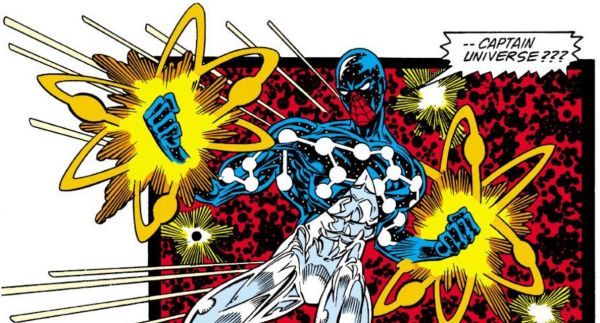
Something that often gets forgotten about Spider-Man both in the movies and the comics, is that he€™s a pretty strong individual. He may not have the brute strength of Thor or the Hulk, but when he was first created by Stan Lee and Steve Ditko in 1962, the character would often refer to the fact that he had the €œproportionate strength of a spider€ €“ meaning that he could hold his own in a fight against almost anyone in the Marvel Universe. By the early 1990s, Spidey€™s strength had become such an afterthought, it made his short-term turn as the cosmic entity, Captain Universe during the €œCosmic Spider-Man Saga€ all the more of a shock. Throughout this arc, Spidey randomly gains new powers like the ability to fly and to harness energy blasts from his hands. In the story's final chapter in Amazing Spider-Man #329, Spider-Man fully realizes these powers and physically embodies Captain Universe. It is in that moment that Spider-Man becomes arguably the most powerful hero in the Marvel Universe. Film directors could have some fun with a €œCosmic Spider-Man€ story as it would allow them to portray Spidey as not only quick and athletic, but capable of destroying an adversary with a flick of a finger. It would also validate fans who are sick of seeing Spider-Man get treated like a physical lightweight.

9. The Death Of Jean DeWolff

Writer Peter David forever changed the way readers viewed Spider-Man comics with his 1985-86 Spectacular Spider-Man arc, €œThe Death of Jean DeWolff.€ In this story, longtime supporting cast member police Captain Jean DeWolff, is murdered in her home by a masked sociopath dubbed the Sin-Eater. The arc is significant because it is the first truly "dark" Spider-Man comic that is similar in tone to Frank Miller's work on Daredevil and Batman. DeWolff has yet to figure into the Spider-Man cinematic universe, but she could easily be introduced as a tertiary character at some point (a la Felicia Hardy and Alistair Smythe in The Amazing Spider-Man 2), so that an adaptation of this storyline would be a possibility. The only potential strike against it is that DeWolff€™s death is quite violent in the comics, which is what makes the moment so shocking. A faithful adaptation could potentially raise the hypothetical film€™s rating to an €œR,€ which is usually bad news for a movie studio trying to attract the largest audience possible. Still, the idea of seeing Spider-Man sleuthing around New York City trying to find Jean€™s killer, would be a terrific and dramatically different take on the character. It€™s not exactly €œfriendly neighborhood€ Spider-Man, but the potential is there for some top-notch storytelling for the director and the rest of the film€™s creative team.

8. Spider-Man vs. Morlun

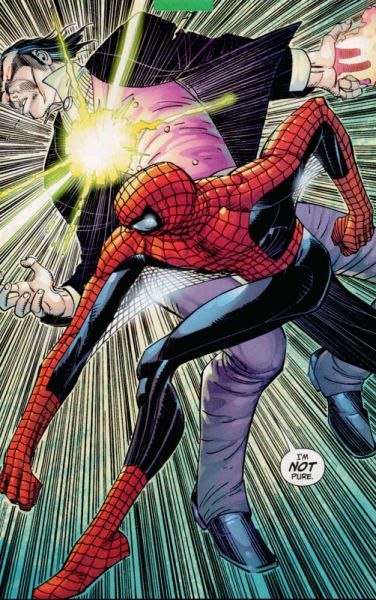
Towards the beginning of the critically and commercially successful J. Michael Straczynski/John Romita Jr. creative run on Amazing Spider-Man, the duo unveiled a brand new adversary in the vampiric Morlun. This enigmatic force of evil fed of a person€™s €œtotemic powers,€ and was seeking out Spider-Man and his spider abilities as a source of €œfood.€ After confronting Morlun and finding himself quickly overmatched, Spider-Man figures the next time Morlun finds him, the villain will probably kill him €“ until he develops an ingenious way to take his enemy down. Rather than fight Morlun, Spider-Man concedes and allows the villain to feed on him. What Morlun finds is Spidey€™s radioactive blood makes him "impure." This weakens Morlun, giving Spidey an opening to land a haymaker in what has become a modern-day classic Spider-Man comic book moment. Since Sony started churning out Spider-Man movies in the early-2000s, outside of Venom, the bulk of the featured villains were all byproducts of the Silver Age of comics. Morlun is very much a contemporary villain in terms of his look, which would be an interesting new direction for the film franchise. Plus, that final confrontation with Morlun from Amazing Spider-Man #35 (vol. 2), might be the greatest Spider-Man fight from the past 30 years.

7. Introducing The Hobgoblin

The Green Goblin has somehow factored into four of the five Spider-Man movies since Sony launched the franchise in 2002. Sure, he€™s Spider-Man€™s greatest nemesis, but there€™s another goblin villain that deserves some cinematic love: the Hobgoblin. First created by Roger Stern and John Romita Jr. in 1983, the Hobgoblin was supposed to be an alternative to the Green Goblin. Part of what made the Hobgoblin such a formidable foe, was the fact that Stern made it very clear that unlike Norman and Harry Osborn, who portrayed the Green Goblin, €œHobby€ was not insane. Instead, he was cold, calculating and very manipulative, and not afraid to dispose of anyone who hindered his plans. Some fans have said that Dane DeHaan€™s Harry/Green Goblin in The Amazing Spider-Man is thematically closer to how the Hobgoblin is portrayed in the alternative Ultimate Spider-Man Universe. While this argument holds some merit, the character€™s introduction in the mainstream Marvel Universe (Earth-616) has some serious big screen potential. In fact, the way Romita Jr., illustrates the character€™s first appearance €“ unveiling parts of the Hobgoblin one panel at a time as he gets dressed and assembles his weapons before finishing with a full splash page €“ feels very cinematic in its pacing and tone.

6. Spider-Man Reveals His Identity To Black Cat

Marc Webb€™s The Amazing Spider-Man 2 introduced the character Felicia Hardy as an employee/assistant at Oscorp. But ardent readers of the comics should note that Hardy€™s alter ego is the sometimes criminal/sometimes hero Black Cat. A few years after the character is first introduced in Amazing Spider-Man #194, Black Cat and Spider-Man became involved romantically with one unique condition: Black Cat had no interest in seeing Peter Parker, the man under the mask, and only wanted to €œdate€ Spider-Man. Peter, being the hopeless romantic and naïve optimist that he can sometimes be, decides in Spectacular Spider-Man #87 that he€™s going to reveal his secret identity to Black Cat anyway. But when he pulls off the mask, Cat demands that he put it back on, reaffirming her original position that she€™s not in this relationship to be with Peter, but rather Spider-Man. This traumatic moment is the beginning of the end for Spider-Man/Black Cat though, the final nail in the coffin for the romance is when Spidey discovers that, behind his back, Felicia received super powers from one of his mortal enemies, the Kingpin. Despite Spidey€™s heartbreak, from a cinematic standpoint, a Spider-Man/Black Cat storyline in a future movie would be an inspired and unexpected choice, as most critics and fans seem to be banking on Mary Jane Watson being the next €œlove interest.€ Plus Black Cat is an interesting enough character on her own that she would be a ripe candidate to build a movie spinoff around.

5. Aunt May€™s Death

Sure, everyone was shocked and saddened to watch Gwen Stacy bite the dust in The Amazing Spider-Man 2, but if Sony wants to find a moment that will really go for the emotional jugular of the moviegoer, the studio can adapt Aunt May€™s €œdeath€ (which was criminally retconned a few years later) from Amazing Spider-Man #400. €œThe Gift€ is considered by many readers to be one of the greatest Spidey stories of all time as it is written and illustrated with the utmost tenderness and earnestness by J.M. DeMatteis and Mark Bagley. In this comic, May emerges from a coma long enough to spend one more day with her nephew, Peter. Over the course of this day, she reveals that she€™s known he€™s been Spider-Man for years (which was also retconned away when May was resurrected), before eventually asking to return to her home in Queens so she can die peacefully. As she€™s dying, Peter recites the famous line from J.M. Barrie€™s Peter Pan about finding the magical place Neverland by looking €œsecond to the right and straight on €˜till morning.€ Someone must be cutting onions as I€™m writing this because my keyboard is all wet. The emotional gut punch of watching the matriarch in Spider-Man€™s family peacefully die while her nephew/surrogate son recites lines from a childhood story would guarantee a theater full of sobbing children and adults.

4. Meeting The Kid Who Collects Spider-Man

Demonstrating that there is no kind of comic book story that Roger Stern can€™t write, in 1984 he crafted one of the most heart-wrenching tales in Spider-Man history in €œThe Kid Who Collects Spider-Man.€ Interestingly enough, the tale is actually the €œB€ story in Amazing Spider-Man #248, though most comic book fans remember it much more fondly than the issue€™s main story of Spider-Man versus the villain Thunderball. The story features Tim Harrison, a young boy who is described by a newspaper article as the greatest Spider-Man fan in the world. Spidey shows up in Tim€™s bedroom one night and the two start sharing stories about the Web Slinger€™s career. Eventually, the boy asks Spidey who he really is under the mask, and shockingly, Spider-Man unmasks and introduces himself as Peter Parker. On the comic€™s last page, we learn (via the newspaper article), that Tim has terminal leukemia and will die in a few days. Adapting such a quietly sad story for the big screen would be a radical departure for a superhero movie, but in The Amazing Spider-Man 2, director Marc Webb and actor Andrew Garfield also exhibited a very clear understanding of how Spider-Man is able to connect with regular New Yorkers €“ including one scene that shows Spidey helping a young boy who is being bullied. Perhaps this magic can be recaptured again in a future film and Tim Harrison€™s story can get the same cinematic treatment as the death of Gwen Stacy, and €œSpider-Man No More.€

3. I Now Pronounce You Spider And Wife

One of the many, many subplots in Sam Raimi€™s disappointing Spider-Man 3 was Peter Parker wanting to propose to his long-time sweetheart Mary Jane Watson. But because of nagging issues like Peter getting possessed by an alien symbiote and becoming an evil disco dancer, moviegoers never get the actual payoff of Peter and MJ tying the knot, as depicted in one of the biggest Marvel events of the 1980s, Amazing Spider-Man Annual #21. The caveat to all this is that Marvel controversially retconned the Peter/Mary Jane union out of existence with its €œOne More Day€ storyline in 2007, and the current editorial regime has expressed zero desire to reverse course and bring these two together again. But that doesn€™t mean this iconic comic book moment will never see the light of day on the big screen. For one, Marvel Studios doesn€™t own the rights to the Spider-Man film franchise, Sony does. If Sony ever wanted to demonstrate its autonomy over the Spider-Man universe (while also giving the old middle finger to Marvel), a Peter/Mary Jane marriage might be the way to go. Of course, if Sony did move forward with this idea, they would have to take things slow with its characters. Peter is currently mourning the death of his first true love, Gwen Stacy, and Mary Jane hasn€™t even been introduced into Marc Webb€™s movie universe just yet. So maybe by the time The Amazing Spider-Man 5 comes out.

2. The Conversation

Sally Field€™s turn as the widowed Aunt May in both of Marc Webb€™s The Amazing Spider-Man films has been wonderful to watch, as the veteran actress has terrific theatrical chemistry with her on-screen nephew, Andrew Garfield. While past filmmakers and comic book creators have tended to portray May as an elderly hindrance, who is one good scare away from having a heart attack and dying, the Webb franchise has given the character much more strength and vitality. With this more modern characterization in mind, Field and Garfield would truly get to flex their acting muscles if a future film adapted one of the greatest Spider-Man/Aunt May stories ever created: €œThe Conversation,€ by J. Michael Straczynski and John Romita Jr. In this story (Amazing Spider-Man #38 vol. 2), May discovers Peter€™s costume on the floor of his bedroom and confronts him about his secret. The two end up having an honest and riveting conversation that was (at the time) 40 years in the making (unfortunately, you can€™t count Aunt May€™s deathbed confession to Peter about knowing his secret identity as detailed in entry #5 since that was later retconned as being an actress hired by Norman Osborn). "The Conversation" relies solely on the strength of its characters and the long-standing history of their dynamic and still ends up being an emotional masterpiece. Webb could achieve the same result by adapting the story and putting his faith in Field and Garfield.

1. Emerging From The Grave

More than 25 years after it was first published, €œKraven€™s Last Hunt€ remains one of the most famous and popular Spider-Man stories of all time. Its plot €“ Kraven defeats the hero and buries him alive in order to assume his identity and prove his superiority €“ is one that is ripe for a cinematic adaptation. And yet, perhaps because of its very dark tone and Kraven€™s controversial suicide at the end, the storyline remains just an iconic comic book story, rather than an iconic movie. Hollywood€™s recalcitrance/disinterest in giving moviegoers a €œKraven€™s Last Hunt€ Spider-Man movie doesn€™t change the fact that the arc is filled with a number of visually stunning sequences that would translate wonderfully to the big screen. Most notably, the scene where Spider-Man finds strength in his love for Mary Jane to overcome these nearly insurmountable odds and pull himself out of the Earth. It is a definitive image of Spider-Man, and one that is frequently referenced in other Spidey comics (typically when the odds are stacked against the hero but he overcomes anyway). And it is one that will provide great satisfaction to Spider-Man readers if a filmmaker successfully captures it in movie form.

Contributor
Contributor

Mark is a professional writer living in Brooklyn and is the founder of the Chasing Amazing Blog, which documents his quest to collect every issue of Amazing Spider-Man, and the Superior Spider-Talk podcast. He also pens the "Gimmick or Good?" column at Comics Should Be Good blog.