10 Most Interesting Opening Shots In Movies

We've actually managed to find several opening shots more interesting than Scarlett Johansson's bum. Read on to see how we did it...
A film's final shot (which we already covered in this great article) can be the lingering image left in your mind long after the movie's over €“ if done right, an effective closing shot can be forever burned into your memory. It's the shock factor of Planet of the Apes, or the terrifying mystery of The Blair Witch Project. The opening shot, however, can be just as important. An opening shot can set the tone of a movie, impart to us all the information we need up front and centre or simply be astoundingly indelible and powerful in itself. An effective opening shot hooks you from the off; it prepares you for what's to come in a single frame and has all the intrigue to keep you in your seat. There are too many brilliant, unique opening shots from cinema history to mention here, and every film fan will have their own, probably very different top ten. This isn't the definitive list, but mentioned here are still ten of the best and most uniquely interesting opening shots from some of cinema's great filmmakers.

10. Rear Window

It couldn't begin any other way. In Rear Window, Alfred Hitchcock never allows us to leave the apartment where photographer L.B. Jeffries (James Stewart) is holed up with a leg injury. All we see throughout the film is what he sees from his apartment window, so of course the first shot is the view of the other apartments and their varied inhabitants outside Jeffries' window. Hitchcock playfully introduces this first shot as the blinds are slowly pulled up on Jeffries' windows. As the curtains would draw up for a theatre performance, Hitchcock is indicating the start of the show €“ he makes clear Rear Window's purpose as entertainment from the off. Then, as the opening credits finish, the camera slowly pans out of the window in the courtyard, and we're plunged into the drama head-first.

9. Lost In Translation

Yes, it's a shot of Scarlett Johansson's bum. No, it didn't make the list for that reason alone. Stop giggling. Sofia Coppola's headily romantic tale of finding love in a foreign city begins as it means to go on: located in the privacy of sterile hotel rooms. Here, Johansson's Charlotte is almost literally naked €“ from the outset Coppola lays the character bare, while also keeping her as emotionally distant as Coppola views life in the city of Tokyo itself. Note that we don't see her face, but her body turned way; she's laid down with the blinds closed, defeated, as the character admits when Bill Murray's Bob Harris first meets her. Coppola isn't just providing titillation for male viewers either €“ Charlotte is dressed plain, unremarkable, seemingly without any thought given to the male gaze, and it's the ordinariness of Johansson in the role that makes it her best, most honest performance to date.

8. Hidden

We're looking down an alleyway, at a house. There are two cars parked out front. What we see is a regular suburban street, an unremarkable sight, even if the cold simplicity of the image and the stillness of the long take is a little unnerving. But we come to realise we're not strictly watching this scene, but watching it through the eyes of Anne (Juliette Binoche) and Georges (Daniel Auteuil) on the television in their marital home. They've been anonymously sent a tape in the mail, and what they're watching on the TV is a recording of their own house, and themselves. The opening shot sets up the (unsolvable) mystery of Hidden, while making us complicit in the voyeurism of whoever the culprit may be. It also gives us a sense of pace, that of a slow-burn, that eventually director Michael Haneke will use against us by inserting moments of shock violence later on. But the plainness of the opening still, coupled with the enigmatic plot, means you'll forever be scouring this opening image for clues.

7. Raiders Of The Lost Ark

Probably the most iconic shot on the list, Spielberg's decision to fade the Paramount logo into that of some South American mountain achieves two things. First of all, it ties Raiders of the Lost Ark into the old serials it plays homage to by referencing the classic Hollywood studio system up front. The knowing fade also allows the film to recognise one important thing from the outset: it's just a movie. For a blockbuster about Nazis on the hunt for a biblical superweapon, it's important not to take things too seriously. But for those who appreciate art for art's sake, the transition itself just looks damn cool. It's Spielberg at his most inventive and tongue-in-cheek, signalling the beginning of possibly his most imaginative and light-hearted film.

6. The Thin Red Line

Every image of a Terrence Malick film is a painting imbued with meaning, with The Thin Red Line in particular full of shots examining the struggle between sheer beauty and utter malice. But the opening shot for Malick's third is an instant symbolic representative of the entire film, as an alligator submerges itself in a tropical pond, its beady eyes and tough armour slowly sinking below the water. The alligator disappears under a layer of algae, and becomes a silent, hidden threat waiting to strike. And that's how The Thin Red Line views death, and war, in a nutshell. The tranquillity of nature, what we see here as lush jungle, is punctuated by the quiet ferocity of a predator. Later, American and Japanese forces will destroy this setting with bombs and bullets €“ it's something the opening shot wordlessly foreshadows.

5. Blade Runner

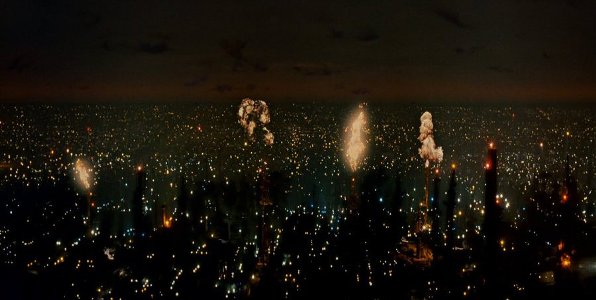
Ridley Scott finds beauty amidst the ugliness of the future in Blade Runner, and begins with a shot that is by equal turns dazzling and horrifying as an introduction to LA 2019. For a neo-noir set almost entirely in the dark, the first frame offers an appropriate glance at the nighttime landscape, a vast, over-populated megacity which stretches out into an orange-smog horizon. The specks of light on the ground shine like glittering stars, of which you'll see none in the night sky through the thick orange-green congealment of fog and light pollution. The factories at the forefront of this endless city callously belch fire into the sky, so that in one single shot we see both the ramifications of extensive pollution on the Earth and the cause of it. And towers of trade, standing high above the dwellings below, tell us just where commerce sits in the hierarchy of things.

4. Apocalypse Now

Francis Ford Coppola's Apocalypse Now has rightly been described as hallucinatory €“ it's an LSD-infused look at the Vietnam War, all colour and chaos, about mankind at his most mindlessly destructive. The film's opening shot could be a tactical strike seen through a confused drugs haze: We see trees. A helicopter flies before us. Yellow smoke begins to rise, almost covering the greenery in the background. It's uncertain what's immediately happening here. Then boom €“ a payload of napalm instantly reduces the treeline to smoking trunks. Coppola pans to the right, showing us the additional devastation, but he shows us nothing more €“ the fire-bombing is just as senseless all down the line. The shot begins as serene; by the end, it's pandemonium, choppers criss-crossing through the ochre smoke before ash-piles that were living things just a second before.

3. Touch Of Evil

It almost seems like a cheat to include an extended tracking shot for an 'opening shot,' as the shot itself takes on so many different forms and absorbs so much more information than conventional opening shots. But when it works, it works. You could have the opening eight-minute long take of Robert Altman's The Player (or even, technically, the entirety of the 87-minute Russian Ark, which is one long tracking shot from beginning to end), but for the best you have to look to a master. It's hard to figure out how - pre-Steadicam - Orson Welles even managed the opening shot of Touch of Evil, which begins on a close-up of a bomb, follows the man that plants the bomb on a car, then follows an unsuspecting couple as they drive the car down the street to their eventual doom. Welles' camerawork is so fluid it flies, in a similar way to that seen in Mikhail Kalatozov's I Am Cuba, but this shot is the touchstone for every director who's attempted a virtuosic tracking shot since.

2. Taxi Driver

Martin Scorsese transforms an innocuous New York taxi cab into the beast of a monster movie in his opening shot for Taxi Driver. A white 'fog' (actually the steam from a New York street vent) is our first image proper, interrupted suddenly by a giant, bulbous thing €“ a vintage yellow taxi €“ crashing through it in slo-mo. The cab dominates the screen, monstrous, the camera staring up in awe as the vehicle passes by silently, like a predator on the hunt. As the cab leaves the frame, we're left with the fog again, and a glimpse at the city streets, followed by the opening credits. The cab leaves as quickly as it arrived, but everything, including the muted colour scheme, the shock of its arrival and the ominous use of slow motion, just feels off. It's actually a hint at the man in the cab, who'll spend the remainder of the film leaving you with an identical sense of unease.

1. 2001: A Space Odyssey

Martin Scorsese once said that: "Watching a Kubrick film is like gazing up at a mountaintop," and arguably no film of Kubrick's makes the point better than 2001: A Space Odyssey. Its opening shot alone dwarfs what most movies try to accomplish: We're in space, looking at the Moon, when Kubrick pans up and looks beyond, to the Earth, and then the Sun. In a brief shot of seemingly perfect symmetry, Kubrick says so much about the enormity of the universe. The alignment gives the shot an almost religious quality €“ is the shining star meant to take on the appearance of an all-powerful deity looking upon mere mortals? Of course this shot is enhanced enormously by the soundtrack choice (as so many on this list are), but the image alone conveys all the mysterious potential and grand majesty of the cosmos.

Contributor
Contributor

Lover of film, writer of words, pretentious beyond belief. Thinks Scorsese and Kubrick are the kings of cinema, but PT Anderson and David Fincher are the dashing young princes. Follow Brogan on twitter if you can take shameless self-promotion: @BroganMorris1