10 MCU Theories That Come Directly From The Creators
Straight from the horse's mouth.
There is surely no movie franchise in existence - save, perhaps, for Star Wars - that's invited as much passionate and downright insane levels of debate as the Marvel Cinematic Universe.
Even a cursory glance online reveals a treasure trove of fan theories about even the most forgettable MCU movies - looking at you, Thor: The Dark World - ranging from the hilariously mundane to the ludicrously grandiose.
Yet fans having their outlandish theories about a superhero movie is one thing, but what about when the creative minds behind these films get in on the fun themselves?
These 10 theories were mostly suggested by the principal creatives involved with each movie - typically the writers and directors - though occasionally the MCU's resident producer himself, Kevin Feige, chimed in to offer his authoritative perspective.
Now, it's important to note that none of these theories are officially 100% canon.
Despite being the "Word of God", most of these filmmakers have stopped short of rubber-stamping their theories for sure, allowing them to ambiguously exist in the background without ever needing formal confirmation on-screen.
That said, don't be surprised if one or two them actually do get referenced in an MCU movie one day.
After all, it was a long-time running gag between fans and Marvel that Stan Lee was playing the same character across his countless cameo appearances, and Guardians of the Galaxy Vol. 2 finally made it canon in the most brilliantly crowd-pleasing way possible. Never say never...
10. Cap Didn't Lift Mjolnir To Spare Thor's Feelings - Avengers: Age Of Ultron

One of the MCU's most enduring mysteries has been whether or not Captain America (Chris Evans) was actually able to lift Thor's (Chris Hemsworth) hammer Mjolnir or not during Avengers: Age of Ultron's party scene.
Though we of course saw Cap finally wield Mjolnir in Avengers: Endgame, fans continue to debate whether Cap truly was worthy back in 2015, given that he was shown slightly shifting the hammer when he attempted to lift it (much to Thor's distress).
But the film's writer-director himself, Joss Whedon, offered up his own theory to a fan who asked him for an answer, telling them, "Did he fail? Or did he stop?"
Given that Mjolnir doesn't work in degrees of worthiness - you can either lift it or you can't - the implication of Whedon's statement is clear, that Cap purposefully feigned an inability to lift Mjolnor in order to spare his pal Thor's feelings.
When Thanos (Josh Brolin) was on the warpath in Endgame, though, there was no time for such modesty, and Cap finally got to wield the magical hammer - this time, much to Thor's relief.
9. Baby Groot Is Original Groot's Son - Guardians Of The Galaxy

James Gunn broke the hearts of fans worldwide last year when he went to Twitter to decisively explain the mechanics behind Baby Groot's (Vin Diesel) existence.
Though most fans simply assumed him to be a regenerated version of the original, mature Groot, Gunn confirmed that the Groot from the first movie who sacrificed himself is indeed dead for real, and Baby Groot is effectively his "son."
Hilariously, Gunn actually said as much mere months after the original Guardians was released, and again in 2017, but fans didn't listen en masse until he re-iterated the news via Twitter last year.
To be clear, Baby Groot is in no way the same as the original, for even though he will presumably end up resembling the fully-grown Groot eventually, he possesses none of that Groot's memories. So sad.
8. Thanos' Sword Was Made By Eitri - Avengers: Endgame

One of the few distinct changes evident in Endgame's 2014 version of Thanos is that he carries around a gigantic Double-Edged Sword, which during his battle with Captain America is strong enough to slice chunks out of Cap's Vibranium shield, suggesting it's made of an unearthly, exotic metal.
On the director's commentary for Endgame, Joe Russo floats his own theory about the origins of the colossal weapon, remarking, "Well, Thanos clearly knew of Eitri."
The implication is of course that Eitri (Peter Dinklage), the King of the Dwarves who created both the Infinity Gauntlet and Thor's weapon Stormbreaker, built Thanos' huge sword.
Better still, Endgame's screenwriters Christopher Markus and Stephen McFeely quickly concurred with Russo, providing fans with an explanation that's about as canonical as they get - even if it's technically not official.
7. Peter Parker Met Tony Stark As A Child - Iron Man 2

A fan theory started doing the rounds in 2017 that Peter Parker (Tom Holland) actually had a cameo in the MCU many years before the character was ever introduced.
The theory dictates that Parker was the young boy who stands his ground against a Hammer drone at the Stark Expo in Iron Man 2.
Between the Expo taking place in Parker's home borough of Queens, the ages lining up perfectly and Peter obviously having an interest in science from a young age, it slots together perfectly.
It wasn't long before Tom Holland "confirmed" the theory himself, but things got even more interesting when Spider-Man: Homecoming's director Jon Watts declared that he'd actually come up with the theory himself while in pre-production on Homecoming.
After being hired for the gig in June 2015, Watts was on-set to watch Spidey make his debut in Captain America: Civil War, and then combed through the MCU's back catalogue in order to fully acquaint himself with the franchise. In his own words:
"I was watching all these other movies and being like, 'What if that little kid at the Stark Expo was Peter Parker? In the Iron Man mask.' Like, he’d be about the right age for that. And he loves Tony Stark. It’s this thing where, because it’s not completely figured out, that you can just go back and basically write fan fiction for those movies, then the fan fiction becomes reality. A lot of the Easter eggs in this movie just started by rewatching the movies...I remember watching [Iron Man 2] with Kevin Feige and everyone and being like, 'Does the math work on that?' He was like, 'It might, maybe.'"
Given that Watts, Feige and co. would've presumably come to this conclusion sometime in 2015 or 2016, they actually beat the fans to the punch by at least a solid year, even if they didn't bring their theory to light until prompted by eager fans.
6. Loki Was Mind-Controlled By Thanos - The Avengers

This theory about the original Avengers movie wasn't fielded out by Joss Whedon or Kevin Feige in a random interview, but quietly introduced by Marvel as a whole late last year, in such a way that fans barely noticed.
But some certainly did, as a perusal of Marvel's official character bio for the MCU's Loki (Tom Hiddleston) seems to confirm that he was himself subject to the very same mind control he inflicted on others through the Scepter given to him by Thanos (which contained the Mind Stone).
The bio says, "Gifted with a Scepter that acted as a mind control device, Loki would be able to influence others. Unbeknownst to him, the Scepter was also influencing him, fueling his hatred over his brother Thor and the inhabitants of Earth."
That seems pretty cut and dried: Loki's inherent penchant for mischief was amplified by the Scepter, and it totally vibes with the fact that Loki seems to cool his villainy in subsequent movies once the Mind Stone is taken out of the equation.
Not all fans are 100% convinced that a listing on a Marvel website counts as canon, as there's little oversight regarding who writes these entries, but it makes all the sense in the world, so it's incredibly easy to believe.
5. The Hulk Wasn't Scared Of Thanos, He Was Tired Of Helping Bruce - Avengers: Infinity War

With Bruce Banner (Mark Ruffalo) suffering through, er, "performance issues" in Avengers: Infinity War, many fans took The Hulk's absence as proof that the Big Green Dude was scared of Thanos after their one-sided fight at the start of the movie, and therefore refused to face him again.
But on the director's commentary for Infinity War, Joe Russo - who didn't write the movie, remember - offers up his own thoughts on The Hulk's refusal:
"What makes him unique as a character is that there is a host body that is being fought over by two distinct personalities who hate each other. And both want control of the host body. So we thought an interesting direction to take him in is what if Banner, who typically uses the Hulk to solve crisis situations, what if the Hulk were no longer interested in solving those problems for Banner? So that the relationship is becoming increasingly dysfunctional. That's what's going on here...People have speculated whether there was some fear on the Hulk's part about having to face Thanos again. But I think ultimately what it is, is that he's tired of playing hero to Bruce Banner."
The theory of course dovetails quite neatly into Endgame's fusion of Banner and Hulk, where after eighteen months in a gamma lab, he's able to "put the brains and the brawn together."
4. Talos Knows About The Multiverse - Spider-Man: Far From Home

And now for by far the freshest theory on our list, coming to light following the release of Spider-Man: Far From Home, and the climatic post-credits reveal that Nick Fury (Samuel L. Jackson) and Maria Hill (Cobie Smulders) were actually Skrulls Talos (Ben Mendelsohn) and Soren (Sharon Blynn) in disguise respectively.
Naturally the film's treatment of Mysterio (Jake Gyllenhaal) seems to imply that the multiverse he and "Fury" spoke of doesn't actually exist, but director Jon Watts has a rather different perspective on the matter, and one that revolves entirely around Talos masquerading as Fury:
"I do think about the multiverse thing. People were really excited about it. And we're not saying that there couldn't be a multiverse in this movie. We are saying that what Jake is saying - what Mysterio is saying in the movie - is bulls**t. But there's something that I think about is that the fact that Nick Fury, who's actually Talos, completely believes this story about the multiverse makes me wonder…now this is off book now, but like, does that mean that Talos is aware of some sort of multiverse? Because…this is fan-fiction, to me. But he seemed to accept it!"
This is of course pure informed conjecture on Watts' part, but the logic tracks pretty solidly that Talos-as-Fury wouldn't blink at the mention of the multiverse if he knew that it did in fact exist.
3. The Infinity Gauntlet Is Used By Wishing - Avengers: Endgame

The precise mechanics of the Infinity Gauntlet aren't ever really made clear during either Infinity War or Endgame, beyond its potential to wreak major havoc or bring about miraculous repair depending on who might be wearing it.
But post-Endgame, the Russos have discussed the nature of the Gauntlet at considerable length, while offering up their own opinion on quite how it all works.
For starters, when asked about how Tony Stark (Robert Downey Jr.) was able to obliterate Thanos' army without killing 2014 Nebula (Zoe Saldana), who was technically a member of his army, Anthony Russo said, "The argument could be that Tony wished away all the evil, the enemy", while pondering what that meant for Gamora (who, per a deleted scene, is shown to be alive following Stark's finger snap).
But in more overt terms, Kevin Feige talked about the "wish" aspect of the Infinity Gauntlet when addressing how The Hulk managed to undo The Blip and return all the dusted victims safely back to Earth. He said:
"If people were in an airplane when they were dusted, they didn't return at 35,000 feet. They didn't fall to their deaths because Smart Hulk is smart, and when he snapped...You can wish for whatever you want and you can wish for everyone to come back safely. Done."
While many fans speculated that the Gauntlet simply reacted to whatever the user's wish was in that precise moment, the movies have been relatively cagey about confirming quite how it works, so it's nice to hear a response that's as close to official as you could ask for.
2. There Were Always Two Caps In The MCU - Captain America: Civil War

Surely the most-debated aspect of Avengers: Endgame is the ambiguity over Steve Rogers travelling back in time to live out a happy, normal life with Peggy Carter (Hayley Atwell).
Did he end up living out his life in the original MCU timeline, or did he create a new parallel timeline by traveling back?
Amusingly, the Russo brothers are completely at odds with screenwriters Markus and McFeely on this, for while the Russos believe that Cap had to create a new timeline in order to live out his life, the writers have a very distinct theory about how the original timeline could juggle two Captain Americas at once:
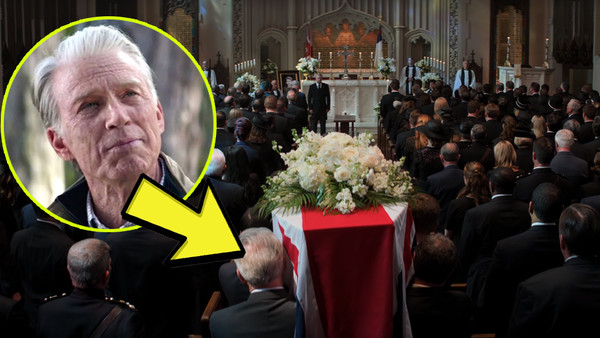
"I would like to believe that through some sort of bulls**t time loop paradox - throw in the words you use when you're bulls***ting science in a movie: 'some sort of quantum paradox' - that there are indeed two Captain Americas in the MCU timeline. That Steve Rogers who looped back into time has therefore always been there, and that he is living somewhere else in the movies you're watching. And what I really like to believe is that there's an old man sitting in back at Peggy's funeral in Civil War, and that's old Steve Rogers, watching young Steve Rogers, carry old Steve Rogers's wife up to the front of the church. Can I explain it scientifically? Not really, no."
It's a fascinating, brain-scrambling idea, especially as an elderly gentleman bearing a decent resemblance to Old Cap can be seen acting as one of the pallbearers for Peggy's coffin in Captain America: Civil War.
This is one of those wonderful things that will likely never get a formal on-screen confirmation either way, but there's enough there for fans to subscribe to whichever version they prefer.
If there really are two Caps on Earth during the entire MCU, though, it sure does re-contextualise the franchise in a fascinating way.
1. Gamora's Soul Was Trapped In The Soul Stone (But Not Really) - Avengers: Infinity War

This is an especially fun one because it saw the Russo brothers hurriedly "confirm" a major aspect of Infinity War's plot, only to have to walk it back days later after they realised it had been "misrepresented" by the Internet at large.
While holding a Q&A at Iowa City High School on the week of release, the Russos were asked about Thanos' brief post-snap interaction with a young Gamora on an ethereal, orange-tinted expanse.
Joe Russo effectively suggested that Gamora was trapped inside the Soul Stone, which many fans interpreted to mean the pocket dimension from the comics known as Soulworld.
But following the online hubbub over what this implied for the victims of the snap - that they were also sent to Soulworld rather than actually erased from existence - Russo had to offer a corrective to his prior remark:
"That moment when he clicks his fingers sends him into this ethereal plane inside of the Soul Stone where as part of his quote unquote hero's journey in the film, he has one last moment to convey a sense of guilt about what he's done. It illustrates what a complicated character he is. So, to clarify, it's a spiritual representation of her and obviously that's something that the Soul Stone has power to do. But really it's there to illustrate his pain and his guilt. I wouldn't read much more into it beyond that."
This was backed up later in the year by VFX artists who worked on designing the mysterious locale, who noted that the place most likely doesn't exist, though added that only Kevin Feige can ever really say for sure.
Basically, Joe Russo opened up a huge, unwanted can of worms and then very quickly and succinctly decided to close said can - even if many fans had already run away with the original theory and didn't even see his retraction.