10 More Perfect Horror Movies You've Never Heard Of
Let these magnificent nasties drill through your eyeballs and nest in your brain.

Yes, we're back again with ten further hidden highlights of horror cinema for you to sink your sharpened teeth into. And it should come as no surprise that there are a whole host more bone-shakers and nail-biters that haven't yet had their due.
The perfect horror movie comes in many forms, and in the 21st century in particular the genre has adopted a flexibility allowing it to seep away from the traditional models presented by the slasher, shocker and exploitation flicks of the past and take on unexpected nuances from some of film's other areas. This is precisely where we find many of the movies in this article, treading the boundaries between horror and comedy, social drama, cinematic deconstruction and all the other places we may not expect them to go.
But why have these blood-soaked and mind-altering gems hitherto failed to find the fanbase they so obviously deserve? Sure, the mixing of genres and unorthodox approaches may be part of it, but more often it is the doing of confused marketing teams, limited or non-existent theatre releases, hipster audiences who don't want to share the spoils, and the bottomless pit of VOD that titles find themselves released into, freefalling through the algorithms.
Alas, for these films at least, those days are over! Time to enjoy ten more perfect horror movies you've never heard of.
10. All My Friends Hate Me (2021)

Sometimes the best horror movie is the one that keeps you guessing until the end. Far from masked slashers stalking the streets and body horror gore in every frame, British indie flick All My Friends Hate Me takes the road less travelled and sets up a psychological rollercoaster that winds the tension tight and doesn't show its hand until the final scene.
Returning from volunteering abroad in a refugee camp, Pete (Tom Stourton) reunites his misfit band of university friends to celebrate his 31st birthday on a secluded country estate. But the unwelcome presence of mysterious local Harry (Dustin Demri-Burns) shatters the group dynamic and upends the celebrations. When everything starts going wrong and his friends turn on him one by one, Pete becomes convinced there is a darker plot afoot.
Helmed by TV director Andrew Gaynord (Stath Lets Flats), the film premiered at Tribeca in 2021, and, despite being picked up by BFI for distribution, has largely flown under the radar. It saw a limited run in mid-and-late-2022, briefly championed by indie and arthouse cinemas, but largely lost in the rosters of the big out-of-town multiplexes, and has since been confined to the well-intentioned yet oft ignored archives of the BFI's own streaming service.
9. One Cut Of The Dead (2017)
As far from a conventional horror movie as they come, Shinichiro Ueda's One Cut of the Dead is a Japanese zom-com that flexes, stretches and breaks just about every generic and filmic boundary using only a tight 90 minutes of your time and a £20,000 budget.
The movie sees a director and his crew face the rising dead in a remote abandoned facility that was apparently used for supernatural experiments during WWII. They must face off against zombies and each other, while attempting to capture the whole affair in a single take.
One Cut of the Dead uses the device of a film within a film to perfection, shooting on location with a director who will literally go to any length to bag the perfect scene. Everything is low budget -- especially the score -- and yet One Cut of the Dead is far more than the sum of its parts, rapidly settling into its own unique filmic vocabulary and having as much fun as it can with it.
Its constant pace and perfect comedy beats make One Cut of the Dead an easy watch, no matter how much shaky cam or amateur dramatics, and, without giving too much away, it manages to step well outside its own boundaries, turning its brilliant effects and acting on their head several times in an unexpectedly creative fashion.
8. Zana (2019)

Is it a psychological horror? Is it a war movie? Is it a human drama? Well, it's kind of all three. Defying categorisation, Zana folds horror tropes and imagery into a stark portrayal of Kosovo life, while dissecting the fallout from the country's infamous late-nineties war, all building to a revelatory climax.
A decade after the war, Lume's (Adriana Matoshi) nightmares are haunted by a blood-soaked youngster, while in her waking life she suffers the personal and social retribution of struggling to conceive. Unable to live up to her husband and stepmother’s desires of a larger family, Lume is taken to snake oil healers who treat her infertility against her will. Afflicted by PTSD, her struggles build and hallucinations threaten to separate Lume from her reality altogether.
Zana has the tense family elements of the likes of Hereditary (2017), played against extended nightmare sequences, witch doctors and mysterious pregnancies, all of which ask us whether we want to write events off as social prejudice or embrace the presence and possibility of something more supernatural. Genre purists may be unsatisfied with the socio-political drama at the film's core, but its meditation on loss is uniquely dark and frequently terrifying, especially surrounded as it is by blood and ghosts.
7. Oculus: Chapter 3 – The Man With The Plan (2006)

Director Mike Flanagan may be horror royalty these days, but back in 2006 he was making low-budget short films in an effort to get studios and financiers to take a gamble on him in the big leagues. Amongst these projects is the fantastic mouthful, Oculus: Chapter 3 -- The Man with the Plan.
In an effort to prove that an antique mirror (known as the Lasser Glass) has been responsible for a string of deaths, murders and suicides throughout the ages, Tim Russel (Scott Graham) sets up shop in a bare room, with just himself, three cameras and the mirror itself. While his intricate series of alarms and checks designed to keep him present initially seem to work, time begins to slip away from Tim and soon he's at the mercy of whatever lives within the mirror's reflection.
Originally intended as part of a longer anthology of horror shorts telling the tale of the film's supernatural MacGuffin-cum-antagonist the Lasser Glass, Oculus: Chapter 3 was instead scaled back to a tight, single-room, single-sequence film, and boy does it ever benefit from it. Flanagan makes creative use of the three camera, three monitor setup, weaving confusion and temporal instability into the film's fabric with only one actor and, for the most part, a normal mirror. Far greater than the sum of its parts, Oculus manages to be scarier than most feature horrors with 1000x its budget -- and it ultimately helped get feature film Oculus made seven years later.
6. Hounds Of Love (2016)

Eschewing tradition, convention and tropes, Australian kidnap feature Hounds of Love turns what could have been a paint-by-numbers piece of torture porn into a tense and terrifying psycho-drama that uses its grimmest elements to develop its characters rather than titillate viewers.
Loosely based upon a series of real crimes committed by Aussie couple David and Catherine Birnie, and somewhat curiously named after the 1985 Kate Bush album, the film sees teenager Vicki (Ashleigh Cummings) abducted from the suburban streets after a blazing argument with her mum. Chained to a bed and forced into a nightmare of violence, rape and domination by nutty bogan duo John (Stephen Curry) and Evelyn (Emma Booth), Vicki uses every tool she has to try and survive the ordeal and turn her murderous captors against each other.
Unlike your run-of-the-mill kidnap horror flick, most of the truly horrific things happen off-camera in Hounds of Love, but somehow this often only makes them worse. The direction is eerie, the characters creepy, the soundtrack equal parts intense and haunting, making the most of synthesisers and drones; and yet, although it did apparently get an international release, you'll be hard-pressed to find anyone who's seen it.
5. Revenge (2017)

Another twist on tradition, French-language thriller-chiller Revenge sets itself up as heir to some of the early video nasties, such as Last House on the Left (1972) and I Spit on Your Grave (1978), and yet the end result is closer to arthouse than last house.
Revenge is the story of Jen's (Matilda Lutz) revenge on a trio of rich hunting buddies' whose rape and murder of the young socialite doesn't quite go to plan. Stuck in the middle of the desert, with a gut wound and no outside contact or point of refuge, Jen runs a guerrilla campaign against her attackers, replete with grot, grime, blood, hallucinations and some creatively staged kills.
Despite its rape-revenge storyline and willingness to unflinchingly depict depravity and gore, Revenge manages to rise above its exploitation roots and deliver something stylish, nuanced, surreal and rewatchable for all the right reasons. As a tonic to the aforementioned nasties, it offers many of the same thrills while centring the story on a three-dimensional female lead whose plight and exploits are all the richer for her character development from saccharine trophy mistress to self-possessed badass.
While the mere fact of subtitles has limited the film's appeal for a wider Western audience, Revenge's lack of exposure has only served to bolster its indie sleeper credentials.
4. Tigers Are Not Afraid (2019)

Mexican indie horror Tigers Are Not Afraid is the place where City of God meets Pan's Labyrinth, where the brutalities of reality manifest surrounded by supernatural horrors, and it never shies away from an opportunity to plunge us into the worst of a society where human trafficking, bloody murder and orphaned children are commonplace.
Estrella (Paolo Lara), a pre-teen with a relatively normal life, is wrenched into orphan-hood when the local drug cartel kidnaps her mother. Armed with three pieces of wish-granting chalk, and stalked by the spectre of her mother and many other dead innocents, she joins up with Shine's (Juan Ramón López) gang of homeless orphans, and they wage a small and surprisingly effective war on the cartel.
Tigers Are Not Afraid's craft and storytelling genius far outstrip its financial means (budgeted somewhere in the region of £1 million) and, while the CG isn't as flashy as its big-budget contemporaries, it blends it with prosthetics and practical effects to bring all manner of street and supernatural horrors to life.
The real genius of the film, however, is how it uses its horror not as a means to deflect from the real terrors faced by its child protagonists, but as a fundamental component of its narrative thrust, viscerally rendering the very real violence of such cities stricken by the Mexican Drug War.
3. Mad God (2021)

Horrific, majestic and dark, stop-motion acid dream Mad God submerges us in layer after layer of visuals that would make David Cronenberg blow chunks, descending into a subterranean hellscape that never shies away from an opportunity to one-up its own depravity.
The Assassin, a lone soldier in a gas mask and trench coat, journeys into the underworld, carried by a diving bell, and with a disintegrating map guiding his mysterious mission -- to destroy the underworld. He ploughs on through eons of misery, passing wretched creatures of all shapes and sizes being torn and tortured and made to suffer all manner of unspeakable indignities for unknown and almost certainly unnecessary purposes, until he becomes one himself.
With no dialogue, Mad God relies on its grim visuals and a rich and foreboding soundscape to carry tension from beginning to end. And, while almost unbearable at times, this combination also ends up being curiously transcendent -- something like the state of euphoria Martyrs tells us people enter when they've endured more pain than their system can handle.
A labour of love, constructed over some 30-odd years using spare weekends, crews of volunteers and Kickstarter money, Phil Tippett's animated odyssey is perhaps the best stop-motion ever to have hit our screens, and certainly the best horror. And it comes with a disturbing message: there is no purpose but creation and destruction themselves.
2. Antiviral (2012)

Brandon Cronenberg has really put his stamp on horror in the last few years, with his most recent picture Infinity Pool finding purchase in some of the more popular corners of the film and cinema scene this year, but back in 2012 he was still small potatoes, fighting to get out from under his father's shadow and putting together his first feature on a budget of less than £2 million.
The feature film in question is Antiviral, starring a post-X-Men, pre-Get Out Caleb Landry Jones as Syd March, employee of a clinic that offers injections of celebrities' diseases to the most obsessive fans. But Syd leads something of a double life, infecting himself and selling the disease pathogens on the black market. He makes some side money and spends most weekends recovering in bed, but soon runs into an illness he can't quite shake, and a dark conspiracy at the heart of it all.
Despite debuting at Cannes and co-winning the Best Canadian First Feature Film at TIFF, Antiviral screened in only two cinemas in the UK, and made somewhere in the region of £100,000 globally. It's no surprise, then, that nobody saw it, and a similarly woeful home media release in the intervening years has ensured things remain that way. Nevertheless, Antiviral's blend of psychological thrills, body horror and good old fashioned misery make it essential viewing.
1. Psycho Goreman (2020)
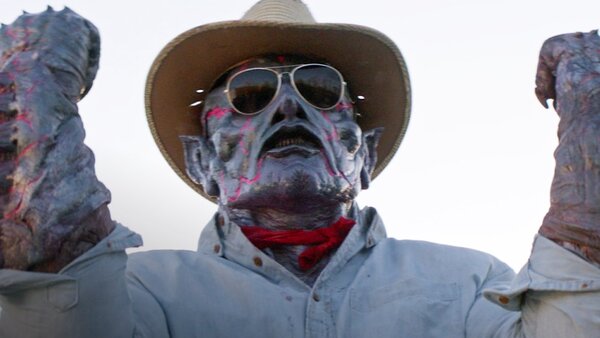
"F**ked up" doesn't even begin to cover Psycho Goreman, but it's a good starting point. Imagine if Quentins Dupieux and Tarantino had made E.T. on a shoestring budget, then throw it in a blender with 1990s Saturday morning TV, and you might get something in the ballpark of Steven Kostanski's bats**t sci-fi horror.
Psycho Goreman (Matthew Ninaber) is a genocidal intergalactic warlord, whose name comes courtesy of a sociopathic little girl (Mimi, played by Nita Josee-Hanna) and her long-suffering brother Luke (Owen Myre), who dig the alien up in their back garden playing a game of Crazy Ball (don't ask), and inadvertently harness the power to control him. Psycho wants nothing more than to visit exquisite suffering upon the galaxy, and the kids want a new playmate. Wackiness ensues.
Due primarily to its B-movie creds, the film has thus far seemed destined for the Shudder back-shelves, and yet Psycho Goreman sports brilliant writing for all, not leaving a single character to melt into the scenery, but paying especially screwy attention to the children, with Josee-Hanna in particular delivering lines that would feel at home on BoJack or South Park.
Add to this Psycho's cadre of alien generals, most of whom look fit for the rogues gallery of Power Rangers; Luke and Mimi's parents, who are going through something of a marital crisis; and more gore and violence than an MMA match in a butcher shop, and this is one unsung horror you'll someday be showing your kids.