10 Most Authentic Music Biopics Ever Made

"He's a fabulous disaster. He's a symbol, a metaphor."

Musicians are ripe fruit for biopics, matched only by political figures and sports stars, and hardly a month seems to pass without the emergence of yet another trailer promising the "incredible journey" that music's biggest stars went on to get to where they are today. The problem is, with such a wealth of biopics out there in cinemas and on television, it's inevitable that some are going to make for woeful viewing. For every Oscar-worthy retelling of the fascinating life story of one of music's great icons, there's a hundred damp squib narratives that fail to grasp what made their central figures such legends in the first place. It's time to weed out the triumphs from the failures; the platinum discs from the cheesy chart flops; the Walk The Line masterpieces from the Hysteria: The Def Leppard Story tragedies. These 10 biopics have been chosen because they're not only fantastic films with exceptional portrayals of musical gods - they're also incredibly true to the biographical stories of their inspirations. They are all compelling stories with convincing performances that are authentic to the history of popular music.

10. What's Love Got To Do With It?

Driven by two exceptional central performances from Angela Bassett and Laurence Fishburne, the biopic of the life of Tina and Ike Turner is a somewhat fictionalised adaptation of Tina's autobiography. While it differs from its source material to a large extent, the captivating narrative and stunningly true-to-life lead performances make What's Love Got To Do With It? one of the most impressive musical biopics to date. Both actors were nominated for Academy Awards, and it's easy to see why. Bassett's Tina is an incredibly strong woman, standing up to her abusive husband and ultimately proving that his manipulative insistence that she needs him to succeed is wrong. When Bassett and Fishburne are onscreen, especially in some of the darker sequences, the chemistry is electric. It may mess with a few facts, but that doesn't prevent this from being a truly captivating biopic.

9. La Vie En Rose

‰dith Piaf holds the distinction of being one of the few artists to become a genuine international popular musical success despite singing in a language other than English. Her unusual career warranted a pretty unusual biopic, and that is what director Olivier Dahan produced with La Vie En Rose. Noted for its disjoined narrative, the biopic is remarkably experimental in structure. Oft-unannounced flashbacks and flash-forwards dominate the film, with Piaf's youth and her old age rubbing up against one another in the context of the film. It's an interesting approach, though not one that is wholly successful. What IS incredibly evocative, however, is Marion Cotillard's portrayal of the legendary chanteuse. The studio was initially sceptical about her being cast, believing she wasn't a big enough name for the role, but she controls the screen at every moment. The wealth of awards she bestowed on her (including an Oscar) are testament to how exceptional her Piaf is.

8. Nowhere Boy

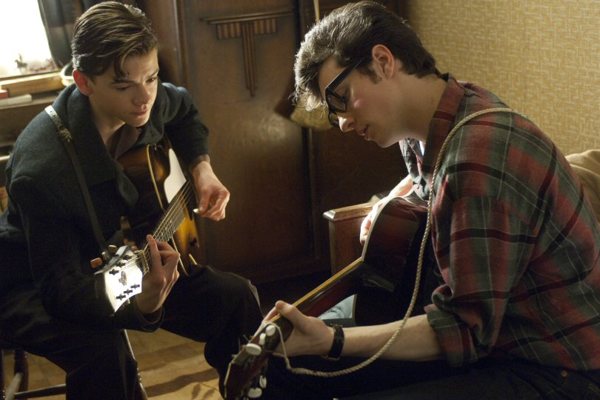
Any attempt to dramatise the life of a cultural legend like John Lennon runs the risk of alienating a vast fanbase that has put The Beatles' frontman on an unimaginably high pedestal. Fortunately Sam Taylor-Wood's Nowhere Boy, which studies the singer's early life, succeeds (for the most part). Based loosely on a biography of Lennon written by his half-sister Julia Baird, it's a touching tale that, despite occasionally leaning on an overly cutesy indie cinema vibe, features several truly awe-inspiring performances. Anne-Marie Duff and Kristin Scott Thomas (Julia Lennon and Mimi Smith respectively) were both nominated for Oscars, and they steal the show here. Aaron Johnson and Thomas Sangster are very good as Lennon and Paul McCartney, but it's undoubtedly the female actors that steal the show here. This film merits selection simply because it is a musical biopic that refuses to bow to audience desires for an in-depth study of The Beatles "famous years". Instead, it illuminates a rarely exposed side of Lennon's life.

7. 24 Hour Party People

Tony Wilson, AKA the owner of legendary Factory Records and nightclub The Haçienda and the man that effectively brought North-West UK maestros Orchestral Manoeuvres In The Dark, Happy Mondays, Joy Division and New Order into the world. The biopic of his life, which stars the brilliant Steve Coogan as Wilson, is a riotous study of his role in driving the post-punk movement and the later Madchester scene. This is one of the most fun "factual" films about music ever made. A psychedelic trip through the mind of one of the most influential men in recent British music history, it's full of humour, intriguingly dark moments and surreal set-pieces (including its infamous finale, featuring a cameo from God Himself...). Coogan is great at its centre, but the real attraction is the story of the incredible bands that Wilson developed. Who wouldn't be attracted to a film that dramatises the nutty drug use of Happy Mondays' Shaun Ryder, the chaotically dysfunctional Joy Division and the early optimism of acid house? No-one, that's who: hence the film's nomination for Cannes' Palme D'Or in 2002.

6. Sid & Nancy

John Lydon hated it. It lost a huge amount of money at the box office. Many critics slated it for its gratuitous celebration of a drug/sex-fuelled countercultural lifestyle. And yet Sid & Nancy is a genuinely brilliant piece of film, exploring the tragic tale of punk's answer to Romeo and Juliet. Few biopics balance aesthetic realism, utterly over-the-top chaos and a compellingly believable story like Sid & Nancy. This is partially down to the selection of the genius Gary Oldman and the hideously underrated Chloe Webb for the film's lead roles. Not only do they deliver fantastically melodramatic but perfectly pitched performances, but they also look scarily like Sid Vicious and Nancy Spungen. Props to the costuming department for that. The film is undoubtedly good value for its 18+ rating. It refuses to hold back in its drugged-up and hyper-sexualised imagery. This simply adds to the realism. As a caveat, though, it's worth noting that Lydon's hatred of the film stems from his belief that there was nothing truthful about it. That doesn't stop it from being a riotous watch, though.

5. Ray

Jamie Foxx had already proven himself to a gifted actor in films such as Any Given Sunday and Collateral, but it was still a brave decision to cast him as one of popular music's biggest ever icons, Ray Charles. Foxx absolutely nails it, and correctly won pretty much every award going. He was only the second actor ever to win all 5 major lead actor awards (Academy, BAFTA, Golden Globe, Critics' Choice, Screen Actors Guild) for the same performance. While it contains a few factual errors/exaggerations - as does any biopic - it is remarkably true to actual events. That's probably as much a testament to the incredible life of Ray Charles, which is an exciting enough story to drive this film. The fact that Foxx is utterly believable as the R&B/blues icon simply makes the film even better. Sadly, Charles died several months before the film was completed. He never got to see his life story rendered so beautifully cinematic. Foxx and director Taylor Hackford did his memory justice. Ray is the perfect tribute to one of the greatest singer-songwriters of all time.

4. I'm Not There

I'm Not There isn't perfect, by any means - it's certainly not as consistently wonderful as Ray - but the brave and innovative approach of the biopic makes it a genuine standout entry into the genre. There's also the fact that Cate Blanchett gives one of the greatest performances of all time. The film, a tribute of sorts to the life of Bob Dylan, employs a narrative structure that is even less linear than that of La Vie En Rose. It intercuts the tales of seven different Dylan-esques figures, and their stories overlap as they each portray different aspects and times of his life. The film is most successful when it is at its bravest - namely, in casting a woman (Blanchett) and an African-American (Marcus Carl Franklin) as characters based on the white male singer. Blanchett in particular is absolutely show-stealing at the centre of the film. She looks almost identical to Dylan, and has his mannerisms completely nailed down. It's a fascinating film that finds a unique method of encompassing the many lives of a legend. Flawed, but so brilliantly watchable.

3. Coal Miner's Daughter

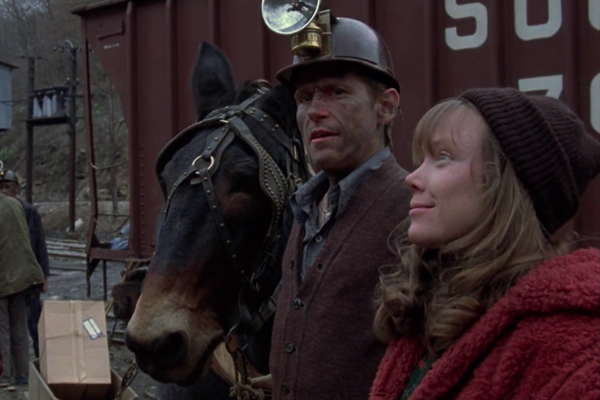
Make no mistake: Sissy Spacek is one of the most devastatingly underrated actors in film's history. Her performances in films such as The Straight Story, Marie and, in particular, Coal Miner's Daughter are just immaculate. Fortunately, she was suitably decorated for her captivating embodiment of country singer Loretta Lynn, winning the Academy Award for Best Actress. CMD is one of the most "feel-good" biopics on the list. From start to finish, it is an endearing and quirky little film, with Spacek delivering one of the most likeable characters ever. The source material could easily have been rendered dull and generic (a typical rags-to-riches story) in the hands of a different director/actor, but here its nuances are explored thoroughly and lovingly. As with all of the best musical biopics, the performance sequences are immaculately shot and presented. The finale of the film's title track is wonderful. Spacek should have become a star after this film. It's a shame that she'll generally be remembered as an underground character actress when she's proven that she can front a film as special as this.

2. Walk The Line

It must have been very difficult to put together a respectable film about the life of a singer that isn't just any country music star - he IS country music for many people. However, casting Joaquin Phoenix and Reese Witherspoon as Johnny Cash and his wife Julia Carter was a masterstroke by James Mangold that made Walk The Line one of the most enjoyable biopics ever created. It's probably not all that factually accurate (Cash's daughter Rosanne said that the figures were "unrecognisable" to her), but that doesn't prevent it from being a great film. At its core, it's a romantic drama between its two leads - and one that transcends many of the trappings of romantic drama more widely due to the compelling performance sequences and portrayal of these two key figures from music's history. Witherspoon in particular is phenomenal. She crackles with intensity, and her vocals are genuinely stirring. Phoenix sings Cash like... Well... Like Cash sings Cash! Roger Ebert, a lifelong Cash fan, was totally convinced by his vocal mimicry. Whether or not the story is true to life, the evocation of the characters' musical talents absolutely is. It may not have won the awards that many felt it merited, but Walk The Line was nominated for plenty and achieved vast commercial success.

1. Control

The best biopic ever created is one that many may not have even seen (certainly outside of the UK). Hemmed by music video director Anton Corbijn, starring little-known Sam Riley and based on the life of Joy Division's tragic singer Ian Curtis, it is an astonishingly accomplished and gorgeous piece of film-making. It also happens to tell the story of one of music's most enigmatic figures. Shot wholly in black and white, Control has the feel of an arthouse film rather than a biopic. Every shot is meticulously rendered, like something from the mind of Francois Truffaut, giving the film the air of something transcendent. Performance sequences, including a carefully recreated performance of Joy Division's infamous televised rendition of Transmission, outdo practically any others in the history of the genre. Riley himself is immaculate. Not only does he mirror the looks of Curtis, he also has the singer's movements and tics down to a microscopically perfect reflection. The black and white visuals, plus Riley's acting, lend the film a documentary aura. It is as if the viewer is actually seeing Ian Curtis' life (and death) onscreen. This is the aim of all biopics, of course, but rarely is it achieved so seamlessly as with Control. Aesthetically stunning, completely authentic to the source material, faultlessly acted and totally believable: Control is what every musical biopic aims, but so often fails, to be.

Contributor
Contributor

Articles published under the WhatCulture name denote collective efforts of a number of our writers, both past and present.