10 Most Dishonest Editing Cuts In Film History
They played us like a damn fiddle.
The art of filmmaking is inherently a manipulative one, because what is the intent of cinema if not to thrill, to move, and sometimes to terrify?
No director wants to make a film which leaves the viewer blank-faced while feeling not a flicker of emotion, and so they'll resort to every last trick in the book to make audiences respond viscerally to their work.
Obviously a film is comprised of so many disciplines working in tandem: the script, a director and their shot choices, the actors, and various below-the-line crafts elements.
But there's perhaps no single discipline which can make or break a film easier than editing: the precise stitching together of hundreds if not thousands of images to form a coherent narrative and get the viewer emotionally invested.
At its best, editing can drop jaws and enhance the meaning of a work - think the brilliant match cut from 2001: A Space Odyssey - though filmmakers will often resort to sneaky, tricky editing techniques in the pursuit of a shocking rug-pull or satisfying reveal.
These 10 films all employed clever - if patently dishonest - editing tricks to get the desired dramatic result, regardless of whether audiences liked it or not...
10. The Old Man ISN'T Tom Hanks - Saving Private Ryan
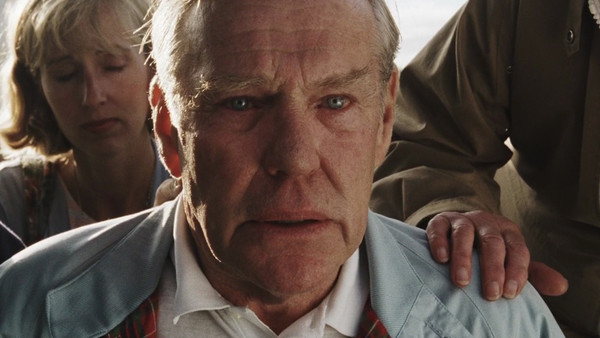
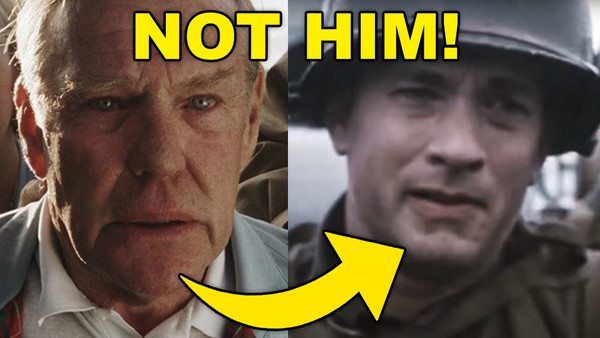
Steven Spielberg's war epic Saving Private Ryan is an inarguable masterpiece, yet it's also built on the foundations of a highly manipulative frame narrative, where we witness an elderly war veteran visiting the Normandy American Cemetery.
As Spielberg closes in on the man's face, filled with emotion as it is, the director smash cuts to the devastating 1944 Normandy Invasion.
From this point, the film follows Captain Miller (Tom Hanks) on his mission to rescue Private Ryan (Matt Damon), and the clear implication by this edit is that the old man is none other than Captain Miller himself.
Except, of course, it eventually turns out that Miller dies at the end of his mission, and the final wraparound reveals that the old man is in fact Ryan himself.
Though expertly executed by Spielberg, it's tough to argue with how needlessly he introduces a tricksy plot twist in a film that, in all of its historical enormity, really didn't need it in order to leave audiences sobbing.
9. Greedo Shoots First - Star Wars: A New Hope (Special Edition)

The whole "Greedo shoots first" debacle might be the most significant controversy surrounding a single piece of editing in any film ever. In the original theatrical release of Star Wars: A New Hope, Han Solo (Harrison Ford) of course shoots bounty hunter Greedo dead in the catina without even flinching.
It was a superbly badass scene and an exceptionally economical piece of character development, immediately letting the audience know just how smart and ruthless Han could be when he sensed danger.
George Lucas, feeling that this made Han a "cold-blooded killer," re-edited the scene for the 1997 Special Edition, having Greedo instead shoot first and miss Han, before Han quickly fires back in self-defense.
In addition to making Han simply seem less-cool, having Greedo miss from three feet away made him and the entire scene play as monumentally stupid.
Worse still, for the 2004 DVD release, Lucas digitally altered the scene further, having the blaster shots fire at almost exactly the same time and making Han awkwardly dodge Greedo's blaster shot through cringe-worthy CGI manipulation.
Lucas continues to defend the edit as consistent with his own conception of Han, which really just confirms how little he truly understands his own creation.
It's dishonest to the fans, and worst of all, dishonest to the character as depicted through the original three movies.
8. Zepp Is An Actual Psychopath (But Not Really) - Saw

The first Saw is a deliciously effed-up thriller best remembered for its bevy of nutty plot twists, one of which only really works because director James Wan resorts to some blatantly continuity-derailing editing tricks.
Throughout the film, we see Dr. Gordon's (Cary Elwes) wife and daughter being held captive by a shadowy figure, eventually revealed to be an orderly at Gordon's hospital, Zep (Michael Emerson).
The obvious implication is that Zep is either the Jigsaw killer himself or an accomplice, made no more evident than by a scene where he points a gun at the head of Gordon's wife and uses a stethoscope to listen to her heartbeat rising, with a clear degree of pleasure no less.
This is, obviously, only something a total psychopath would do, but it makes no sense at all once the end of the film reveals that Zep was just another pawn in Jigsaw's (Tobin Bell) game, and simply doing what Jigsaw ordered him to in order to survive.
You can argue that Jigsaw told him to check the wife's heartbeat - for some reason - but even within the skittish logic of the Saw franchise, that's a pretty epic reach.
This is one of those scenes that plays fine in the moment, and you'll likely be so awestruck by the film's twists that you won't think too hard about the logic, but on a second viewing, seeing Zep acting genuinely sadistic makes no sense whatsoever.
7. The Movie Literally Rewinds Itself - Savages

Oliver Stone's Savages is in no way a good film, but it's a fairly inoffensive, forgettable thriller, at least until its jaw-droppingly inane finale.
At the end of the film, protagonists Ophelia (Blake Lively), Chon (Taylor Kitsch), and Ben (Aaron Taylor-Johnson) are mortally wounded and decide to commit suicide together by taking a group overdose.
But after they die, the shot of their corpses suddenly turns sepia-toned and begins rewinding backwards through the last five minutes of the movie, revealing that this was nothing more than Ophelia's nightmarish daydream.
The remaining moments of the movie instead give the trio a far happier ending, and that's that.
Savages may not be a good film, but it at least seemed committed to a gritty, grim tone up to this point, only for the film to literally hit the rewind button and betray that mood completely. Terrible.
6. Michael Moore Opens A Bank Account, Gets A Free Rifle Immediately - Bowling For Columbine

Michael Moore's legendary 2002 documentary about American gun culture remains as ferociously relevant today as it was almost 20 years ago, but as is the case with most of Moore's films, he also employs some cheeky, arguably unethical editing tricks to get his point across.
Bowling for Columbine memorably opens with Moore visiting a Michigan bank where customers are given a free hunting rifle for making a deposit, and the filmmaker is seen doing just that.
He makes the deposit, fills out the forms, gets his rifle, and the film then cuts to Moore proudly brandishing the weapon in the bank's parking lot.
Except, that's not quite how it went down.
In reality, the bank has a gun delivered to a nearby licensed weapons dealer after performing a background check on the customer.
In the case of the film, they only agreed to hand Moore a gun on the premises after his agents claimed he was making a film about unique businesses in America. Doing so required them to ship the gun from a vault 300 miles away the night before.
The shot of Moore walking out of the bank into the parking lot was reportedly filmed at a later date, and though the director insists that none of the scene was staged, he did admit that the passage of time was compressed for "production reasons," whatever that means.
It's all the more frustrating as Moore makes so many brilliant arguments in his film, so one has to wonder why he bothered cooking-up half-truths such as this which only undermine his fine work.
Then again, a bank giving out rifles at all is still deeply unsettling, no matter the iffy editing tricks at work.
5. It Takes 15 Cuts To Make Liam Neeson Climb A Fence - Taken 3
Modern action movies are routinely taken (!) to task for their hyperactive editing techniques, but this was elevated to a whole new level of ridiculousness in the wretched Taken 3.
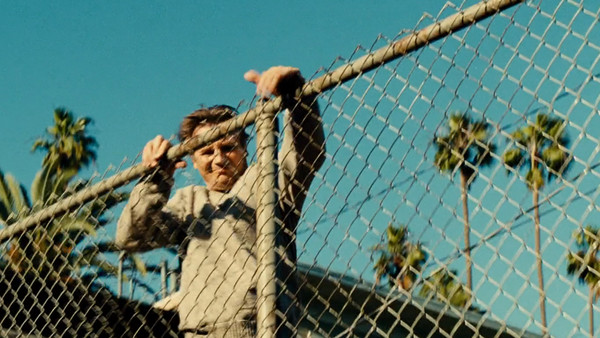
In an early scene where hero Bryan Mills (Liam Neeson) is on the run from the cops, he leaps onto a car and then hops over a fence.
Given that Neeson was 62 years of age at the time of shooting, it's not terribly surprising that he used a double to execute the stunt, and an in hilariously misguided attempt to conceal the double, director Olivier Megaton chopped the simple stunt up into 15 cuts over the course of a mere six seconds.
Even were it not an absolute headache to watch, it's totally unsuccessful in its attempt to convince us that Liam Neeson actually scaled the fence for real: his face is visible in just a few early cuts, before his face is obscured for every other major "action" shot.
Seriously, why not just have the stunt double scale the fence from the back in a single shot? Or better yet, just cut the stunt altogether if a 60-something man can't realistically do it anyway.
4. The Timeline Switcharoo - Saw II

After the first Saw film bamboozled audiences with mind-blowing plot twists and blatantly toyed with its own internal logic through editing, fans knew to keep their eyes peeled for the sequel.
Even so, few could've anticipated Saw II's climactic reveal, that the central game actually took place before the start of the movie, and Detective Matthews' (Donnie Wahlberg) kidnapped son Daniel (Erik Knudsen), who is seen partaking in the game via a pre-recorded video veed, is totally safe and sound.
Though this twist isn't easily guessed, the film doesn't really play fair with audiences either.
When Matthews first uncovers the video feed of the game in the first act, director Darren Lynn Bousman zooms in tight on the game unfolding on the video screen, and then almost immediately transitions to the very same scene unfolding within the movie's own cinematic continuity.
In terms of film language, this implies that the game is most definitely happening now, when of course, it ended some time before Jigsaw (Tobin Bell) was cornered by the cops in his warehouse at the start of the film.
The Saw movies thrive on convoluted storytelling, for sure, but this was the wrong kind of deceitful filmmaking.
3. It Happened On 9/11 - Remember Me

2010 romantic drama Remember Me is a standard fare coming-of-age movie for the most part, revolving around the blossoming love between troubled youths Ally (Emilie de Ravin) and Tyler (Robert Pattinson).
Except, the movie derails itself decisively at the very end, when Tyler finally tries to make nice with his workaholic father Charles (Pierce Brosnan) by visiting him at his office, just as Tyler's sister Caroline (Ruby Jerins) is getting settled in at school.
We see Caroline's schoolteacher write the date on the board, September 11, 2001, before we cut to Tyler staring out the window of his father's office.
The shot then slickly zooms out to reveal that Tyler is in fact in the World Trade Center, and after giving us a gorgeous CGI glimpse of the still-standing Twin Towers, the shot cuts to black, just as the attacks unfold and Tyler is killed.
Ultimately this is a case of a movie that just didn't have enough trust in its central romance, and so decided to needlessly exploit a real-life tragedy for dramatic shock value.
The cut from the classroom to Tyler unknowingly awaiting his fate is embarrassingly ham-fisted and pretty much undoes anything good the movie delivered up to that point - which still isn't much. It didn't feel earned in the slightest.
2. Batman's "Death" - The Dark Knight Rises

Editing has always been a bit of a blind spot in Christopher Nolan's Batman movies, and that's no truer than in The Dark Knight Rises.
More than merely dishing up an awkwardly-cut fight scene, though, Nolan employs manipulative editing to suggest that Batman (Christian Bale) sacrifices himself in the film's finale.
The climax sees the Caped Crusader flying a neutron bomb out of Gotham City towards the ocean, and because the Bat's autopilot system isn't working, he has no choice but to fly the vehicle himself, seemingly to his doom.
To that end, Nolan solemnly shows Batman contentedly accepting his heroic fate, before cutting to the bomb timer with a mere 5 seconds to go, after which we see the bomb explode.
This happens in the span of 10 seconds, very clearly implying in basic cinematic language that Batman has died with no possibility of escape. And yet, the very end of the movie of course reveals that the autopilot was fixed and Batman presumably bailed out long before the explosion happening.
The editing tells a different story, though, and given Nolan's penchant for smart, operatic direction, this felt like a pretty lousy, low-effort attempt to trick the audience into believing Batman really was dead for all of a few minutes.
1. Louise's Past Is Actually Her Future - Arrival
And our list ends now with proof that dishonest editing isn't always bad, and sometimes it can even amplify a film's themes quite beautifully.
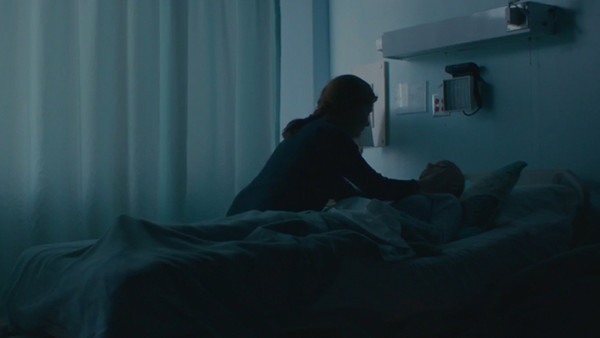
Denis Villeneuve's fantastic sci-fi drama Arrival opens with an emotionally shattering montage in which we witness linguist Louise Banks (Amy Adams) raising her young daughter, which tragically climaxes with her child dying of an incurable disease as a teenager.
The montage is backed by Louise's mournful narration, that her daughter's death was "the end." She then adds, "But now I'm not so sure I believe in endings and beginnings," as the scene cuts from the hospital where her daughter died to the present, where Louise is teaching at a university.
The cut between the two locations obviously implies that Louise's daughter died in the past, with the narration serving as a "bridge" between the hospital and the university.
But as the film's third act reveals, Louise's burgeoning knowledge of the alien language ultimately allows her to view time in non-linear fashion.
As such, Louise's daughter wasn't yet born and we were instead being shown a glimpse of the future, where she conceived the child with her love interest in the movie, Ian Donnelly (Jeremy Renner).
It's a quite ingenious use of editing to not only trick the viewer but also play with the film's own non-linear perspective on time. That it happens to be completely devastating is surely what makes it work in spite of its obviously manipulative intent.