10 Most Shocking And Strange Facts About Famous Horror Movies
Sometimes reality is stranger than fiction.

Many among you might already be familiar with the usual trivia that gets trotted out on lists with titles similar to this one. It's likely you all know that Halloween's Michael Myers is wearing a William Shatner mask, that Psycho was the first movie to show a toilet flush, that Freddy Krueger's glove is visible in Evil Dead 2's tool shed.
But did you know that a certain horror classic features an actual convicted murderer/possible serial killer? Or that a notorious video nasty featured a scene deemed so realistic that it had genuine consequences in the life of the actor involved?
Here we've compiled a list of ten shocking and strange facts about well-known horror movies, ranging from the grisly to the outright bizarre. Some will send a shiver down your spine, others may raise a chuckle and even the most seasoned horror buffs among you could find some trivia to add to your knowledge.
But be warned, the following contains references to true events, in some cases more horrifying than the movies themselves...
10. Leatherface Drew Blood On Screen For Real
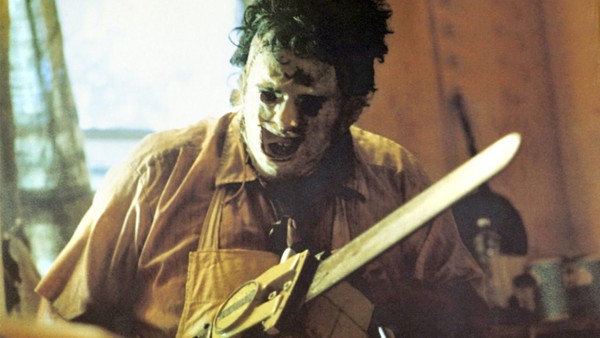
Notorious in its time and now rightly revered, The original Texas Chainsaw Massacre remains a gruelling watch even compared to the most bloodthirsty horrors of today. This is in large part thanks to the movie's scuzzy, gritty look which may have been borne out of necessity as much as it was a stylistic choice.
For his independent production director Tobe Hooper was working with an extremely limited budget. This meant that set decorations and props such as the animal bones, feathers and carcasses scattering the set were in fact real, while cast and crew were extremely low paid. Leatherface himself, Gunnar Hansen, reportedly received around $800 for an entire summer's worth of work and John Larroquette's fee for narrating the movie's introduction was just a single joint of marijuana.
This factor no doubt heavily influenced what transpired during filming of the infamous dinner scene, where the Sawyer family torture and terrorise Marilyn Burns as Sally. With blackout curtains used to block the daylight outside, temperatures on that dining room set rose to around 120 degrees Fahrenheit. The stink of the already smelly cast, who had to endure wearing the same unwashed costumes for days on end, was soon joined by the smell of rotting meat. It became so unbearable that some of the actors would go outside to vomit between takes.
It was at some point in this twenty seven hour shoot, that Hansen was required to simulate cutting Burns' finger with a prop knife. But when the prop knife failed a fatigued and frustrated Hansen opted to use a real knife to actually slice her finger, just so they could finish the scene.
Neither Burns nor John Dugan, the actor who as Grandpa Sawyer then had to suck the wounded finger, knew what had really happened until years later at a postscreening Q&A.
9. An Actual Witch Helped Make The Craft

1996's The Craft is a teen horror about a group of high school girls who form a coven of witches and find they are able to tap into a spiritual power in order to make their darkest wishes come true. The film features a number of scenes where the girls perform rituals and cast spells and in a bid to make these somewhat authentic, and possibly to avoid upsetting the witch community, Columbia pictures hired genuine witch Pat Devin to serve as a technical consultant on set.
Devin is credited as a Dianic Wiccan High Priestess and she had a lot of input during pre-production as well as the actual script. The words used in all of the spells and chants were her suggestions, originating from certain books she felt the girls would have access to. Included at her insistence, Devin actually had to seek permission from the high priestess of a local coven to use the rite seen in the initiation scene.
But with all this authenticity was there a risk something might be conjured up for real? Events that took place during the filming of one sequence would suggest so to several of the cast and crew who witnessed.
It happened while filming the beach scene, where the girls attempt to invoke the fictional God Manon. First a great fog rolled in, then as star Fairuza Balk spoke the words a flock of bats hovered over the set and the nearby tide crashed in to extinguish the circle of candles in which the cast were stood.
According to director Andrew Fleming:
"Every time the girls started the ceremony, and only when they would start the ceremony, the waves would start coming up tremendously fast. Then right when Nancy says her line, "Manon fill me", right at that exact moment, we lost power."
Cautious not to inspire teens to "invoke anybody real", Devin had been fine with using the name "Manon" as it wasn't listed anywhere in the books and texts she knew. After what happened on the beach she realised that the name sounds very close to Mananan, the Gaelic god of the sea.
8. For Once Chucky Wasn't To Blame

England 1993 and a horrific child murder has shocked and horrified the nation. Two boys, Robert Thompson and Jon Venables, both aged just 10 had tortured and murdered two year old James Bulger after abducting him from his mother's side at a supermarket.
The senseless, sadistic crime dominated the news for months, continuing into the trial where the judge suggested that exposure to violent videos might have inspired the boys' actions. This wasn't long after the "Video Nasty" panic of the eighties which saw various horror movies banned and their distributors taken to court.
Headed by "moral campaigner" Mary Whitehouse the tabloid-fuelled movement whipped up hysteria claiming that movies such as The Evil Dead and The Exorcist would corrupt young minds, leading to deviant behaviour and violence. In the case of the Bulger killing and Child's Play 3, many saw proof of what Whitehouse had warned.
Police investigation into the video rental history of both boys' parents found that Child's Play 3 had been rented by Venables' father. At the climax of that movie the possessed killer doll, Chucky, dies near a railway track (actually a ghost train) and had earlier been struck with a paintball pellet. For some the similarities to the Bulger killing were all too obvious. Bulger had also died on a railway track and was also spattered with paint.
But that was where the similarities ended and detectives handling the case found it unlikely the movie had even been seen by Venables, since he was not living with his father at the time of the rental. Later psychiatric reports also confirmed that Venables disliked horror films, however the tabloid media overlooked this and still proudly offered up the movie as a scapegoat rather than explore the more disturbing truths about the case.
Despite the Daily Mirror's triumphant headlines claiming credit for having the movie banned in the UK, Child's Play 3 was never officially banned and only voluntarily dropped from video stores, making it a rare VHS. Nowadays the movie can be freely purchased on Blu Ray and DVD.
7. Hostel's Murder Tourism Might Be Real

Back when it was first released in 2005 Eli Roth's Hostel was one of the first of a new wave in horror, a sub-genre referred to as "Torture Porn" or "Gorno". Roth's graphic visuals were generally influenced by the VHS and grindhouse horrors of his youth, movies like Cannibal Holocaust and Pieces. But the story of Hostel actually drew direct inspiration from something he discovered online.
For those who haven't seen, Hostel is about a group of backpackers who are travelling Europe when they are captured by an organisation called Elite Hunting. This organisation provides wealthy people with the opportunity to torture and kill other human beings for thrills. A disturbing concept with some similarity to "The Most Dangerous Game" and the various other movies that inspired, although these had nothing to do with Hostel's conception.
Roth was actually drawn to make the movie after coming across a website offering package deals much like those enjoyed by the Elite Hunting clientele. In Roth's words: "It started with a conversation with Aint It Cool News' Harry Knowles. Harry and I were talking about sick stuff we'd seen on the internet, like that guy in Texas who set it up so you could control a gun and hunt lions and wild game online.
I thought, 'Jesus, why wouldn't they just put a human being in a room?' And Harry said 'Well actually I found something like that.' and he sent me a link to a site."
The site promised that for $10000 a person could travel to Thailand to execute someone. It claimed that the victim would be someone who has signed up willingly as they were broke, and that part of the $10000 fee would be given to their family.
Roth never found out if the site was real or not.
"I was at the point where I wanted to do a documentary about it, and it's like, to get any further I would have had to give personal information and I figure these people kill people for a living, I'm not gonna find out."
6. Poltergeist Curse

1982's Poltergeist is said to be a "cursed movie" where several of the series' cast suffered real-life tragedies subsequent to working on the film. Much like others featured in this list, many have blamed these tragedies on the production itself, and it's easy to see why when the common link to a web of death and misfortune is a movie about dark spirits.
Shortly following the release of the first movie, actress Dominique Dunne, who played eldest Freeling sibling Dana, was murdered by her ex-boyfriend, hence not appearing in the sequel. Actors Will Sampson who played heroic Shaman Taylor, and Julian Beck who played the villainous preacher Kane, also died after appearing in Poltergeist 2: The Other Side, due to medical conditions.
Most famously, Heather O'Rourke, who in all three Poltergeist movies played Carol Anne, the young girl pursued by evil spirits, died unexpectedly at the age of twelve. This was the result of cardiac arrest, but it would add fuel to the legend of the "Poltergeist curse" which would continue to have an impact on the superstitious Hollywood community for years to come.
In 1990, several cast and crew of the Patrick Swayze movie Ghost swore that they were haunted by the spirit of O' Rourke while shooting on the same set where Poltergeist and Happy Days (which O' Rourke had also appeared in) were filmed - Paramount's stage 19. In each case they reported hearing the laughter of a little girl and small footsteps running the catwalk where it is said O'Rourke often liked to play.
Was this just a bad taste attempt to build hype for Ghost? We'll probably never know. But over the years many Paramount security guards have been keen to avoid this set at night.
5. Jason Voorhees Is An Animal Lover

Friday the 13th's hockey-masked hulk Jason Voorhees is responsible for the highest kill count among the '80's boogeymen, somewhere over 140. After coming back from the grave to avenge his murderous mother's death in Part 2 he took over as the series' villain and for a further six instalments hacked, slashed, stabbed and impaled anybody daring to venture near the site of his death, Camp Crystal Lake.
By Part VII the formula was growing stale and in an attempt to add novelty Jason was pitted against a telekinetic teen similar to Stephen King's Carrie. Following that the next gimmick would be to take Jason out of his territory, specifically putting him in Manhattan where he could wreak a whole new level of carnage in and around the famous landmarks.
Or not.
Due to the restricted budget the majority of the movie takes place on a boat travelling from Crystal Lake to New York, and most of the "New York" scenes were actually shot in Vancouver. Even more disappointing for fans was that the majority of the kills even seemed to occur offscreen. One minute the cheesily named SS Lazarus is filled with people, roughly a hundred or so, then less than a dozen kills later it's virtually empty.
One kill which was actually set to be filmed, didn't for reasons other than budgetary restraints. This was down to stuntman/actor Kane Hodder, the man playing the part of Jason. The scene called for a confrontation between Jason and a dog when Jason first arrives at the New York shore. The idea was that the dog would snarl and bark at Jason, who would promptly punt it into the water for darkly comic effect.
Hodder however, felt this was a step too far and something the merciless, undead, mass murderer wouldn't do, so the scene was scrapped.
Guess no one felt brave enough to remind him of what happened to the dog in part 2.
4. Nail Gun Massacre On A Budget

The Nail Gun Massacre, as its title suggests, is an infamously sleazy grindhouse feature about a motorcycle helmet wearing killer who uses the titular tool to murder construction workers - along with any women unfortunate enough to be having sex with them at the time.
Much like the classic its title alludes to, The Texas Chainsaw Massacre, the whole production was made on a shoestring budget by director Terry Lofton. But where TCM's Tobe Hooper crafted suspense and genuine discomfort, Nail Gun Massacre delivers mostly unintentional laughs.
A former stuntman on The Dukes of Hazard, Lofton wrote, directed and produced the movie himself. He even created the special effects and performed some of the stunts. To push his costs down further he recruited locals with little or no acting experience to star. For one scene he even roped in his dear old grandmother.
Legendary director Martin Scorsese often put his own mother in his movies, most memorably she played the mother of Joe Pesci's Tommy in Goodfellas. Mrs Scorsese was an elderly lady raised in little Italy and is wholly believable in her scenes. Perhaps Lofton was seeking the same effect when he hired his grandma to play the store clerk, her actual job in real life, although it was most likely because the actor he originally hired had bailed at the last minute.
Either way grandma's performance does indeed add to the movie. Her stumbled lines and eagerness to deliver them are both charming and amusing, especially when you notice that she's blatantly reading them from a sheet on the counter.
Then again, perhaps it did help to create a sense of realism. The wife of actor John Rudder certainly took the movie seriously, even going so far as to divorce her husband over his sex scene with Shelly York as she believed they were really having sex on film.
3. A Real-life Murderer Featured In The Exorcist

Considered the greatest horror movie of all time The Exorcist also carries a lot of baggage as another cursed movie with a number of accidents and deaths surrounding the film. First an unexplained fire burned down the set, destroying everything apart from the room where they'd film the exorcism scenes. Actors Linda Blair and Max Von Sydow both lost members of their family during the shoot and Jack MacGowran and Vasiliki Maliaros died soon after filming wrapped.
There are many more odd occurrences surrounding this film, but the most disturbing might be its connection to a series of gruesome murders.
For the scene where Regan receives a cerebral angiography, director William Friedkin recruited real-life radiographer Paul Bateson as the technician who performs the procedure. Incidentally this is the very part which tended to cause some audience members to faint, an occurrence exploited in the movie's marketing.
Years later Bateson was convicted of murdering a film journalist and served twenty four years in prison. During this sentence he allegedly confessed to the Hudson River "Bag Murders" which took place in the late '70's.
In a strange coincidence these crimes inspired Friedkin's 1980 thriller starring Al Pacino and it was only after signing on to make the movie that Friedkin learned of the connection. The director was so intrigued by this he went to visit Bateson in prison and found him to be the same mild-mannered character he'd worked with years before.
Bateson was later portrayed in an episode of Mindhunter. He was released from prison in 2003 and his current whereabouts are unknown, although it is believed he may have died.
2. Never Sleep Again

Freddy Krueger, undead killer and dream demon of the Nightmare on Elm street series was formed as an amalgamation of various troubling elements from the mind of director Wes Craven. The name was taken directly from one of Craven's school mates who'd bullied him for several years, while Freddy's hat, dirty clothes and menacing demeanour were based on a hobo he'd seen through his bedroom window one night when he was ten years old.
But the biggest inspiration for the concept itself, Freddy's ability to murder a victim through their dreams, came from a genuine medical phenomenon. SUNDS, Sudden Unexplained Nocturnal Death Syndrome, whereby a person in otherwise good health mysteriously dies in their sleep. Craven had read an article in the LA times documenting a spate of such deaths which took place through the late '70's and early '80's.
Unlike the movie, all of the victims were male Hmong refugees who'd survived the Cambodian killing fields and relocated to the United states. In each instance the men were either found dead in the morning or were observed during the night to be making "gurgling noises" before expiring.
In July 1980, Portland based Doctor Larry V. Lewman became concerned after examining two victims only a few days apart. In both cases, despite detailed autopsies and toxicology tests, no cause of death could be determined. The fact that both men were Hmong refugees from Laos presented a further link and after checking records Lewman discovered that there had been two additional inexplicable deaths of Laotian refugees in the previous nine months.
The Doctor started to contact medical officials in areas with significant Hmong populations and discovered a further 13 incidences. By 1981 the Center for Disease Control had identified a further 35. An initial theory leading to a federal investigation was that nerve gas used in the conflict might have been responsible, but this was very quickly debunked. If it was nerve gas, why did it affect only males? And why had it taken up to several years to take effect? And why only during sleep?
After years of study and various failed theories a general consensus was reached, attributing cause of death in these cases to heart attack, likely brought on by "night terrors".
Death by nightmare.
1. The Omen Came True

And now to the most cursed horror movie of all, one whose own creator, Robert Munger, feared could draw the Devil's wrath if it was actually made. Producers ignored Munger's concerns and pressed ahead with their antichrist project, quickly securing star Gregory Peck in the lead role. Tragic and eerie happenings soon followed.
After Peck agreed to appear the actor's son committed suicide, leaving no note. Although grief-stricken, Peck was undeterred from starring and pressed ahead to begin filming in October of that year. Then on the flight to England Peck's plane was struck by lightning, the engine caught fire and the plane almost crashed.
A few days later producer Mace Neufield's plane was also struck by lightning on its way across the Atlantic. Neufield narrowly escaped death two more times during production. First when the Hilton hotel in London where he was staying blew up, then again when en route to a restaurant which also blew up. Many others involved in the movie's production were set to attend the same dinner, although luckily none were there when the bomb, attributed to the IRA, went off.
Another notable incident occurred during work on the zoo sequence where animals react to the young antichrist Damien. In the movie, Damien and his mother are driving through a safari trail when baboons attack the vehicle as a response to Damien's mere presence. Originally there was meant to be a scene after where tigers terrorise Damien, but the wrangler responsible for the big cats was mauled to death during its preparation.
But most eerie of all was the ominous car crash involving special effects expert John Richardson. Richardson was the man responsible for the Omen's elaborate death scenes, including the show-stopping demise of David Warner's Keith Jennings, where Jennings is decapitated by a flying sheet of glass.
Tragically, Richardson's assistant Liz Moore suffered a similar fate while they were travelling together in Holland and their car had a head on collision. In the impact the other vehicle tore through Richardson's, simultaneously cutting Moore in half. Somehow Richardson survived, but when he came to on that lonely road the first thing he saw was a road sign for the town named Ommen.
Below it the sign's distance marker read 66.6 km, the biblical number of the beast and the same number marking the antichrist's head in the movie.
Watch Next
Horror Quiz: Who Said It Freddy, Chucky Or Pinhead?