10 Most Visually Stunning Movies Of 2014 (So Far)

Looks aren't everything, but they certainly help.

In a sense, movies are a little bit like people - we know we shouldn't judge them by appearances alone, but good looks certainly help, don't they? Impressive, jaw-dropping visuals can often make a film more enjoyable even if it is lacking in other departments, providing us with eye candy to compensate for other shortcomings. Of course, beauty is only skin - or cinema screen - deep, and great looks alone doesn't make for a great film. There's also the small matter of deciding on exactly what factors make a movie good looking. Crisp and expressive black and white cinematography can provoke a strong reaction every bit as much as exquisitely high resolution colourful animation. A crisp, detailed close up of a face in which every pore seems to ooze expression can mesmerize just as a grand, expansive landscape can capture the astonishing qualities of the planet we live on - beauty, after all, is in the eye of the beholder. 2014 has already been a good year for stunning looking movies, from black and white art house fare through to bombastic blockbusters. Here are ten of the most visually stunning movies released so far this year - and we still have Interstellar to come...

10. Tracks

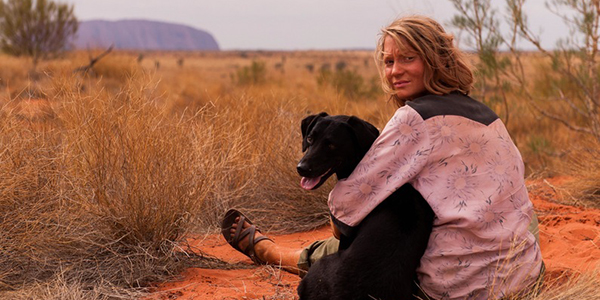
The Australian outback has formed the backdrop for a number of excellent films - from the searing portrait of masculinity and aggression of Wake in Fright to the surreal coming-of-age Walkabout - its vast and desolate expanses featuring some of the most impressive landscapes ever filmed. Tracks tells the true story of Robyn Davidson (Mia Wasikowska) and her nine month trek across 1,700 miles of Australian desert. Wasikowska proves herself capable of sustaining a movie with her screen presence, and Adam Driver as the National Geographic photographer who meets up occasionally for a photo shoot en route is solid in the role, but it is the cinematography which really steals the show and enriches our experience of her journey. Director of photography Mandy Walker already demonstrated her knack of capturing both the heat and the timeless space felt in the outback in Australia, and Tracks is every bit as luminous. These visuals sometimes compensate for the occasional moments where the film begins to meander.

9. The Raid 2: Berendal

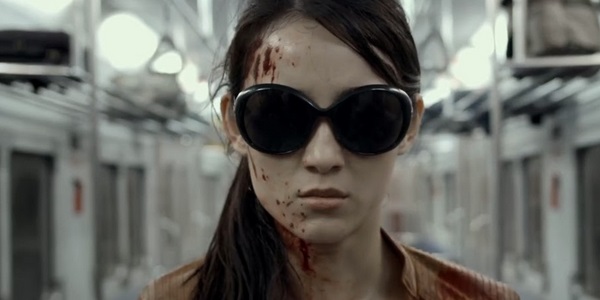
If there's one thing that Asian directors have been known to do exceptionally well, it's shoot an exciting action scene while doing as much of it as possible for real. And when it comes to hand to hand fight scenes, the fact that the majority of their leading stars were trained from an early age in martial arts means that, at the top of their game, they produce some of the most intense, powerful and impressive punch ups you're likely to see. The Raid 2: Berendal is no exception. Following on directly where The Raid: Redemption left off, it sees policeman Rama going deep undercover to take down a criminal syndicate. While writer-director Gareth Evans is clearly enjoying expanding on the criminal underworld setting, taking a leaf out of John Woo's Heroic Bloodshed movies, it also boasts some of the most brutal fight scenes since, well, The Raid. The fight choreography and staging is often balletic, while Evans's camera effortlessly weaves around the action. It holds its own against any action movie Hollywood can offer, and all for the meager budget of $4.5 million.

8. Godzilla

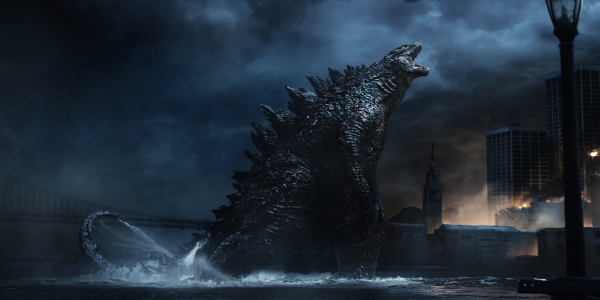
To describe the latest American version of Godzilla as better than Roland Emmerich's 1998 mess is tantamount to damning with faint praise, and Gareth Edwards' effort seems to have gone too far in the opposite direction, replacing camp silliness and terrible gags with a po-faced seriousness that threatens to strip the film of any sense of fun. Still, while the latest Godzilla movie is hardly a barrel of laughs (or a laugh full stop, to be more accurate - humour is notably absent from the film), at least it manages a few awe-inspiring moments of the eponymous giant lizard as he towers over cities whilst battling other MUTOs. The real shame with Godzilla - beyond the fact that the only really interesting character is killed off in the first act - is that there isn't more of the creature on screen. When the film comes to life, Edwards proves that he is capable of staging some impressive set pieces with a real sense of scale while keeping the photography naturalistic. It's a shame the lack of action and long-winded exposition drag this Godzilla down.

7. Under The Skin

The minimalist approach and lack of explicit explanations as to what's going on in Under the Skin certainly led to a lot of frustration from viewers who were expecting something more mainstream - and given that Scarlett Johansson is its star, it's perhaps not surprising that some were put off by the art house flavour. For others, the slow, atmospheric pace and shifts in mood made it one of the best films of the year so far. You'd be forgiven for questioning why Under the Skin is on a list of visually stunning films if all you'd seen were the scenes in which Johansson drives around the streets of Scotland looking for male prey - filmed with hidden cameras to capture the responses of unsuspecting members of the public, the image is often crude and grainy. This only makes the contrast to the moments in the mysterious void all the more striking and otherworldly, while the final scene - as Johansson's alien grasps with her identity in a windswept forest - sticks in the mind well after the film has finished.

6. Ida

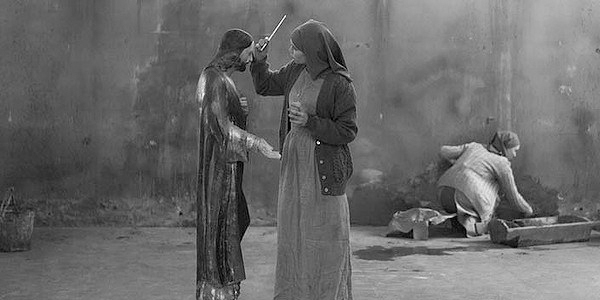
Like Under the Skin, Ida is also a minimalist tale which focuses on a woman on a journey of self-discovery, but the similarities largely end there. If Under the Skin invited comparisons to Stanley Kubrick, Pawel Pawlikowski's film bears far more in common with the likes of Carl Theodor Dreyer, Robert Bresson and Ingmar Bergman. Ida is a nun in the 1960s who is sent from the convent to meet up with her aunt before taking her vows and discovers that she is in fact Jewish, and that her parents concealed her religious identity in order to protect her from the Nazis. The dialogue may be as sparse as the Communist-era architecture, but the imagery speaks volumes - each frame is a minor masterpiece, with evocative compositions bringing the characters to the fore and setting them against rich backdrops. Agata Trzebuckowski, who plays Ida, has a kind of classic look rarely seen in films today, and her performance balances expression and austerity perfectly in balance with the imagery.

5. The Lego Movie

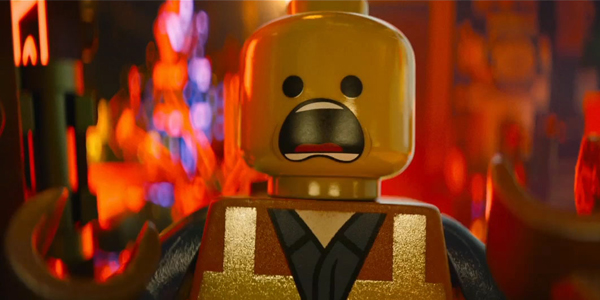
Not many people were particularly enthusiastic about the prospect of a movie based on Lego - the toy without a narrative, it's unsurprising that a lot of people assumed it would be nothing more than a shameless cash-in designed to sell a ton of toys. That it turned out to be one of the smartest animated movies aimed at kids in quite some time is something that no one really saw coming. From the moment The Lego Movie starts it doesn't take long before you realise you're in for something special in the visuals department. The attention to detail and the manner in which every aspect of everything you see on screen is made up of Lego makes it a treat for the eyes. That directors Phil Lord and Christopher Miller aren't afraid to take things in weird and surreal directions only makes the film even more surprising, and the art and animation departments show off more than enough talent to match the witty script which lambasts corporations at the same time as praising creativity. The amusing voice acting from a strong cast including Chris Pratt and Will Ferrell is the icing on the cake.

4. Snowpiercer

Films set in a single location can be difficult to pull off, but Bong Joon-ho, South Korean director of The Host, proves that less certainly is more with Snowpiercer, his first (mostly) English language film starring Chris Evans, Tilda Swinton and John Hurt. Set entirely on a train occupied by the last remnants of mankind, Snowpiercer is an example of how excellent production design can transform a movie into something else entirely. It's the effortless combination of production design and Joon-ho's direction which propels Snowpiercer forward from one scene to the next, each compartment of the train representing yet another layer in the socially stratified microcosm humanity's last hope stands for. Each set is refreshing and unique, playfully subverting the usual expectations which tend to come with movies about a dystopian future, while the camerawork makes the most of the enclosed settings leaving no angle untouched. Exhilarating and inventive, Snowpiercer is one of 2014's movie gems.

3. Noah

Darren Aronofsky's Noah, starring Russell Crowe in the title character (few other actors have a sufficient ego for such a role), predictably caused controversy amongst the devout, despite the fact that the film contains very little to offend, regardless of your religious convictions. Despite feeling laboured and overlong in parts, if there's one thing it had it's Aronofsky's signature impressive visual style. Aronofsky envisions a primitive earth of huge open landscapes and depicts it with a camera which often swoops over vast panoramic environments. The use of CGI for the Nephilim and other now-extinct creatures might seem a little odd when they first appear on screen, but the detail in which they're rendered means that they fit unobtrusively into the setting. Biblical movies by their very nature are intended to feel epic, and while Noah isn't going to go down in history as a masterpiece, its grand set pieces are some of the most impressive seen in a movie so far this year.

2. The Wind Rises

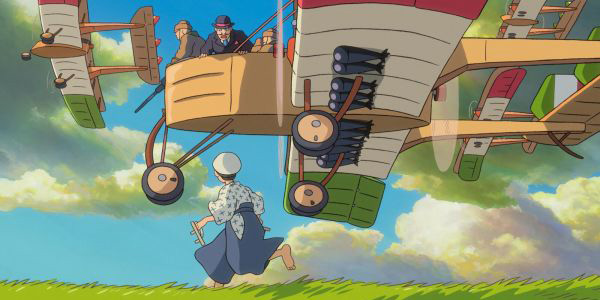
Traditional hand drawn cel animation might be close to becoming a relic of the past in the mainstream, having been pretty much superseded by computer animation, but it's still alive and kicking in Japan - anime movies and TV series of all genres continue to be produced, and Hayao Miyazaki has been at the forefront for decades. The Wind Rises, said to be Miyazaki's final movie (perhaps until the next one - it wouldn't be the first time he's announced his retirement then returned from the wilderness to direct once again), is his most grounded movie of all. Set shortly before the Second World War, its tale of a young engineer's ambition to build the perfect airplane is more firmly rooted in the real world than any of his previous films, which only makes the luscious and vibrant depictions of everyday life in all their subtle details all the more impressive (not to mention the incredible earthquake sequence). It's an interesting swansong for the director; a more personal project which panders less to a younger audience.

1. Grand Budapest Hotel

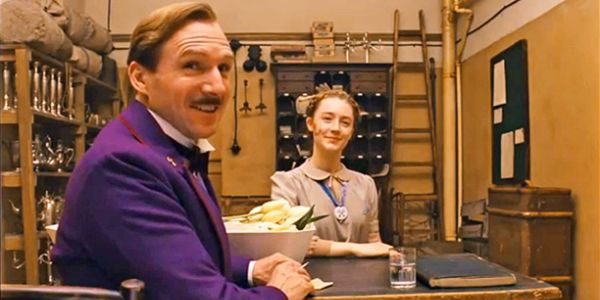
If any director's films can be said to have been production designed within an inch of their lives, it's the films of Wes Anderson. His first film Bottle Rocket hinted at his knack for well ordered compositions, but it was his second feature Rushmore which really set him apart from the crowd as a director with a distinctive visual style. Since then, he's become something of a cinematic legend, utilizing a palette more distinct and recognizable than many other directors. Filmed entirely on location in Germany and starring Ralph Fiennes in one of his finest roles yet as the devoted concierge of the Grand Budapest Hotel, it seems as if Anderson has taken his OCT-like production design and composition to new heights. The titular hotel is envisioned in an almost dreamlike manner (and Alexandre Desplat's incredible score certainly seems to accentuate a fairy tale-like quality to the setting), while Anderson slips from one aspect ratio to another depending on the timeline. Pastel pinks and vibrant lilacs splatter the screen, not an inch of which is wasted. It's not just one of the most visually stunning films of this year - it's perhaps Anderson's finest film yet. Which other visually stunning films have impressed you so far this year? Why not post a comment below and let us know?

Contributor
Contributor

Andrew Dilks hasn't written a bio just yet, but if they had... it would appear here.