10 Most Visually Stunning Westerns Ever Made
From the Old West to the Outback, here's some of the genre's most gorgeous films to savour.

It may take some effort, but cast your mind back to the days before superheroes ruled the multiplexes, before animation was a typical stone-cold box-office behemoth, to when the Spielberg school of action and adventure serial nostalgia was yet to emerge on the silver-screen.
Back then, it was the western that ruled the roost in Hollywood and around the world - the genre that longed for the days of nomadic existence out on the frontier and turned it into a moneyspinner.
The western still has its place of course in the cinematic pantheon, having never really died away after its fifties and sixties heyday so much as entered into a form of hibernation - and to this day, they still light up the screen with their visions of outlaws and lone rangers carving their ways across the plains.
Some of these films though just aren't all about the heroes and zeroes in the desert - some of them are just pure artistry to look at, utterly thrilling in their visual panache and on a level with any of the best highbrow work in the business.
That's what this list is - a collection of some of the genre's most gorgeous films to savour in all their eye-searing brilliance. Though directors obviously have significant control over the look of their films, I've included the name of the cinematographer responsible for each of these entries alongside their work, to help celebrate just how great a job they have done in crafting such an evocative feel.
10. True History Of The Kelly Gang (Ari Wegner)

Starting with the most recent entry on this list, Justin Kurzel's quasi-biopic about the Australian folk legend Ned Kelly may not take place in the Old West - but it adheres to every major beat of the genre and executes it with such aplomb that it's hard to not be swept up in its blood-strewn provocation and general nihilism.
Away from its ensemble of excellent turns though, led by 1917 breakout George MacKay, it's a piece of primal filmmaking powered by its own visual language and potent poetry, captured by Ari Wenger who brings an operatic, widescreen grandeur to its relentless vision of bushranger Australia in the dying days of rural lawlessness on the far side of the world.
Wenger, who also shot Peter Strickland's horror In Fabric and the Florence Pugh-starring Lady Macbeth, arguably saves her best for last though, as in the final third, the film mutates into an acid-trip, hallucinogenic vision of a western, punctured with lurid bursts of colour and fury. It's terrifying to behold in its sound and thunder - but utterly spellbinding to watch as a piece of visual art.
9. The Wild Bunch (Lucien Ballard)

The legacy of Sam Peckinpah's oeuvre is arguably as occupied as much with his off-screen issues as it is with his on-screen successes, but there's little denying that his revisionist western peak, released in 1969, remains one of the genre's greatest highs; a frequently ferocious endeavour that drew contemporary acclaim and condemnation for its approach to then-particularly sadistic violence on screen.
Following the exploits of a band of ageing gunslingers around the US-Mexico border in 1913 as they look to pick up one last score, it's almost as memorable now for the images conjured up by genre veteran Ballard, by then well-established for his work with Henry Hathaway, with whom he had made works such as The Sons of Katie Elder and Nevada Smith.
He reunited with Peckinpah here after shooting Ride the High Country and, coupled with the director's fast editing technique, they crafted a number of indelible images that linger in the pantheon of great western shots all these years later. Half-a-century on, The Wild Bunch remains one of the most distinctive pieces of work by either man, and remains a visual treat of bloodied bravura.
8. The Sisters Brothers (Benoît Debie)

Arriving at the rear end of 2018 on the back of several well-received festival rollouts - including the Silver Lion for Best Director at the Venice Film Festival - Jacques Audiard's first English-language feature got somewhat buried and passed over for awards season, which is something of a shame given the sheer quality of its performances and technical craft.
Though the eye-catching quartet of lead performances from John C. Reilly, Joaquin Phoenix, Jake Gyllenhaal and Riz Ahmed are the worthy star attraction to this offbeat, slow-growing adaptation of Patrick deWitt's 2011 novel, its cinematography from Spring Breakers lens-man Debie is among his career best, transmuting from sun-baked starkness through shadowed agony as the brothers' best-laid plans slowly begin to fold in upon themselves.
It's a film whose visual power doesn't hit with visceral immediacy though; rather, it percolates at a leisurely pace before blossoming into a collection of often painful images, laced with raw emotion under their surface. The film was shot on location in that favourite locale of the spaghetti western genre, rural Spain; Audiard's choice to film adjacent to his homeland of France pays dividends in conjuring the feel of a old-fashioned genre piece underneath its slightly skewed vision.
7. Slow West (Robbie Ryan)

This particularly simmering Sundance winner was the debut of Scottish filmmaker John Maclean, who turned to his previous short films to reunite with star Michael Fassbender for a tail of a young man looking for his love in the hinterlands of America, accompanied by a bounty hunter looking for a score of his own.
Though it flew relatively under the radar upon release, it's worth seeking out for its unusually lush visual palate alone; a side effect of filming in New Zealand, whose strikingly barren vistas and towering tree trunks convey a different sense of starkness compared to the more familiar locales found typically in the genre.
That particular quality is only enhanced by Ryan though, the cinematographer who is just coming off an Oscar nod for The Favourite. The Irishman has become a keen part of Ken Loach and Noah Baumbach's creative circles in recent years, and his distinctive flavours and colours here are what renders the film with an almost aching quality.
6. The Hateful Eight (Robert Richardson)

Quentin Tarantino had arguably dabbled in the western genre before with his Kill Bill duology before he brought a revisionist glee to the fantastic Django Unchained - but he arguably delivered a more visually distinct distillation of the genre with his subsequent gonzo chamber piece, about a group of strangers gathered at a stagecoach lodge where all is not what it seems.
Boasting a score from none other than Ennio Morricone himself - who won his first competitive Oscar for his efforts here - it's a more moderately paced effort compared to the more consistent blood-letting on show in its predecessor, but what really helps it tick is the sheer sense of claustrophobia conjured by Robert Richardson both in and around Minnie's Haberdashery, the centrepiece of this ultimately bonkers face-off.
Shot in 65mm and transferred to 70mm for projection, it remains one of the few films to be shown in the latter format over the past decade and it tells; every frame feels calibrated with a frostiness that seeps into the bones in shivering fashion. Richardson has shot six films with Tarantino to date, but this - to paraphrase another Quentin character - may just be his masterpiece.
5. The Proposition (Benoît Delhomme)
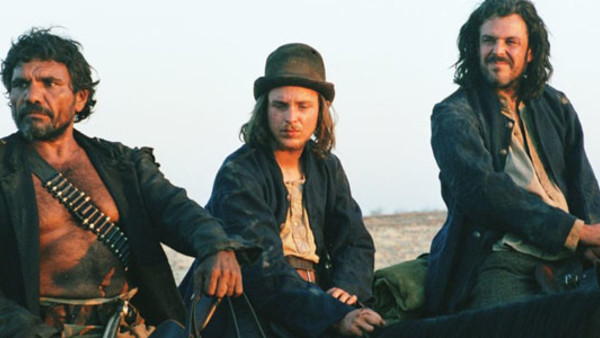
A second entry from Australia on this list, John Hillcoat's brutal drama about the line between good and evil men comes from a script by musician Nick Cave, and contains much of the lyrical horror and beauty found in his work with his band The Bad Seeds, as it charts the journey of two separate men on opposite sides of the law as they sit primed for a collision course under the parched heat of the Outback sun.
Featuring a raft of brilliant, often underplayed performances from Guy Pearce, Ray Winstone and Danny Huston, it's a frequently unflinching mood piece, studied mostly with panoramic visions of a country that looks perpetually on the verge of cannibalising itself with a simmering taste for violence.
It's surely the high-water mark for cinematographer Delhomme, who infuses every frame with such a raw sense of loneliness, even when characters are grouped together en masse for blood-soaked stand-offs. It culminates in further acts of shocking violence - and yet, rendered with an almost dreamy eye, it's impossible to shirk away from the nightmares it unfolds over its closing act.
4. Once Upon A Time In The West (Tonino Delli Colli)

His Dollars Trilogy complete, Sergio Leone looked set to walk away from the western - until he was coaxed back in for another round though when Paramount not only offered him a generous budget but the chance to work with Henry Fonda, the director's favourite actor.
Their resulting collaboration is arguably Leone's masterpiece - and given just how many of his films are considered among the very best by scholars and critics, that's saying something. But one thing that few would struggle to dispute though is that it is Leone's most beautifully striking entry into the genre.
Reuniting with cinematographer Delli Colli - with whom he worked on The Good, the Bad and the Ugly - it's a gloriously lit work, shot in a way that captures the sprawling size of the Old West perhaps more than any other work in his oeuvre.
Those skies - azure blue with the shadow of dust and cloud below and above them - seem to stretch on for miles and miles, folding every player beneath it into its own breathtaking world.
3. True Grit (Roger Deakins)

Frankly, there's any number of westerns or neo-westerns shot by the acclaimed British cinematographer that could have made this list. The fifteen-time Academy Award nominee and two-time victor even managed to get cited twice in the same year once for his work in the genre, with No Country for Old Men and The Assassination of Jesse James by the Coward Robert Ford.
But I've gone with True Grit, his eleventh collaboration with the Coen Brothers, to represent his body of work here. Less an out-and-out remake of the 1969 film starring John Wayne than a more droll adaptation of the namesake book it was based on, it featured a wonderfully grizzled Jeff Bridges in the lead role and introduced the world to actress Hailee Steinfeld.
Yet the visuals are practically a character in their own right, from the quietly oppressive stark thicket of forestry through which the heroes pursue their target, to the star-and-snow-flecked rides through the night, conjuring up the sense of danger and desperation held close in the Old West through a muted lens less unforgiving than foreboding than anything else.
It's one of Deakins' best - a gorgeous vista rendered with reverence.
2. Unforgiven (Jack N. Green)

There's no actor, save John Wayne, as perhaps innately linked to the vision of the western in the wider cinematic consciousness than Clint Eastwood. Though the veteran actor-director has gone on to vast success on both sides of the camera away from the genre, it's his work out on the plains, enshrined in the Dollars Trilogy, that will likely remain his legacy long after he is gone.
Perhaps he would have escaped such a tag if he hadn't returned over twenty years after to deliver one of the all-time greats in the shape of Unforgiven though. Tracking two retired gunslingers as they set off for an effective final mission to the town of Big Whiskey, it brought Eastwood an Oscar for Best Director as well as winning the gong for Best Picture.
Much of its atmospheric brilliance though rests with Jack N. Green and his cinematography, soaked in the colour shifts of sunrises and sunsets, figures silhouetted in the half-darkness throughout. It's a masterful framing for a masterful film.
1. The Searchers (Winton C. Hoch)

Is there a better definition of widescreen western than this John Ford masterpiece? The only work in the genre made by the six-time Academy Award winner during the fifties remains high in the estimation of both fans and critics, widely hailed as one of the finest films of all time for its tale of a Civil War veteran (played by John Ford) hunting for his abducted niece.
It also made for the director's final collaboration with three-time Oscar-winning cinematographer Hoch, one of the men who helped pioneer Technicolor in the industry. The pair had worked together to acclaimed results on westerns before, including She Wore a Yellow Ribbon - but their partnership here has stood the test of time for obvious reasons.
From the panoramas shot in Monument Valley, with their achingly large skies and bush-scrubbed desertlands beneath, it effectively is the quintessential western vision, to which just about all others are held against. It remarkably pulled a donut on Oscar nomination day, not even making it to the Dolby Theatre, but that has if anything only served to increase its reputation over the subsequent years.
Watch Next
Can You Name The Clint Eastwood Film From Just One Image?
