10 Movie Career Twists Noone Saw Coming
 There are some movie careers which are very clearly marked out from the open scene - Leonardo DiCaprio, for instance, was always a combination of too handsome and too talented not to make it to the very top of the film industry. Yet, just one generation before him, the same could easily have been said of a young Mickey Rourke who, after thrilling in Diner and Rumble Fish, quit the acting scene to become a professional boxer and struggled for years to reclaim his rightful place in Hollywood. Likewise, there are an array of established actors now who, at one point, looked like they were never going to make it. Jack Nicholson, a man so ingrained into Hollywood's folklore, it's almost impossible to imagine a time before, struggled for other a decade trying to make it, even pursuing writing screenplays for The Monkees. Michael Douglas, another member of Hollywood royalty, floundered for years until the 80s came and the Oscar winning producer finally became a star in his own right. For every inevitable success or failure in Hollywood, there are those careers which don't go in the straight paths we imagine - those who climb the heights or fall out of favour due to bad career choices or a dose of lucky serendipity, those who sidestep the conventional ways of thinking and those who make decisions which flummox us all. This article examines these very same paths and looks at 10 movie career twists no one saw coming.
10. Kylie Minogue - From Soap Star & Hollywood Starlet To Interesting & Challenging Roles
 After making a name for herself as the star of Australian soap Neighbours, Kylie Minogue endeavored to translate this success first into a musical career and then, ultimately, into Hollywood movie roles. Whilst her collaborations with hits factory Stock, Aitken and Waterman allowed for the singer to conquer the charts, Minogue's attempts to transform herself into a leading lady fell flat at the first hurdle - Street Fighter, a cinematic adaptation of the popular video game, was so critically loathed that it seemed her acting career would be over before it began. Her next film, a small performance in the even more widely panned Bio-Dome, seemed to confirm this. With Minogue's movie career seemingly in tatters by the mid 1990s, her next moves galvanized her career movie and established her as an indie darling in completely unexpected ways. Remembering that America is not the be-all and end-all for any actress, Mingoue began her rejuvenation by teaming up with fellow Australian and making an appearance in the spectacularly successful Moulin Rouge! As the first critically acclaimed movie of her career to date, Minogue did the opposite of what was expected of her and, instead of trying to shoe horn herself into more Hollywood blockbusters, began to look for exciting opportunities around the globe. An opportunity to appear in the (at that time) most expensive Bollywood film ever made, Blue, was graciously accepted and, more recently, Minogue played a significant part in the Cannes pleasing (and multi-lingual) Holy Motors - a fantastical movie by French -maker Leos Carax. It's not many actresses who can write on their CV that they've appeared in Jean-Claude Van Damme movies, Oscar winners, Bollywood thrillers and films that rocked Cannes.
 From ignoble beginnings, Minogue has, against all odds and expectations, ended up with one of the most varied acting CVs in recent times.
9. Ronald Reagan - From Hollywood B-Movies To President Of The United States
 For a man whose acting career was highlighted by a movie in which he played opposite a monkey (Bedtime for Bonzo), Ronald Reagan sure ended up making good for himself. Reagan's professional life began in radio, his authoritative voice used to call American football games, before a screen test in 1937 began a career in Hollywood B-Movies (appearing in 19 movies within his first two years as an actor). Any chances of breaking through to leading man status, however, were curtailed with the onset of the Second World War in which Reagan served with the U.S. Army. His post-war return to acting led to few plaudits, but an array of titles such as the aforementioned Bedtime for Bonzo, and ultimately his career fizzled out with a final appearance in the 1964 movie The Killers acting as his swansong. Alas, Reagan's life in the public eye was to not end here - instead, using the communicative skills learned in his thespian and broadcasting sojourns, a career in politics came calling.
 Running with ultra-conservative policies and appealing to nostalgic moralism, Reagan ended up with an astounding career third act beginning with a role as Governor of California and concluding with a two term stint as the most powerful man in the free world - as president of the United States of America.
8. George Clooney - From Handsome Star To Renaissance Man
 Pretty boys are a dime a dozen in Hollywood and, although it's impossible to deny how handsome George Clooney is, a role in Return of the Killer Tomatoes hardly inspired confidence in the longevity and success of his career in Hollywood. After a stop-start career with no real breakthroughs, aside from a well received role in television drama E.R., at the age of 36, relatively old in the average actors' career path, Clooney was finally given the chance to star in his own blockbuster. Taking the reigns from Val Kilmer, Clooney was asked to portray the iconic Batman in the latest installment of the wildly successful franchise. Regarded as one of the worst films of all time, Batman & Robin was a movie so violently atrocious it was not inconceivable to imagine Clooney's movie career as D.O.A. Would it be possible to build a film career from this low, low ground? Thankfully, the answer is a resounding "yes!" With some serendipity, Clooney was able to resurrect his career with a role in Steve Soderbergh's Out Of Sight - an unexpected hit from a director who had released a string of flops consistently for the previous decade. Released just a year after Batman & Robin, the movie was able to erase some of the sour taste of his outing as a superhero and provided a surefooted base upon which to re-purpose his career.
 Since this point, the cerebral actor, and son of a news reporter, has managed to not only establish himself as one of the most bankable actors in the industry but also a keen, multi-talented intellectual who is as talented behind the camera as in front of it. Beginning with Confessions of a Dangerous Mind, Clooney has crafted a highly impressive catalogue of directorial efforts and has found himself as the first person in Hollywood history to receive Oscar nominations in six separate categories. He has received two - one for his supporting turn in Syriana, one as a producer of Argo. Not bad for the star of Return of the Killer Tomatoes and Batman & Robin.
7. Nicolas Cage - From Respected Actor To Hollywood's Most "Out There" Leading Man
 Nicolas Kim Coppola started his cinematic journey in the least noticeable way possible - his debut was that of an un-credited extra in the largely forgotten Robert Redford movie Brubaker. Under the pseudonym Nicolas Cage, a name taken to draw attention away from his famous surname, it was inevitable that recognition would quickly come his way, however, and a string of critically acclaimed performances marked him out as one of the most talented actors of his generation. From Rumble Fish through to Raising Arizona, his demented turn in Vampire's Kiss through to his lead role in David Lynch's Palm d'Or winning Wild at Heart, Cage's stock rose and rose, culminating in Golden Globe and Oscar triumphs for his portrayal of a suicidal alcohol in Leaving Las Vegas. Cage's next film, however, signified a career shift that shocked us all. After having established himself as one of the most intensely charismatic, albeit slightly eccentric, character actors in the industry, Cage decided to trade in the off-beat dramas with which he had made his name to become an unlikely Hollywood action hero. Beginning with The Rock, Cage's new career path saw him star in big budget fare such as Con Air, Face/Off, Gone In Sixty Seconds, National Treasure and Ghost Rider.
 With neither the strong man aesthetics of an Arnold Schwarzenegger or the matinee idol looks of Tom Cruise, Cage has since spent a large percentage of his career as a square peg trying to fit a round hole.
6. Grace Kelly - Hollywood Darling Quits Acting At 26 To Become Royalty
 race Kelly, in her short career, managed to craft one of the most critically acclaimed filmographies in the industry's history - no less a source than the American Film Institute ranks her as the 13th greatest female movie star of all time. What makes the achievement all the more remarkable is that Kelly left acting and Hollywood behind her at the incredibly young age of 26, retiring from movie-making to marry Prince Rainier III and take up a new role as the Princess of Monaco. Beginning as a theatrical actress, Kelly quickly moved towards the silver screen and became a favourite of Alfred Hitchcok who cast her as one of his blonds in Dial M for Murder, Rear Window and To Catch a Thief. Perhaps the peak of her five year movie career, however, was an uncharacteristically non-glamorous performance in The Country Girl for which she won an Academy Award - her popularity reflected by both her acting peers and cinema going audiences alike. With performances like this one, it's breath-taking to speculate what Grace Kelly could have achieved had she the desire to extend her career as an active performer.
 Kelly's eleventh, and final, film was titled High Society - a fitting precursor to the life as royalty ahead of her.
5. Bobcat Goldthwait - From "That Guy With The Funny Voice" To Creative Auteur
 Like "the sound effects guy", Bobcat Goldthwait was doomed by many to be referred to simply by his role in the Police Academy films. His waspish, raking and high pitched voice means many cinema-goers know the actor as "the guy with the funny voice" or, when he pops up in other films such as Scrooged! or Tapeheads, "that dude from Police Academy". Attempting to escape this typecasting, Goldthwait decided to try his hand at directing his own movies resulting in 1992's Shakes The Clown - a little seen movie which heavily divided those who witnessed it. Whilst some referred to it as "the Citizen Kane of alcoholic clown movies", other reviews were far from complimentary at the dark humour on display. It seemed likely that Goldthwait would have to play out his day playing variations of Zed from Police Academy. Like all good dramas, however, a huge twist came in Goldthwait's career.
 Nearly a decade and a half after Shakes, Goldthwait again tried his hand at directing (this time leaving himself off camera). Debuting at Sundance Film Festival, his next effort, Sleeping Dogs Lie, proved to be something of a game-changer. The broad strokes of his previous movies were gone and, in its place, Goldthwait had sculpted a rather nuanced, thoughtful feature which showed a maturity way beyond anything else in his career. Showing that this was no fluke, Goldthwait replicated, and succeeded, this success with The World's Greatest Dad - a dark satire on grief culture starring Robin Williams in the funniest performance he had put on screen in years. Rather unexpectedly, "the guy with the funny voice" from Police Academy" had transformed himself into an auteur of incredible levels of creativity.
4. Matthew McConaughey - From Laconic Star To The Most In-Demand Serious Actor After DiCaprio
 With his sleepy eyes and slow Southern drawl, it often appears that Matthew McConaughey is so laid back as to be practically horizontal. It also seemed that his laconic attitude may have passed over into a laziness of film choices with the once much touted actor apparently sleep-walking through his career. After winning a host of notices with a career making performance in A Time to Kill, McConaughey took a career path which compromised almost entirely of sub-standard rom coms. From How To Lose a Guy In Ten Days through to Fool's Gold and Failure To Launch, the Texan actor was receiving a pay check but barely flexing his acting muscles - instead he just displayed his actual muscles in chick flicks and let the money come in. Suddenly, when movie audiences had grown complacent with Matthew McConaughey's complacency, the actor made a couple of statement films back to back. In William Friedkin's vicious Killer Joe, McConaughey took the lead role as the violent, sexually charged titular character - a bounty hunter who revels in punishing debasement. It was a performance which jolted the audience and, in a better film, would have surely netted the actor a whole spate of awards. Following this up with Magic Mike, awards speculation flowed again as his character showed a vitality and spark which had been missing in McConaughey for years.
 That he followed these movies up with Paperboy, and has an upcoming role in Martin Scorsese's The Wolf of Wall Street, shows the actor has jettisoned his complacency in favour of much higher quality control, giving a career everyone assumed was dead to rapid rom-coms, an unexpected second life as one of the most exciting actors working today. Unbelievably to think only a few years ago but McConaughey's stock has risen so much he was actually the first star (and by all accounts has the leading role) in Christopher Nolan's next movie, Interstellar.
3. Michael Powell - From British Film-making Giant To Relative Obscurity
 Michael Powell is a director who, throughout a career of teaming with Emeric Pressburger, established himself as one of the most loved English film-makers of all time. Their astounding filmography, featuring some of the greatest British films ever made, included, amongst many others, A Matter of Life and Death, The Life and Death of Colonel Blimp, Black Narcissus and The Red Shoes. It is perhaps because of this, Powell thought he would be allowed some leeway to experiment with his film-making style and create something altogether new in his filmography. As the 1950s were ending, Powell realised the world, and cinema around him, was becoming a darker place and attempted to take his film-making in a similar path. His next feature, released without long-term collaborator Pressburger, was Peeping Tom - a dark, horror movie focusing on voyeurism and audience's collective responsibility for violence on screen. A young, demented film-maker stabbed a women he filmed with a sharp blade fixed onto the end of his camera. For people more familiar with Powell's life-affirming features, this was too much. Despite being championed by the likes of Martin Scorsese, Peeping Tom effectively drew a sad end to Powell's career - it was so attacked and vilified, his career was irreparably damaged.
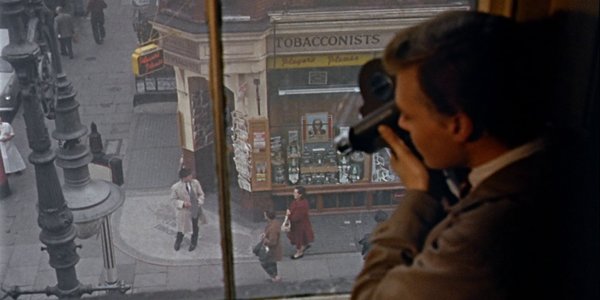 Peeping Tom has since grown to be regarded as a classic movie and a rare horror movie with genuine ominous and social commentary. That it was released in the same year as Psycho, Eyes Without a Face and The Housemaid, shows that Powell was indeed on the ball, zeitgeist-wise, whether the British establishment wanted to admit it or not. That such a talented man was effectively banished from film-making in Britain is as sad a movie twist as one can imagine.
2. Charlie Chaplin - From Global Icon To Hollywood Banishment
 Britain's own Charlie Chaplin has the distinction of being perhaps the world's first internationally recognised movie star. Taking Hollywood by storm, Chaplin dominated box offices during the era of silent movies with his sentimental, vaudeville-inspired slapstick - without the barrier of language, the movies he created became legendary around the world and inspired mirth amongst people the world over. The on-set of sound in movies, however, meant that Chaplin became in danger of being left behind by a new breed of movie-makers. Yet, in The Great Dictator, Chaplin managed to show that dialogue was of no problem at all - the satire of Germany's fascist regime ends with one of the all time great monologues, urging the people of the world to rise up against "machine men, with machine minds and machine hearts". The twist that the most iconic actor of silent movies was also a powerful orator was a profound one. The real twist in Chaplin's career is, sadly, a rather tragic one. Having become politicised in his film-making with The Great Dictator, Chaplin continued to add social messages to his films - Monsieur Verdoux was a scathing indictment of capitalism and greed, arguing it leads to murder and mass killings. The film, of course, flopped and brought a lot of controversy and criticism Chaplin's way and also raised suspicion - in the McCarthy witch hunt era any public criticism of capitalism meant, by default, the figure was a communist. Chaplin's next film, the hugely moving Limelight, was an emotional and nostalgic look at the career of a forgotten vaudeville comedian which drew heavily on his childhood and current plight for inspiration. After it's 1952 premiere in London, Chaplin attempted to return to America where he was denied entry to the country - a nation which would then largely boycott the aforementioned film due to his perceived political attitude. Chaplin, the man upon whom Hollywood had built its industry, was exiled and remained in Europe for the next twenty or so years. A final, redemptive twist to the story came with the closest thing Hollywood have ever collectively come to giving an apology. For the 1972 Academy Awards, the 82 year old Charlie Chaplin was invited to receive an honorary Oscar for "the incalculable effect" he had on making movies the "art form of the century". He accepted the trophy in one of the most emotional events on record. In an ironic epilogue the film which ultimately disallowed Chaplin's living in America, Limelight, received an Oscar of its own the following year due to a loophole in voting.
1. Robert Downey Jr - From County Jail To The Biggest Star On The Planet
 Robert Downey Jr's talent has never been something that is in doubt - boyish good looks coupled with an old school magnetic charm have meant the actor has won high praise for pretty much every performance he has been involved with. A note perfect turn as the lead role in a biopic of Charlie Chaplin brought the actor to the cusp of Hollywood's elite with an Academy Award nomination and critical praise from his industry peers. With the world at his feet, Downey Jr made the incredible mistake of allowing his demons to catch up with him and getting heavily involved in drugs - roles dried up and the actor found himself practically uninsurable. Stints in jail and rehab followed and, where there was once a hugely promising career, RDJ seemed to be yesterday's man in Hollywood. Whilst many wouldn't touch the actor with a barge pole, redemption was offered by none other than Shane Black (another comeback kid) who offered the actor a lead role in his forthcoming Kiss, Kiss Bang, Bang. The collaboration proved to be a boon for both men and put Downey Jr back on the map. Despite his charm and talent, the charismatic actor was still something of a gamble when approached to portray Tony Stark in an adaptation of the comic book Iron Man but, having accepted, the role has energised the Chaplin actor's career who, in turn, has cemented himself as one of the top performers in Hollywood.
 A career that could have so easily ended in tragedy has ended with one of the all time great comebacks.