10 Movie Messages Everybody Misunderstood
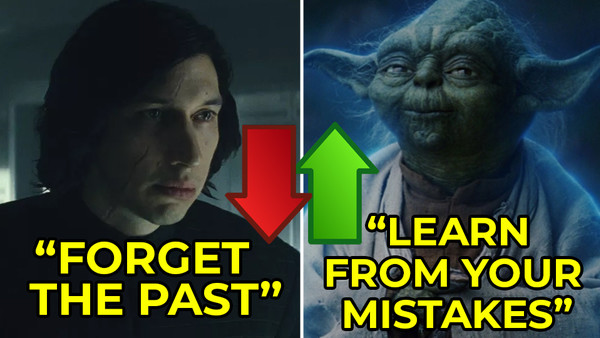
Don't listen to Kylo Ren.
Whether you want to believe it or not, every single piece of entertainment you've ever watched has a viewpoint and is inherently conveying a message in some form or another.
Even the most brainless piece of schlock is created by someone with their own worldview which will transpire into their work, whether for better or for worse.
And while most movies dish up pretty basic and easily digestible messages, sometimes films aren't quite so cut-and-dried about what they want to tell viewers, and the results can be a bit confusing.
These 10 films were all clearly conceived with something to say about the world around us, but the filmmaker's real message got muddied and lost in the shuffle as audiences opted for a more simplistic surface reading instead.
You're certainly not foolish to mis-read any of these films, and in many respects you can argue the fault at least lies partially with the filmmaker. However, if you dare to take a deep dive into what they really mean, you'll often find the intended meaning is starkly different...
10. Pop-Culture Shouldn't Define Your Identity - Ready Player One

What Everybody Thinks
With Steven Spielberg's CGI-fuelled adventure blockbuster being filled with crowd-pleasing cameos from beloved pop-culture icons - ranging from Back to the Future's DeLorean, to The Iron Giant, to Overwatch's Tracer - many fans assumed that Ready Player One was really nothing more than a feature-length love-letter to every nerdy piece of media you've ever interacted with.
And though it certainly is that, it's also far more of a cautionary tale than many of its devotees will ever care to admit.
The Real Message
As much as the film is aesthetically defined by the lush VR expanse known as the OASIS and everything within it, there's also a firmly subversive streak running throughout.
After all, the real world in which Wade Watts (Tye Sheridan) resides is a near-future dystopian dump, and the OASIS is a primary source of escape for people - quite understandably.
But if you look past the digital recreations of classic heroes, the film is ultimately about embracing pop-culture and entertainment, yet not allowing it to fully define your identity, to the extent that you scarcely even exist in the real world.
As the eventual custodian of the OASIS, Wade even decides to shut it down twice a week so that people are forced to tend to the crumbling world around them, rather than shield themselves from global devastation with a fancy headset.
For a film so flagrantly dining out on nostalgia and brand awareness, it's quite daring that Spielberg's real message is so counter to that - even if it largely fell upon deaf ears with audiences.
9. It's All About Humanism (Not Feminism) - Mad Max: Fury Road

What Everybody Thinks
George Miller's Oscar-winning Mad Max sequel is without question one of the greatest action films of all time, and at the time of its release it was widely praised for its perceived "feminist" leanings, whereby female characters were given an uncommon degree of agency - especially Charlize Theron's ferocious Furiosa.
Hell, some even cried foul that the film was too feminist, sidelining Tom Hardy's titular, near-mute hero in favour of Theron's more effervescent one. Aside from this being a gross take, they're not even right about the film really being feminist.
The Real Message
While Fury Road undeniably does a fantastic job with the women who inhabit its male-dominated world and sees Furiosa seeking to smash Immortan Joe's (Hugh Keays-Byrne) revolting patriarchy, the end result is really more indicative of a humanist tone than anything.
After all, the film is defined by a heroic man and woman teaming up to eliminate the threat to their mutual existence, and many of the film's strongest moments see Max and Furiosa combining their efforts in order to succeed.
The debate has raged for literally years over whether or not Fury Road is indeed a feminist film, with even some feminist commentators arguing that it doesn't do enough to address the uneven power dynamic between men and women to be truly feminist.
But we can all agree that the film is wholly concerned with people, whatever their gender, age or physicality, stomping out tyranny for their collective prosperity. That is humanism.
8. It's Not Pro-Torture - Zero Dark Thirty

What Everybody Thinks
Kathryn Bigelow's thriller about the epic manhunt for Osama Bin Laden was released to its fair share of controversy, largely pertaining to its portrayal of "enhanced interrogation" - that is, torture.
Torture is shown to result in actionable intelligence throughout the film, and Bigelow's "detached" approach to its depiction was condemned by some as condoning and even glorifying its apparent "necessity."
The Real Message
But it's tough to watch Zero Dark Thirty and really make a good faith argument that it is a flattering endorsement of torture, which is shown in all of its expected brutality and ruthlessness.
Screenwriter Mark Boal himself said, "It's just misreading the film to say that it shows torture leading to the information about bin Laden", and Bigelow herself said, "Do I wish [torture] was not part of that history? Yes. But it was."
Documenting the torture in an un-emotional, unsentimental way as the film does might strike some as cold and even taking a "both sides" approach to the issue, but the focus on the dehumanising nature of torture really says it all.
Bigelow could've shied away from this if she had a different agenda, but she didn't.
7. Miscommunication Will Destroy Humanity (Not Racism) - Night Of The Living Dead

What Everybody Thinks
George A. Romero's legendary 1968 zombie classic memorably concludes with black protagonist Ben (Duane Jones) being mistaken for a zombie and shot dead by a gun-totting posse.
In the five decades since the film's release, it's been commonly ascribed as Romero's deliciously ironic social commentary on the period, particularly the racial tensions of the 1960s.
With the assassinations of both Martin Luther King Jr. and Malcolm X fresh in the public's mind when the film hit cinemas, it's at least easy to appreciate why Night of the Living Dead is held up as a scathing critique of race relations in late-60s America.
The Real Message
As tight and meaningful as that reading of the film might seem, Romero himself admitted in interviews that he never considered Ben's race when casting the part, and the final scene wasn't written as an intentional commentary on racism.
As such, it's easy to observe how Night of the Living Dead really serves as a broader commentary on the inevitability of humanity destroying itself through a lack of communication and co-operation.
Ben could've announced himself to the rednecks, and the rednecks probably should've appreciated that Ben wasn't a zombie - he was holding a rifle, after all - but when the apocalypse looms, people get incredibly stupid.
This isn't to deny that Romero's film has taken on a life of its own beyond the meaning he intended, but in straight-up factual terms, the film is a broader parable about humanity's self-destructive tendencies rather than a pointed skewing of racism.
6. Don't Kill The Past, Learn From It - Star Wars: The Last Jedi

What Everybody Thinks
With the recent release of the first trailer for Star Wars: The Rise of Skywalker, there's been disdain from many fans over the implication that the upcoming film is going to serve as a more sentimental and nostalgic finale to the sequel trilogy.
Some complained that this would fly in the face of the message posited in The Last Jedi, where Kylo Ren (Adam Driver) endeavoured to "let the past die", while Luke Skywalker (Mark Hamill) similarly seemed content to bury his history.
This, in conjunction with the film's many subversive twists and anti-fan service moments, has widely been interpreted as writer-director Rian Johnson's mission statement - forget the past and focus on the present.
The Real Message
But conflating Kylo Ren's directive with that of Johnson is a major mistake, and not at all what he's really saying. You need to turn to Yoda (Frank Oz) to get to the real heart of the matter, who tells Luke (Mark Hamill), "The greatest teacher, failure is."
And given that Yoda is pretty much the wisest character in Star Wars, it's pretty safe to say his sentiment reflects Johnson's true feelings - that the past crucially can't be forgotten, and where possible, it must be learned from for a brighter future.
When you look at it like that, taking Kylo Ren as a strict avatar for Johnson's creative process seems, well, a bit daft.
5. It's An Allegory For Depression (Not Climate Change) - Annihilation

What Everybody Thinks
Alex Garland's incredible adaptation of Jeff VanderMeer's sci-fi novel is centred around a group of military scientists who visit the mysterious extraterrestrial zone known as the Shimmer. Inside, humans and animals find themselves mutated by its DNA-refracting qualities, changing them forever more.
The deeper allegorical meaning of the movie has been extensively debated, with many believing it to be a commentary on climate change, and how the "cancerous" Shimmer mutates the world in much the same irreparable way that climate change does.
This was certainly an apparent theme in VanderMeer's book, so you can at least see where people were coming from.
The Real Message
But Garland's film is no straight adaptation of the source material, and his story has its focus trained far more specifically on the struggle of its focal individuals rather than Earth as a whole.
A clear theme in the movie - especially in the third act - is the notion of self-destruction, with two characters literally destroying secondary versions of themselves with grenades. But more specifically, Annihilation is an allegory for depression.
There are many, many signposts for this throughout the film - time passes faster in the Shimmer (depressed people often struggle to maintain a sense of time), the journey into the Shimmer itself comes with a high level of risk (and the scientists know this), and the Shimmer's destructive tendencies themselves reflect the apathetic nature of mental illness, arriving and consuming without any palpable reason.
This is perhaps best visualised when protagonist Lena (Natalie Portman) literally battles a doppelgänger of herself, reflecting an internal struggle and one that very nearly sees her suffocated against a door by "herself."
That some part of the Shimmer ultimately appears to reside within Lena even once she escapes it seems further indicative of depression, which can be quelled but never decisively destroyed.
4. Nostalgia Is Dangerous - Midnight In Paris

What Everybody Thinks
Midnight in Paris is easily one of Woody Allen's best movies from the last 20 years, following ennui-laden screenwriter Gil (Owen Wilson), who travels back in time every midnight while struggling to confront his present relationship woes.
When the film was first released, many critics wrote of it being a "love letter" to the past, what with its gorgeous period details and pithy "cameos" from real-life artists - perhaps most memorably Corey Stoll as Ernest Hemingway.
Many viewers seemingly checked out long before the movie ended, then, opting to take its initially dew-eyed view of the past at face value, pondering how lovely it'd be to travel back to a simpler time while patently ignoring Allen's critique of such nostalgic pining.
The Real Message
Indeed, Allen's film is actually very much concerned with the dangerous pull of nostalgia, given that fondness for the past is relative, and there's no true "Golden Age" to discover.
Quite brilliantly, the film concedes that humans have a tendency to rubbish the present at the expense of an idealised past.
Take our own present, for instance, where no matter how horrendous the present global political climate might seem, the vast majority of humans are safer than they have ever been, and yearning for a "better time" is simply illusory.
This concept is quite literally verbalised by Michael Sheen's Paul during the film, as he says, "Nostalgia is denial - denial of the painful present." That Paul is also a bit of a pretentious toff probably didn't help endear that message to much of the audience, though.
But living as we do in an era of entertainment that seems more content to dine out on nostalgia than ever before, Allen's sharp rejection of soppy clambering for a non-existent past couldn't be much more welcome.
3. Sexism Is Deeply Terrible - Sucker Punch

What Everybody Thinks
Zack Snyder's 2011 critical and commercial dud was ripped to shreds for being perceived as nothing more than a flagrantly sexist, stylised male power fantasy, suiting-up its young female protagonists in skimpy outfits as they battle gigantic CGI creatures for the enjoyment of, above all else, hormonal teenage boys.
This is Zack Snyder, after all.
The Real Message
Sucker Punch may not be a good film, but it's also not really sexist either, and further still, it's actually a rebuttal against the sexism that pervades throughout the entertainment industry - especially in nerd culture.
The bulk of the film takes place in a fantasy world created in the mind of Babydoll (Emily Browning), which she uses to mentally escape from the reality of abuse, violence and rampant misogyny that exists within the asylum where she has been institutionalised (and, at the end of the film, is lobotomised).
In this world, Babydoll and her fellow inmates are reinvented as the capable, kick-ass heroines they cannot be in reality, with this ridiculous fantasy world in turn satirising the soulless objectification women frequently endure in blockbuster filmmaking.
It is effectively Snyder trying to have his cake and eat it too, by giving audiences the glossy digital carnage they expect, and at the same time exposing young teenage boys to the degradation of women they're so often guilty of perpetuating.
Sucker Punch is absolutely a mess of ideas, tones and styles, but Snyder's ambition should be commended, in trying to bring a subversive vision to the masses, even if it's one that mostly fell upon deaf ears with its intended demographic.
2. It's About Class, Not Race - Us

What Everybody Thinks
Before Jordan Peele's new horror film even hit cinemas, there was a general expectation that the film would, like Get Out, be concerned primarily with race.
Once Us was released, there was much discussion online about its true meaning, with some contending that due to its depiction of a marginalised group of people living underground - the doppelgängers known as the Tethered - it absolutely must be an allegory of the underground slave railroad, and therefore strictly concerned with race.
But thankfully, the truth is much more interesting than that.
The Real Message
Peele himself put it best - "It’s important to me that we can tell black stories without it being about race...After you get over the initial realization that you’re watching a black family in a horror film, you’re just watching a movie. You’re just watching people. I feel like it proves a very valid and different point than Get Out, which is, not everything is about race."
Us is really a movie concerned with class and socio-economic status as opposed to race, as best indicated when Adelaide's double Red (Lupita Nyong'o) introduces herself and her family as "Americans."
Adelaide and her family are nice, well-to-do people spending some downtime at their lush family beach house, while their Tethered equivalents are literally beneath them, forced to live underground with the rest of their "kind" (who, by the way, are a racially diverse bunch).
As such, the struggle of the Tethered is one of both literal and figurative upward mobility, to get above ground and take a more respectable place in society at any cost. And this is precisely the dynamic encouraged by an uncaring government - fight amongst yourselves and see who comes out, yes, on top.
1. It Celebrates Human Achievement (But Isn't Anti-American) - First Man

What Everybody Thinks
Damien Chazelle's majestic Neil Armstrong biopic First Man was widely pilloried by people of all political persuasions for not including the iconic planting of the American flag on the lunar surface.
Many commentators - especially Conservative ones - felt that Chazelle's film was as a result blatantly un-patriotic and even un-American, shying away from an achievement that was funded and executed by Americans.
President Trump himself said, "It's almost like they're embarrassed at the achievement coming from America."
The Real Message
Chazelle rubbished claims that the exclusion of the flag-planting scene was a political statement, claiming that his desire was to "share with audiences the unseen, unknown aspects of America's mission to the Moon."
Star Ryan Gosling meanwhile took a less diplomatic stance and really got to the heart of the matter, calling it a "human achievement", and that its depiction in the film reflects that. For the record, the American flag is still shown planted on the Moon, but the moment of it being planted is not included.
But Gosling really hit the nail on the head - the Moon landing is something all of humanity should be proud of, and in the same spirit that no one nation can claim ownership of the Moon, landing on the Moon is a human triumph above all else.
Yet even with that in mind, the film makes great pains to depict the heartbreak and tragedy that NASA suffered through in their quest to land on the Moon, namely numerous astronauts dying in the process. If that isn't a testament to America's sacrifice, what is?
For a movie that's ultimately about expanding your sense of scope in the universe, it sure would make sense for the "but what about America?" crowd to think a little more about the bigger picture.