10 Movie Remakes Better Than The Original
Sometimes original doesn't always mean best.
Few words strike a mix of fear and anger into movie fans' hearts as quickly or directly as 'remake'. In a Hollywood increasingly reliant on recognisable IPs and going back into the same old wells multiple times over, the term remake - or the closely related reboot and revival - generally means that something that you love is going to be tainted.
In some cases, that's absolutely fair. Classics like Psycho, The Italian Job, and Planet of the Apes have all been remade in ways that'll leave you never wanting to hear the word again. But the truth of the matter is that remakes are not all bad. Sometimes there might be a film that, despite having a good idea, wasn't executed well enough the first time around. It could be the wrong director, writer, stars, or just lack of technology that make a modern take a more viable option.
Heck, even if the film is great, there's still the chance of improving on it with the right talent involved, which is what all of these - despite plenty of misgivings - actually managed to do.
10. Cape Fear

Perhaps more known today for being the subject of one of the greatest Simpsons episodes… well, ever, Martin Scorsese’s 1991 remake of Cape Fear, starring Robert DeNiro and Nick Nolte in the leading roles, isn’t just a great remake, but one of the best thrillers of all time.
Centred around a defence attorney and the convict he helped conspire to put away forever, Cape Fear first released in 1962 and starred Gregory Peck and Robert Mitchum opposite each other as Sam Bowden - the aforementioned attorney - and Max Cady, his former client now released from prison. Both works were based on the 1957 novel, The Executioners, and though the original is certainly a great film, Scorcese’s remake is the superior of the two.
But for what reason? Both films utilise the same score composed by Bernard Herrmann, and both boast the same compelling tale all about Cady’s obsession to get revenge on the man who was supposed to help him avoid incarceration. However, the remake manages to go much darker than the original film, and Robert De Niro is utterly bone-chilling as Cady, more-so than Mitchum.
Both are absolutely still worth watching, but the remake manages to offer something more, all whilst paying respect to the original J. Lee Thompson adaptation.
[Ewan Paterson]
9. Scarface

A reason 1983's Scarface is demonstrably better than the 1932 original? You probably didn't know there WAS an original.
Thankfully, though Howard Hawks' adaptation of the 1929 novel is still surprisingly recommendable thanks to great cinematography and a solid leading performance from Paul Muni, it's nothing on the enrapturing, support-cast dominating presence of Al Pacino as Tony Montana.
Relocating the setting to Miami and swapping out traditional Italian mob extortion and gun-running for the cocaine-fuelled delights of The Magic City's underbelly, the star of the show is of course, Pacino.
Playing Montana as a big dreamer with a ferocious edge, the movie's hefty runtime lets us see him go from quick-witted Cuban refugee to hard-working everyman, only to get completely lost in a twisted version of the American Dream.
By movie's end you've seen not only one of the West's quintessential tales of chasing your dreams no matter the cost, but one of the finest acting performances in Hollywood history.
[Scott Tailford]
8. A Star Is Born (2018)

While other movies on this list might have one or maybe two classic prior instalments to be compared to, Bradley Cooper's most recent take on A Star is Born had three other iterations to better, all of which were a defining product of their time, be it in their depictions of the 1930s Hollywood system or the 1970s music scene.
With three different versions to analyse though, Cooper had the benefit of identifying the strongest elements from each and avoiding the weakest. His film succeeds, then, partly by amending the sins of the past, particularly in how the central relationship is more balanced this time around, leading to far more compelling drama.
That's not to say there's nothing original in the mix, of course, and the stellar opening hour in particular is brilliantly inventive. The way the two leads get to know each other and grow into one another feels so truthful, with heavily improvised scenes naturally selling the believability of the central relationship. The actual songs and performances themselves are outstanding as well, and by shooting live and on location Cooper achieves something so many directors fall short on: actually capturing the atmosphere of playing to a huge crowd.
Each version of A Star is Born has defined its respective era, but Cooper's take might just be strong enough to make a fourth remake redundant. Then again, who am I kidding? This is Hollywood we're talking about...
[Josh Brown]
7. Dawn Of The Dead (2004)

The original might be hailed as one of the greatest zombie movies of all time - with a social critique on commercialisation and capitalism whilst building upon the zombie law - but the remake of Dawn of the Dead somehow surpasses it whilst giving zombies more bite to them.
After the superb Romero trilogy ended, the genre all but dropped dead for years, and it seemed like the undead hordes that craved brains were a thing of the past. That was until Zack Snyder’s 2004 violent remake help resurrected them for the mainstream. And yes, 28 Days Later released around the same time, but after Dawn they were here to stay.
Zombies were scary again. From very the opening encounter with the young girl silhouetted in the doorway to the climactic van escape, Dawn of the Dead is a terrifying heart-pumping journey that arguably has a superior fleshed out cast of characters compared to Romero's 1978 original. Even Andy from the gun store across the street feels like a fully fleshed out part of the group and for the most part, he’s only ever seen holding up signs.
No longer did the plot have to rely on a group being dysfunctional as for the most part this new group overcome their differences rather quick. Give or take a zombie baby. For one of the rare times in the genre, the humans are the least this group have to worry about.
Whilst remaining true to Romero's work this stand-alone story is a perfect update for original, and should certainly be considered the pinnacle of zombie genre.
[Ben-Roy Turner]
6. Little Shop Of Horrors
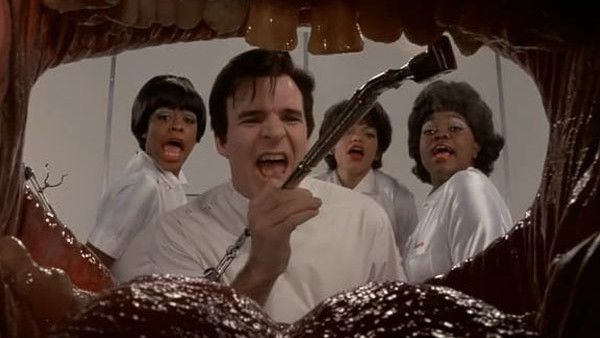
Sure, the original has Jack Nicholson (as sadistic dental patient Wilbur Force), but the 1986 version is vastly superior to Roger Corman’s 1960 attempt in almost every way.
Made on a shoe-string budget with some Corman veteran stock actors and a left-over set, the 1960 version has its cult appeal. And it’s charming in its own way - which makes the fact that it was literally completed from rehearsals to principal photography in SIX DAYS - but it misses the theatricality of the musical it was based on.
That’s one place where the 1986 version really improves: not only are the performances - particularly by Rick Moranis, Steve Martin and Ellen Greene - delightful, but the songs are a joy. “Suddenly Seymour” and “Somewhere That’s Green” are modern musical treasures (and so is Greene herself). The music actually helps the whole grotesque element - the baroque staging clashing with the grubby reality of Skid Row. It’s not just functional, it’s aspirational.
It’s being remade again as a dark non-musical, which is a travesty, but hopefully it’ll just direct more attention to the 1986 version.
[Simon Gallagher]
5. 3:10 To Yuma
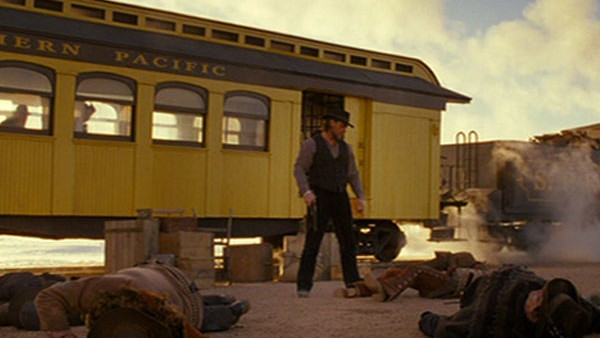
Before James Mangold was wowing the comic book crowd with The Wolverine and Logan, he was busy doing the same for western fans with 2007’s 3:10 to Yuma.
A remake of the 1957 classic starring Glenn Ford, Mangold’s remake instead features Russell Crowe and Christian Bale against each other as an outlaw and Civil War veteran respectively. The catch? Crowe’s character is arrested and it falls to Bale’s reluctant hero to ensure he boards the titular 3:10 to Yuma, a train that’ll take him to be tried and, should the courts deem it, hanged.
Over the course of their journey, Crowe’s outlaw comes to respect his captor, even as his gang attempt to free him. It’s a brilliant premise that begets some wonderfully orchestrated action and drama, and though the same can be said of the original, it never achieved the same sense of scale as Mangold’s remake.
[EP]
4. IT: Chapter One

There's a lot of things to love about the original IT miniseries. Tim Curry's version of Pennywise made him a horror icon, haunting the minds of both children and adults for decades as the killer clown everyone was scared of. What everyone happily forgets (or misremembers) though, is how !*$% boring so much of the three-hour film is. Everyone remembers Pennywise popping up in the showers, but nobody remembers the long stretches of terrible adult drama in the second half, or when the clown turns into a big Lovecraftian spider-monster at the end.
In part because it chose to split the book up and focus purely on the main cast as kids, the recent remake is inherently far tighter. The cast themselves are also excellent, bouncing off each other like actual kids would, both afraid and overwhelmed at the situation yet still teasing and putting on a confident front. Unlike the original, there's far more heart to the remake because of this; you really feel for this group even before a clown turns up to try and eat them, relying on each other as a family unit because their real, flesh-and-blood relatives are completely screwed up.
Also, it helps that it's freaking terrifying. Bill Skarsgard's take on Pennywise is an entirely different beast from Curry's, while the film itself has the R-Rated bite to back up its bark. Throw in inventive sequences that capitalise on the clown's ability to manipulate the kids' worst fears, and you're left with a horror that's scary in part because of how unpredictable it is.
It was a smash hit for a reason, and hopefully Chapter 2 will capture the same magic that made the first so special.
[JB]
3. Ocean's Eleven

Steven Soderbergh's Ocean's Eleven isn't just much better known than Lewis Milestone's Ocean's 11; it's simply much better, period.
The 1960 original was a fun vehicle for the Rat Pack, with Frank Sinatra, Dean Martin, Sammy Davis Jr et al essentially playing slight twists on their already well-known personas. The story is similar - Danny Ocean recruits a crack team to rob a bunch of Las Vegas casinos - but, while there's a certain 1960s cool to the flick, the script is overly contrived, and the performances themselves don't amount to much despite the star-billing.
Enter Soderbergh in 2001, who turns in an equally starry cast - George Clooney! Brad Pitt! Matt Damon! - but crucially a whip-smart, razor-sharp script that absolutely crackles with energy. The whole team bring a huge amount of energy and charm, bouncing off each other in the way such ensembles often promise and often fail to deliver. That's backed by the clever writing and direction from Soderbergh, who turns this into a thrilling flick that's an absolute blast to watch from start to finish. It's undeniably cool, slick, and not just a remake that's better than the original, but a perfect example of the heist genre too.
[James Hunt]
2. True Grit

Rooster Cogburn may not have been the most iconic role in John Wayne’s filmography, but it is fondly remembered. After all, who doesn’t look at a sequence of a bounty hunter firing both a repeater and revolver on horseback - at the same time - and consider it nothing short of amazing?
Joel and Ethan Coen’s 2010 remake of True Grit may lack the same exuberant approach to gunfighting, but it does succeed where the original didn’t, namely in its ability to convey the tone intimated by the source-material’s title.
Wayne’s performance in the original 1969 film was revered, and it stands out today as one of the actor’s more unique performances, namely for the fact that Cogburn didn’t possess the usual stoicism of the actor’s previous roles. Be that as it may, it’s hard not to watch the original True Grit and see it as just another Wayne western, sporting a usual tale of revenge, shootouts, and frontier justice.
The remake, on the other hand, sets out to tell a truly grim tale. Interwoven throughout is the Coen Brothers’ signature style, but the remake is also buoyed by two magnificent performances, namely Jeff Bridges as Cogburn, and Hailee Seinfeld as Mattie Ross, the young girl who seeks revenge against the man who murdered her father.
[EP]
1. The Thing

One of the finest horror films of all time, 1982's The Thing is a masterclass in pulling off the "killer in the room with you" scenario.
Interestingly though, despite the film being heavily inspired by 1951's The Thing From Another World (right down to an extraterrestrial being thawed from a block of ice), here the creature is already in humanoid form, ambling towards the crew and regenerating limbs when wounded.
For the 1982 edition, John Carpenter focused entirely on this latter idea of regeneration, and replication. His edition came with a haunting, dissonant score, and a creature you never see in its original form. Instead, any member of the cast could be lying about who they really are at any time, and therein lies this movie's genius.
Outside of some iconic visuals and believably terrified acting performances from Kurt Russel, Keith David and more, it's the Thing's core premise as an entity that stand out. Some supremely effective, laboured-over practical effects bring it to life like nothing else, and things like this movie's "head-crab" will never, ever be outdone.
[ST]
Which other remakes do you think are better than the original? Let us know down in the comments.