10 Movie Ripoffs Better Than The Original
Sometimes the ripoff just does it better.

Many proclaim that originality in Hollywood is dead, and that the industry is largely content to just recycle the same basic ideas ad nauseum for safe repeat profit. And then there are those movies that aren't just working from a similar elemental idea - they're very clearly cribbing from something that already exists.
While we as viewers are prone to view blatant ripoffs with a certain level of disdain, what with the number of low-effort "mockbusters" flooding the market every single year, there are rare instances where the inspired film is actually the better one. And that's surely the case with the following 10 movie rip-offs, which while undeniably singing from the same hymn sheet as other films and stories, actually came out on top where the overall execution is concerned.
In some cases, both movies are thankfully good, but in every single instance the ripoff film is actually the superior one, benefitting from its more full-throated direction, outstanding ensemble cast, and so on. The lesson here? Just because a filmmaker originated an idea, it doesn't mean they know the best way forward...
10. National Treasure Is Better Than The Da Vinci Code

Now to be clear, National Treasure was released in 2004, a whole two years before the big-screen adaptation of The Da Vinci Code came out, but it's hilariously obvious that the Nicolas Cage-starring action-adventure flick took cues from Dan Brown's bestseller released the year prior.
The success of Brown's fast-paced airport novel inspired a glut of junky, me-too globe-trotting adventure flicks with religious undertones, and while most have been quickly forgotten to time, National Treasure and its 2007 sequel have managed to endure.
A whole two decades after National Treasure's release, it has remained a popular classic, largely due to its light tone, decadent locations, and the charms of its cast - Cage being joined by Sean Bean, Diane Kruger, Justin Bartha, Jon Voight, Harvey Keitel, and Christopher Plummer.
The film's big strength is that, unlike The Da Vinci Code, which was aspiring to be great "pulp art" as both a novel and a film, National Treasure never once took itself too seriously, embracing the pulp but leaving the art at the door. And honestly, when was the last time you ever even thought about The Da Vinci Code?
9. Madagascar Is Better Than The Wild

It's a tad unfortunate that 2006's animated film The Wild has long been deemed a rip-off of Madagascar released the previous year - what with both plots revolving around a group of animals from Central Park Zoo getting shipped off to an exotic locale - but in actual fact, The Wild was in development long before Madagascar, with production stalling long enough that DreamWorks could develop their own competing project and beat them to the cinema.
Yet even accepting that DreamWorks effectively ripped Madagascar's concept off from Disney, it's tough to deny that Madagascar is the better - and by far the most successful - of the two movies.
Basically everything, from the animation to the cast, humour, and songs is just effortlessly superior in Madagascar, enough that it wasn't surprising to see so many dismiss The Wild as a feckless knock-off, even though it actually wasn't. It just wasn't a very good movie.
8. Alien Is Better Than It! The Terror from Beyond Space

Ridley Scott's Alien is undeniably one of the most influential sci-fi films of all time, but screenwriter Dan O'Bannon was himself inspired by a glut of sci-fi films, and none more so than 1958's sci-fi horror It! The Terror from Beyond Space.
Much like Alien, the story follows the crew of a ship who inadvertently stumble across an alien monster which finds its way onboard and starts picking said crew off one-by-one. While Alien is obviously a far more technically sophisticated film, it lifts not only the spine of its story but also much of its atmosphere - namely the smoky, claustrophobic design of the ship - from It!
There is a myriad of other superficial similarities, like the alien also travelling through vents, being scared of fire, and finally getting sucked into the vacuum of space. Alien producer David Giler even stated in an interview that he wouldn't have been surprised if O'Bannon "stole" the idea, while after viewing Alien, It! writer Jerome Bixby referred to himself as "the grandfather of ‘Alien."
But while It! is a solid - if undeniably dated - romp, Alien is one of the most timelessly well-aged sci-fi films ever made, and there's just no competing with that.
7. Kill Bill Is Better Than Lady Snowblood

Quentin Tarantino has never been shy about wearing his multitude of cinematic influences on his sleeve, and to that point it didn't take long for cinephiles to appreciate that Kill Bill was heavily inspired - if we're being kind - by the 1973 Japanese revenge classic Lady Snowblood.
Like Lady Snowblood, Kill Bill follows a heroine who seeks revenge against those who slaughtered her family, with a non-linear narrative, and with part of the story told through animation (similar to Snowblood's storyboard-like asides).
Hell, the theme song to Lady Snowblood was even featured in Kill Bill, and Meiko Kaji - who was both the lead actress in Lady Snowblood and sang the aforementioned theme - later claimed that Tarantino showed the film to his cast and crew while shooting Kill Bill.
This is really a best-case scenario where both movies are great, honestly, though Kill Bill's sheer energetic brio, ambitious storytelling format, and Uma Thurman's excellent performance nudge it ahead.
6. Nosferatu (1922) Is Better Than Dracula (1931)

Even though F.W. Murnau's Nosferatu was released almost an entire decade before Tod Browning's Dracula, it's no secret that Nosferatu was an unofficial, unauthorised adaptation of Bram Stoker's classic horror text, resulting in a lawsuit that caused almost all copies of the film to be destroyed. And while both films are stone-cold horror classics, it's fair to say that critical consensus actually comes down on the side of the ripoff here.
Nosferatu's gorgeously lit German Expressionist visuals and sheer pervasive atmosphere pull far ahead of Dracula, its status as a silent film only making it that much more moody and enigmatic. Count Orlok's (Max Schrek) design is also more viscerally unsettling than Dracula (Bela Lugosi), and the film as a whole is just more unnerving to behold.
They're both great films, mind, but in this case, the "ask forgiveness, not permission" rip-off is actually the better-made and more effective movie in basically every respect.
5. Cars Is Better Than Doc Hollywood
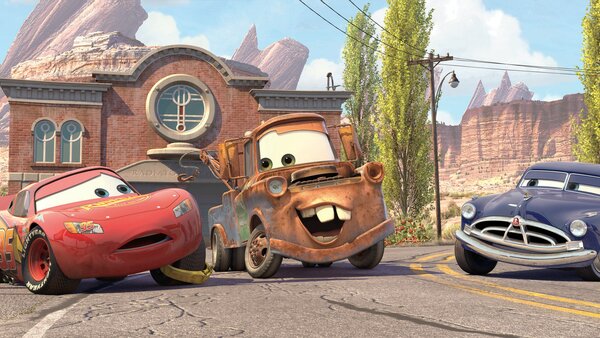
Pixar's Cars may seem like a wholly original IP on the surface, but it didn't take long for many to realise that the plot is a thinly-veiled riff on the 1991 Michael J. Fox-starring rom-com Doc Hollywood.
In that film, Fox's protagonist is a hotshot doctor who crashes his car while cruising through a podunk town, forcing him to stick around in order to make things right, where he comes to appreciate small-town values and re-evaluate his high-flying life.
That's... basically the exact plot of Cars from start to finish - subbing out an arrogant doctor for an arrogant race car - to the extent that the "inspiration" is basically indisputable, even with the shift from live-action to animated form.
It has to be said, though, that Cars is far and away the better of the two films. Doc Hollywood's an entertaining enough ride, but Cars' dazzling animation, excellent voice cast, and thrilling race scenes make it a no-brainer winner.
4. Willy's Wonderland Is Better Than Five Nights at Freddy's

The moment that Willy's Wonderland was announced - a horror film in which Nicolas Cage plays a janitor who faces off against possessed animatronic mascots in a family entertainment joint - many noted the obvious similarities to hit video game franchise Five Nights at Freddy's.
Honestly, it was an unofficial FNAF movie, enough that some even questioned the legality of following through with such a familiar premise, especially as a licensed FNAF adaptation was also already in the works. That film was finally released last year, roughly two-and-half years after Willy's Wonderland, though naturally many saw Cage's film as wildly derivative of the pre-existing idea. But reviews were considerably kinder to Willy's Wonderland, which received praise for its offbeat tone, wild violence, and Cage's uncharacteristically stoic performance in the lead role.
Five Nights at Freddy's, meanwhile, was raked over the coals by all but the series' die-hard fans, many criticising its brutally overlong runtime, nonsensical plot, and sanitised violence.
3. Slither Is Better Than Night of the Creeps

James Gunn's 2006 sci-fi horror-comedy Slither is a ton of fun, if also an extremely transparent riff/ripoff of Fred Dekker's 1986 film Night of the Creeps.
Both films revolve around alien slug-like creatures that invade Earth, infect human beings, and turn them into glorified zombies, while adopting a darkly comedic bent. Curiously, though Gunn has cited numerous influences on his own film - namely David Cronenberg's Shivers and The Brood - he's never mentioned Night of the Creeps, despite the core concept and execution being so similar.
To Gunn's credit, he also does more with the concept than Dekker did, playing up the giddy B-movie homages while working with far more sophisticated effects and a superior cast.
Both films are fun and honestly make for a rock-solid double bill. Plus, Dekker clearly has no qualms about the inspiration, not only downplaying the originality of his own concept but admitting that he himself cribbed from a bevy of popular films such as Alien, George Romero's zombie films, and even Ed Wood's Plan 9 from Outer Space.
2. Raiders of the Lost Ark Is Better Than Secret of the Incas

While it's no secret that Raiders of the Lost Ark is inspired by the classic adventure serials George Lucas watched as a child, it's easy to gloss over how liberally it "borrowed" from the 1954 Charlton Heston-starring film Secret of the Incas.
Throughout that picture, Heston's protagonist Henry Steele wears basically the very same outfit that would be canonised as Indiana Jones' (Harrison Ford) signature attire -a brown leather jacket, fedora, tan pants, over-the-shoulder bag, and revolver.
Beyond that, Secret of the Incas has several set pieces that appear to have been imitated or "homaged" in Raiders of the Lost Ark, especially the latter's iconic Map Room sequence. Hell, Raiders' costume designer Deborah Nadoolman Landis even later revealed that the film's crew watched Secret of the Incas numerous times, and she was ultimately surprised that the movie wasn't mentioned in the credits for its obvious influence on Indiana Jones.
It also has to be said, Raiders not only far surpassed the cultural relevance of Heston's film - which barely made a dent upon release - but exceeded its quality in every measurable way. Decidedly less-varnished and charming than Raiders, Secret of the Incas is largely regarded today as a curiosity for Indiana Jones fans and, honestly, little else.
1. Stone Cold Is Better Than Cobra

1991's action flick Stone Cold may have been critically and commercially unsuccessful upon release, but it's endured as something of a perverse cult classic, with many coming to appreciate how over-the-top and almost laughably testosterone-fuelled it is.
It might ultimately be more apt to call Stone Cold a parody of the Sly Stallone-starring 1986 actioner Cobra rather than a mere ripoff, given that it opens with a near-identical action sequence in which our similarly-attired hero - played here by American football star Brian Bosworth in his debut - saves a supermarket from shotgun-totting baddies.
Both films revolve around a badass cop who takes on a local gang - not the most original idea, granted - but the key difference is that Stone Cold takes itself a lot less seriously than Cobra. Cobra is certainly an entertaining blunt object of a movie in its own right, but Stone Cold refines its formula into something more giddily enjoyable. Also, it's got Lance Henriksen and William Forsythe playing a**hole bikers, which is basically impossible to compete with.