10 Movie Scenes That Totally Tricked Your Brain
Miles Morales moves at 12fps to reflect his lack of experience.

More than anything else, cinema is a grand magic trick, projecting 24 frames per second in front of your eyes to give the impression that you're actually watching something truly real unfold.
Ever since film's inception, filmmakers have sought to heighten viewer immersion in their escapist worlds with creative, mind-boggling techniques designed to trick your brain in myriad ways.
This can range from extremely elaborate techniques that toy with the viewer's perception of images and sound, to lower-budget solutions which play devilish tricks hidden in plain sight.
Whatever the method, these 10 movie scenes all managed to get one over on just about every audience member with extreme ingenuity and technical skill.
The connection between the audience and a film can be severed if something isn't sufficiently rooted in reality - as we've all seen - but these films all used our own interpretation of the world against us to pull off brilliantly slippery cinematic sleights of hand.
You may not have consciously noticed even a single one of these tricks, but one way or another, your brain almost certainly did. Here's how the filmmakers did it...
10. The Aquarium Is Actually A Video Projection - Dr. No

Though the James Bond films are recognised today as some of Hollywood's glossiest productions, back at the franchise's inception things weren't quite so fancy.
The first ever Bond film, 1962's Dr. No, was produced on a svelte budget of just $1.1 million, and because legendary production designer Ken Adam was given just £14,500 to dress the sets, he had to get incredibly creative to give Dr. No's (Joseph Wiseman) lair an appropriately grandiose sheen.
While you'd never know simply by looking at it, the iconic "aquarium" on the wall of his lair is actually an ingenious fake. It's nothing more than video being projected against a screen and cleverly lit to replicate the luminance of a real aquarium.
Hilariously, because Adam only had the budget to buy stock footage of smaller fish, he had to blow up the footage to make the fish look larger.
In order to explain this effect to an audience who probably didn't notice anyway, Dr. No even says to 007 (Sean Connery) in the film, "The glass is convex, 10 inches thick, which accounts for the magnifying effect."
It did give us the legendary follow-up line from Bond, though - "Minnows pretending they are whales. Just like you on this island, Dr. No."
9. Buzzing Bee Sound Effects Make You Subconsciously Anxious - The Exorcist

William Friedkin's The Exorcist is one of the greatest and most unnerving horror films of all time, in large part due to the anxiety-inducing atmosphere director William Friedkin generates.
It's well-documented that Friedkin included "subliminal" imagery throughout the film, namely brief flashes of demon Pazuzu's terrifying face, to keep the audience thrown off-kilter, but he also employed more subtle techniques to get the hairs standing up on viewers' necks.
In many of the film's earlier scenes, Friedkin integrated the sly sound of buzzing bees in order to induce a primal fear response in the viewer's lizard brain. You may feel uncomfortable during these scenes but not really know why.
Friedkin claims he also added "disturbing industrial sounds" into the soundscape of the demon scenes, in an attempt to trigger audience members' fight-or-flight response and make them feel a sense of impending danger.
As much as viewers might take umbrage with a filmmaker toying with their subconscious in such a way, it's undeniably genius-level cinematic manipulation.
8. "Bumping The Lamp" Helps You Accept The Toons Are "Real" - Who Framed Roger Rabbit

Who Framed Roger Rabbit is one of the most technically astonishing movies of all time, its ground-breaking hybrid of live-action filmmaking and 2D animation winning it both the Best Visual Effects Oscar and a Special Achievement Academy Award.
While we as audience members of course know that Roger Rabbit and the other toons aren't in any way real, director Robert Zemeckis ingeniously tricks our minds into fully accepting the illusion through an innovative technique called "bumping the lamp."
In this context, bumping the lamp is the act of manipulating the physical environment of a scene in order to sell the presence of the cartoon character, who is of course added during post-production.
Zemeckis and his crew went to exhaustive lengths to execute the results of the toons' physical movements in-camera, using elaborate rigging to have every non-animated element be part of the live-action shoot.
The term bumping the lamp was coined from the scene in which Eddie Valiant (Bob Hoskins) bumps his head on a lamp, causing light to shine all around the room while Eddie interacts with Roger.
Because the ever-shifting lighting is also applied to Roger himself, audience members subconsciously believe that Roger is "real," rather than being distracted by him not blending in correctly with the environment.
Between this and the tireless efforts to carry out his actions in-camera - such as having the weight of boxes shift when he sits on them - it's truly next-level filmmaking that absolutely should've earned Zemeckis a Best Director Oscar nomination.
7. Everyone Believed Gary Sinise Didn't Have Legs - Forrest Gump

Another Robert Zemeckis masterstroke now, with the film that not only won him the Best Director Oscar but also nabbed the gong for Best Visual Effects - and rightly so.
Despite being a noted stage actor, Gary Sinise had just a few screen credits to his name at the time of Forrest Gump's release, such that most audiences simply believed his amputee Lt. Dan was played by an amputee actor.
The world was shocked to learn, then, that Sinise did indeed have legs in real life, and the effect was achieved in the film through extremely complex, state-of-the-art VFX.
Much like Roger Rabbit, Zemeckis knew that people would truly accept the illusion if they could see Sinise moving around the environment in the same tangible way that an amputee actually would, rather than his movements being limited by technological limitations.
What ultimately tricks your brain into completely believing the effect, whether you knew who Sinise was beforehand or not, is those moments where Lt. Dan moves around outside of his wheelchair, moving his stump into physical spaces where we know his legs should be.
Zemeckis and his VFX team went to the lengths of adding CGI objects into the spaces where Sinise's legs would've been, such as a coffee table during the New Year's Eve scene.
In combination with subtle lighting tricks and smart camera placement, this ensured the effect still looks note-perfect today.
6. Tom Cruise Isn't Really In New York - Eyes Wide Shut

Compositing is one of the toughest effects-based disciplines to pull off correctly.
Placing an actor in an environment they weren't actually present in is extremely difficult because perfectly matching the lighting and general conditions of the original footage is so challenging.
Also, our brains are extremely good at picking up on things like poorly matched lighting: we immediately know something's "off" if it's not consistent.
But ever the perfectionist, Stanley Kubrick went the old-fashioned rear projection route on his final film, Eyes Wide Shut.
Because Kubrick feared flying and consequently shot his films in the UK, he had to have the film's Manhattan setting precisely recreated on a London soundstage.
Yet for the shot where Cruise's protagonist Bill Harford walks down the New York streets, Cruise was actually just walking on a treadmill in front of a rear projection.
Because both the dynamic lighting and the speed of the camera's movements were matched so perfectly to Cruise, the overwhelming majority of audiences had no idea they were looking at two elements combined together.
As frustrating as Kubrick's obsessive eye for detail must've been for his cast, it also meant that the risky technical aspects of the productions were expertly controlled down to the most minute degree.
5. The Floating Speeder Was Achieved With Mirrors... And Vaseline - Star Wars: A New Hope

The original Star Wars is such an impressive technical achievement that audiences are liable to believe that just about everything fantastical they're watching is a complex, expensive visual effect.
Case in point, the side-on wide shots of Luke Skywalker (Mark Hamill) driving through Tatooine in a speeder appear to the naked eye to have been achieved by painting out the wheels on the bottom of the prop vehicle.
But George Lucas actually had an elegant practical solution, which involved placing a long mirror in front of the wheels to reflect the dusty environment and imply the vehicle was indeed levitating off the ground.
To ensure the end result looked seamless, Vaseline was also rubbed over a camera lens filter to provide a slight blur to the speeder's base, which the crew nicknamed "the forcefield."
4. A Low-Frequency Sound In The Club Scene Makes You Anxious & Nauseous - Irréversible

Gaspar Noé's 2002 thriller Irréversible is not a film for the faint of stomach, to be blunt.
It depicts brutal murder and sexual violence in extremely confronting, matter-of-fact fashion, and because that apparently isn't offputting enough, the director also decided to employ some sneaky tricks to further mess with the viewer's brain.
For the movie's infamous nightclub sequence, Noé piped an extremely low-frequency noise into the film's sound mix, which creates feelings of anxiety and even nausea is viewers, placing a dizzying cherry on top of what is a willfully unpleasant experience.
Noé himself said of the technique:
"We added 27 Hz of infrasound - a low frequency sound which the police use to stop riots. You can't hear it, but it makes you shake. In a good theater with a subwoofer, you may be more scared by the sound than by what's happening on the screen. A lot of people can take the images but not the sound. Those reactions are physical."
This likely explains why Irréversible's infamous Cannes premiere saw 250 audience members reportedly walk out, while 20 viewers fainted and required oxygen from emergency services.
Though the effect presumably isn't as pronounced if watched on a TV's tinny native speakers or, gasp, on your phone, it's surely an interesting experiment for anyone with a decent surround sound system to conduct at home. Just have a sick bowl ready before you start.
3. The "Mirror" Scene Is Actually Clever Use Of Doubles - Terminator 2: Judgment Day

As Star Wars: A New Hope proved, mirrors can be an invaluable tool in elegantly tricking audiences' brains into believing an illusion, but James Cameron took that to a whole new level in his technological landmark Terminator 2.
The film's Director's Cut features inarguably one of the greatest "deleted scenes" of all time, where John (Edward Furlong) and Sarah Connor (Linda Hamilton) reset the T-800's (Arnold Schwarzenegger) CPU from read-only to read-write, allowing it to become a learning computer.
The sequence takes place in front of a mirror, with Cameron even panning directly across the mirror yet somehow not capturing the film crew in the shot.
This was actually achieved through masterful use of doubles: the mirror isn't actually a mirror at all but another part of the set.
Linda Hamilton's twin sister Leslie doubles as Sarah on the other side of the mirror, while the T-800 in the foreground is a prop whose face we never see, while Schwarzenegger is actually sat in the "mirror" section.
The trickiness of course lies in perfectly syncing up the movements of both sides, especially with a moving camera where shifting planes of movement can make it far easier for viewers to notice the seams.
And yet, the end result is so meticulously executed that most audiences would simply assume the mirror was another of the film's many brilliant, complex visual effects.
Instead, it was pulled off completely practically, and because it's so damn convincing you probably never even thought about the invisible camera crew the first time you saw it.
2. Miles Moves At A Lower Frame-Rate To Show His Inexperience - Spider-Man: Into The Spider-Verse

Spider-Man: Into the Spider-Verse is one of the most visually stunning animated films of all time, and also one jam-packed with Easter eggs and incredible visual details.
But one that you most certainly didn't notice is a clever trick used to visualise Miles Morales' (Shameik Moore) clumsy inexperience as a superhero.
In the earlier passages of the film where Miles is still learning to be Spider-Man, he's typically shown moving as just 12 frames-per-second, giving him a jerky look which reflects his burgeoning superhero status at the time.
During the forest chase sequence, this is juxtaposed with the more experienced Spider-Man Peter B. Parker (Jake Johnson), who moves at a more fluid, assured 24 frames-per-second.
But by the end of the film, when Miles has truly earned the mantle of Spider-Man, he moves at a fully actualised 24fps.
You'd probably never notice it just by looking at the film, but your brain caught it. It's an extremely smart and innovative way to use visuals to enhance a movie's storytelling.
1. Camera Filter Tricks Allow An "Impossible" Transformation - Sh! The Octopus
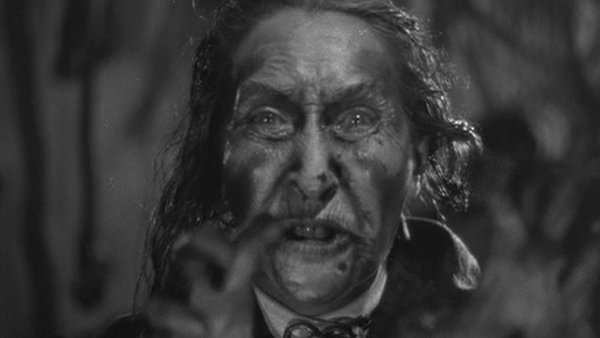
An oldie but a goodie now, with the 1937 mystery-comedy Sh! The Octopus.
The film features a fascinating effect which surely must've blown audience's minds 80-something years ago, when Elspeth Dudgeon's character Nanny undergoes a sudden, grotesque transformation into a witch in the middle of a scene.
While today such an effect could be achieved via VFX with relative ease, such tools obviously weren't available back in 1937, and so director William McGann had to get incredibly creative to pull off such a mind-melting, how-the-hell-did-they-do-that effect.
Despite the seeming impossibility of executing such a radical transformation in-camera so long ago, it was actually completed entirely practically.
McGann used an ingenious technique developed by cinematographer Karl Struss for 1925's Ben-Hur, involving the manipulation of colour filters to trick the viewer's mind.
For Dudgeon's transformation, extensive makeup was applied to her face using a single shade of colour, after which a filter was applied to the camera lens that matched the colour of the makeup, in turn rendering it invisible to the camera.
Then all it took was for the camera operator to close the filter as Dudgeon removed her wig and the makeup would suddenly become visible to the audience.
One can only imagine how viewers of the time, without easy access to behind-the-scenes information, must've felt when they watched this near-literal movie magic play out on screen.