10 Movie Sequels That Got A Raw Deal
Stop doing The Exorcist III and Gremlins 2 so dirty...

Sequels have long been problematic. Even when shameless cash-ins on hits mange to be successful, they are still just that, and are regarded as such regardless of quality.
There are naturally exceptions to the rule, and there will always be a debate about what truly qualifies as a sequel. And from there, you enter your own world of mislabled, in-name only, foreign, direct-to-DVD and a virtual underworld of films that defy classification.
But other cases are much more cut and dry. A film makes good with critics and the box office, it's likely headed for duplication, be it in sequel or knock-off form.
This was particularly true of the 90s, when Hollywood seemed to have perfectly managed the expectations of a potential blockbuster with subgroups - the erotic thriller for adults, the family-oriented comedy, the action hero blowing away stock villains all had solid, devoted audiences that would devour whatever was being sold.
But some sequels have since developed mixed reputations, or they've all but fallen by the wayside in favor of more timely entertainment. Here are a few that still hold up.
10. Clear and Present Danger

Clear and Present Danger performed fairly well at the box office, appealing the "mature" crowd that seemed to be gathering in droves for a mid-aged Harrison Ford action flick, so the film did no harm to the director, stars, producers or even viewers. And we're sure Tom Clancy took a nice cut of the profits to continue to fund his campaign to end fictional terrorism everywhere.
At least, that's the tone the cinematic Jack Ryan took. For Clancy may have carried Ryan's story forward (he becomes President in the books, which, at this point, sure), but studios kept on trying to reboot him with more an eye more focused on the Middle East. It wasn't exactly a leap for Ryan, The Sum of All Fears' novel plot does indeed involve Arab extremists, but 9/11 turned it to the main focus.
So spare a thought for the days of Ryan before the world turned upside down, when things were less racially dodgy (slightly) and Ford (and Baldwin before him) would take the time to track down bad Russians or a dirty president.
Clear and Present Danger, of the three pre-9/11 Ryans, is by far the best, with director Phil Alden Robinson flexing his muscles in conspiracy thriller (he'd already turned out the excellent Sneakers). Perhaps for the final time, it also features Ford in fine dramatic and physical form, a fake helicopter jump notwithstanding.
9. Gremlins 2: The New Batch

It's difficult to overshadow the legacy of Gremlins. The Steven Spielberg-produced family-friendly horror was originally an invention of screenwriter Chris Columbus, who would go on to direct the Home Alone films. But the Gremlins belongs more with its horror inspiration than those feel gooderies, leading with its director Joe Dante.
Dante had recently seen success with his knowledgeable horror-comedy The Howling, and he was on Spielberg's mind since he launched his career with Piranha in his Roger Corman days.
And while Dante has always found his way back to horror, he still find ways to pay homage to his second love: Looney Tunes cartoons.
Though his actual live-action Looney Tunes effort was met with mixed reactions (which is better than what was expected), his sequel to Gremlins represents a far more unhinged tribute to the cartoon and, well, everything Dante loved as a kid.
Dante also launched the website TrailersFromHell, in which he and other filmmakers provide commentary over B-Horror classics and Hammer films, which certainly accounts for Christopher Lee appearing in Gremlins 2: The New Batch as a mad scientist.
Anyone walking into Gremlins 2 expecting more of the same will be granted that fan service, with Gizmo and the more eccentric creatures returning as well as some human characters. But the film's crowning achievement Is John Glover's turn as a Trump/Ted Turner magnate who refuses to screen old movies in black and white.
8. Grumpier Old Men

One of the biggest criticisms of any sequel, particularly a studio-imposed film with a new, fairly hatchetman-like director, is that it's just more of the same; Hollywood just regurgitating plots and characters ad nausea. This was especially true of the 90s, and became almost so toxic that we haven't had a truly atrocious example since The Hangover Part II.
There's no question that Grumpier Old Men is guilty of every single sin a sequel could commit. The plot, revolving around two elderly rivals cum friends vying for love, isn't any different from the first film, a superior work. The film's script even hits the same emotional beats of the first film, with its leads' two children (Kevin Pollak and Daryl Hannah) fighting to have a relationship.
All of this would prove toxic if said leads weren't Jack Lemmon and Walter Mathauu, one of the funniest, most entertaining comic pairings in cinema. Prior to the Men films, the two hadn't appeared together since 1981's Buddy Buddy, a bizarro comedy that relies on their chemistry and the unhinged, turn-and-he'll-knife-you Klaus Kinski. It wasn't exactly a satisfying conclusion.
What's more, the supporting cast includes a raunchy Burgess Meredith improvising some of the filthiest PG-13 old man talk imaginable. There's a reason both films end with outtakes of the cast cracking each other up, they instinctively understood we weren't satisfied yet.
7. The Drowning Pool

1966's Harper introduced the world to Ross Macdonald's cool as hell private eye in the smoothest way one can: by casting Paul Newman. Contrary to popular belief, it was Lew Harper that first dunked his head in ice to shake off a hangover long before Newman's character in The Sting did it. And William Goldman's crackling script offers no shortage of moments for the actor to ooze cool, including a somewhat famous ending shrug that flies in the face of a typical P.I. arc.
The film was a huge hit, leaving questions to why it took nearly a decade for the character to return to the screen. Goldman did adapt another MacDonald novel, The Chill, but the script was never produced.
Finally, 1975's The Drowning Pool, based on a novel 25 years older, transported the hip, L.A private dick to the New Orleans bayou. Unfortunately, the film didn't leave the same impression as Harper. The main criticism is that the supporting characters were writ toolarge, too stereotypically southern. But as a Paul Newman vehicle, no one was complaining.
The actor and character still work quite well, and given the heightened reality of detective fiction, it's not that much of a leap to accept the more outlandish supporting characters.
6. The Exorcist III

It's not easy being the sequel to a film that was almost instantly praised as the greatest horror film ever made. Hype around The Exorcist was as outlandish and extreme as it Is today, just to give a sense of how revered it is. And for the most part, it lives up to it. While not necessarily terrifying for everyone (those lacking in religous background might be less inclined to agree with the consensus), it's hard to argue that it's not a great film.
The same can't be said for the sequel, often cited as one of the worst of all time up there with Jaws: The Revenge. John Boorman's Exorcist II: The Heretic is the kind of confusing, bizarre, unappealing kind of bad that doesn't even qualify as unintentionally funny save for James Earl Jones' bee costume.
By the time William Peter Blatty took back control of the franchise with the third film, adapted from his novel Legion, no one had any expectations.
That's precisely why even its messy theatrical cut, with a studio-enforced exorcism in the film's final act and reshoots that only serve to confuse the audience, is still worth a look. The film follows Lt. Kinderman, a side character in the first film, following a series of murders that may be committed by the same demon.
That it includes what some call a scene scarier than anything in the first film and cameos from Samuel L. Jackson, Fabio and Larry King are just icing on the cake.
5. Fletch Lives

Director Michael Ritchie was famous for knowing how to control Chevy Chase. The actor, known for improvising and generally just being difficult, was already gaining notoriety in Hollywood after leaving SNL rather discourteously to seek individual success. Ritchie offered a deal while shooting Fletch, arguably Chase's signature 80s role: Do one take as scripted, and I'll film all the improv you want.
One can imagine the stack of film Fletch's editor had to sift through when putting together an Assembly Cut, but Ritchie's work managed to perfectly balance Chase's appeal with a crackerjack mystery.
The character was not an original, but from a series of novels from Gregory MacDonald. Irwin Maurice Fletcher, of the novels, is funny, but in radically different ways from Chase. The one crossover from the novels beyond the basic plot and characters is the lead's quick wit that served the first film so well.
Fletch Lives was an affront to fans of the novel series. Not only was not an adaptation of one of the many novels (this writer's favourite: Fletch Won), but an original work that abandoned any of the books' mythology. If other characters from the books appeared, they did so briefly to serve narrative purpose, only to be written out early.
The question of how much you enjoy it depends on how much mileage you get out of Chase and a reasonably decent mystery for a comic film.
4. Candyman 2: Farewell to the Flesh
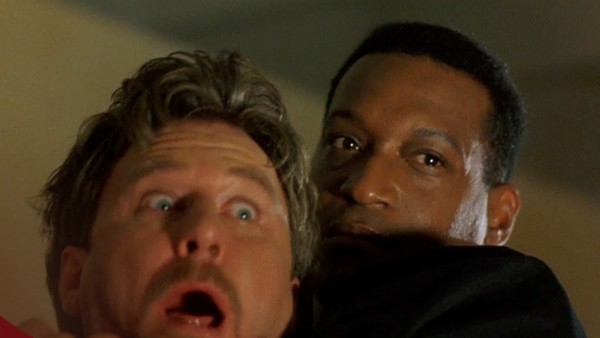
Candyman will soon be getting a reboot courtesy of producer Jordan Peele, whose race-conscious horror films have certainly proven as timely as ever, but the original film is pretty hard to surpass. Clive Barker's novella avoided much of the racially-charged film, Bernard Rose transplanted the events to Chicago and it's class struggle. Candyman is about as complicated an idea about race politics and identity that white people were willing to engage in at the time of its release, and even now its subtext is both chilling and relevant.
Much of that would be irrelevant if it wasn't delivered with the effectiveness, fear and ultimate tragedy that Tony Todd managed to convey as the titular killer.
Though much of the tragedy is only fully revealed in Bill Condon's 1995 sequel. The film was largely disparaged by critics, and there's no question it doesn't live up to its predecessor. The budget is less, the gore is increased where it didn't need to be and the plot is too straightforward.
But it does offer a handful of decent scares and more of what was desired: Tony Todd. Some may argue the original's less-is-more approach to his story, offering just the bare essentials, is ideal. But Rose, with the approval of the NAACP, wanted to create a black Dracula. There was no "more" for there to be less.
3. Jaws 2

It helps to think of Jaws 2 less as a sequel, or if you do then make it the only legitimate sequel to Steven Spielberg's classic. Jaws 2, after all, does the least to connect its story to the original beyond just throwing another shark in the water. The other two sequels get convoluted as hell trying to justify why one family seems to be terrorized by a particular species of maneater.
What Jaws 2 does successfully, however, is move as far away from Steven Spielberg's action-picture tendencies and delve more into horror. Jeannot Szwarc's follow-up is a straight-up slasher flick.
Gone from Amity's shores are the complex characters wrestling with a seemingly unstoppable threat, the great white in Jaws 2 is malicious. It even leaves calling cards for its hunter, the half-eaten beached whale being no different than the
2. Psycho II

Looking at the back cover of a VHS release of Psycho II, the text reads as though Universal had no confidence in the likelihood you'd want to watch a sequel 23 years after the original film and three years after the death of its director.
The text insists that the script was written by Tom Holland (who would go on to write and direct Fright Night) and directed by "Hitchcock scholar" Richard Franklin, lest we thought the material would fall into lesser hands.
It's enough to make one want to comfort the box with some warm milk and ensure it that Psycho II isn't all bad. It's certainly a marked improvement on Robert Bloch's cheeky novel meant to satirize Hollywood slasher films, which was thrown away in favour of an original script.
Psycho Ii works best when it moves away from Hitchcock's film, placing almost all the responsibility in a cagey, eccentric performance from Anthony Perkins. Perkins would go on to direct the third film and largely claim ownership over the screen character, and its earned here.
While some of the gorier aspects of Psycho II may be unwelcome (though given Hitchcock's late career, it's d to tell where he'd fall on the issue of gore), there is a genuinely curious mystery at the core of Psycho II. While the ultimate resolution is less than satisfying, audiences will certainly enjoy watching different parties try to manipulate Norman Bate's fragile mind.
1. Jurassic World: Fallen Kingdom

J.A. Bayona's bonkers mainland follow-up to Jurassic World was not a success. And there's little reason anyone who grew up with its predecessor would agree that its worth reappraisal. But many readers may not have been fully conscious or alive to appreciate just what a spectacle Jurassic Park was when it first hit theatres in 1993. Stan Winston's special effects, a blend of masterful puppetry and early CGI, had finally paid off after years of the artist honing his craft with triumphs like the Predator, Pumpkinhead and the Terminator.
For those who do remember, Jurassic World was a step down, completely lacking in the same sense of wonderment that accompanied the first film. It's an aesthetic that no amount of money or nostalgic callbacks could possibly recreate.
Jurassic World: Fallen Kingdom announced that it would live to a promise Steven Spielberg made but abandoned in The Lost World: the dinosaurs would see the mainland.
How they get to the mainland haunted screenwriters for decades. When they finally get there, characteristic to the franchise's messy history of false starts, it's a mishmash of half-recycled ideas that barely cohere into a coherent film, mixing in subplots about cloning and hybrid-dinosaurs as old as John Sayles' abandoned script.
But we're talking about a franchise in which dinosaurs are set to rule present-day earth. If we are afraid of getting a little bats**t, we really aren't doing this right.