10 Movies To Challenge Even The Most Hardcore Film Buff

You can't call yourself a film buff unless you've made it through these.
Broadly speaking there are two categories of movies which roughly correspond to two types of audience. Firstly there are mainstream movies geared towards entertainment - largely appealing to the masses, these are normally told through a conventional narrative format with a three act structure, with easy to recognise characters who follow a formulaic arc, often within a readily identifiable genre. The second category can be summed up as cinema as "art". These are the more experimental films screened primarily in art house cinemas and at international film festivals which seek to push the boundaries of the medium. Aesthetically and thematically, these movies are less interested in box office returns on investments than they are with delivering a unique message or vision - often intensely personal to the director - discarding the conventions of mainstream cinema in favour of abstraction, allegory and layered symbolism. The corresponding audiences to these two approaches to filmmaking - as with video gamers - can be divided roughly into the casual viewer and the hardcore film buff; with the true cinephiles making up the latter. While some mainstream films emerge which play with and subvert the conventions of cinema, the really challenging movies tend to come from the avante garde. The following are ten great movies for the hardcore film buff after something to really get their mental gears working. If you struggled to get your head around Inception these might not be the films you're looking for.

10. Upstream Color

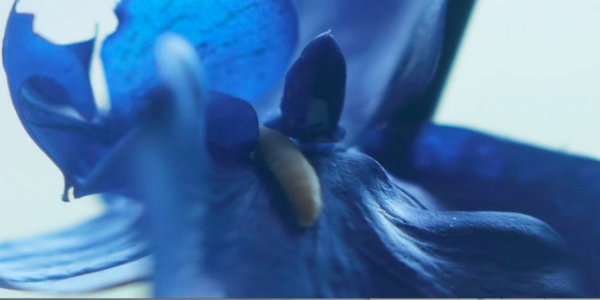
Shane Carruth wowed and perplexed audiences in equal measure back in 2004 with his debut independent film, Primer. An audacious movie, not least on account of its miniscule budget (completed for just $7,000), it marked Carruth as a director to watch, eschewing conventional structure and refusing to pander to the lowest common denominator. After a decade waiting, Carruth finally returned behind the camera to produce his second feature, the beautiful puzzle box of a movie, Upstream Color. Starring Carruth and Amy Seimetz, Upstream Color tells of two people who have been unwittingly infected with a parasite who meet by chance on a train and experience a connection which seems to transcend the regular psychic realm. As they slowly piece together their memories of what happened to them - and these memories seem to merge with one another - they uncover the source of their predicament in The Sampler, a strange pig farmer locked in a regenerative cycle in which the parasite passes from humans to pigs to orchids, which grow from the corpses of the infected piglets he throws into a river. As baffling and metaphysical as the "story" is, Upstream Color is also a gloriously shot and edited work of cinema which frequently reaches poetic heights. Comparisons with David Lynch and Terrence Malick's The Tree of Life (shortlisted for this list) are entirely justified - Upstream Color is a surreal yet strangely moving full of rich imagery exploring symbiosis, memory and our place in nature.

9. Uncle Boonmee Who Can Recall His Past Lives
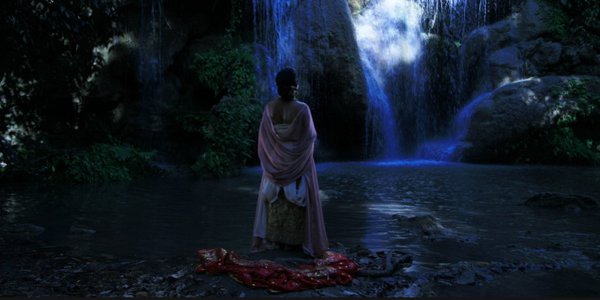
Thai director Apichatpong Weerasethakul had already clearly established his arthouse credentials back in 2004 with the release of Tropical Malady, a beautifully shot, measured exploration of burgeoning homosexuality amidst the sweltering tropical heat. Hi Palme d'Or winner Uncle Boonmee Who Can Recall His Past Lives takes the languorous pacing of his earlier movies to new levels. Given that one of the central themes Weerasethakul aimed to consider with Uncle Boonmee was the possible extinction of the cinematic form itself, it's perhaps unsurprising that watching the movie leads the audience to radically question the manner in which the content is presented. Conventional narrative having been thrown out the window, we're presented with a series of stylistically different vignettes which operate on the level of the parable. Recollection, death and reincarnation are staged with a degree of mystification anticipating the broader spiritual symbolism which comes to dominate. Weerasethakul's film is often slow and frequently as meditative as the monk from whom he drew inspiration, staged in a way which sometimes recalls the otherworldly set ups in Kon Ichikawa's An Actor's Revenge. Sukhdev Sandhu described it as "barely a film, more a floating world", a summary which captures its transcendent power.

8. Russian Ark

A strong background in 300 years of Russian history wouldn't go amiss before sitting down to Russian Ark, acclaimed Russian director Alexander Sokurov's graceful, single-take journey through the expansive, luxuriant halls of Saint Petersburg's Winter Palace. In Russian Ark, the camera takes the point of view of an unseen narrator who takes the audience on a tour of the aforementioned palace, elucidating as to his fate as a ghost, destined to wander from room to room amongst the memories of the city and the many people who had come before him. From intimate scenes to grand banquets and balls, Russian Ark eavesdrops on the historical events featuring such figures as Tsar Nicholas I, Catherine the Great and the Shah of Iran. Sokurov's project, featuring thousands of extras and three orchestras, would have been ambitious enough had it been filmed conventionally. The fact that he opted to do it all in a single take makes it all the more impressive, even if non-historians may find themselves delving for Wikipedia to brush up on the facts. The making of documentary, In One Breath, is essential viewing for those curious as to how such a challenging shoot could be pulled off with such grace.

7. Holy Motors

Leos Carax is a contemporary French director who, perhaps more so than any other, embodies the spirit of the French New Wave. Fusing the intellectual sensibilities of Jean Luc Godard with the spiritual musings of the legendary Robert Bresson (who famously held most of cinema in disregard), Holy Motors emerged as one of the most distinct and impressive movies released in 2012. Carax's regular collaborator Denis Lavant stars as Oscar, a strange man who travels around the city inhabiting various roles as the film progresses. He dons a motion capture suit and enters into a strange dance/combat /sex ritual with a weirdly costumed woman; he transforms into Monsieur Merde (translate that if you will), loitering around a park before kidnapping a model (Eva Mendez) from a photo shoot; later, he plays the role of a gangster, shooting his former self. All of this focuses around the limousine which takes him from one location to the next. A commentary on the nature of performance and identity as much as it is a free-wheeling exercise in the absurd, Holy Motors is as enthralling as it is perplexing, with Carax directing with an eye for the spectacular every bit as evocative and thought-provoking as Lavant's awesome central performance. The surprising cameo from Kylie Minogue in the film's final moments is the icing on an unusually delicious cinematic cake.

6. Synecdoche, New York

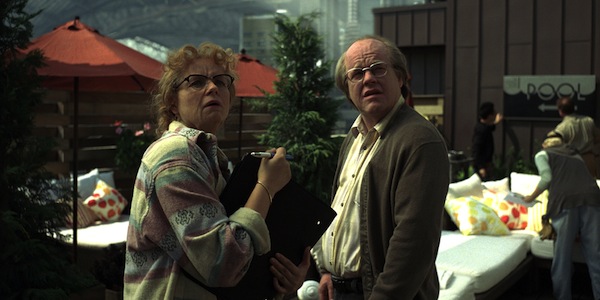
Charlie Kaufman had already established himself firmly as a writer of postmodern sensibilities less interested in adhering to conventional approaches to cinema than he is blasting them into a thousand pieces, only to reconfigure them in his own style. This much was apparent in Being John Malkovich and perhaps even more so in Adaptation, a film in which his own writer's block informed a multi-layered story in which fact, fiction and the indistinct line between were scrutinized. Stepping behind the camera for his directorial debut and it is clear that Kaufman desired to take these themes of realism versus reality, identity and authorship to the next level, using the development of an increasingly elaborate stage production as the device to explore these themes. Starring the late, great Philip Seymour Hoffman as Caden Cotard, a theatre director whose life begins to fall apart after being left by his wife, Synecdoche, New York is as layered as the city in which it is set. Given enough money to stage a new production, he sets out to craft an epic study in the raw brutality of life, but soon finds himself buried deeper beneath a project which spirals out of control, becoming all-consuming. With multiple meanings intricately layered throughout, it is perhaps not surprising that Synecdoche, New York's commercial reception failed to match its critical approval. Whether you view it as a Jungian process of individuation or a meta deconstruction of art and life and the intertwining of the two, it is a movie with stratified meaning, and one which certainly rewards multiple viewings.

5. The Mirror

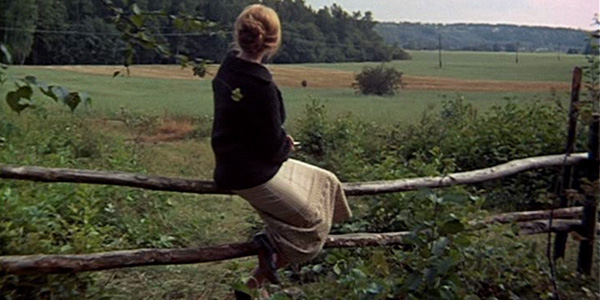
British writer Will Self once described Andrei Tarkovsky's The Mirror as the most beautiful film ever made, and it's hard to argue with him - sumptuously shot, as an exploration of memories and emotions spanning three periods of life, this deeply personal autobiographical work is a masterpiece of "pure cinema", in which conventional form is subsumed beneath stirring imagery and evocative narration. That said, at the time of its release, others dismissed the film as "incomprehensible", a charge which many audiences are likely to agree with. Tarkovsky has never been a director interested in pandering to the lowest common denominator to achieve popularity, his works often intellectually and philosophically rigorous explorations of deep themes. The Mirror is something of a stream of consciousness film, far more preoccupied with the transient nature of memory and the past than it is with telling a coherent story. A difficult movie to take in, The Mirror is one which requires the viewer to switch off their preconceptions as to what the function of cinema is - much in the same way the modernist writers of the early 20th century such as James Joyce and Marcel Proust redefined the written word, so too does Tarkovsky ask the viewer to reconsider the form and function of the moving image. The result is spellbinding.

4. Inland Empire

A list about challenging films wouldn't be complete without a feature from David Lynch, contemporary master of the weird and wonderful. From his earliest short films it's been abundantly clear that Lynch is far less interested in representations of reality than he is with delving into the dark recesses of the human consciousness, and in no film is this perhaps more evident than his wildly illogical, hugely self-indulgent but strangely brilliant movie Inland Empire. Starring Laura Dern, Inland Empire at first seems to explore familiar Lynchian territory, as Dern's character - an actress by the name of Nikki Grace - prepares for her comeback role as the character Sue Blue in a movie called On High in Blue Tomorrows. With hints of the doppleganger motif emerging - echoing Lynch's other excellent film about the disintegrating psyche of an actress, Mulholland Drive - Nikki Grace finds herself spiralling down through a series of increasingly bizarre, and often unconnected, scenarios. Attempting to tease out the (multiple) meanings from Inland Empire often feels like a futile task - you can't help but get the impression that Lynch has deliberately crafted a hermetically sealed movie in which the search for meaning is in itself a meaningless proposition - in this world, the imagery and sound, the incongruous symbolism and scenes of abstraction are the purpose, with Lynch the master illusionist, pulling invisible strings and jerking his audience to and fro as if locked in a surreal, inescapable fun house.

3. Celine And Julie Go Boating

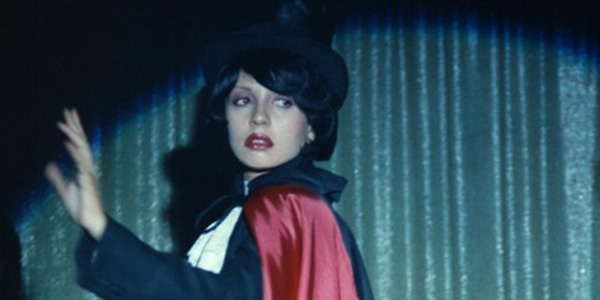
Magic and mystery permeate Celine and Julie Go Boating, a mesmerising film by the great French New Wave director Jacques Rivette weighing in at over three hours long, in which the titular friends exchange identities, learn magic spells, explore the underbelly of Paris and, of course, go boating. The radiant Dominique Labourier and Juliet Berto star as the two young women who meet up in a Parisian park and decide to move in together. The two play one another's roles in various circumstances, with Celine meeting Julie's childhood sweetheart and Julie filling in at a cabaret audition. As the house in which they live starts to exhibit increasingly strange and magical properties, they set out to attempt to unravel its mysteries. Memory and identity again play a central thematic role in Celine and Julie Go Boating, a film which is as much a meta-analysis of the form and function of cinema itself as it is a portrayal of the magical and numinous. Influenced by both Lewis Carroll and Marcel Proust (who's novel In Search of Lost Time deconstructed the nature of memory to its finest details), Rivette's movie is a glorious free-wheeling affair with entrancing central performances and a spirited disregard for the formal rules of filmmaking.

2. Sátántangó

rsz_satanatango Anyone familiar with Gus Van Sant's later movies such as Gerry and Elephant will be familiar with his new-found love of the works of Béla Tarr, the Hungarian director who influenced their deliberately slow pacing and long, long takes. The epitome of this approach to editing (or lack thereof) came with Tarr's 1994 film, Sátántangó. If the three hour plus running time of Celine and Julie Go Boating is enough to put off many viewers investing the time, then Sátántangó's seven and a half hour running time will come as a truly daunting prospect even for the most hardcore cinephile. Adapted from the novel of the same name by László Krasznahorkai, it depicts a rural village in quiet turmoil on the cusp of the collapse of Communism, as the community struggle to deal with both their own scheming, duplicitous nature and that of their fellow resident Irimiás, returning to the village after having disappeared two years before. Long takes are the order of the day here, and Tarr uses this style to deliver an unflinching and highly immersive portrait of the town and those who dwell within. The parallels with Andrei Tarkovsy are clear - Tarr's preoccupation with lingering on his subjects in order to allow the audience ample time to meditate on its meaning is borne through from start to finish. Sátántangó is something of an endurance test for any film fan, but one worth persevering with to the end.

1. The Holy Mountain

The Holy Grail of esoteric experimental cinema, Alejandro Jodorowsky's The Holy Mountain is without a doubt one of the most visually impressive movies ever made, loaded with occult symbolism and crafted to perfection. It's also a film which very nearly never made it to a wider audience - we can be thankful that it did, since few other films are so deserving of their cult following. The Holy Mountain is undoubtedly one of the most rich and symbolic works of cinema ever produced. With each character seen to represent archetypal figures found in astrology and Tarot, the journey on which they embark represents nothing less than the total alchemical transformation of the spirit in which the vice and folly of humanity is playfully - and satirically - explored before the final ascend up the titular peak. Jodorowsky concludes by breaking the fourth wall, culminating in the final shot as the camera pulls back revealing the crew, as the alchemist declares "real life awaits us!" - it is a work of genius in every respect with a legendary production history to match. Keen to deliver an authentic hallucinatory feel, Jodorowsky made the cast take magic mushrooms to bring to life the death and rebirth sequences. Fellow tripper John Lennon originally put up much of the cash for the production, but The Holy Mountain transcends its 70s psychedelia origins and is something of a timeless masterpiece, a cinematic tour de force which should be essential viewing for any hardcore film buff. Which films have you seen that truly challenge the audience? Agree or disagree with the choices on this list? Why not post a comment below?

In this post: 
Holy Motors
 
First Posted On: 
Contributor
Contributor

Andrew Dilks hasn't written a bio just yet, but if they had... it would appear here.