10 Movies Probably Made Out Of Spite
Shrek might be the most hate-filled feel-good movie ever made.

Why are most movies made? To make money, of course, and if we're so lucky, there might also be a genuine desire there to make a great piece of art.
But sometimes films come to fruition with an altogether more ulterior motive, out of spite for another person or entity who has wronged the filmmakers in some way.
While it's safe to say that no movie is produced for sheer, unbridled rage, these 10 films were all born out of some level of prior animosity between the creators and those in their orbit.
From movies made to stop the rights reverting to the original owner, to directors who made their own hit franchise when another turned them down, to films intent on bucking cinematic conventions, these projects all came to cinemas with a major chip on their shoulder.
And before you ask, no, Adam Sandler's most recent release Hubie Halloween didn't make the cut, because though he threatened to make a terrible movie if he didn't win the Best Actor Oscar for Uncut Gems, that film was actually in production long before Sandler was snubbed for an Academy Award...
10. Fantastic Four (2015)

Perhaps the most common reason for a major movie being hurriedly thrown together - beyond the craven pursuit of money, of course - is that a studio doesn't want their rights to a given IP to lapse.
Most contracts between movie studios and rights holders will allow the rights to revert back to the original owners if a new film isn't made within a certain number of years, and so studios obviously have a vested interest to keep the movies coming.
This was absolutely true of Fox's Fantastic Four movies. After 2007's Rise of the Silver Surfer cratered at the box office, the studio had seven years to get a new project in front of cameras before the rights returned to Marvel Studios.
And so, 2015's hastily-assembled, Josh Trank-helmed reboot began filming just barely seven years prior to the previous film's release.
Between critical scorn, an atrocious box office performance, and an infamously troubled production, all it really did was keep the IP out of Marvel's hands for a few more years.
But given that Disney acquired Fox in 2019, Marvel Studios ironically ended up owning the three prior Fantastic Four movies anyway, and are presently in the early stages of putting together a reboot with MCU Spider-Man filmmaker Jon Watts directing.
The definition of spite is delivering a self-own just so your rivals can't have nice things for a little while longer.
9. Raiders Of The Lost Ark

As much as George Lucas has confirmed time and time again that the Indiana Jones franchise was inspired by the adventure serials he and director Steven Spielberg grew up watching, there is an altogether dishier rationale for the series' existence.
Prior to the creation of Indy, Spielberg was incredibly eager to direct a James Bond film, even directly approaching Bond producer Cubby Broccoli after the release of Jaws, though Broccoli thought he wasn't a good fit to helm Bond.
Spielberg tried again after the release of Close Encounters of the Third Kind two years later, but was knocked back because his asking price was now too high.
At this point Spielberg declared, "Forget it," and while stewing over the double rejection was persuaded to direct Raiders of the Lost Ark, which George Lucas pitched to him as "better than James Bond."
Spielberg was quickly sold, deeming the concept "a James Bond film without the hardware," and after a few tweaks - namely changing the character's surname from Smith to Jones - it was a done deal.
The film's immediate critical and commercial success launched a phenomenally successful IP, and to rub salt in the wound, Raiders of the Lost Ark trounced new Bond film For Your Eyes Only at the 1981 box office.
8. Never Say Never Again

The Bond franchise itself isn't entirely averse to a little pettiness, mind, given that the release of 1983's non-canon 007 outing Never Say Never Again was the culmination of a two-decade-plus quest by producer Kevin McClory to assert his rights over Ian Fleming's 1961 novel "Thunderball."
Basically, McClory worked with Fleming to write a script for a potential nautical-themed Bond film which was eventually discarded, with Fleming repurposing it into the Thunderball novel without crediting McClory or scriptwriter Jack Whittingham.
A lawsuit was later settled which allowed McClory to produce the 1965 Eon-produced Bond film Thunderball, but not adapt his own version of the novel for at least a decade.
After years of development, and a legal challenge from Fleming's trustees, McClory's version of Thunderball, Never Say Never Again, was finally released in 1983.
Better still, it pulled off the incredible coup of luring Sean Connery back to play 007 some 12 years after he hung up the suit in Diamonds Are Forever.
Bond fans remain sharply divided on the film, which while elegantly directed by The Empire Strikes Back's Irvin Kershner unavoidably feels like a retread of what came before.
Even so, that the film exists at all is a sure testament to McClory's ability to hold a grudge for more than 20 years. Impressive.
7. Red State

The last decade-or-so of Kevin Smith's career sure has been something, that's for sure, and the major departure point for the Clerks filmmaker came with 2011's Red State.
The low-budget horror film was a total creative 180 for a director who'd staked his name on irreverent comedies, but Red State truly felt like the work of a director trying to thumb his nose at his detractors.
It's little secret that Smith had a tough time shooting the more mainstream comedy Zack and Miri Make a Porno, which ultimately disappointed at the box office, and in an attempt to deliver a sure-fire hit, he next tackled the 2010 Bruce Willis buddy cop disaster Cop Out.
After catching enormous flak for Cop Out, which remains the only film he's ever directed without also writing, Smith was in search of a reset, and so decided to make Red State for just $4 million, which was by far his lowest budget since 1997's Chasing Amy.
It wasn't just the film's aggressively unexpected tone which felt spiteful - yet in a good way, mostly - but the fact that Smith originally planned to auction off the film's rights at its 2011 Sundance premiere, only to reveal that he would actually be self-distributing it.
The move was widely criticised by Hollywood commentators who felt that Smith was attempting a childish gotcha against both his critics and Hollywood as a whole.
And this is all before he went on to make Tusk and Yoga Hosers...
6. Glass

M. Night Shyamalan has had one of the most fascinating careers of any major filmmaker, from being crowned "the next Spielberg" following The Sixth Sense to his more divisive follow-ups, a couple of blockbuster duds, and what appeared to be a more reserved comeback.
Jaws were dropped around the world when Shyamalan's Split was revealed to be a secret Unbreakable sequel, seemingly setting the stage for a third film to bring the constituent characters together for an epic showdown.
But Glass wasn't really that movie at all.
Audiences conditioned on the formula of modern superhero movies quite clearly expected Glass to be a big-scale follow-up to Unbreakable and Split, with Bruce Willis, James McAvoy, and Samuel L. Jackson throwing down with one another in a mighty superhero brawl.
But Shyamalan, seemingly in a quest to troll viewers expecting this, gave them anything but.
The three principal actors spend a huge chunk of the film locked inside an asylum, the brief action sequences are minimalist and unremarkable, and even the setup for a bombastic third act turns out to be a red herring.
Oh, and the film ends with all three super-powered individuals dead. In effect, Shyamalan was taking your expectations for a Glass sequel and plugging them in the head at close-range.
If nothing else, it felt like Shyamalan getting revenge on critics and audiences for his most expensive failures, The Last Airbender and After Earth, by subverting the formula of the tentpole movie and delivering something far smaller and less commercial.
It's certainly an interesting provocation, though you can't really blame audiences for finding it unsatisfying either.
5. Unsane

It's often joked about that Steven Soderbergh directs films in spite of himself, because as accomplished a filmmaker as he is, he seems so thoroughly fed up with the traditional Hollywood method of shooting and releasing a film.
2017's Logan Lucky saw Soderbergh come out of retirement to direct the film and also independently distribute it, which despite his tireless efforts performed modestly at the box office.
For his next project, Soderbergh radically changed tack, shooting his low-key thriller Unsane on an iPhone 7 Plus with minimal cast and crew for just $1.5 million.
Though Unsane wasn't a reaction to Logan Lucky's failure given that it was filmed in secret shortly before that film's release, it does nevertheless speak to Soderbergh's deep-seated desire to disrupt Hollywood's established order.
At least in the case of Unsane, it managed to turn a profit, and proved successful enough that Soderbergh made another iPhone film, 2019's acclaimed sports drama High Flying Bird.
Like many left-field filmmakers, Soderbergh seems to have found his niche these days on streaming services such as Netflix and HBO Max, who are all-too-happy to pay for his movies given the prestige his name brings to their platforms.
Soderbergh's upcoming heist thriller, No Sudden Move, will mark his fourth straight release to a streaming service.
4. Star Wars: The Rise Of Skywalker

Following the success of Star Wars: The Force Awakens, J.J. Abrams was credited with revitalising Star Wars for both a new generation of fans and long-suffering older ones.
Despite the familiar safety of The Force Awakens, it provided a firm foundation for a more adventurous and ambitious sequel, which for better or worse Rian Johnson's The Last Jedi certainly was.
Rather than take the lead from Abrams' film, The Last Jedi basically ripped up the rule book, throwing out some of the more sentimental, nostalgia-laced aspects of The Force Awakens and forging an uncharted path ahead.
The Last Jedi was as a result massively divisive with fans, and though J.J. Abrams was certainly diplomatic when discussing the film, the result of his follow-up The Rise of Skywalker tells a different story.
As many fans feared, much of The Rise of Skywalker was basically an attempt to undo Johnson's more radical and controversial storytelling elements, while relying on tried-and-tested nostalgia-bait, such as the return of Emperor Palpatine (Ian McDiarmid) as the primary antagonist.
If The Last Jedi was a response to Star Wars' obsession with nostalgia, The Rise of Skywalker was a wild over-correction by Abrams and co-writer Chris Terrio, to move the needle back in the intended direction of The Force Awakens, as unsurprisingly gave many fans whiplash.
3. The Man Who Killed Don Quixote
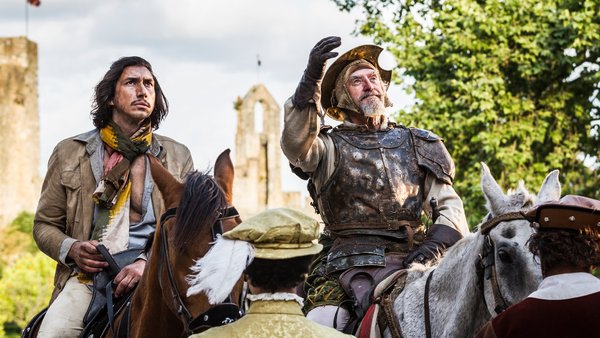
When Terry Gilliam's adventure-comedy The Man Who Killed Don Quixote finally premiered in 2018, it was the culmination of a near-30-year journey to get the film, based loosely on Miguel de Cervantes' 17th-century novel, made.
After 2000's Johnny Depp-starring version was cancelled mid-production due to a number of practical and financial issues, Gilliam mounted several subsequent attempts to get it made between 2003 and 2016, all of which resulted in failure due to monetary and scheduling problems.
But given that Gilliam's original attempt had been immortalised in the brilliant 2002 documentary Lost in La Mancha, his quest became something of a Cause in its own right, with film fans rooting for the director from the sidelines to get back on the saddle every time something fell through.
Even so, fans were shocked to hear in 2017 that the film was finally in production, starring Adam Driver and Jonathan Pryce.
Never one to be deterred, a 76-year-old Gilliam seemingly flipped an enthusiastic middle finger at God as he finally completed a relatively incident-free shoot.
Though Gilliam had to sort through a tangle of legal issues in order to get the film released, it finally premiered at Cannes 2018 to broadly positive reviews, most critics simply relieved that the man could get closure on this chapter of his life and career.
Considering Gilliam's age when he shot the movie, it likely would've been his last realistic attempt to get it done, and if nothing else is an incredible testament to the man's perseverance.
Fate herself was telling him the film wouldn't ever get made, and he simply told her, "No."
2. Shrek

Shrek is such a wonderful, heart-warming movie that it's tough to imagine its primary creative impetus was vengeful fury, but that's exactly what happened.
Jeffrey Katzenberg served as the chairman of Walt Disney Studios from 1984 to 1994, a tenure which ended amid a major falling out with Disney CEO Michael Eisner and Walt Disney's nephew Roy E. Disney.
Katzenberg was ultimately forced to resign from Disney and received an estimated $250 million settlement after filing suit. Later in 1994 he co-founded DreamWorks, and soon enough set about producing an adaptation of William Steig's 1990 picture book Shrek!
Even the most casual observer of the Shrek movie will appreciate how thoroughly it skewers both general fairy tales and more pointedly tired Disney tropes, deconstructing them with a playful wink at the audience.
It's no stretch at all to suggest that this was Katzenberg's ultimate "F**k you" to Disney, to creatively rib how staid their animated output had become by the turn of the millennium, long after the Renaissance which Katzenberg himself spearheaded had come and gone.
In the lead up to the film's release, Disney responded by refusing to air commercials for Shrek on their Radio Disney station, and DreamWorks clapped back by releasing Shrek on home video the same day as Monsters, Inc., where it went on to become one of the best-selling DVDs of all time.
But perhaps the real validation of Katzenberg's cinematic tantrum was that Shrek beat Monsters, Inc. to win the first ever Best Animated Film Oscar, and even today, Shrek remains one of the few DreamWorks films that can truly live up to the majesty of Disney's finest.
1. The End Of Evangelion

1997's The End of Evangelion was produced after the ambiguous ending to the original Neon Genesis Evangelion anime series left fans confused and irritated, many feeling that director Hideaki Anno had spectacularly dropped the ball.
Unfortunately fans couldn't simply voice their displeasure in a respectful way, and Anno went on to receive death threats for how he chose to end the show.
When production company Gainax floated the idea of a film to give the series a more satisfying and complete ending, Anno basically used the opportunity to stick it to petulant fans by giving them another baffling head-scratcher of an ending - but a visually mesmerising one, at least.
You can practically feel the disdain bleeding off the screen while watching the movie, which adopts a considerably darker, less hopeful tone than the series, and basically strains itself to give answers that will challenge audiences expecting something more conventional.
In the film's unforgettable live-action sequence, Anno even included brief clips of the hate mail he received - or rather, replicas of the letters, for legal reasons.
You can't really fault Anno here - he was able to get his own back on the trolls while still delivering an artistically accomplished piece of work.