10 Movies About Real Wars (That Were Terribly Inaccurate)
These movies weren't what you were taught in school.
 Buena Vista Pictures"War, what is it good for? Absolutely nothin'!" sang Edwin Starr. He was probably quite right - death, destruction and the looting and pillaging of other people's land, property and resources, few would argue that war is good for humanity. With that said, war does make for some very good films - it's a genre which is as old as cinema itself and is showing no sign of disappearing any time soon. Some movies strive to show war in all its horror; others prefer to entertain, or function as propaganda, tricking the audience into thinking that a cause is just. And often the filmmakers bend the truth to make their movie more appealing - it might be something innocuous like utilizing an inappropriate piece of kit which wasn't actually used at the time, or something more notable such as changing the outcome of a battle or attributing a breakthrough to the wrong side. Here are ten movies about real wars which played loose with the facts and offered up a distorted version of events which are terribly inaccurate.
10. The Hurt Locker
 Universal StudiosKatheryn Bigelow's hugely overrated Oscar winning war movie The Hurt Locker follows a bomb disposal team in Iraq as they struggle to keep on top of all the Improvised Explosive Devices being set by the Iraqi insurgency. Jeremy Renner stars as William James, a man who's maverick tendencies lead to escalating tensions within his unit. Based on the writings of Mark Boal, a freelance writer who had spent time embedded with troops in Iraq and who also wrote the screenplay, The Hurt Locker faced considerable criticism at the time of its release for its less than accurate accounting of the war and the process involved. Iraq veteran Kate Holt described it as, "Hollywood's version of the Iraq war and of the soldiers who fight it, and their version is inaccurate." From minor details such as equipment and uniforms to the behaviour of the soldiers, veterans were not impressed by claims for realism, while a journalist working for Military Times said, "Some of the scenes are so disconnected with reality to be almost parody." Still, these inaccuracies didn't prevent the film from being a success, and Bigelow would go on to make another film which played loose with the facts, Zero Dark Thirty, which many keen-eyed observers considered to be little more than a pro-torture CIA propaganda movie. Given that the CIA advised throughout the production, perhaps this wasn't such a wild claim.
9. Red Tails
 20th Century FoxAnthony Hemingway helmed the director's chair for George Lucas's ill-fated pet project Red Tails, about the Tuskegee Airmen, the African-American servicemen who took to the skies in World War II in the fight against fascism. Lucas's first offense was to cinematic heritage - in pre-release interviews and promotional material he went out of his way to imply that Hollywood hadn't done a movie about black men in warfare despite their being a number of films which explore precisely that subject (he even absurdly suggested that Hollywood doesn't want to touch "black movies" at all). The second offense was the lack of clarity that the events being depicted were largely fictional - contentious aspects which were challenged by the Commemorative Air Force's Red Tail Squadron included the number of losses the Tuskegee Airmen suffered and their overall record. It's highly unlikely that a stronger focus on reality would have made much difference to Red Tails' box office performance - hardly the most subtle or nuanced filmmaker at the best of times, Lucas's attempts to make a war movie with political commentary on the role of black minorities fails on every level.
8. The Patriot
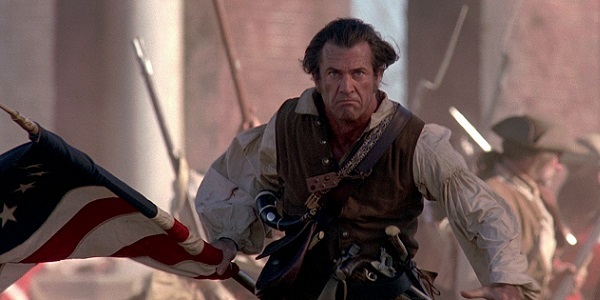 Columbia PicturesRoland Emmerich's historical (ahem!) war film starring Mel Gibson and Heath Ledger takes the real-life events of the American Revolutionary War as its subject matter - it's a grand and epic production with a cast of thousands of extras, sweeping in its use of emotions and - predictably - light on historical accuracy. There wasn't a critic at the time who didn't spot the glaring inaccuracies from the start, and some of them realised quickly that evaluating in terms of its faithfulness to what actually happened would be a pointless exercise. It seems that Emmerich and his collaborators spent plenty of time at the Smithsonian Institute ensuring that the weaponry, costumes and sets were all as accurate as possible but forgot to pick up a history book before writing the script - the result was a reduction of anything resembling actual events being reduced to pure fiction, most egregiously in its depiction of atrocities which never actually happened. Still, if you want a good villain in a movie then you have to make the audience hate them, so a few "white lies" are to be expected. Screenwriter Robert Rodat is no stranger to twisting the truth - his script for Saving Private Ryan conveniently omitted the role of the Allies in the D-Day beach landings, turning it into an all-American fare.
7. Enemy At The Gates
 Paramount PicturesJean-Jacques Annaud's 2001 war movie Enemy at the Gates focuses on the events surrounding the Battle for Stalingrad, undoubtedly one of the most bloody, drawn-out conflicts from the Second World War. Starring Jude Law as the real-life Russian sniper Vassili Zaitsev it plays out as a one-on-one battle of wits and accuracy between him and German marksman Major Erwin Konig (played by Ed Harris). Perhaps only audiences in America really took to the action depicted on screen, since Enemy at the Gates managed to offend both Russian and German audiences at the time of its release. In Russia, some Stalingrad veterans were so appalled that they called on the Russian Dumas to ban the movie entirely, while German critics lambasted it as both an oversimplification of history and a glorification of war (a charge which could be leveled at any number of Hollywood movies). In the filmmakers' defense, the film was always intended as a fictional work based on true events rather than an historically accurate portrayal of events, but herein lies the danger of taking truly disturbing events and twisting them for the purposes of entertainment - there will always be people who were there at the time who take offense at the horrors of war being trivialised in such a way.
6. The Green Berets
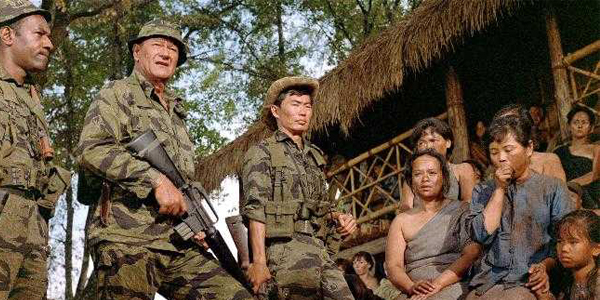 Warner BrosJohn Wayne was something of a poster boy for the American military machine long before he went on to make The Green Berets in 1968 - the irony is that Wayne himself went out of his way to avoid serving in the Army during the Second World War but would go on to make a number of pro-war propaganda movies encouraging other, braver men to offer their lives for their country. While many Americans were becoming increasingly tired of their military's involvement in the disastrous Vietnam War in 1968, Wayne's reaction was the opposite, and the The Green Berets is his answer to anti-war sentiment; a film which extolls the virtues of military might and delivers a strong anti-Communist message. Naturally he got the full cooperation of the Pentagon, and predictably the movie comes across as pure propaganda. The Vietcong are one-dimensional tyrants while the myth of Wayne the war hero is plastered all over the screen. Fortunately a number of American filmmakers were to emerge in the following years who would shatter the myths enabled in movies like The Green Berets - from Francis Ford Coppola's Apocalypse Now to Oliver Stone's Platoon, the cruel and brutal reality of the Vietnam War finally found its place on screen. Needless to say, the Pentagon refused to offer those directors their assistance.
5. Windtalkers
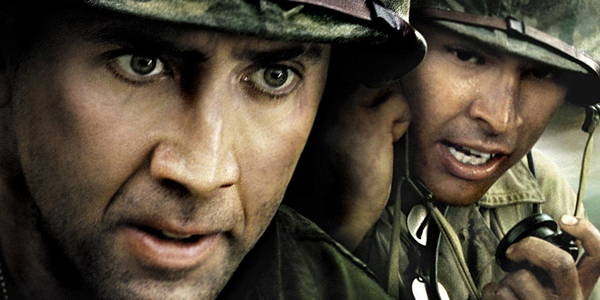 20th Century FoxJohn Woo's American directorial output has been hit or miss to put it mildly - Windtalkers, starring Nicolas Cage and Christian Slater, is certainly one of his better efforts. Set during World War II it follows Corporal Joe Enders (Cage) as he is assigned to protect a Navajo code talker Ben Yahzee (Adam Beach) as the Army takes on the Japanese in the South Pacific. The most glaring inaccuracy in Windtalkers just happens to be the element on which the entire emotional development plays out. Tasked with protecting Yahzee, Enders is under strict orders to kill him should he fall into enemy hands, lest the enemy torture him and gain access to the code in his head. Unfortunately for those concerned with historical accuracy, no such orders ever existed - a fact that would have completely removed any tension from the film. The lack of accuracy in the film's many battle scenes is hardly surprising given Woo's background as the master of the action movie - from Hard Boiled and The Killer to Face/Off, Woo's forte has always been exciting and dynamic slow-motion infused shoot outs bearing little resemblance to the real world, and Windtalkers is no exception.
4. U-571
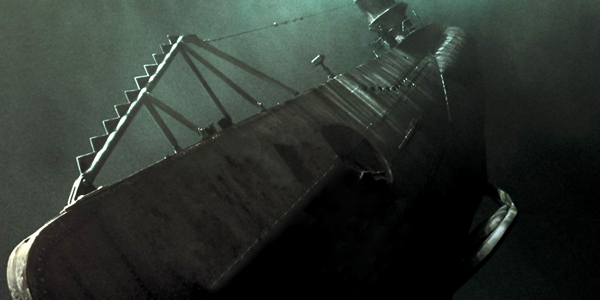 Universal PicturesJonathan Mostow took subverting historical truths for the purposes of entertainment (and American jingoism) to new lows with U-571, in which American Navy submariners board a German U-boat in order to capture the Enigma code machine. Starring Matthew McConaughey, Harvey Keitel and Jon Bon Jovi it performed well at the box office and was well received in America. The same can't be said for the UK, where people were justifiably outraged at the glaring alteration Mostow had made to history for the sake of his film. The reality is that it was British personnel from the HMS Bulldog who had captured the Enigma machine - several months before the Americans had even entered the war. That the film was viewed as an atrocious piece of historical revisionism is hardly surprising. The British Prime Minister at the time, Tony Blair, described it as "an affront" to the servicemen who had carried out the operation. The rather weak counterargument offered in defense of this huge change was that U-571 wouldn't have been financially viable with a British cast, which seems like a poor excuse for claiming cinematic credit for the bravery of others. Even the screenwriter later admitted it was a gross distortion and that he wouldn't do it again, although some would argue that the damage had already been done.
3. The Messenger: The Story Of Joan Of Arc
 With movies like Taxi and The Transporter to his name, Luc Besson is hardly a filmmaker who would inspire confidence in those who like their historical epics to be grounded in a semblance of reality. Sure enough, The Messenger: The Story of Joan of Arc dispenses with what historians know in favour of a distorted version which lends itself better to on-screen drama. Milla Jovovich's central performance in the title role is better than could have been expected given her limited range, but the emphasis on her fractured psyche couldn't be further from the truth. While the movie portrays her as borderline delusional after witnessing a horrific event, nothing of the sort exists in the historical record. Indeed, the evidence points to her being calm and collected, full of generosity and warmth. Given that this was supposed to be a biopic, getting her personality so excruciating wrong is kind of baffling (you had one job, Besson!) Besson was clearly far more concerned with getting the action looking just right, and chose to trade in historical characteristics of his protagonist for blood-soaked fields swarming with armies instead. For her troubles, Jovovich earned herself a Golden Raspberry Awards nomination.
2. Braveheart
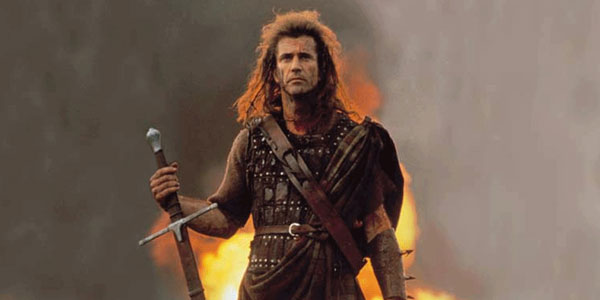 20th Century FoxWhile Mel Gibson wasn't really to blame for the glaring inaccuracies in The Patriot, the same can't be said for his multi-Oscar winning "historical epic" Braveheart. Gibson plays the main role of William Wallace, the 13th-century warrior who led the Scots into the war of independence against King Edward of England before finding himself tried for high treason. The fact that Braveheart is one of the most inaccurate movies in the history of cinema didn't prevent it from becoming a smash at the box office. But historians were less impressed than the popcorn-guzzling audiences in the multiplex, with one describing it as follows: "The events aren't accurate, the dates aren't accurate, the characters aren't accurate, the names aren't accurate, the clothes aren't accuratein short, just about nothing is accurate." Both Mel Gibson and his screenwriter Randall Wallace have defended their decision to turn truth on its head in the name of making an entertaining movie - while they acknowledge the many inaccuracies they believe their changes are more "cinematically compelling". Another historian observed that it couldn't have been more inaccurate if they'd inserted a plasticine dog and called the movie William Wallace and Gromit - it certainly sounds like a movie we'd like to see.
1. Pearl Harbour
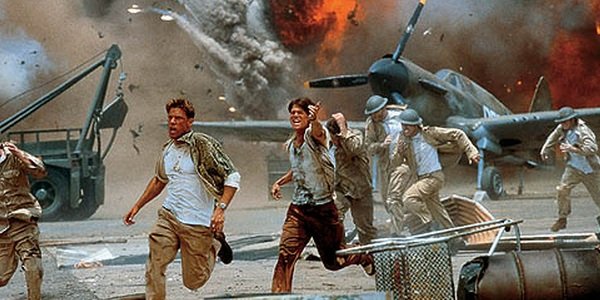
 Buena Vista PicturesAnyone expecting a nuanced, mature examination of the nature of warfare from producer Jerry Bruckheimer and director Michael Bay should probably get their head examined, but for fans of mindless action and terrible characterisation Pearl Harbour certainly didn't disappoint. A war movie for the Ritalin generation, Bay took the serious subject matter of the Japanese attack on Pearl Harbour and addressed it with the same level of maturity he brings to the Transformers franchise - loud, dumb and simplistic. The complete lack of background and context leading up to the attack was entirely expected, as was the sickly sweet tacked on love story designed to appeal to those who loved Titanic and the copious nostalgia tinted shots of military hardware. Survivors of the attack itself were less than impressed with the depiction of events - from planes which shouldn't have been there to Americans flying with the RAF and a timeline of events that is all but a fabrication, those who were there at the time had their work cut out picking out all the many faults in the movie. Of course, the biggest distortion - commonplace in Hollywood war movies - is the simplification of good versus evil, with the Japanese depicted as mindless psychotic villains and the Americans as faultless and noble. But then who would really expect anything else from Michael Bay? Which movies based on real life wars have you seen that were terribly inaccurate? Why not post a comment below and let us know?