10 Movies That Almost Had Much Better Endings
So close.

There's perhaps no more important aspect of assembling a film than ensuring the ending is just right.
Countless great films have been derailed at the last minute by deeply unsatisfying endings, and to the same token, smart filmmakers know when it's time to ditch their original ideas and actually listen to test audiences.
But it's sadly far more common that studios, for fear of damaging their bottom line, will rubbish a brilliantly daring original ending and switch it out for a more sentimental finale that might even ensure the possibility of a franchise.
Granted, many of these endings are still pretty good, but had the filmmakers been able to stick to their guns and trust their original gut feeling, then the self-contained story would've had so much more integrity.
Instead, these 10 films all left their superior climaxes on the cutting room floor, even if in some cases the studio was eventually merciful enough to include them on the home video release...
10. First Blood

The Actual Ending
Just as John Rambo (Sylvester Stallone) plans to murder the villainous Sheriff Teasle (Brian Dennehy), Colonel Trautman (Richard Crenna) appears and, after a lengthy and emotional chat, manages to convince Rambo to turn himself in rather than be shot dead by the police.
The iconic final scene then sees Rambo being taken into custody for his violent rampage, leaving the door open for the glut of braindead sequels that followed.
The One We Almost Got
Much like the source novel, the film originally ended with Rambo's death. An exhausted Rambo tries to convince Trautman to kill him rather than allow him to go to jail, and when Trautman hesitates, Rambo grabs his gun and shoots himself in the stomach. The end.
Unsurprisingly, test audiences loathed this ending, so Stallone went back and conceived a slightly less depressing one.
Why It Would've Been Better
Though the theatrical ending is still very good in its own way, there's a greater sense of realism to the bleaker original ending, which also serves as a far more startling commentary on how society treats war vets when they return home.
Furthermore, Rambo's death would've prevented the (mostly) terrible array of shoot 'em up sequels.
9. Paranormal Activity

The Actual Ending
Katie (Katie Featherston) gets out of bed in the middle of the night and heads downstairs, screaming for her boyfriend Micah (Micah Sloat).
He wakes up and runs downstairs, and after a beat, we hear loud footsteps returning upstairs, only for a possessed Katie to throw Micah's dead body at the camera, knocking it over.
Katie then approaches the camera, flashes a demonic, CGI-assisted grin, and disappears into the night.
The One We Almost Got
The original ending screened to early festival audiences before the film was bought by Paramount was a lot less open-ended. After it's implied that Katie has killed Micah, she returns to the bedroom and rocks back and forth for days at a time.
The police eventually arrive to discover Micah's body, and just as they find Katie upstairs, the demon leaves her body, causing Katie to awaken confused.
Just as Katie approaches the cautious police officers with a bloody knife still in hand, the demon slams the door behind the cops, startling one of the officers who promptly shoots Katie dead. The film then ends with the officers sweeping the rest of the house as a memorial title card flashes up for Katie and Micah.
Once Paramount acquired Paranormal Activity, however, they decided to shoot several different endings in the hope of extending the film into a franchise.
Why It Would've Been Better
For starters, this ending was a satisfying one-off that wouldn't have opened the door for a string of increasingly forgettable sequels, and the execution was both smarter and more tragic, with the demon tricking Katie into getting herself killed.
Conversely, the theatrical ending involved a hideous visual effect and a lousy final jump scare, neither of which were apparent in the original finale. Such is what happens when Hollywood discovers a creative original idea, sees money signs, and promptly turns it into something decidedly more conventional.
8. Die Hard With A Vengeance

The Actual Ending
The oddly forgettable climax to the otherwise spectacular third Die Hard film sees Simon Gruber (Jeremy Irons) attempting to make his epic escape, while John McClane (Bruce Willis), his unwitting pal Zeus (Samuel L. Jackson), and the NYPD try to stop him.
Gruber and his girlfriend Katya (Sam Phillips) flee in a helicopter, only for McClane to shoot a power line, which hits the chopper and causes it to crash, killing Gruber and Katya in an explosive fireball.
The One We Almost Got
The original ending actually sees Gruber initially getting away, and the final scene picks up some time later, with an embittered McClane blamed for his escape and eventually tracking Gruber down to a bar in Hungary.
John "invites" Gruber to play a game of "McClane Says," which effectively amounts to Russian Roulette with a portable rocket launcher that's had the sights removed, meaning it's impossible to tell which end is the business end.
Simon gets McClane's riddle wrong, and after being forced to fire the launcher, it sends a rocket straight through his body, killing him instantly.
Unfortunately, the studio thought this ending lacked action and showed an overtly cruel side to McClane, and instead ordered the more action-packed, sanitised final ending to be shot at great expense.
Why It Would've Been Better
Screenwriter Jonathan Hensleigh put it best when, on the movie's DVD commentary, he said that his intention was to show that the events of the movie and everything McClane was ultimately blamed for had a tremendous impact upon him psychologically.
Though the ending arguably feels more in line with the climax of a James Bond or Jason Bourne movie, its caustic edge would've been refreshing for the franchise, even if it also would've left fans questioning how John could come back from this for the fourth film.
Still, as a savage piece of character development, it was effortlessly superior to the bland finale we ended up with.
7. The Shawshank Redemption

The Actual Ending
Frank Darabont's legendary 1994 prison drama concludes in undeniably heartwarming fashion, as convict Red (Morgan Freeman) is finally paroled after spending 40 years in Shawshank.
Red then violates his parole in order to meet up with his escaped pal Andy (Tim Robbins), crossing the border into Mexico and finally being reunited with him on a Zihuatanejo beach in the film's tear-jerking final scene.
The One We Almost Got
Originally, writer-director Frank Darabont actually ended the movie with Red taking the bus across the Mexican border, leaving the outcome of his attempted reunion with Andy entirely unknown.
However, producer Liz Glotzer insisted that Darabont shoot a reunion scene despite his protest that it was "commercial, sappy."
As a compromise, the studio assured Darabont that he'd have the final decision on whether the extended epilogue was used, and after seeing how strongly a test audience reacted to it, the director ultimately changed his mind.
Why It Would've Been Better
Hollywood frequently underestimates the value of subtlety, and it doesn't need to be reiterated how little test audiences reflect the tastes of intelligent, discerning viewers.
Though the ending we got is in no way bad, it does feel like one sentimental indulgence too far, because leaving the audience to consider whether Red and Andy really found each other again would've been so much more provocative and interesting.
6. Fatal Attraction

The Actual Ending
The movie that coined the term "bunny boiler" ends with the psychotically obsessed Alex Forrest (a brilliant Glenn Close) attempting to stab Beth (Anne Archer), the wife of her weekend fling Dan Gallagher (Michael Douglas).
After Dan almost drowns Alex, she fights back one last time, only to be shot dead by Beth, seemingly bringing the family's troubles to an end.
The One We Almost Got
The originally shot ending was very different, with Alex slitting her own throat and framing Dan for her murder. After Dan is arrested, Beth finds a cassette tape which details Alex's intent and ultimately gets Dan acquitted.
The final shot hauntingly shows the moment where Alex slowly cuts her own throat while listening to Madame Butterfly before we solemnly fade to black.
But of course, those pesky test audiences wanted a more outwardly "satisfying" demise for Alex, and so a new ending was shot, much to Close's protest, who was adamant that a character like Alex would implode before she could be killed.
Why It Would've Been Better
Close was absolutely right - though the theatrical ending gave the popcorn-munching crowds their epic climax, there's a genuine sadness to the original ending, which rather than turn Alex into a cartoonish villain serves as a potent reminder that, after all, she was a deeply ill, fractured woman.
But as Close herself admits, there's no way the movie would've grossed a stonking $320.1 million worldwide if director Adrian Lyne stuck with the original climax.
5. Bird Box

The Actual Ending
After spending years trying to keep herself and the two children she cares for safe from the creatures which kill anyone who sees them, Malorie (Sandra Bullock) makes it to a sanctuary along with the kids, which just so happens to be a school for the blind.
The school has been able to flourish due to the residents' inability to see the creatures, and feeling a sense of hope for the first time in years, Malorie not only frees her pet birds, but also finally gives names to the children - Tom (Julian Edwards) and Olympia (Vivien Lyra Blair).
The One We Almost Got
The film originally ended in somewhat bleaker fashion as in Josh Malerman's original novel, with Malorie and the kids arriving at the school only to learn that the residents intentionally blinded themselves to ensure they could never set eyes upon the creatures.
Screenwriter Eric Heisserer stated in interviews that it seemed "smarter" to give the film a more optimistic ending, and director Susanne Bier similarly stated that she had no desire to leave the audience feeling hopeless.
Why It Would've Been Better
Though both endings provide a certain catharsis, the intense bleakness of the book's ending, where people are so desperate to survive that they literally remove their own sight, feels truer to the overall tone of the story than the softer, more coincidental meeting with the already-blind survivors.
Given that the final film ended up being viewed by 80 million households during its first week on release, though, Netflix probably feels that their more mainstream-skewing ending was the right one, integrity be-damned.
4. Star Trek II: The Wrath Of Khan
The Actual Ending
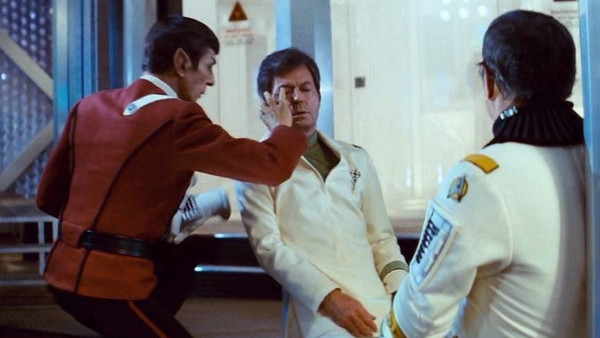
The second-ever Star Trek movie is the most iconic for damn good reason, namely that it ends with the tragic, sacrificial demise of Spock (Leonard Nimoy).
But to soften the blow for audiences, the film also provides a few closing hints that Spock isn't gone for good.
Moments before he expires, he performs a mind-meld on Bones (DeForest Kelley) - telling him, "Remember") - and the final shot of the movie lingers on Spock's casket resting on the Genesis planet, suggesting that maybe we'll see him again.
The One We Almost Got
The original cut of the film gave Spock a far more decisive demise, with the mind-meld and the shot of Spock's casket both absent, therefore suggesting that he was indeed perma-dead.
But typically, test audiences were fuming that Spock was worm food, and so producer and story writer Harve Bennett suggested these extra inserts to be shot before the film's theatrical release.
Why It Would've Been Better
As wonderful a character as Spock is, and as entertaining as some of his post-resurrection adventures were, his daft revival in The Search for Spock does rather undermine the emotional impact of his "death" in this film.
As tough as it is to argue that Spock should've stayed dead, it would've made The Wrath of Khan more dramatically watertight in retrospect, that's for sure.
3. Freddy Vs. Jason

The Actual Ending
As is the predictable outcome of pretty much any "versus" movie, this horror slugfest ends with an ambiguous final scene that ensures neither side is the loser.
Jason (Ken Kirzinger) emerges out of Camp Crystal Lake while holding Freddy's (Robert Englund) severed head, and after a beat, Freddy's noggin winks at the audience, implying the battle is far from over.
The One We Almost Got
According to writers Mark Swift and Damian Shannon, they toyed with several other endings during production, including the possibility of having Freddy and Jason drag each other to Hell, where they're suddenly interrupted by Hellraiser's Pinhead.
Pinhead would arrive by separating the pair with his trademark chains, before asking them the sequel-baiting question, "Gentlemen, what seems to be the problem?"
But naturally, legal red tape prevented it from happening, as New Line Cinema didn't want to go to the hassle of securing the rights to Pinhead. Boo.
Why It Would've Been Better
Does it even need to be said? Throwing Pinhead into the mix would've had horror fans tearing the seats out of their cinema in fits of uncontrollable excitement.
2. Law Abiding Citizen

The Actual Ending
After spending the entire movie launching his preposterous - and preposterously entertaining - revenge crusade against the broken American legal system, vigilante Clyde Shelton's (Gerard Butler) plan to blow up City Hall and kill the Mayor backfires horribly.
Ultimately, our thoroughly unlikeable attorney "hero" Nick Rice (Jamie Foxx) discovers the bomb and plants it in Shelton's own jail cell without him knowing, killing him and saving the day.
The One We Almost Got
Though it's often stated that Jamie Foxx insisted upon the film's original ending being changed, that's actually not true at all according to those who worked on Law Abiding Citizen.
However, it is true that the story went through numerous iterations during shooting, as the filmmakers struggled to reconcile how much more likeable Clyde was than Nick.
As a result, though most of the other planned endings still resulted in Clyde's death, they were decidedly less charitable to Nick than in the final cut.
One proposed ending saw Nick actually killing Clyde by hand, resulting in him ending up in jail and making a deal with the DA, effectively turning him into the new Clyde and ensuring that the cynical, corrupt legal system continues to perpetuate.
Why It Would've Been Better
The theatrical finale leaves a sour taste because Nick's happy ending, where he sits down to watch his daughter's musical recital, just doesn't feel remotely earned.
There's not much of a feeling that he's really changed in any way, and so his "victory" over Clyde feels completely hollow and unsatisfying.
The alternate ending is a fairer compromise, in that while it still ends with the fan favourite character dead, at least Nick is also forever tarnished by his behaviour.
1. Man On Fire

The Actual Ending
Tony Scott's dizzying 2004 action-thriller wraps up with strung out bodyguard Matt Creasy (Denzel Washington) surrendering himself in exchange for the life of his employer's nine-year-old daughter, Pita (Dakota Fanning).
In the final scene, Creasy dies from gunshot wounds sustained earlier in the film as he's being driven away by Pita's kidnappers, seemingly at peace, while the Big Bad known as The Voice (Roberto Sosa) is quickly shown being gunned down by agent Manzano (Giancarlo Giannini).
The One We Almost Got
Man on Fire's alternate ending is the stuff of legend: it has Creasy survive the climactic car ride to end up facing off against The Voice himself.
And after a brief chat, it's revealed that Creasy has concealed a literal butt-load of C4 up his own rectum, which he promptly detonates, killing himself, The Voice, and anyone else in the vicinity.
Though this ending was reportedly suggested by Washington himself, Scott apparently nixed it as he felt it didn't match the overall tone of the film.
Why It Would've Been Better
Given that Denzel literally kills a guy earlier in the movie by shoving a bunch of C4 up his ass, this would've been one of the all-time most insane callbacks in cinematic history, not to mention given Creasy an impossibly badass demise compared to just...expiring of previously sustained wounds.
Mercifully, the scene was at least made available on the film's DVD release, and it's a doozy alright.