10 Movies That Made Shocking Genre Shifts Halfway Through
 It's hard to imagine how shocking Psycho's mid-point switcharoo must have been back in 1960, especially when you consider that audiences hadn't even seen a flushing toilet on the big screen at that point in history (we've come a long way, I know). Nowadays, Psycho's unexpected shift - which actually takes place 47 minutes in - seems like old hat: not because it isn't surprising or revolutionary, but because we know it so well. Psycho is the shower scene. In the wake of what is arguably the finest example of a "shocking tone shift," directors who are not Alfred Hitchock have experimented with the idea of changing things up a fair way into their movies with varying degrees of success. Unexpectedly taking your picture into a direction that audiences would have never imagined possible so far into in movie is risky business: there's a chance that movie-goers won't buy it, given how they've spent nearly an hour (give or take) of their time investing in the established tone. Paul Thomas Anderson - director of There Will Be Blood and The Master - nicely categorised these flicks as "gearshift movies." They're the movies that head in what appears to be one direction, stop suddenly, and verge off into places you never expected them to go. It might be that the tone is swapped out for something on the other end of the spectrum entirely, or - in some rare cases - the genre is thrown out and replaced with a new one. Here's 10 movies that - for better or worse - made the decision to confuse, shock, surprise, frustrate, dumbfound or blow us away us with mid-point genre (or tonal) shifts. The big question remains: did the decision pay off? Be warned: major spoilers for all the movies mentioned are contained within.
10. Million Dollar Baby (2006)
 The marketing people wanted you to think that Million Dollar Baby was the female version of Rocky, and for the most part, those marketing people delivered on their promise. It's an underdog story starring the "is she hot/isn't she hot?" actress Hilary Swank, with Clint Eastwood working his grouchy magic as her trainer ("I don't train girls"). You'll see then, that Million Dollar Baby appears to nicely fall into the sports movie category, because it's a sports movie, and because I like putting things into categories. It's not quite as simple as that, though. For anyone who merely wanted a movie with the simplicity of a Rocky installment, Million Dollar Baby would have shattered their expectations immensely: the plot twist that occurs part-way through the movie, which leaves Swank's plucky fighter as a quadriplegic, throws everything we thought we knew up in the air. It's a harrowing, numbing turn of events - one that left many movie-goers feeling miserable and confused - that transforms Baby from your regular sports yarn and into a grim drama dealing with subjects like euthanasia and mortality. Boo! Where's the training montage?
9. Miracle Mile (1998)
 Romance and the apocalypse go hand in hand, because what's the one thing that people want to do when they know the world is about to end? I'm not going to spell it out for you. Anyway, lots of movies have tried to tackle the combined subjects of love and world ending at the same time, be it Shaun of the Dead, or the more recent Seeking A Friend For The End Of The World. But both of those movies are comedies, you'll see, which means that they deal with the possibilities of "being annihilated" and "dieing horribly" with a fair degree of flippancy. Miracle Mile, a little-known movie from the '80s that deserves a whole lot more attention, opts to do things a little differently. The first 20 minutes of the movie are dedicated to conventional rom-com tropes, with a shy Anthony Edwards falling in love with a waitress, as played by Mare Winningham. At this point, you think you know the whole story, because you've seen it a zillion times before. It's a cutesy set-up, though utterly deceiving in every sense. Suddenly there's a phone call, and Edwards is told that the world is going to end in 50 minutes. Goodbye rom-com, hello... bleak, miserable drama about two people facing their inevitable deaths? Where's Richard Curtis when you need him?
8. Hancock (2009)
 If you happen to have ever read one of my previous articles, you probably noticed that - at one point - I mentioned how disappointing Hancock was, and that such a good concept was wasted on such a bad movie. It doesn't matter what the article was about: I just mention that whenever I can. I can't help myself. Now, though, I'm writing about Hancock in a place that makes sense, and for the exact reason that it turned out so bizarrely: the movie opts for a sudden genre (or tone, perhaps) shift at its mid-point. Why? To this day, nobody is sure. The movie, of course, stars Will Smith as a down and out, alcoholic and apathetic superhero named John Hancock, who teams up with PR guy Jason Bateman in an attempt to win back the public's affection. That concept in itself is enough to hinge a good movie on: a simple comedy with a neat premise, starring two highly charismatic stars. Unfortunately the movie throws out any notions of fun halfway through, when Hancock discovers that Bateman's wife, as played by Charlize Theron, is a superhero, too. They proceed to have an affair. And it doesn't work. It's mean-spirited, for starters, and with the revelation comes a dozen other unnecessarily convoluted plot points that reduce the movie to a series of exposition-driven scenes that exist purely to have you wishing the movie was back in its first half hour. Presumably Hancock's director, Peter Berg, wanted to make a film with more substance than your average superhero flick. But this is the man who eventually directed Battleship, which featured Rihanna in a starring role. I think he may have been overreaching, somewhat.
7. Something Wild (1986)
 There can be such a thing as a jarring genre switch that actually works, even though - at first - you might not appreciate how it changes the first half of a movie you were enjoying so much. Case in point: Jonathan Demme's Something Wild, which tells the story of a boring banker, played by Jeff Daniels, who gets caught up in a wild fling with a wild child played by Melanie Griffith. The two embark on a crazy fling, purposely evoking the tone and spirit of the classic screwball comedies. And look at the poster for this movie: it's says "wacky," right? I mean, Jeff Daniels is upside down. What's wackier than being upside down? And yet, after all the funny stuff, some great set-pieces and a rockin' soundtrack, Demme drops a poisonous element into the mix: Ray Liotta. As Griffith's ex-boyfriend, he's a complete and utter psycho, and guess what? He wants her back. Liotta's sudden presence pulls the movie into new, dark territory - territory that feels completely at odds with what came before. One could certainly argue that Something Wild would've worked better as a happy-go-lucky comedy entirety, but to that I say: "Why don't you spend a bit of time being upside down?"
6. From Dusk Till Dawn (1997)
From Dusk Till Dawn sounds like a movie pitched by a madman - "So, uh, George Clooney and Quentin Tarantino play two bank robbing brothers who end up on a road trip in Mexico..." - and that's before you've even factored in the fact that it randomly morphs into a fully-fledged exploitation/vampire flick at its mid-point. Why? I'm not sure there's any better reasoning at work here than "Why not?", and that's fine by me. Robert Rodriguez (Sin City) is behind the camera on this one, but this movie comes beamed straight from Tarantino's brain. So whereas some flicks opt for unexpected tonal shifts, Dawn goes for a total genre switch-up: the movie begins with Clooney and Tarantino's notorious criminals taking Harvey Keitel and his family hostage in their RV to evade the cops and escape into Mexico, only for - at the hour mark - the whole gang to take refuge in a terrifying biker bar, the ingeniously named Titty Twister. Turns out this is actually an ancient vampire temple masquerading as a burly hangout, though, and our heroes are launched into an all-out war. A lot of movie-goers weren't pleased with that direction Dawn took back in 1996, disappointed that such a promisingly, Pulp Fiction-aligned crime drama appeared to be have been spoiled with some ill-judged silliness. In retrospect, it holds up well. And, hey, at least it's different.
5. Hot Fuzz (2007)
 Edgar Wright's hilarious homage to Hollywood action movies plays a coy little game: for its first half, Hot Fuzz makes a point of subverting each and every one of the tropes associated with excessive and explosive action flicks, and then spends the second half embracing them all with a giddy enthusiasm. But apparently that wasn't enough for the filmmaker and his co-writer Simon Pegg, who opted to switch genres entirely at the movie's mid-point: Hot Fuzz merges into occult horror territory, playing tribute to iconic movies like The Wicker Man. And it's safe to say that this only really half works, because the two genres - action movie and atmospheric occult horror flick - don't feel right for one another, even as the butt of a joke. It's a case of too muchness, though Hot Fuzz still scrapes by because it's so damn funny. Compared to the perfectly paced and ingeniously plotted zombie homage Shaun of the Dead, though, Edgar Wright's sophomore feature looks like a bit of a mess. Still, there's a bit where Timothy Dalton gets his face pierced by the spiral of a miniature church, so it's hard to stay too mad.
4. Life Is Beautiful (1997)
 If you've never seen Life Is Beautiful, chances are you've at least heard of it, or glimpsed the poster at one point, which features a very happy Roberto Benigni wearing a hat. That's because this movie won a lot of Oscars, and that's how foreign films get into the public consciousness, because we sure aren't going to look for them ourselves, right? Anyway, Life Is Beautiful starts out as a charming, albeit conventional romantic comedy about a Jewish couple, Roberto Benigni and Nicoletta Braschi, who just happen to live in a Mussolini-ruled Italy. In the same way that one might like to classify Stanley Kubrick's Full Metal Jacket, though, Life Is Beautiful is perhaps best-described as a movie in two halves. And the second half couldn't be more different from the first: the story shifts to three years later, and the holocaust is about to begin. The movie becomes about Benigni's character, who now has a son, making up stories to protect him from the truths of what's happening. It's a dramatic turn, and the weight of the transition is certainly felt, given the fluffy nature of the movie's first half.
3. The Prestige (2006)
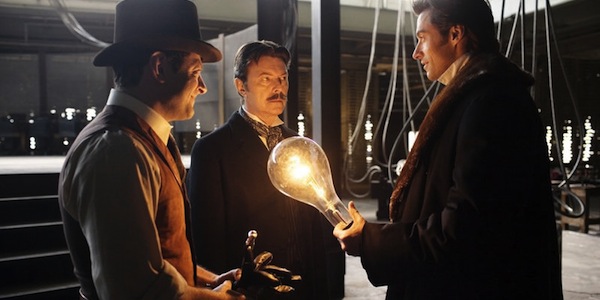 If you're going to change the genre of your movie suddenly, you may as well do it using David Bowie. That's presumably what Christopher Nolan thought when he came around to adapting Christopher Priest's novel for the big screen. Given that its premise is based around two magicians, it's no wonder that The Prestige emerged as something of a tricky one: what begins as a picture about two rival magicians - Hugh Jackman and Christian Bale - and their constant attempts to one up each other, the movie soon verges into unexpected territory at the arrival of real-life scientist and inventor Nikola Tesla, as played by David Bowie. And suddenly The Prestige is a science-fiction movie? This occurs when Hugh Jackman's character, Angier, hires Tesla to build him a machine of frightening capabilities. Up until this point, though, there's no hint that the movie will be anything but a mystery thriller, and the arrival of the "machine" storyline feels slightly at odds. These feelings pass relatively quickly, though, as the movie reveals itself to have been a science-fiction yarn all along. But it's not until halfway through that we truly understand the world of Nolan's movie in its entirety. Not everyone liked The Prestige's secret sci-fi movie change-up, though. R.J. Carter, writing for The Trades, wrote: "I love a good science fiction story; just tell me in advance." It's a fair point.
2. Sunshine (2007)
 Danny Boyle's Sunshine was plagued with a relatively nightmarish production, and it shows - filming begin without a finished script, and the movie's writer, novelist Alex Garland, has admitted that they struggled to come up with a satisfying conclusion to the story. Which is why, perhaps, that Sunshine's bizarre genre shift, which takes place a little later than halfway (call it a third act shift, if you like), feels so forced and unnecessary. Especially since this movie starts out as hard sci-fiction and later settles for being just a generic slasher movie. The flick itself concerns the crew of the Icarus II, who are on a space voyage to our dying sun in the not too distant future. Their mission? To deliver a payload (a huge bomb, basically) which they hope will re-ignite it and save the Earth. Complications arise, though, when a surviving member of the ill-fated Icarus I, "Pinbacker," boards our protagonists' ship and begins to wreak havoc. But in switching from sci-fi to plain ol' slasher movie, Sunshine loses its intelligent momentum and falls into chaos (the editing, incoherent and bizarre, doesn't help).
1. Audition (1999)
 Look, there's no use beating around the bush when it comes to this particular subject: the Japanese make super-weird movies. C'mon, we're all thinking it, right? I mean, yeah, all countries have made their fair share of nutty flicks, but with the Japanese, it seems different. Like they get an added kick out of it. As though they thrive on making the most twisted and perverse movies imaginable. So it was nice to sit down to Audition, which - on this rare occassion - I originally went into without knowing anything about the plot. At all. The first half, then, presents itself as a goofy romantic comedy about a lonely widower who uses his high-profile job in television to "audition" girls as potential future wives. This is engaging and enjoyable to watch, actually rather funny, and, had this been the whole movie, would have worked fine. But then it happens. Out of nowhere, at around the movie's halfway point, we're suddenly in a random apartment and a phone is ringing somewhere... and is that a burlap sack on the floor? A giant burlap sack? Is it... moving? What the hell's in the sack? So it's goodbye gentle comedy, hello... well, I'm not sure how to describe what happens, exactly, so let's just say that Audition would give Hostel and Saw's bastard child a run for its money. Best of all, though, the shift is totally unexpected if you're lucky enough to know nothing about what's in store before you sit down to watch it. Unless, of course, you noticed that the movie was directed by J-horror maestro Takashi Miike. Then the fluffy hi-jinks of Audition's tame first half probably scared the out of you. Like this article? Let us know in the comments section below.